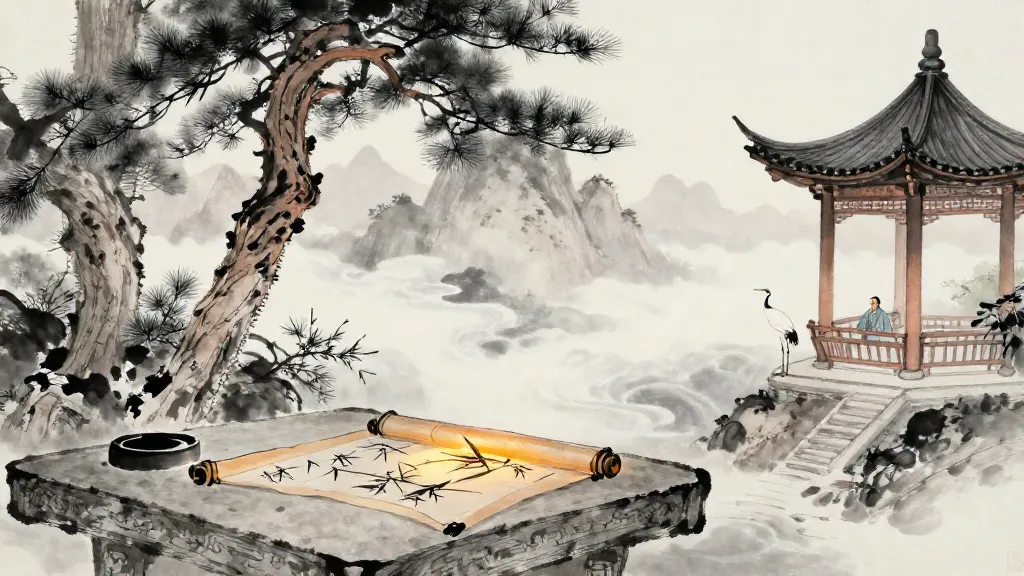
小匡 (The Minor Rectification) — Chinese ink painting

管子 Guanzi · Chapter 20

小匡

The Minor Rectification

View:

管仲相齊

Guan Zhong Becomes Minister of Qi

桓公自莒反於齊,使鮑叔牙為宰。鮑叔辭曰:"臣,君之庸臣也。"

After Duke Huan returned to Qi from Ju, he wished to make Bao Shuya his chief minister. Bao Shu declined: 'I am but my lord's ordinary servant. If my lord wishes merely to keep me from cold and hunger, that is my lord's grace. But if you would truly govern the state, only Guan Zhong can do it. There are five ways in which I am inferior to Guan Zhong: in generous compassion for the people, in governing without losing the balance, in trustworthiness that binds the feudal lords, in setting propriety and duty as models for all directions, and in standing at the army gate making every soldier braver.' The Duke protested: 'Guan Zhong shot me — he nearly killed me!' Bao Shu replied: 'He acted for his lord. If you pardon and recall him, he will serve you with the same devotion.'

參國伍鄙

The Three-Part State and Five-Part Countryside

管子對曰:"昔者聖王之治其民也,參其國而伍其鄙,定民之居,成民之事,以為民紀。"

Guan Zhong replied: 'The ancient sage kings governed their people by dividing the capital into three and the countryside into five, fixing the people's residences and completing the people's occupations to establish the people's order.' He divided the state into twenty-one districts: six for merchants and artisans, fifteen for soldiers and farmers. The Duke commanded eleven, with High-Minister Gao commanding five and State-Minister Guo commanding five — thus the state was organized into three armies. The Four Occupations — scholars, farmers, artisans, and merchants — were each settled in their proper quarters and were not to be mixed. When scholars congregate, fathers discuss duty with fathers and sons discuss filial piety with sons. When farmers congregate, they examine the four seasons and prepare their tools. When artisans congregate, they evaluate materials and compare techniques. When merchants congregate, they observe scarcity and monitor prices. Thus 'the sons of scholars are always scholars; the sons of farmers are always farmers.'

Notes

1context

The 'Four Occupations' (四民) system — scholars, farmers, artisans, merchants — became the foundational social classification in Chinese civilization. The Guanzi's rationale of occupational heredity and segregation influenced Chinese social organization for over two millennia.

寓軍於政

Concealing Military Organization within Civil Administration

管子對曰:"作內政而寓軍令焉。"

Guan Zhong's revolutionary insight was to embed military organization within civil administration. Five households formed a squad (軌) of five soldiers; ten squads formed a platoon (里) of fifty; four platoons formed a company (連) of two hundred; ten companies formed a regiment (鄉) of two thousand; five regiments formed a division (師) of ten thousand. Thus three divisions made three armies. Because the military units were identical to the neighborhood units, men who fought together were men who had grown up together: 'Those in the same squad protected one another; households loved one another; from youth they lived together; in maturity they traveled together. In sacrifice they shared blessings; in death they shared grief. Thus in night battle their voices were mutually recognized — enough to prevent confusion. In daylight battle their faces were mutually known — enough for mutual recognition. Their joy in each other was enough to die for one another.'

九合一匡

Nine Assemblies, One Rectification of the Realm

有教士三萬人,革車八百乘。

With thirty thousand trained soldiers and eight hundred war chariots, Duke Huan embarked on his career of hegemony. In the east he rescued Xu and halved Wu; he preserved Lu and defended Cai; in the south he confronted Song, Zheng, and campaigned against Chu, crossing the Ru River and reaching Wen Mountain, making Chu pay tribute of silk to the Zhou court. He rescued Duke of Jin, captured the Di king, defeated the Hu and Mo peoples. In the north he campaigned against the Mountain Rong, subdued Lingzhi, and destroyed Guzhu, bringing the Nine Yi peoples into submission. He assembled the feudal lords six times by war chariot and three times by ceremonial chariot — nine assemblies of the lords, one rectification of the realm. Then he laid down arms, took off his armor, traveled to court the Son of Heaven in court dress, and was granted the Celestial Son's commendation.

Notes

1context

The phrase 'nine assemblies of the lords, one rectification of the realm' (九合諸侯,一匡天下) became the definitive description of Duke Huan's hegemony in all subsequent Chinese historiography, appearing in Confucius's own words in the Analerta.

Edition & Source

Text
《管子》 Guanzi
Edition
中華古詩文古書籍網 transcription
Commentary
Traditional commentaries