About This Project
Three Traditions,
One Question
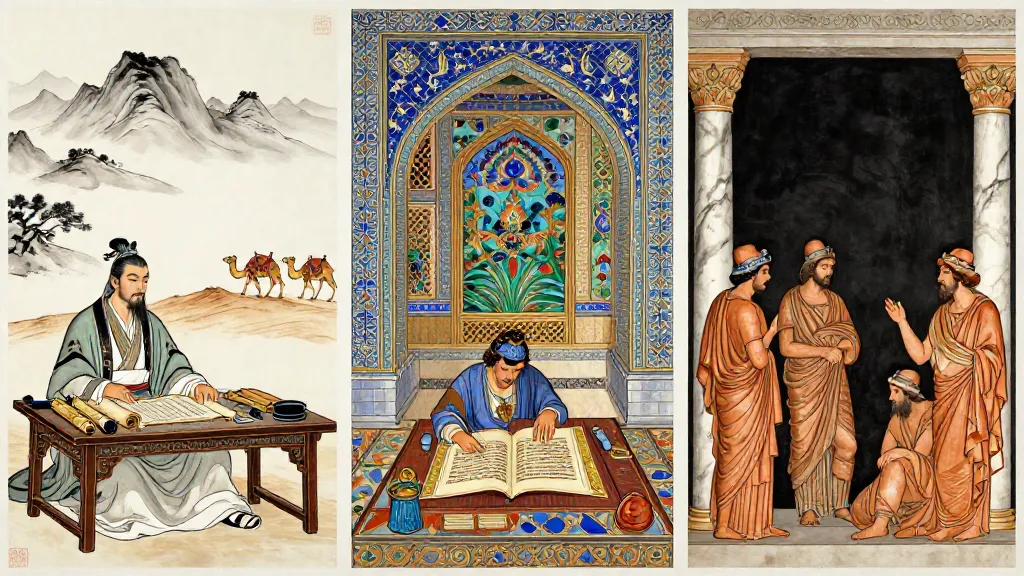
In the 5th–3rd centuries BC, three civilizations on opposite sides of the world were asking the same questions: How do states rise and fall? What makes alliances hold or shatter? When does a great power destroy itself?
By Augustin Chan with AI · Published January 2025 · Updated March 2026
Origin
Where This Started
Warring States Day is a research instrument investigating whether the King Wen I-Ching sequence — a 3,000-year-old arrangement of 64 hexagrams — changes how an AI agent reasons under pressure. The first phase tested the sequence as a neural network training schedule: five experiments yielded a definitive negative result. But the same properties that destabilize gradient descent — anti-habituation, unpredictable transitions, negative autocorrelation — are exactly the kind of thing multi-agent strategic play might surface. The research pivoted to a Diplomacy-style simulation of ancient China's Warring States period (475–221 BC), where seven AI agents — all language-model agents with historical personas — compete for territorial control. Han, the weakest, reflects each round through a symbolic framework (the King Wen I-Ching in one condition; tarot or scrambled text in others) before it acts; the other six play from baseline prompts. This project began with the Warring States period itself — seven kingdoms locked in a centuries-long struggle that ended when Qin swallowed them all. It is one of the most intensely studied periods in Chinese history, and one of the most relevant to modern geopolitics.
A major inspiration was Xianyang CB (@XianyangCB), whose brilliant commentary on the Warring States period brings this era to life for modern readers. Her work connecting ancient Chinese statecraft to contemporary strategic thinking helped spark the question at the heart of this project: can the patterns encoded in the I-Ching — patterns the ancients used to navigate exactly this kind of chaos — still change how a modern AI agent navigates it?
But as we studied the Warring States, something became impossible to ignore. At the same time China's seven kingdoms were maneuvering for survival, the Greek city-states were tearing themselves apart in the Peloponnesian War, and Persia's empire was cresting and cracking. The same patterns were playing out simultaneously across the ancient world — and these civilizations were not as isolated as we imagine.
The Silk Road — or more accurately, the network of overland and maritime routes that would later be called that — was already active centuries before Zhang Qian's famous westward mission in 138 BC. Persian lapis lazuli reached Shang dynasty tombs. Chinese silk appeared in Egyptian mummies. Greek coins circulated in Gandhara. Ideas, technologies, and strategic intelligence flowed along these routes long before any single empire controlled them. These three traditions weren't just asking the same questions by coincidence — they were connected.
The Traditions
Why These Three?
China
The Warring States · 475–221 BC
Seven kingdoms compete for supremacy in a multi-polar system where alliance politics, espionage, and philosophical innovation matter as much as military force. This is the core of the project — the game board, the simulation, the test bed.
孫子兵法
The Art of War
The foundational text on strategy. Not just military — a theory of winning without fighting.
戰國策
Strategies of the Warring States
Real diplomatic speeches, political maneuvers, and backroom deals from the period itself.
韓非子
Hanfeizi
Legalist philosophy from a prince of Han — the state we use as our test bed. How to build power through institutions.
史記
Records of the Grand Historian
Sima Qian's masterwork. The biographies of the diplomats, generals, and spies who shaped the era.
Greece
The Persian & Peloponnesian Wars · 5th century BC
While China's states maneuvered, the Greek world fought two defining conflicts: the Persian Wars (tiny city-states vs. the world's largest empire) and the Peloponnesian War (Athens vs. Sparta — the original superpower rivalry). The Greek world during the Persian Wars looks like a classic 合縱 moment: small, fractious states temporarily aligning against a hegemonic threat. The Peloponnesian War resembles 連橫 dynamics — alliances shifting, smaller states hedging between two poles, coalitions forming and reforming.
But the symmetry has limits. In the Chinese system, 合縱連橫 was not just descriptive — it was a conscious, theorized diplomatic technology. Figures like Su Qin and Zhang Yi explicitly debated whether to align “vertically” (anti-hegemon coalition) or “horizontally” (ally with the hegemon for advantage). It was almost algorithmic: a playbook for survival in a tightening power funnel dominated by Qin.
Greece had bloc identities, but not bloc theory. The Ionian–Dorian divide — Athens and the Aegean coast versus Sparta and the Peloponnese — shaped affinity and rivalry for centuries. It was a civilizational cleavage that politics could exploit: maritime cosmopolitanism versus landed austerity, democracy versus oligarchy. But it never became a formal diplomatic grammar comparable to 合縱連橫. Greek interstate politics remained a volatile mix of kinship claims, regime type, local interest, and contingency.
The endgame trajectories diverge too. China's Warring States system converges toward unification under Qin — an inevitable gravitational center that the alliance strategies are responding to. Greece remains multipolar and unstable until an external disruptor — Philip II of Macedon — imposes order from the outside. Both systems exhibit alliance fluidity under pressure. Only the Chinese case develops a named, self-aware strategic framework around it. Only the Chinese case is clearly collapsing toward a single unifier from within.
Θουκυδίδης
Thucydides
The Peloponnesian War. The Melian Dialogue is the purest statement of political realism ever written.
Ἡρόδοτος
Herodotus
Thermopylae, Salamis, the hubris of Xerxes. How a small alliance defeated the ancient world's superpower.
Ξενοφῶν
Xenophon · Cyropaedia
How Cyrus built a coalition to overthrow an empire — alliance fluidity under pressure, before anyone had a name for it.
Persia
The Fall of Empires · Sasanian Collapse
Persia is the bridge — literally and figuratively. The Achaemenid Royal Road from Sardis to Susa was the western anchor of the routes that connected the Mediterranean to China. Persian merchants and envoys moved between Greek harbors and Central Asian oases; Persian administrative innovations influenced governance from Athens to the Qin bureaucracy. Persia didn't just fight Greece and trade with China — it was the connective tissue of the ancient world, the middle kingdom of the Silk Road.
Ferdowsi's Shahnameh — written around 1000 AD but drawing on sources stretching back to the Achaemenids — tells the story of what happens when that connective tissue tears. When internal corruption meets external pressure, even the greatest empires fall. It is the long view that the Greek and Chinese historians didn't live to see.
The Silk Road
Not Three Worlds — One
We tend to study these civilizations in separate departments — Classics, Sinology, Iranian Studies — but the ancient world didn't have departments. The network of caravan routes, sea lanes, and royal roads that we call the Silk Road was a single system. Jade moved west; glass moved east; horses, metalwork, and military technology flowed in every direction.
More importantly, ideas moved. The concept of standardized coinage appeared in Lydia, Gandhara, and Chu within roughly the same century. Iron-casting techniques spread from China westward. Astronomical observations were exchanged between Babylon and both Greece and China. When Herodotus describes the Persian Royal Road's relay system — fresh horses at every station, messages crossing the empire in days — he is describing the same infrastructure that would carry silk, spices, and strategic intelligence between the Mediterranean and the Yellow River for the next two thousand years.
Athens
Persepolis
Xianyang
Athens → Sardis → Persepolis → Bactria → the Hexi Corridor → Xianyang
This project treats the Silk Road not as background scenery but as the reason these traditions can be read together. The same trade routes that carried silk and jade also carried the strategic problems — how to hold a coalition, when to fight, when to trade — that all three civilizations were trying to solve.
The Connection
What Links Them
Alliance & Betrayal
Su Qin's 合縱 (vertical alliance) against Qin. The Delian League turning into the Athenian Empire. Cyrus welding Medes, Persians, and Hyrcanians into a coalition. Same pattern, three stages.
Hubris & Overreach
Athens at Sicily. Xerxes at the Hellespont. Qin's collapse fifteen years after unification. Every tradition has a story about the moment a great power believes it cannot lose — and then does.
The Underdog Problem
Han, smallest of the seven. Athens against the Persian Empire. Media before Cyrus. How does a weak state survive among giants? This is the question at the center of our planned AI experiment.
Realism vs. Idealism
Han Fei's Legalism vs. Confucian virtue. Thucydides' cold realism vs. Pericles' democratic ideals. The Shahnameh's judgment on rulers who mistake power for justice. These debates haven't ended.
The experiment: We take these patterns — encoded in the I-Ching's King Wen sequence, distilled from millennia of observation — and test whether they can guide an AI agent through the same chaos that destroyed real kingdoms. The Warring States simulation is the laboratory; these texts are the primary sources. Read about the experiment →
Where to Start
New Here?
Meet the Seven States
Start here. Learn who the players are and what's at stake.
The 64 Hexagrams
The I-Ching's ancient decision framework. The algorithm we're testing.
Browse the Library
Eight classical texts across three civilizations, with original languages and translations.
Want to go deeper? Follow @XianyangCB for brilliant ongoing commentary on the Warring States period, and @8bitoracle for updates on this project. The research page has the full paper and methodology.
Transparency
How This Site Is Made
The text editions, commentary, and analysis on this site are written with AI assistance (Claude Opus 4.6) under the editorial direction of Augustin Chan, who steers the research, validates the scholarship, and shapes every piece. The classical text translations, verse commentary, and image generation are powered by Inkstone, an open-source set of Claude Code skills for classical Chinese scholarship. Hero images are generated via fal.ai.
Augustin Chan is the author. AI is a tool in the process. Read the full editorial statement →