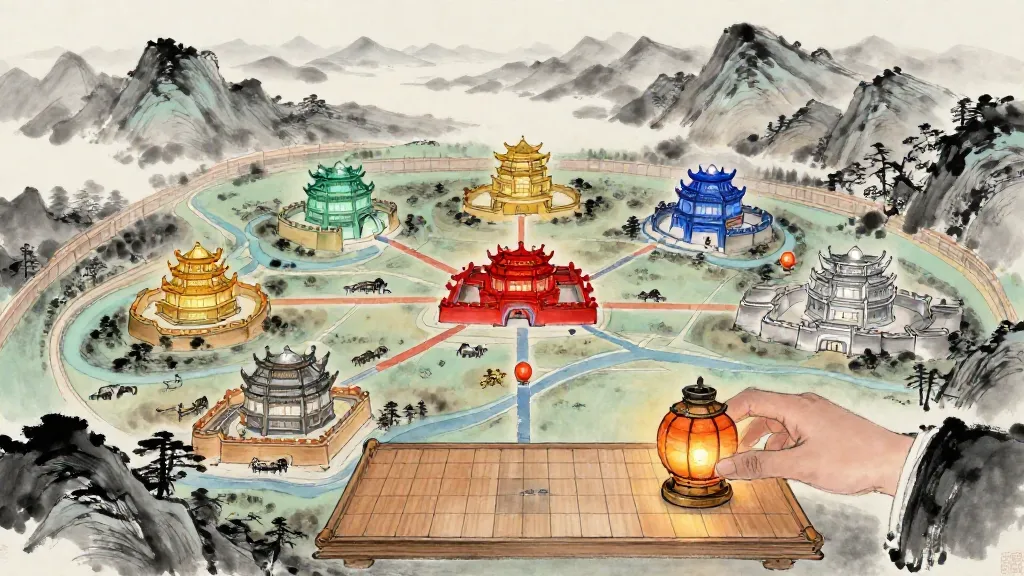
The Seven States
Seven kingdoms contending for supremacy in ancient China's Warring States period (475–221 BC). Each state embodies a distinct philosophical tradition and strategic doctrine.
The Warring States period (戰國時代, 475–221 BC) was an era of prolonged warfare among seven major Chinese states: Qin (秦), Chu (楚), Qi (齊), Yan (燕), Zhao (趙), Wei (魏), and Han (韓). Each state developed distinct philosophical traditions and strategic doctrines — from Qin's Legalism to Qi's Jixia Academy scholarship. The period ended when Qin conquered all six rivals, unifying China under its first emperor in 221 BC.
By Augustin Chan with AI · Published January 2025 · Updated March 2026
Qin Qín
Ruthless efficiency, institutional strength, expansionist. Rewards military merit, punishes dissent. Centralized bureaucracy eliminates feudal aristocracy.
Han Hán
The framework-receiving agent in the Phase 2 simulation. Historically the weakest state and first to fall. Each round, Han's agent reflects through a symbolic framework — the King Wen I-Ching in one condition, tarot or scrambled text in others — before it acts, while the other six states play from baseline prompts. The published finding (arXiv:2606.07552): Han never wins, but the framework it reflects through reshapes which state does.
Zhao Zhào
Strong cavalry tradition, aggressive defense, tactical excellence. Known for the Hufu cavalry reform. Brave but sometimes strategically reckless — the disaster at Changping exemplifies tactical talent undermined by political misjudgment.
Wei Wèi
Early hegemon that declined through strategic overextension. Strong bureaucratic tradition. Economically sophisticated but gradually squeezed between Qin and Qi. A cautionary tale of power squandered.
Yan Yān
Cautious, northern frontier state, late mover. Ancient lineage but often passive. Capable of dramatic action when provoked (Yue Yi's campaign against Qi) but struggles with sustained strategic initiative.
Chu Chǔ
Vast territory, decentralized governance, culturally distinct from northern states. Unpredictable and patient. Rich shamanic tradition. Capable of immense power but hampered by feudal aristocratic factions that resist centralization.
Qi Qí
Intellectual powerhouse, economic giant, diplomatic heavyweight. Qi's Jixia Academy attracted thinkers from every school. Wealthiest state through salt and fish monopolies. Capable of brilliant diplomacy but prone to complacency after periods of success.
Seven States at a Glance
| State | Capital | Philosophy | Territory | Key Figure | Fate |
|---|---|---|---|---|---|
| 秦 Qin | Xianyang | Legalism | Large (west) | Shang Yang | Unified China (221 BC) |
| 楚 Chu | Ying | Shamanism / Daoism | Largest (south) | Qu Yuan | Conquered 223 BC |
| 齊 Qi | Linzi | Jixia Academy | Large (east) | Sun Bin | Conquered 221 BC |
| 燕 Yan | Ji | Conservative | Medium (north) | Jing Ke | Conquered 222 BC |
| 趙 Zhao | Handan | Military reform | Medium (north) | Li Mu | Conquered 228 BC |
| 魏 Wei | Daliang | Legalism (Li Kui) | Small (central) | Li Kui | Conquered 225 BC |
| 韓 Han | Xinzheng | Legalism (Han Fei) | Smallest (central) | Han Fei | First conquered 230 BC |
Frequently Asked Questions
What were the Seven Warring States?
The Seven Warring States (戰國七雄) were Qin (秦), Chu (楚), Qi (齊), Yan (燕), Zhao (趙), Wei (魏), and Han (韓) — seven major kingdoms that competed for supremacy in ancient China from 475 to 221 BC. Each state developed distinct philosophical traditions and strategic doctrines. The period is one of the most intensely studied eras in Chinese history, producing foundational texts on strategy, diplomacy, and governance that remain influential today.
When was the Warring States period?
The Warring States period (戰國時代) lasted from 475 to 221 BC, spanning approximately 254 years. It began after the partition of the Jin state into Zhao, Wei, and Han in 453 BC (formally recognized in 403 BC), and ended when Qin conquered the last rival state, Qi, in 221 BC. Key milestones include the reforms of Shang Yang in Qin (356 BC), the Battle of Changping (260 BC) where Qin defeated Zhao, and the first unification of China under Qin Shi Huang in 221 BC.
How did the Warring States period end?
The Warring States period ended with Qin's systematic conquest of all six rival kingdoms between 230 and 221 BC. Han fell first in 230 BC, followed by Zhao (228 BC), Wei (225 BC), Chu (223 BC), Yan (222 BC), and finally Qi (221 BC). Qin's success was built on decades of Legalist institutional reforms, a professional military, and the strategic isolation of rival states through diplomacy. The King of Qin then proclaimed himself Qin Shi Huang (秦始皇), the First Emperor, creating a unified Chinese state for the first time.