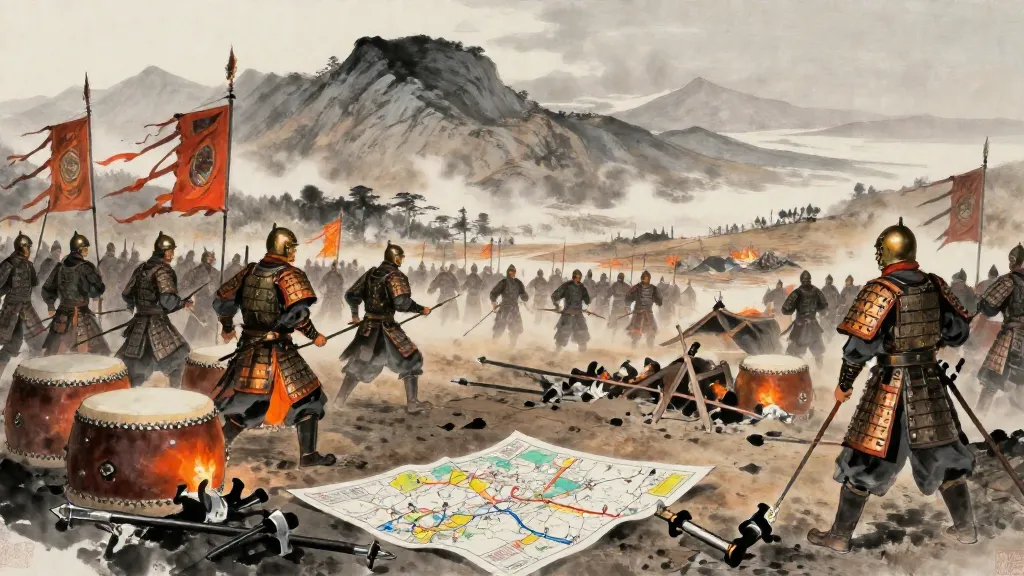
備城門 (Defending the City Gate) — Chinese ink painting

墨子 Mozi · Chapter 52

備城門

Defending the City Gate

View:

守城總論

General Principles of City Defense

禽滑厘問於子墨子曰:"由聖人之言,鳳鳥之不出,諸侯畔殷周之國,甲兵方起於天下,大攻小,強執弱,吾欲守小國,為之奈何?"子墨子曰:"何攻之守?"禽滑厘對曰:"今之世常所以攻者:臨、鉤、沖、梯、堙、水、穴、突、空洞、蟻傅、轒轀、軒車,敢問守此十二者奈何?"

Qin Guli asked Master Mozi: 'Following the words of the sages, the phoenix does not appear, the feudal lords have rebelled against the Shang-Zhou order, armored troops are rising everywhere under Heaven, the large attack the small and the strong seize the weak. I wish to defend a small state -- what should I do?' Master Mozi said: 'What type of attack would you defend against?' Qin Guli replied: 'The common methods of attack in today's world are: mounds for overlooking, hooks, battering rams, siege ladders, earthen ramps, water flooding, tunneling, breakthrough, hollow rams, ant-climbing, covered assault wagons, and elevated chariots. How does one defend against these twelve methods?'

Notes

1context

Chapters 52-71 form the military section of the Mozi, the most detailed surviving treatise on defensive siege warfare from ancient China. These chapters are highly technical, describing weapons specifications, fortification construction, troop deployment, and logistics. They reflect the Mohist school's practical expertise in defensive engineering, which they offered to small states threatened by larger neighbors.

2person禽滑厘Qin Guli

Qin Guli (禽滑厘) was Mozi's chief military disciple, who appears as the primary questioner throughout the defense chapters.

守城十四要件

Fourteen Requirements for City Defense

子墨子曰:"我城池修,守器具,推粟足,上下相親,又得四鄰諸侯之救,此所以持也。"凡守圍城之法,厚以高;壕池深以廣;樓撕揗,守備繕利;薪食足以支三月以上;人眾以選;吏民和;大臣有功勞於上者,多主信以義,萬民樂之無窮;不然,父母墳墓在焉;不然,山林草澤之饒足利;不然,地形之難攻而易守也;不然,則有深怨於適而有大功於上;不然,則賞明可信而罰嚴足畏也。此十四者具,則民亦不宜上矣,然後城可守。十四者無一,則雖善者不能守矣。

Master Mozi said: 'When the city walls and moats are in good repair, defensive equipment is ready, grain supplies are sufficient, those above and below trust each other, and one can obtain relief from neighboring states -- these are the means of holding out.' The general method for defending a besieged city: the walls must be thick and high; the moats deep and wide; the towers and parapets in good repair with well-maintained defensive equipment; fuel and food sufficient for at least three months; a large and selected garrison; harmony between officials and people; senior ministers who have rendered service to the ruler, whose trustworthiness and righteousness attract the people's loyalty without limit. Failing that: the people's ancestral graves are there. Failing that: the surrounding forests and marshes provide ample resources. Failing that: the terrain is difficult to attack and easy to defend. Failing that: there is deep enmity against the enemy and great merit in the eyes of the ruler. Failing that: rewards are clearly trustworthy and punishments are severe enough to inspire fear. When these fourteen conditions are met, the city can be defended. When not a single one is met, even the most capable cannot defend it.

城門防禦工事

Gate Fortification Specifications

故凡守城之法,備城門為縣門,沉機長二丈,廣八尺,為之兩相如;門扇數合相接三寸。施土扇上,無過二寸。塹中深丈五,廣比扇,塹長以力為度。

The general method for defending a city: to fortify the city gate, construct a suspended gate with a drop mechanism two zhang long and eight chi wide, made as a double-leaf gate; the gate leaves should overlap by three cun when closed. Earth is applied on top of the leaves, no more than two cun thick. A trench is dug in the center, one zhang five chi deep, as wide as the gate leaves, and of a length determined by the available labor.

Notes

1context

The technical specifications throughout this chapter use traditional Chinese measurements: 1 zhang (丈) = approximately 2.3 meters; 1 chi (尺) = approximately 23 cm; 1 cun (寸) = approximately 2.3 cm. The Mohist defense specifications are remarkably precise, reflecting practical engineering experience.

城上防備部署

Defensive Deployment on the Walls

守法:五十步丈夫十人、丁女二十人、老小十人,計之五十步四十人。城下樓卒,率一步一人,二十步二十人。城小大以此率之,乃足以守圉。

The defensive standard: for every fifty paces of wall, assign ten adult men, twenty able-bodied women, and ten elderly and children -- a total of forty persons per fifty paces. For the garrison below the wall towers, the ratio is one person per pace: twenty people per twenty paces. Cities of all sizes should follow this ratio, which is sufficient for defense.

Notes

1context

The inclusion of women, elderly, and children in the defense force reflects the Mohist approach of total mobilization for city defense. The specific ratio of 40 defenders per 50 paces of wall is a practical planning standard for garrison commanders.

Edition & Source

Text
《墨子》 Mozi
Edition
中華古詩文古書籍網 transcription, 《四部叢刊》本
Commentary
Mo Di (墨翟) et al., Warring States period