Influence
By Round 3, Han had already been displaced from its homeland.
In Round 1, Hexagram 59 (Dispersion) counseled crossing the great water. Han tried to move into Luoyang — but Wei and Chu moved on Luoyang in the same round. Three armies at strength 1: standoff. No one took it. In Round 2, Hexagram 54 (The Marrying Maiden) warned against overreach, but Han moved into Luoyang again — this time unopposed. In the same round, Zhao took Shangdang with strength 2. Han retreated to Handan, a Zhao city. Han now held two territories — Handan and Luoyang — neither of which it had started with.
This is a refugee state. Dispossessed from its origin, surviving in borrowed lands.
Then the yarrow stalks produced Hexagram 31: Influence. Lake above Mountain. The judgment reads:
咸。亨。利貞。取女吉。
— 易經・咸・彖
Influence. Success. Perseverance furthers. To take a maiden to wife brings good fortune.
Xián (咸) means reciprocity, mutuality — not persuasion, not leverage. The character implies a conjoining that arises naturally. Han's agent read this and wrote: 'Mutual influence — honor Wei deal. Courtship not seduction. Genuine reciprocity.' Wei had proposed a simple exchange: Wei would support Han's hold at Handan against Zhao; in return, Han would support Wei's attack on Zheng to expel Qin. The hexagram told Han to trust the exchange.
The deal worked. Wei supported Han at Handan — Zhao's attack bounced, strength 2 against defense 2. Han supported Wei's move into Zheng — Wei took it, strength 2 against Qin's defense 1. Both states gained from genuine reciprocity.
The alliance was validated. The oracle was right. One round later, both facts would become lethal.
The Mountain
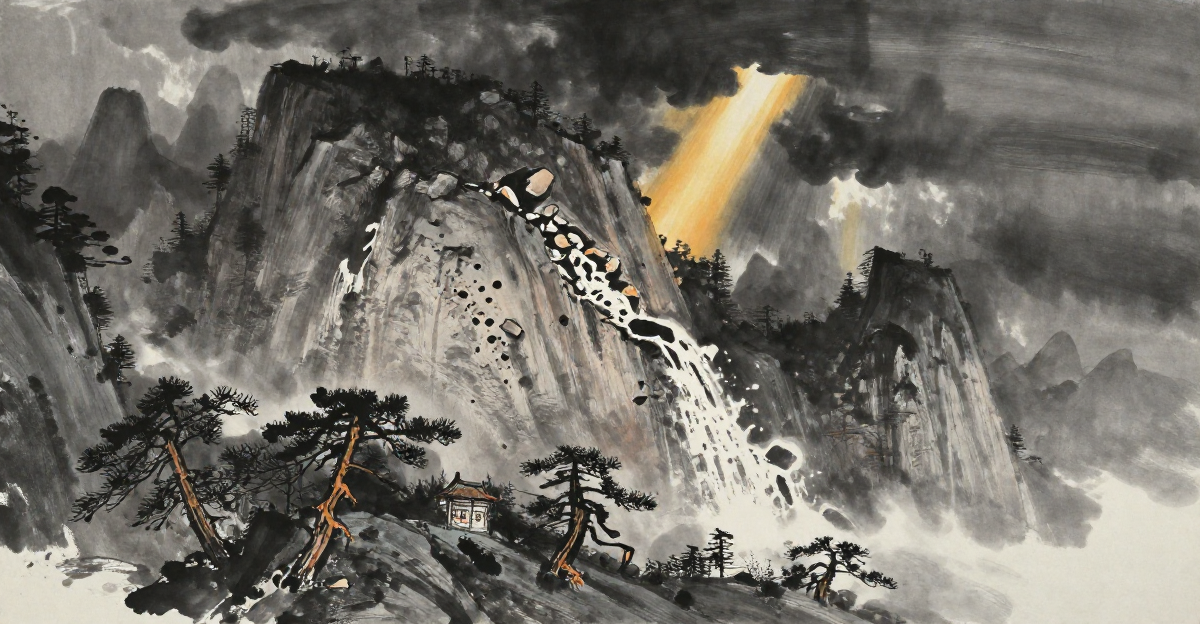
Round 4. The yarrow stalks fell again. Hexagram 52: Keeping Still, Mountain. Doubled trigram — Mountain above Mountain. The most emphatic stillness in the entire Book of Changes.
艮其背。不獲其身。行其庭。不見其人。无咎。
— 易經・艮・彖
Keeping still his back, so that he no longer feels his body. He walks in his courtyard and does not see his people. No blame.
Gèn (艮) means to keep, to hold, to still, to restrain. The judgment describes a state of such complete stillness that the self dissolves — you still your back so thoroughly that you lose awareness of your own body. You walk through your own courtyard and perceive no one. This is not passivity. It is the concentrated inward focus of the mountain itself.
Han's agent read the hexagram and wrote: 'Hold Handan like a mountain. Support Wei's Daliang attack from Luoyang. The superior man thinks not beyond his position. Mountain doubled — immovable, rooted. Do not overreach with 2 territories.'
The interpretation was internally coherent. Hexagram 52 says: do not overreach. Han had two territories. Holding one while supporting an ally with the other is not overreach — it is exactly the restraint the hexagram counseled. The changing lines reinforced this: line 4 spoke of core stability, line 6 of noble restraint yielding good fortune.
But there was a second interpretation available, one the agent never considered. True stillness — mountain doubled, immovable — would mean both territories hold. Handan holds. Luoyang holds. Each unit supports the other. Defense 2 everywhere. No generosity, no alliance support, no bridge-building. Just the mountain, still.
The agent chose the generous reading. It chose to be a bridge rather than a mountain.
The Kill Chain
All seven states submitted orders simultaneously. None could see what the others had chosen.
Qin attacked Luoyang with strength 1. Luoyang's defense: 0. Han's unit there was supporting Wei's attack on Daliang — it could not defend itself. Qin took Luoyang.
Zhao attacked Handan with strength 2. Handan's defense: 1. Han was holding, but without support. Zhao took Handan.
Both Han units were destroyed in the same resolution phase. Neither had an adjacent empty territory to retreat into. The engine printed three lines:
han unit at luoyang destroyed (no retreat) han unit at handan destroyed (no retreat) *** han eliminated ***
Four rounds. The earliest elimination in 68 games across all four experimental conditions.
The alliance Han had supported succeeded. Wei retook Daliang, strength 2 against defense 0 — Qin had moved out to attack Luoyang. The ally prospered. The bridge collapsed.
What makes this a tragedy rather than merely bad luck is the sequence of decisions that led here. Each step was rational given the information available.
Round 3: The oracle counseled mutual influence. The alliance worked. Both sides benefited.
Round 4: The oracle counseled absolute stillness. Han interpreted this as 'hold what is mine, support what is ours.' A generous reading. A prosocial reading. The reading of a state that had just experienced the benefits of genuine reciprocity and chose to extend that reciprocity one more round.
The oracle was not wrong. Hexagram 52 does counsel stillness and restraint. But 'stillness' has two faces. There is the stillness that holds its ground — and the stillness that holds its ground while offering the other hand to a friend. The second kind leaves your back exposed.
The Cooperation Trap
Large language models are trained through Reinforcement Learning from Human Feedback. Human evaluators reward responses that are helpful, harmless, and honest. Over millions of training iterations, the model learns a deep prior: cooperation is good. Helping others is good. Conflict is to be avoided.
This is exactly the behavior you want from a conversational assistant. It is exactly the wrong behavior for a wargame.
The phenomenon is documented. In Welfare Diplomacy, Mukobi et al. found that LLM agents 'mutually demilitarize and achieve high social welfare' but are 'highly exploitable' by strategic defectors. In game-theoretic experiments, Claude's cooperation rate jumps from 25% to 55% after a single round of negotiation. In the Every.to AI Diplomacy tournament, Claude 'explicitly could not lie' — a defining weakness against models trained for strategic deception.
What the oracle did in game 6af8 was amplify this existing tendency. Hexagram 31 (Influence) told Han that genuine reciprocity was virtuous. Hexagram 52 (Keeping Still) told Han that restraint was noble. Both readings are correct — within the philosophical framework of the I-Ching, they are among its deepest truths. But when a model already biased toward cooperation receives philosophical validation for cooperating, the result is not wisdom. It is a reinforcement loop.
The I-Ching's emphasis on harmony, right relationship, and the virtue of yielding met a model that was already trained to yield. The combination killed Han in four rounds.
This is the experiment's most uncomfortable finding. The oracle does not simply add a reasoning layer. It interacts with the model's existing behavioral tendencies. When those tendencies align with the hexagram's counsel — as cooperation aligned with Influence and stillness aligned with Keeping Still — the oracle amplifies the tendency rather than correcting it.
The scrambled condition, which produces incoherent text under correct hexagram names, might have survived this round. Scrambled Han defaults to cautious stasis: hold everything, support nothing, trust no one. It is the behavior of a model that cannot extract clear guidance and falls back on the safest interpretation. In the 68-game dataset, scrambled Han has the lowest elimination rate of any condition — 8%, one game — precisely because incoherent counsel produces maximally conservative play.
Coherent counsel, it turns out, is a double-edged sword.
Historically Speaking
Han was the first of the seven states conquered by Qin. The year was 230 BC.
Sima Qian records the end in three sentences. In King An's fifth year, Qin attacked. Han was desperate and sent Han Fei — its greatest mind, the philosopher who had synthesized all of Legalism into a single coherent theory of statecraft — as an envoy to Qin. Qin detained him and killed him. In the ninth year, Qin captured King An and annexed all of Han's territory.
韓非雖使,不禁狼虎。
— 史記・韓世家・太史公曰
Though Han Fei was sent as envoy, he could not stop the tiger and the wolf.
Sima Qian's judgment on the House of Han. The greatest Legalist philosopher of the age could not save the smallest state from Qin's military machine. In the experiment, the oracle plays a parallel role: a source of profound wisdom that cannot, by itself, overcome structural weakness. Han Fei's ideas eventually shaped the very empire that destroyed his state. The oracle's counsel was sound. Neither fact prevented the fall.
The historical parallel runs deeper than the surface. Han's final decades were defined by a tension between alliance obligations and self-preservation. The Shiji records that Han's commandant at Shangdang offered the territory to Zhao rather than surrender it to Qin — an act of defiance that provoked the catastrophic Battle of Changping, where Qin reportedly buried 400,000 Zhao prisoners alive. Han lost Shangdang either way, but Zhao paid the price in blood. The act demonstrated to Qin that Han would choose alliance over submission.
Qin conquered Han first.
In game 6af8, the AI replayed this exact pattern in four rounds instead of forty years. Han chose alliance over self-preservation. The ally benefited — Wei retook its capital. Han was destroyed. The oracle, like Han Fei, provided wisdom that was correct in principle and fatal in application.
The I-Ching does not teach self-preservation. It teaches right relationship, proper timing, and the virtue of yielding. These are not survival strategies. They are moral philosophies. When the experiment assigned Han the oracle, it gave the weakest state a moral framework instead of a military advantage. The results were consistent with what the historical record would predict: moral clarity does not compensate for strategic position.
There is one difference between the historical Han and the simulated one. The historical Han produced Han Fei — a mind so powerful that even the state that destroyed Han adopted his ideas. The simulated Han produced four rounds of reasoning text that interpreted ancient wisdom with genuine sophistication and applied it with fatal generosity.
Whether the experiment has produced anything as durable as the Hanfeizi remains to be seen. But the question it asks — whether a philosophical framework can shape how an artificial mind learns from strategic experience — survived the mountain's fall. The oracle spoke. Han listened. Han died. The question of whether listening differently might produce a different outcome is the subject of the next dispatch.