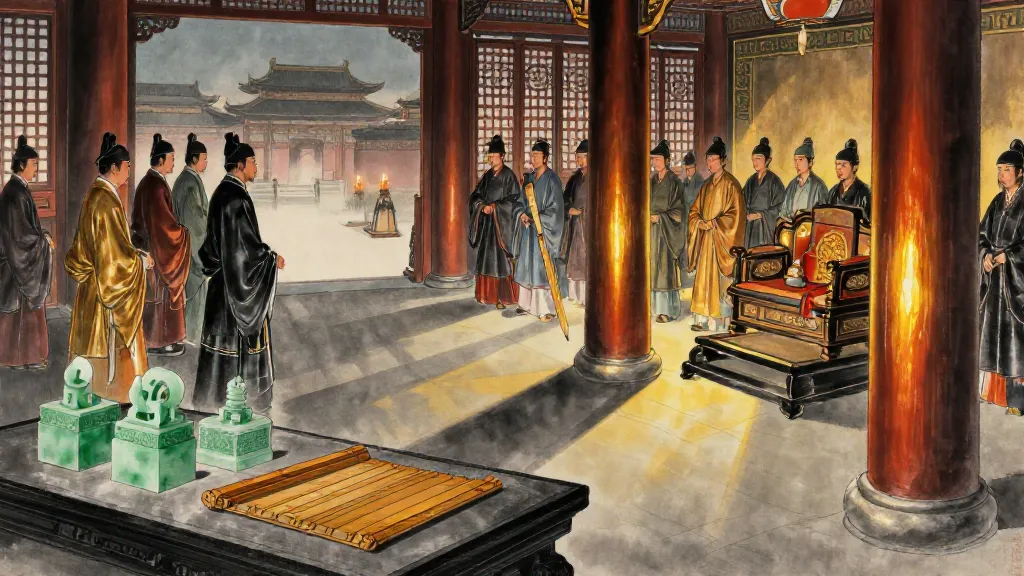
大匡 (The Great Rectification) — Chinese ink painting

管子 Guanzi · Chapter 18

大匡

The Great Rectification

View:

管鮑之約

The Compact of Guan Zhong and Bao Shu

齊僖公生公子諸兒、公子糾、公子小白。使鮑叔傅小白,鮑叔辭,稱疾不出。管仲與召忽往見之。

Duke Xi of Qi fathered Prince Zhu'er, Prince Jiu, and Prince Xiaobai. He assigned Bao Shu to tutor Xiaobai, but Bao Shu declined, feigning illness and refusing to appear. Guan Zhong and Shao Hu went to see him. Guan Zhong said: 'You must go. The future ruler of Qi is not yet known — it may be either of these princes. You must take your post.' Shao Hu disagreed: 'I see that Xiaobai will never become the successor.' But Guan Zhong replied: 'The people of Qi despise Prince Jiu's mother and pity Xiaobai for being motherless. Prince Zhu'er is eldest but low-born — the future is uncertain. Without me, none can manage Xiaobai.' Thus the three men divided their loyalties between the two princes — a compact that would determine Qi's destiny.

Notes

1person鮑叔牙Bào Shūyá

Bao Shuya (鮑叔牙) was Guan Zhong's lifelong friend and the man who recommended him to Duke Huan. Their friendship became proverbial for selfless loyalty.

2person召忽Shào Hū

Shao Hu (召忽) was the third member of the compact with Guan Zhong and Bao Shuya. He chose to die loyally for Prince Jiu when the succession was decided.

桓公即位

Duke Huan Takes the Throne

鮑叔牙奉公子小白奔莒,管夷吾、召忽奉公子糾奔魯。

Bao Shuya escorted Prince Xiaobai to flee to Ju; Guan Zhong and Shao Hu escorted Prince Jiu to flee to Lu. After Duke Xiang was assassinated, Xiaobai raced back from Ju. Guan Zhong, intercepting him, shot an arrow that struck his belt-hook — Xiaobai feigned death and entered Qi first, becoming Duke Huan. When Guan Zhong was sent back in bonds, Shao Hu committed suicide, declaring: 'You be the living minister; I will be the dead minister.' Duke Huan, at Bao Shu's urging, forgave the man who had tried to kill him and made Guan Zhong his chief minister.

Notes

1person齊桓公Qí Huán Gōng

Duke Huan of Qi (齊桓公, r. 685–643 BC) was the first of the Five Hegemons of the Spring and Autumn period. Under Guan Zhong's administration, he convened the feudal lords nine times and unified the realm once.

霸業之成

Achieving Hegemony

桓公二年踐位,召管仲。管仲至,公問曰:"社稷可定乎?"管仲對曰:"君霸王,社稷定;君不霸王,社稷不定。"

In Duke Huan's second year, he summoned Guan Zhong. Guan Zhong arrived, and the Duke asked: 'Can the altars of state be secured?' Guan Zhong replied: 'If my lord becomes hegemon king, the altars will be secure; if not, they will not be secure.' The Duke initially resisted: 'I dare not aspire so high — just to secure the altars.' Guan Zhong refused to serve under such limited ambition. Only when the Duke sweated and said, 'Then let us strive for hegemony,' did Guan Zhong accept. For the first years, the Duke ignored Guan Zhong's advice, waged unsuccessful wars against Song and Lu, and was humiliated by Cao Gui's dagger diplomacy. Only after repeated failures did he follow Guan Zhong's counsel: first build internal strength, then aid displaced states, then earn the respect of the feudal lords through generosity rather than force. After five years of patient reform, the lords submitted willingly.

Notes

1person曹劌Cáo Guì

Cao Gui (曹劌) was a Lu warrior who famously held Duke Huan at knifepoint at a diplomatic meeting, forcing him to return territory seized from Lu. This incident taught Huan the limits of raw military power.

Edition & Source

Text
《管子》 Guanzi
Edition
中華古詩文古書籍網 transcription
Commentary
Traditional commentaries