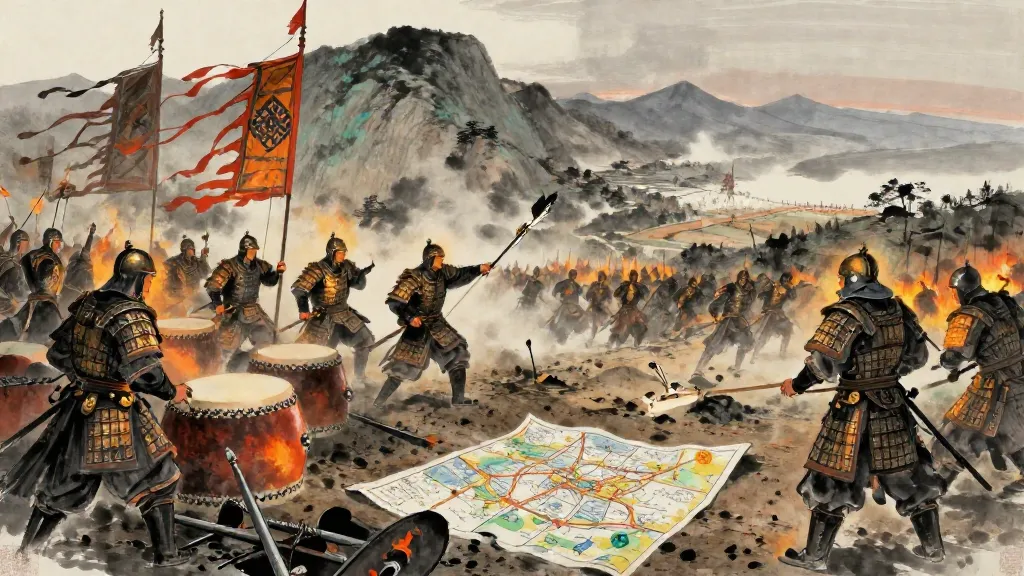
難一 (Difficulties, Part One) — Chinese ink painting

韓非子 Hanfeizi · Chapter 36

難一

Difficulties, Part One

View:

一:舅犯與雍季之賞

One: The Rewards of Jiu Fan and Yong Ji

晉文公將與楚人戰,召舅犯問之,曰:"吾將與楚人戰,彼眾我寡,為之奈何?"舅犯曰:"臣聞之,繁禮君子,不厭忠信;戰陣之間,不厭詐偽。君其詐之而已矣。"文公辭舅犯,因召雍季而問之,曰:"我將與楚人戰,彼眾我寡,為之奈何?"雍季對曰:"焚林而田,偷取多獸,後必無獸;以詐遇民,偷取一時,後必無復。"文公曰:"善。"辭雍季,以舅犯之謀與楚人戰以敗之。歸而行爵,先雍季而後舅犯。群臣曰:"城濮之事,舅犯謀也。夫用其言而後其身,可乎?"文公曰:"此非君所知也。夫舅犯言,一時之權也;雍季言,萬世之利也。"仲尼聞之,曰:"文公之霸也,宜哉!既知一時之權,又知萬世之利也。"

Duke Wen of Jin was about to fight the men of Chu. He summoned Jiu Fan and asked: 'I am about to battle Chu. They are many and we are few -- what should I do?' Jiu Fan said: 'I have heard that a gentleman of elaborate courtesy never tires of loyalty and good faith; but on the field of battle, one never tires of deception and trickery. Simply deceive them, my lord.'

Duke Wen dismissed Jiu Fan and summoned Yong Ji, asking the same question. Yong Ji replied: 'If you burn the forest to hunt, you may steal a great catch of game, but afterward there will be no game left. If you use deception on the people, you may steal a temporary gain, but afterward there will be no return.' Duke Wen said: 'Excellent.' He dismissed Yong Ji, then used Jiu Fan's strategy to fight Chu and defeated them.

Upon returning, when distributing ranks, he placed Yong Ji first and Jiu Fan second. The ministers objected: 'The victory at Chengpu was Jiu Fan's strategy. You used his words but ranked him second -- can this be right?' Duke Wen said: 'This is not for you to understand. Jiu Fan's words were an expedient for the moment; Yong Ji's words are a benefit for ten thousand generations.'

Confucius heard of this and said: 'Duke Wen's hegemony was fitting indeed! He understood both the expedient of the moment and the benefit of ten thousand generations.'

Notes

1person舅犯Jiu Fan

Jiu Fan (舅犯), also known as Hu Yan (狐偃), was Duke Wen's maternal uncle and chief advisor who devised the strategy for the Battle of Chengpu (632 BC).

2person雍季Yong Ji

Yong Ji (雍季) was a minister of Jin who counseled against deception as a governing principle.

韓非反駁:仲尼不知善賞

Han Fei's Rebuttal: Confucius Did Not Understand Good Rewarding

或曰:雍季之對,不當文公之問。凡對問者,有因問小大緩急而對也。所問高大,而對以卑狹,則明主弗受也。今文公問"以少遇眾",而對曰"後必無復",此非所以應也。且文公不不知一時之權,又不知萬世之利。戰而勝,則國安而身定,兵強而威立,雖有後復,莫大於此,萬世之利奚患不至?戰而不勝,則國亡兵弱,身死名息,拔拂今日之死不及,安暇待萬世之利?

One may object: Yong Ji's answer did not match Duke Wen's question. Answers should correspond to the scope and urgency of the question. When the question is about a great and urgent matter, and the answer is narrow and petty, an enlightened ruler will not accept it. Duke Wen asked 'how to face many with few,' and the answer was 'afterward there will be no return' -- this was not a proper response.

Moreover, Duke Wen did not understand either the expedient of the moment or the benefit of ten thousand generations. If he fights and wins, the state is secure, his person is safe, his army is strong, and his authority is established. Though there be 'returns' afterward, nothing is greater than this -- what worry that the benefit of ten thousand generations will not come? If he fights and loses, the state is destroyed, the army weakened, his person dead and his name extinguished. He would barely be able to snatch himself from today's death -- when would he have leisure to await the benefit of ten thousand generations?

Notes

1context

The 'Difficulties' (難) chapters follow a distinctive format: first the conventional anecdote is presented (often featuring Confucius's approval), then Han Fei systematically demolishes it. This is dialectical philosophy: testing received wisdom against rigorous analysis.

二:舜之德化——矛盾之說

Two: Shun's Moral Transformation -- The Argument of Shield and Spear

歷山之農者侵畔,舜往耕焉,期年。甽畝正。河濱之漁者爭坻,舜往漁焉,期年而讓長。東夷之陶者器苦窳,舜往陶焉,期年而器牢。仲尼嘆曰:"耕、漁與陶,非舜官也,而舜往為之者,所以救敗也。舜其信仁乎!乃躬藉處苦而民從之。故曰:聖人之德化乎!"

或問儒者曰:"方此時也,堯安在?"其人曰:"堯為天子。""然則仲尼之聖堯奈何?聖人明察在上位,將使天下無奸也。今耕漁不爭,陶器不窳,舜又何德而化?舜之救敗也,則是堯有失也。賢舜,則去堯之明察;聖堯,則去舜之德化:不可兩得也。楚人有鬻盾與矛者,譽之曰:'盾之堅,莫能陷也。'又譽其矛曰:'吾矛之利,於物無不陷也。'或曰:'以子之矛陷子之盾,何如?'其人弗能應也。夫不可陷之盾與無不陷之矛,不可同世而立。今堯、舜之不可兩譽,矛盾之說也。"

The farmers at Mount Li encroached on each other's boundaries. Shun went there to farm, and after a year the field ridges were straight. The fishermen at the river bank fought over the sandbars. Shun went there to fish, and after a year the elder was given precedence. The potters of the Eastern Yi made crude and flawed vessels. Shun went there to make pottery, and after a year the vessels were sturdy. Confucius sighed: 'Farming, fishing, and pottery-making were not Shun's official duties. Yet Shun went and performed them to rescue what was failing. Shun was truly benevolent! He personally endured hardship, and the people followed him. Hence it is said: The sage's virtue transforms!'

Someone questioned the Confucians: 'At this time, where was Yao?' They answered: 'Yao was Son of Heaven.' 'Then what does Confucius's veneration of Yao amount to? A sage of brilliant perception occupies the highest position -- he is supposed to ensure that there is no wrongdoing under Heaven. If the farmers quarreled, the fishermen fought, and the potters made shoddy work, then what virtue did Shun transform? If Shun had to rescue failures, then Yao had failings. If you praise Shun, you remove Yao's brilliant perception. If you venerate Yao, you remove Shun's moral transformation. You cannot have both.

A man of Chu was selling shields and spears. He praised his shields: "My shields are so hard, nothing can pierce them." Then he praised his spears: "My spears are so sharp, they can pierce anything." Someone asked: "What happens if you use your spear on your shield?" The man could not answer. An impenetrable shield and an all-penetrating spear cannot both exist in the same world. That Yao and Shun cannot both be praised -- this is the argument of the shield and the spear.'

Notes

1context

This passage contains the origin of the word 矛盾 (mao dun, 'spear-shield'), which in modern Chinese means 'contradiction.' It is one of the most famous passages in all of Chinese philosophy. Han Fei uses formal logic to expose the internal contradiction in Confucian hagiography.

三:管仲去三子

Three: Guan Zhong's Advice to Remove the Three Men

管仲有病,桓公往問之,曰:"仲父病,不幸卒於大命,將奚以告寡人?"管仲曰:"微君言,臣故將謁之。願君去豎刁,除易牙,遠衛公子開方。"

Guan Zhong fell ill. Duke Huan went to visit him: 'If Zhongfu's illness is, unfortunately, terminal, what instruction will you leave for me?' Guan Zhong said: 'Even without your asking, I was about to raise this. I beg you to dismiss Shu Diao, remove Yi Ya, and distance Prince Kaifang of Wei.'

Notes

1person豎刁Shu Diao

Shu Diao (豎刁) was a eunuch who castrated himself to serve Duke Huan in the inner palace. Yi Ya (易牙) was a cook who allegedly cooked his own son to please the duke. Prince Kaifang (開方) of Wei had abandoned his mother for fifteen years to serve Duke Huan.

韓非反駁:管仲無度

Han Fei's Rebuttal: Guan Zhong Lacked Method

或曰:管仲所以見告桓公者,非有度者之言也。所以去豎刁、易牙者,以不愛其身,適君之欲也。曰:"不愛其身,安能愛君?"然則臣有盡死力以為其主者,管仲將弗用也。曰"不愛其死力,安能愛君?"是君去忠臣也。

One may object: Guan Zhong's dying advice to Duke Huan was not the speech of a man who understood method. His reason for removing Shu Diao and Yi Ya was that they did not love their own persons but merely catered to the ruler's desires. He argued: 'One who does not love his own person -- how can he love the ruler?' But by this logic, any minister who devotes himself to death in service of his lord should also be dismissed. Saying 'One who does not love his own life -- how can he love the ruler?' means the ruler would remove his loyal ministers.

Notes

1context

Han Fei's critique is that Guan Zhong relied on character assessment (judging people by their dispositions) rather than institutional design (structures that prevent abuse regardless of character). Removing three individuals does not prevent others from rising to fill the same role. Only systematic controls -- not personal judgments of loyalty -- can protect the ruler.

四:趙襄子賞高赫

Four: Lord Xiang of Zhao Rewards Gao He

襄子圍於晉陽中,出圍,賞有功者五人,高赫為賞首。張孟談曰:"晉陽之事,赫無大功,今為賞首,何也?"襄子曰:"晉陽之事,寡人國家危,社稷殆矣。吾群臣無有不驕侮之意者,惟赫子不失君臣之禮,是以先之。"仲尼聞之曰:"善賞哉!襄子賞一人而天下為人臣者莫敢失禮矣。"

或曰:仲尼不知善賞矣。夫善賞罰者,百官不敢侵職,群臣不敢失禮。上設其法,而下無奸詐之心。如此,則可謂善賞罰矣。使襄子於晉陽也,令不行,禁不止,是襄子無國,晉陽無君也。今襄子於晉陽也,知氏灌之,曰灶生龜,而民無反心,是君臣親也。襄子有君臣親之澤,操令行禁止之法,而猶有驕侮之臣,是襄子失罰也。

Lord Xiang was besieged at Jinyang. After breaking out, he rewarded five men of merit, with Gao He as the foremost. Zhang Mengtan asked: 'In the affair of Jinyang, Gao He had no great achievement. Why is he foremost in rewards?' Lord Xiang said: 'In the affair of Jinyang, my state was in peril and the altars of soil and grain were endangered. Among all my ministers, not one failed to show a spirit of arrogance and contempt -- only Gao He did not lose the proper courtesies between ruler and minister. This is why I placed him first.' Confucius heard and said: 'Excellent rewarding! Lord Xiang rewarded one man and none under Heaven who serve as ministers dare lose their courtesy.'

One may object: Confucius did not understand good rewarding. One who is skilled at rewards and punishments ensures that all officials dare not encroach on their duties and all ministers dare not lose propriety. When the ruler establishes his law above, there are no treacherous hearts below. This may be called skilled rewarding and punishing. During the siege of Jinyang, if Lord Xiang's commands were not followed and his prohibitions not enforced, then Lord Xiang had no state and Jinyang had no ruler. Yet while Zhibo flooded Jinyang until 'stoves bred turtles,' the people showed no spirit of rebellion -- ruler and minister were close. If Lord Xiang possessed the grace of this closeness and wielded the law of enforced commands, and yet still had arrogant and contemptuous ministers, then Lord Xiang had failed in punishment.

Notes

1person高赫Gao He

Gao He (高赫) was a minister of Zhao whose sole distinction during the Jinyang siege was maintaining proper etiquette. Han Fei argues this is precisely the wrong person to reward.

五:師曠撞琴與六至九

Five: Shi Kuang Strikes His Zither, and Cases Six through Nine

晉平公與群臣飲,飲酣,乃喟然嘆曰:"莫樂為人君,惟其言而莫之違。"師曠侍坐於前,援琴撞之。公披衽而避,琴坏於壁。公曰:"太師誰撞?"師曠曰:"今者有小人言於側者,故撞之。"公曰:"寡人也。"師曠曰:"啞!是非君人者之言也。"左右請除之,公曰:"釋之,以為寡人戒。"

或曰:平公失君道,師曠失臣禮。夫為人臣者,君有過則諫,諫不聽則輕爵祿以待之,此人臣之禮義也。今師曠非平公之過,舉琴而親其體,雖嚴父不加於子,而師曠行之於君,此大逆之術也。

Duke Ping of Jin was drinking with his ministers. In the midst of the revelry, he heaved a sigh and said: 'Nothing is more pleasurable than being a ruler -- one's words are never opposed.' Shi Kuang was seated in attendance before him. He seized his zither and hurled it. The duke threw open his robes and dodged; the zither smashed against the wall. The duke asked: 'Grand Master, whom were you striking at?' Shi Kuang said: 'Just now a petty man was speaking at your side, so I struck at him.' The duke said: 'It was I.' Shi Kuang said: 'Ah! Those are not the words of one who rules men.' The attendants asked permission to punish him. The duke said: 'Release him. Let this serve as my warning.'

One may object: Duke Ping lost the way of the ruler, and Shi Kuang lost the courtesy of a minister. A minister, when the ruler errs, should remonstrate. If remonstrance is not heeded, he should be prepared to give up his rank and salary. This is the proper courtesy of a minister. Now Shi Kuang criticized Duke Ping's error not by offering counsel but by hurling a zither at his person. Even a strict father would not do this to his son, yet Shi Kuang did it to his ruler. This is the technique of great insubordination.

Notes

1person晉平公Jin Ping Gong

Duke Ping of Jin (晉平公, r. 557-532 BC) was the ruler of Jin during the late Spring and Autumn period.

2context

Han Fei's rebuttal attacks both parties: the duke for welcoming physical assault as 'frank counsel' (which normalizes violence against the ruler), and Shi Kuang for bypassing proper institutional channels. The Confucian reading celebrates Shi Kuang's boldness; Han Fei sees it as a dangerous precedent.

九:韓宣王兩用公仲公叔

Nine: King Xuan of Han Employs Both Gongzhong and Gongshu

韓宣王問於樛留:"吾欲兩用公仲、公叔,其可乎?"樛留對曰:"昔魏兩用樓、翟而亡西河,楚兩用昭、景而亡鄢、郢。今君兩用公仲、公叔,此必將爭事而外市,則國必憂矣。"

或曰:"昔者齊桓公兩用管仲、鮑叔,成湯兩用伊尹、仲虺。夫兩用臣者國之憂,則是桓公不霸,成湯不王也。湣王一用淖齒,而手死乎東廟;主父一用李兌,減食而死。主有術,兩用不為患;無術,兩用則爭事而外市,一則專制而劫弒。今留無術以規上,使其主去兩用一,是不有西河、鄢、郢之憂,則必有身死減食之患。"

King Xuan of Han asked Jiu Liu: 'I wish to employ both Gongzhong and Gongshu. Is this feasible?' Jiu Liu replied: 'In the past, Wei employed both Lou and Di and lost the Western River territory. Chu employed both Zhao and Jing and lost Yan and Ying. If your majesty now employs both Gongzhong and Gongshu, they will certainly compete for influence and seek support externally, and the state will surely be in trouble.'

One may object: 'In the past, Duke Huan of Qi employed both Guan Zhong and Bao Shu, and King Tang of Shang employed both Yi Yin and Zhong Hui. If employing two ministers were always the state's ruin, then Duke Huan would not have achieved hegemony and King Tang would not have become king. King Min employed only Nao Chi and was killed by his own hand in the eastern temple. Lord Wuling employed only Li Dui and was starved to death. When the ruler has techniques of control, employing two creates no danger. When the ruler lacks techniques, employing two leads to factional competition, while employing one leads to despotic control and assassination. Now Jiu Liu lacks the technique to guide his ruler from above. Making his lord abandon dual employment for sole reliance -- this means either the loss of Western River and Yan-Ying, or the danger of being killed or starved.'

Notes

1person淖齒Nao Chi

Nao Chi (淖齒) was a Qi general who murdered King Min of Qi (齊湣王) in 284 BC during the invasion by the Yan-led coalition.

2context

Han Fei's rebuttal makes a characteristically systematic point: the number of ministers is irrelevant. What matters is whether the ruler possesses 術 (techniques of control). With techniques, multiple ministers check each other. Without techniques, even a single minister becomes a tyrant.

Edition & Source

Text
《韓非子》 Hanfeizi
Edition
中華古詩文古書籍網 transcription, 《四部叢刊》本
Commentary
Han Fei (韓非), Warring States period