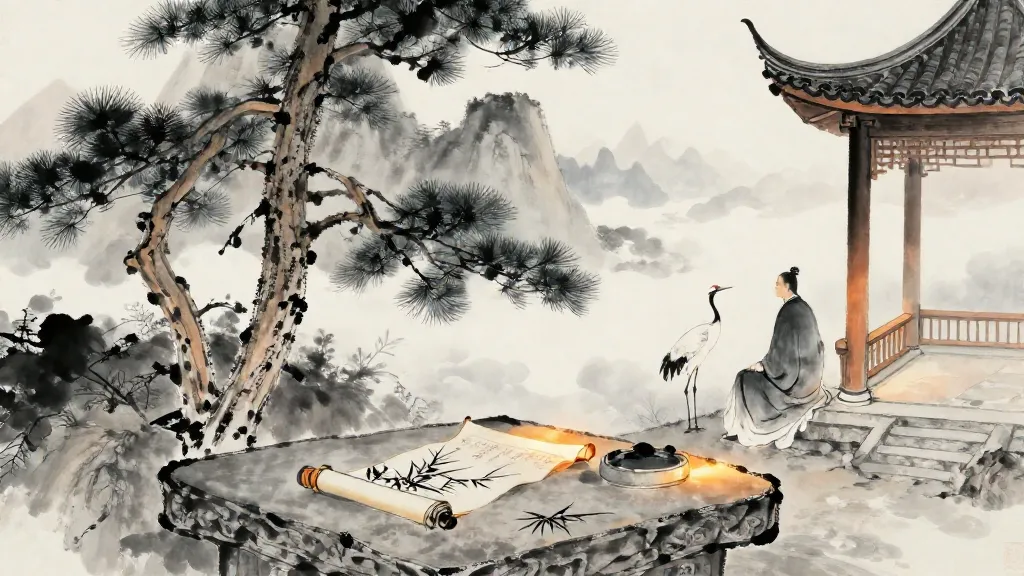
難三 (Objections and Refutations III) — Chinese ink painting

韓非子 Hanfeizi · Chapter 38

難三

Objections and Refutations III

View:

子思不以過聞

Zisi Declines to Report Misconduct

魯穆公問於子思曰:"吾聞龐氏之子不孝,其行奚如?"子思對曰:"君子尊賢以崇德,舉善以觀民。若夫過行,是細人之所識也,臣不知也。"子思出。子服厲伯入見,問龐氏子,子服厲伯對曰:"其過三。"皆君之所未嘗聞。自是這後,君貴子思而賤子服厲伯也。

Duke Mu of Lu asked Zisi: "I have heard that the son of the Pang clan is unfilial. What is his conduct like?" Zisi replied: "The gentleman honors the worthy to elevate virtue, and promotes the good to guide the people. As for misconduct, that is what petty men take note of -- I do not know of it." Zisi withdrew. Zifu Libo then entered for an audience, and when asked about the Pang clan's son, Zifu Libo answered: "He has three faults" -- all things the duke had never heard before. From this time on, the duke esteemed Zisi and looked down upon Zifu Libo.

Notes

1person子思Zisi

Zisi (子思, c. 483-402 BC) was the grandson of Confucius and an important transmitter of the Confucian tradition. He is traditionally credited with authoring the Doctrine of the Mean (中庸).

2person魯穆公Lu Mugong

Duke Mu of Lu (魯穆公, r. 415-383 BC) was a ruler of the state of Lu during the Warring States period.

或曰:子思之過

Objection: Zisi's Error

或曰:魯之公室,三世劫於季氏,不亦宜乎?明君求善而賞之,求奸而誅之,其得之一也。故以善聞之者,以說善同於上者也;以奸聞之者,以惡奸同於上者也:此宜賞譽之所及也。不以奸聞,是異於上而下比周於奸者也,此宜毀罰之所及也。今子思不以過聞而穆公貴之,厲伯以奸聞而穆公賤之。人情皆喜貴而惡賤,故季氏之亂成而不上聞,此魯君之所以劫也。且此亡王之俗,取、魯之民所以自美,而穆公獨貴之,不亦倒乎?

Someone objects: Is it not fitting that Lu's ducal house was held hostage by the Ji clan for three generations? An enlightened ruler seeks out the good and rewards it, seeks out treachery and punishes it -- acquiring both is equally important. Thus one who reports the good does so because he shares the ruler's love of good; one who reports treachery does so because he shares the ruler's hatred of treachery -- both deserve praise and reward. To fail to report treachery is to differ from the ruler above and conspire with the treacherous below -- this deserves censure and punishment. Yet Zisi did not report misconduct, and Duke Mu esteemed him; Libo did report treachery, and Duke Mu looked down on him. Human nature is to desire esteem and shun contempt, so the Ji clan's usurpation went unreported to the top -- this is how the ruler of Lu was held hostage. Moreover, this is the custom of doomed kings: something the people of Zou and Lu use to flatter themselves. That Duke Mu alone prized it -- is this not perverse?

Notes

1context

The Ji (季) clan was the most powerful of the three noble families (Three Huan/三桓) that dominated Lu's politics from the 6th century BC onward, effectively reducing the duke to a figurehead. Han Fei uses this as a cautionary example of what happens when ministers' misconduct goes unreported.

2translation

比周 means to form private cliques or conspire together. It is a key Legalist term for the kind of factional behavior that undermines the ruler's authority.

寺人披見文公

The Eunuch Pi Seeks Audience with Duke Wen

文公出亡,獻公使寺人披攻之蒲城,披斬其祛,文公奔翟。惠公即位,又使攻之惠竇,不得也。及文公反國,披求見。公曰:"蒲城之役,君令一宿,而汝即至;惠竇之難,君令三宿,而汝一宿,何其速也?"披對曰:"君令不二。除君之惡,恐不堪。蒲人、翟人,余何有焉?今公即位,其無蒲、翟乎?且桓公置射鉤而相管仲。"君乃見之。

When Duke Wen was in exile, Duke Xian sent the eunuch Pi to attack him at Pucheng. Pi cut off his sleeve, and Duke Wen fled to the Di people. When Duke Hui ascended the throne, he again sent Pi to attack at Huidou, but Pi failed to capture him. When Duke Wen finally returned to power, Pi sought an audience. The duke said: "In the affair at Pucheng, the ruler's order allowed one night's travel, yet you arrived immediately. In the crisis at Huidou, the ruler's order allowed three nights, yet you arrived in one -- why such haste?" Pi replied: "A ruler's command admits no hesitation. In eliminating the ruler's enemies, I feared only falling short. What did the people of Pu or the Di have to do with me? Now that you have ascended the throne, will there be no Pu or Di for you? Moreover, Duke Huan set aside the arrow-hook incident and made Guan Zhong his chief minister." The duke then received him.

Notes

1person晉文公Jin Wengong

Duke Wen of Jin (晉文公, r. 636-628 BC), personal name Chong'er (重耳), was one of the Five Hegemons. He spent nineteen years in exile before returning to power.

2person齊桓公Qi Huangong

Duke Huan of Qi (齊桓公, r. 685-643 BC) was the first of the Five Hegemons. Before becoming duke, he was nearly killed by Guan Zhong's arrow (which struck his belt-hook), yet he later appointed Guan Zhong as chief minister.

3person管仲Guan Zhong

Guan Zhong (管仲, c. 720-645 BC) was the famous chief minister of Qi who engineered Duke Huan's hegemony.

或曰:寺人披之危險

Objection: The Danger of the Eunuch Pi

或曰:齊、晉絕祀,不亦宜乎?桓公能用管仲之功而忘射鉤之怨,文公能聽寺人之言而棄斬祛之罪,桓公、文公能容二子者也。後世之君,明不及二公;後世之臣,賢不如二子。不忠之臣以事不明之君,君不知,則有燕操、子罕、田常之賊;知之,則以管仲、寺人自解。君必不誅而自以為有桓、文之德,是臣仇而明不能燭,多假之資,自以為賢而不戒,則雖無後嗣,不亦可乎?且寺人之言也,直飾君令而不貳者,則是貞於君也。死君後生,臣不愧,而復為貞。今惠公朝卒而暮事文公,寺人之不貳何如?

Someone objects: Is it not fitting that Qi and Jin saw their sacrifices cut off? Duke Huan could employ Guan Zhong's talents and forget the arrow-hook grudge; Duke Wen could heed the eunuch's words and set aside the crime of cutting his sleeve. These two dukes were able to tolerate such men. But later rulers lack the discernment of those two dukes, and later ministers lack the worthiness of those two men. When disloyal ministers serve undiscerning rulers -- if the ruler does not perceive it, then there arise traitors like Yan Zhuo, Zihan, and Tian Chang; if the ruler does perceive it, the ministers excuse themselves by citing Guan Zhong and the eunuch. The ruler refuses to execute them and flatters himself that he possesses the virtue of Huan and Wen. Thus he harbors enemies while his discernment cannot penetrate their schemes, lends them ever more resources, considers himself wise yet takes no precautions -- would it not be fitting if he had no descendants? Moreover, the eunuch Pi claimed he adorned himself with the principle of unswerving obedience to the ruler's command. If one serves a lord unto death and does not waver, that is loyalty. But when Duke Hui died in the morning and Pi served Duke Wen that very evening -- what became of his unswerving loyalty?

Notes

1person田常Tian Chang

Tian Chang (田常, also known as Tian Chengzi 田成子, d. c. 455 BC) was the minister who effectively usurped power in Qi, paving the way for the Tian clan's eventual replacement of the Jiang ruling house.

2context

Han Fei's argument is characteristically Legalist: what worked for extraordinary rulers (Huan and Wen) becomes dangerous doctrine for ordinary ones. Forgiving enemies requires superhuman discernment; ordinary rulers who imitate this practice merely invite treachery.

桓公之三難

The Three Difficulties of Duke Huan

人有設桓公隱者曰:"一難,二難,三難,何也?"桓公不能對,以告管仲。管仲對曰:"一難也,近優而遠士。二難也,去其國而數之海。三難也,君老而晚置太子。"桓公曰:"善。"不擇日而廟禮太子。

Someone posed a riddle to Duke Huan: "One difficulty, two difficulties, three difficulties -- what are they?" Duke Huan could not answer, and told Guan Zhong about it. Guan Zhong answered: "The first difficulty is keeping entertainers close while keeping capable scholars at a distance. The second difficulty is leaving one's state and frequently journeying to the sea. The third difficulty is the ruler growing old while delaying the installation of a crown prince." Duke Huan said: "Excellent." Without waiting for an auspicious day, he performed the temple ceremony to install the crown prince.

Notes

1context

Duke Huan of Qi's failure to settle the succession ultimately led to a devastating civil war among his sons after his death in 643 BC. His corpse was left unburied for sixty-seven days while his sons fought for power -- one of the most infamous succession crises in Chinese history.

或曰:管仲射隱不得

Objection: Guan Zhong Missed the Mark

或曰:管仲之射隱,不得也。士之用不在近遠,而優俳侏儒固人主之所與燕也,則近優而遠士而以為治,非其難者也。夫處世而不能用其有,而悖不去國,是以一人之力禁一國。以一人之力禁一國者,少能勝之。明能照遠奸而見隱微,必行之令,雖遠于海,內必無變。然則去國之海而不劫殺,非其難者也。楚成王置商臣以為太子,又欲置公子職,商臣作難,遂弒成王。公子宰,周太子也,公子根有寵,遂以東州反,分而為兩國。此皆非晚置太子之患也。夫分勢不二,庶孽卑,寵無藉,雖處大臣,晚置太子可也。然則晚置太子,庶孽不亂,又非其難也。物之所謂難者,必借人成勢而勿侵害己,可謂一難也,貴妾不使二後,二難也。愛孽不使危正適,專聽一臣而不敢隅君,此則可謂三難也。

Someone objects: Guan Zhong missed the mark in solving the riddle. Whether scholars are employed does not depend on their physical proximity, and entertainers and jesters are simply those the ruler relaxes with -- keeping entertainers close and scholars distant is not a true difficulty in governance. As for one who cannot make use of what he has in the world and perversely refuses to leave his state, that is trying to restrain an entire state with one man's strength -- few can succeed at that. But if one's discernment can illuminate distant treachery and perceive hidden subtleties, and one's commands are always enforced, then even though one travels to the sea, there will be no upheaval at home. Leaving the state for the sea without being seized or killed is therefore not a true difficulty either. King Cheng of Chu installed Shang Chen as crown prince, then wanted to replace him with Prince Zhi. Shang Chen launched a rebellion and murdered King Cheng. Prince Zai was the Zhou crown prince, but Prince Gen was favored; Gen rebelled in the eastern provinces and split the state in two. These were not caused by late installation of the crown prince. If positional advantage is not divided, if concubines' sons are kept low, and if favorites have no institutional basis, then even with powerful ministers, late installation of a crown prince is acceptable. So that too is not a true difficulty. What may truly be called the three difficulties are: first, relying on others to build one's positional advantage while preventing them from encroaching on oneself; second, honoring a favored consort without allowing her to rival the queen; third, loving a concubine's son without letting him endanger the legitimate heir, and exclusively heeding one minister without allowing him to overawe the ruler.

Notes

1person楚成王Chu Chengwang

King Cheng of Chu (楚成王, r. 671-626 BC) was murdered by his own crown prince Shang Chen (商臣), who then became King Mu of Chu.

2context

Han Fei redefines the 'three difficulties' in strictly Legalist terms: the real dangers are structural problems of power -- delegation of authority, harem politics, and succession -- not the personal failings Guan Zhong identified.

仲尼之對三公

Confucius's Answers to Three Rulers

葉公子高問政於仲尼,仲尼曰:"政在悅近而來遠。"哀公問政於仲尼,仲尼曰:"政在選賢。"齊景公問政於仲尼,仲尼曰:"政在節財。"三公出,子貢問曰:"三公問夫子政一也。夫子對之不同,何也?"仲尼曰:"葉都大而國小,民有背心,故曰'政在悅近而來遠'。魯哀公有大臣三人,外障距諸侯四鄰之士,內比周而以愚其君,使宗廟不掃除,社稷不血食者,必是三臣也,故曰'政在選賢'。齊景公築雍門,為路寢,一朝而以三百乘之家賜者三,故曰'政在節財'。"

Duke Zigao of She asked Confucius about governance. Confucius said: "Governance lies in pleasing those nearby and attracting those far away." Duke Ai asked Confucius about governance. Confucius said: "Governance lies in selecting the worthy." Duke Jing of Qi asked Confucius about governance. Confucius said: "Governance lies in economizing resources." After the three lords departed, Zigong asked: "All three lords asked you the same question about governance, yet you gave different answers. Why?" Confucius said: "She has a large capital but a small state, and the people have rebellious hearts -- therefore I said 'governance lies in pleasing those nearby and attracting those far away.' Duke Ai of Lu has three powerful ministers who externally block visiting scholars from the neighboring states and internally conspire to keep their lord ignorant. Those who ensure the ancestral temples go unswept and the altars of soil and grain receive no blood sacrifices are surely these three ministers -- therefore I said 'governance lies in selecting the worthy.' Duke Jing of Qi built the Yong Gate and constructed the road-chamber, and in a single morning bestowed estates of three hundred chariots on three different men -- therefore I said 'governance lies in economizing resources.'"

Notes

1person葉公子高She Gong Zigao

Duke Zigao of She (葉公子高) was a noble of Chu who governed the district of She. He is famous in the Confucian tradition for the anecdote about 'Lord She's love of dragons.'

2person子貢Zigong

Zigong (子貢, c. 520-446 BC), personal name Duanmu Si (端木賜), was one of Confucius's most prominent disciples, renowned for his eloquence and diplomatic skill.

3person齊景公Qi Jinggong

Duke Jing of Qi (齊景公, r. 547-490 BC) was known for his extravagance and for the wise counsel of his minister Yanzi (晏子).

或曰:仲尼之對,亡國之言

Objection: Confucius's Answers Are the Words of a Doomed State

或曰:仲尼之對,亡國之言也。恐民有倍心,而誠說之"悅近而來遠",則是教民懷惠。惠之為政,無功者受賞,而有罪者免,此法之所以敗也。法敗而政亂,以亂政治敗民,未見其可也。且民有倍心者,君上之明有所不及也。不紹葉公之明,而使之悅近而來遠,是舍吾勢之所能禁而使與不行惠以爭民,非能持勢者也。夫堯之賢,六王之冠也。舜一從而鹹包,而堯無天下矣。有人無術以禁下,恃為舜而不失其民,不亦無術乎?明君見小奸於微,故民無大謀;行小誅於細,故民無大亂。此謂"圖難於其所易也,為大者於其所細也。"今有功者必賞,賞者不得君,力之所致也;有罪者必誅,誅者不怨上,罪之所生也。民知誅罰之皆起於身也,故疾功利於業,而不受賜於君。"太上,下智有之。"此言太上之下民無說也,安取懷惠之民?上君之民無利害,說以"悅近來遠",亦可舍已。

Someone objects: Confucius's answers are the words of a doomed state. Fearing the people have rebellious hearts and earnestly advising to 'please those nearby and attract those far away' is teaching the people to expect benevolence. When benevolence becomes policy, the meritless receive rewards and the guilty are pardoned -- this is how the law is destroyed. When the law is destroyed and governance falls into chaos, using chaotic governance to rule a corrupted people is clearly unworkable. Moreover, when people have rebellious hearts, it is because the ruler's discernment does not reach far enough. Rather than strengthening the Duke of She's discernment, Confucius tells him to please those nearby and attract those far away -- this is abandoning what positional advantage can enforce and instead competing for the people through ineffectual benevolence. This is not the way of one who can wield positional advantage. Yao was the most worthy of the six sage-kings, yet Shun followed him once and encompassed all, and Yao no longer possessed All-Under-Heaven. To lack techniques for controlling those below and rely on being a Shun who never loses his people -- is this not a lack of techniques? The enlightened ruler detects minor treachery in its subtlest form, so the people never hatch great plots; he applies minor punishments at the smallest level, so the people never cause great disorder. This is what is meant by 'plan against the difficult while it is still easy; accomplish the great while it is still small.' When those with merit are surely rewarded, those rewarded do not feel indebted to the ruler -- it was their effort that brought it. When the guilty are surely punished, those punished do not resent the ruler -- it was their crime that brought it. When the people know that punishments and rewards all arise from their own actions, they devote themselves eagerly to productive work and do not look for gifts from the ruler. 'Under the best rulers, the people below merely know they exist.' This means the people under the best rulers have no cause for gratification -- where then is the need for people who cherish benevolence? When the people of a superior ruler neither benefit nor suffer from favoritism, the advice to 'please those nearby and attract those far away' can be discarded.

Notes

1context

Han Fei systematically dismantles all three of Confucius's prescriptions as fundamentally misguided. His counter-argument is that all three problems share a single root cause -- the ruler's failure to understand his subordinates (知下). With proper techniques (術) and law (法), all three problems dissolve simultaneously.

2translation

The quotation '太上,下智有之' (under the best rulers, the people below merely know they exist) derives from Laozi chapter 17. Han Fei repurposes this Daoist ideal to argue against Confucian benevolence: the best ruler needs no gratitude from the people.

或曰:選賢與節財之過

Objection: The Errors of 'Select the Worthy' and 'Economize Resources'

哀公有臣外障距內比周以愚其君,而說之以"選賢",此非功伐之論也,選其心之所謂賢者也。使哀公知三子外障距內比周也,則三子不一日立矣。哀公不知選賢,選其心之所謂賢,故三子得任事。燕子噲賢子之而非孫卿,故身死為僇;夫差智太宰嚭而愚子胥,故滅于越。魯君不必知賢,而說以選賢,是使哀公有夫差、燕噲之患也。明君不自舉臣,臣相進也;不自賢,功自徇也。論之於任,試之於事,課之於功,故群臣公政而無私,不隱賢,不進不肖。然則人主奚勞於選賢?景公以百乘之家賜,而說以"節財",是使景公無術使智富之侈,而獨儉於上,未免於貧也。有君以千里養其口腹,則雖桀、紂不侈焉。齊國方三千里而桓公以其半自養,是侈於桀、紂也;然而能為五霸冠者,知侈儉之地也。為君不能禁下而自禁者謂之劫,不能飾下而自飾者謂之亂,不節下而自節者謂之貧。明君使人無私,以詐而食者禁;力盡於事、歸利於上者必聞,聞者必賞;污穢為私者必知,知者必誅。然,故忠臣盡忠於公,民士竭力於家,百官精克於上,侈倍景公,非國之患也。然則說之以節財,非其急者也。

Duke Ai had ministers who externally blocked visitors and internally conspired to keep him ignorant, yet Confucius advised him to 'select the worthy.' This is not a discussion of merit and achievement -- it means selecting those whom one's heart considers worthy. If Duke Ai had known his three ministers were blocking visitors externally and conspiring internally, those three would not have stood for a single day. It was precisely because Duke Ai did not know how to select the worthy, selecting only those his heart deemed worthy, that the three ministers were able to hold office. King Kuai of Yan considered Zizhi worthy and not Sun Qing, and so died in disgrace. King Fuchai of Wu considered Grand Steward Pi wise and Wu Zixu foolish, and so was destroyed by Yue. The ruler of Lu did not truly know worthiness, yet Confucius advised him to select the worthy -- this is to expose Duke Ai to the same disasters as Fuchai and Kuai.

The enlightened ruler does not personally promote ministers -- ministers recommend one another. He does not personally judge worthiness -- merit reveals itself. He evaluates through appointment, tests through tasks, and assesses through results. Therefore all ministers govern impartially without private interests, concealing no worthy men and advancing no unworthy ones. Why should the ruler toil at selecting the worthy?

Duke Jing bestowed estates of a hundred chariots, yet Confucius advised him to 'economize resources.' This means Duke Jing had no techniques to prevent his officers from growing extravagant with their wealth, and was told to economize only at the top -- which would not save him from poverty. A ruler who feeds himself from a thousand li of territory -- even Jie and Zhou of old were not more extravagant. Qi's territory spanned three thousand li, and Duke Huan used half of it for his own sustenance -- more extravagant than Jie and Zhou. Yet he became foremost among the Five Hegemons because he understood where extravagance and frugality truly matter. A ruler who cannot restrain those below but restrains himself is called 'coerced.' One who cannot regulate those below but regulates himself is called 'disordered.' One who does not economize below but economizes for himself alone is called 'impoverished.' The enlightened ruler ensures people have no private interests: those who feed themselves through deceit are prohibited; those who exhaust their strength in service and return the profit to the ruler are surely recognized, and the recognized are surely rewarded; those who engage in corrupt private dealings are surely detected, and the detected are surely punished. Thus loyal ministers devote themselves fully to public duty, scholars and people exhaust their strength in their labors, and all officials excel in service to the ruler. Even if the ruler is twice as extravagant as Duke Jing, it is no danger to the state. Therefore, the advice to 'economize resources' does not address the urgent matter.
Notes

1person燕王噲Yan Wang Kuai

King Kuai of Yan (燕王噲, r. 320-314 BC) abdicated in favor of his minister Zizhi (子之), leading to civil war and Yan's near-destruction by Qi's invasion.

2person吳王夫差Wu Wang Fuchai

King Fuchai of Wu (吳王夫差, r. 495-473 BC) trusted the corrupt Grand Steward Pi (太宰嚭) and ignored the loyal Wu Zixu (伍子胥), leading to Wu's destruction by King Goujian of Yue.

一對而三公無患

One Answer to Resolve All Three Rulers' Problems

夫對三公一言而三公可以無患,知下之謂也。知下明,則禁於微;禁於微,則奸無積;奸無積,則無比周;無比周,則公私分;分私分,則朋黨散;朋黨散,則無外障距內比周之患。知下明,則見精沐;見精沐,則誅賞明,誅賞明,則國不貧。故曰:一對而三公無患,知下之謂也。

To answer all three rulers with a single phrase that eliminates all three problems -- this is what is meant by 'understanding those below.' When understanding of those below is clear, prohibitions are applied at the subtlest level. When prohibitions are applied at the subtlest level, treachery does not accumulate. When treachery does not accumulate, there are no conspiracies. When there are no conspiracies, public and private are distinguished. When public and private are distinguished, factions dissolve. When factions dissolve, there is no problem of external obstruction and internal conspiracy. When understanding of those below is clear, even the finest details are perceived. When the finest details are perceived, punishments and rewards are clear. When punishments and rewards are clear, the state does not grow poor. Therefore it is said: one answer to resolve all three rulers' problems -- this is what is meant by 'understanding those below.'

Notes

1context

This is the climax of Han Fei's argument: where Confucius offered three different prescriptions for three different problems, Han Fei insists there is only one root cause and one solution. The Legalist ruler needs not benevolence, nor the ability to judge character, nor personal frugality -- but techniques (術) for 'understanding those below' (知下), which allows him to detect and prevent all forms of ministerial misconduct.

子產聽哭聲知奸

Zi Chan Detects Murder by Listening to Weeping

鄭子產晨出,過東匠之閭,聞婦人之哭,撫其御之手而聽之。有間,遣吏執而問之,則手絞其夫者也。異日,其御問曰:"夫子何以知之?"子產曰:"其聲懼。凡人於其親愛也,始病而憂,臨死而懼,已死而哀。今哭已死,不哀而懼,是以知其有奸也。"

Zi Chan of Zheng set out early one morning and, passing through the lane of the Eastern Craftsmen, heard a woman weeping. He grasped his charioteer's hand and listened. After a while, he dispatched officials to seize and interrogate the woman -- she had strangled her husband with her own hands. On another day, his charioteer asked: "How did you know, sir?" Zi Chan said: "Her voice betrayed fear. When people lose someone they truly love, at first they worry during the illness, then they feel dread as death approaches, and after death they grieve. This woman was weeping over a death, yet showed not grief but fear -- that is how I knew there was foul play."

Notes

1person子產Zi Chan

Zi Chan (子產, d. 522 BC), also known as Gongsun Qiao (公孫僑), was the celebrated chief minister of Zheng, widely admired for his wise governance. Confucius himself praised him.

或曰:子產之治多事

Objection: Zi Chan's Governance Is Too Laborious

或曰:子產之治,不亦多事乎?奸必待耳目之所及而後知之,則鄭國之得奸者寡矣。不任典成之吏,不察參伍之政,不明度量,恃盡聰明勞智慮而以知奸,不亦無術乎?且夫物眾而智寡,寡不勝眾,智不足以遍知物,故則因物以治物。下眾而上寡,寡不勝眾者,言君不足以遍知臣也,故因人以知人。是以形體不勞而事治,智慮不用而奸得。故宋人語曰:"一雀過羿,必得之,則羿誣矣。以天下為之羅,則雀不失矣。"夫知奸亦有大羅,不失其一而已矣。不修其理,而以己之胸察為之弓矢,則子產誣矣。老子曰:"以智治國,國之賊也。"其子產之謂矣。

Someone objects: Is Zi Chan's governance not excessively laborious? If detecting treachery depends entirely on what one's own ears and eyes can reach, then the treachery caught in Zheng will be very little indeed. Not relying on established officials, not examining through cross-checking and verification, not making measures and standards clear, but depending entirely on one's own perception and exhausting one's mental resources to detect treachery -- is this not a complete lack of techniques? When things are many and one's intelligence is limited, the limited cannot overcome the many; intelligence is not sufficient to know all things. Therefore one uses things to govern things. When those below are many and those above are few, the few cannot overcome the many -- which means the ruler is not sufficient to know all his ministers. Therefore one uses men to know men. In this way the body is not exhausted yet affairs are well governed, and one's mental faculties are not taxed yet treachery is detected. Hence the saying of the people of Song: 'If a single sparrow flies past Yi the Archer and he must hit it, then we make an impossible demand of Yi. But spread a great net across All-Under-Heaven, and no sparrow escapes.' Detecting treachery likewise requires a great net that lets nothing slip through. To neglect proper systems and use one's own personal perception as bow and arrow -- that is making an impossible demand of Zi Chan. Laozi said: 'To govern a state with cleverness is the state's misfortune.' This describes Zi Chan exactly.

Notes

1context

The concept of 參伍 (cross-checking and verification) is central to Han Fei's theory of bureaucratic control. Rather than relying on personal genius, the ruler should build institutional mechanisms that automatically detect inconsistencies in ministers' reports.

2person羿Yi

Yi (羿), also known as Hou Yi (后羿), was the legendary divine archer of Chinese mythology, famous for shooting down nine of ten suns.

3translation

The Laozi quotation (以智治國,國之賊也) is from chapter 65 of the Daodejing. Han Fei, who wrote one of the earliest commentaries on the Laozi, frequently draws on Daoist wisdom to support Legalist arguments.

秦昭王問韓魏之強弱

King Zhao of Qin Asks About Han and Wei's Strength

秦昭王問於左右曰:"今時韓、魏孰與始強?"右左對曰:"弱於始也。"。"今之如耳、魏齊孰與曩之孟常、芒卯?"對曰:"不及也。"王曰:"孟常、芒卯率強韓、魏,猶無奈寡人何也。"左右對曰:"甚然。"中期推琴而對曰:"王之料天下過矣。夫六晉之時,知氏最強,滅范、中行而從韓、魏之兵以伐趙,灌以晉水,城之未沈者三板。知伯出,魏宣子御,韓康子為驂乘。知伯曰:'始吾不知水可以滅人之國,吾乃今知之。汾水可以灌安邑,絳水可以灌平陽。'魏宣子肘韓康子,康子踐宣子之足,肘足乎車上,而知氏分於晉陽之下。今足下雖強,未若知氏;韓、魏雖弱,未至如其晉陽之下也。此天下方用肘足之時,願王勿易之也。"

King Zhao of Qin asked his attendants: "At the present time, are Han and Wei stronger or weaker than they were originally?" The attendants replied: "Weaker than before." "And how do the present Ru Er and Wei Qi compare with the former Lord Mengchang and Mang Mao?" They replied: "They do not compare." The king said: "Lord Mengchang and Mang Mao led a strong Han and Wei and still could do nothing against me." The attendants said: "Precisely so." Zhongqi pushed aside his qin and responded: "Your Majesty's assessment of All-Under-Heaven is mistaken. In the time of the six noble houses of Jin, the Zhi clan was the strongest. They destroyed the Fan and Zhonghang clans, then led the forces of Han and Wei to attack Zhao, flooding Jinyang until only three courses of wall remained above water. When Zhibo rode out in his chariot, Lord Xuan of Wei was his driver and Lord Kang of Han was his outrider. Zhibo said: 'I never knew before that water could destroy a state. Now I know it. The Fen River could flood Anyi, and the Jiang River could flood Pingyang.' Lord Xuan elbowed Lord Kang, and Lord Kang stepped on Lord Xuan's foot. This exchange of elbow and foot atop the chariot, and the Zhi clan was partitioned below the walls of Jinyang. Today, though Your Majesty is strong, you are not yet as strong as the Zhi clan. Though Han and Wei are weak, they have not yet been reduced to what they were at Jinyang. This is a time when All-Under-Heaven may be using elbows and feet. I beg Your Majesty not to take them lightly."

Notes

1person秦昭王Qin Zhaowang

King Zhao of Qin (秦昭王, also known as King Zhaoxiang 昭襄王, r. 306-251 BC) was the Qin ruler who oversaw the great expansion of Qin power, including the victory at Changping.

2person孟嘗君Mengchangjun

Lord Mengchang (孟嘗君, d. 279 BC), personal name Tian Wen (田文), was one of the Four Lords of the Warring States, known for maintaining thousands of retainers.

3context

The story of Zhibo's destruction is a classic parable of hubris: by boasting about using flood tactics while his supposed allies were in the chariot, Zhibo revealed that Anyi (Wei's capital) and Pingyang (Han's seat) could be next, prompting Han and Wei to turn against him. The exchange of elbow and foot was the silent signal that sealed the conspiracy.

或曰:昭王之問有失

Objection: King Zhao's Question Was Mistaken

或曰:昭王之問也有失,左右中期之對也有過。凡明主之治國也,任其勢。勢不可害,則雖強天下無奈何也,而況孟常、芒卯、韓、魏能奈我何?其勢可害也,則不肖如耳、魏齊及韓、魏猶能害之。然則害與不侵,在自恃而已矣,奚問乎?自恃其不可侵,強與弱奚其擇焉?失在不自恃,而問其奈何也,其不侵也幸矣。申子曰:"失之數而求之信,則疑矣。"其昭王之謂也。知伯無度,從韓康、魏宣而圖以水灌滅其國,此知伯之所以國亡而身死,頭為飲杯之故也。今昭王乃問孰與始強,其畏有水人之患乎?雖有左右,非韓、魏之二子也,安有肘足之事?而中期曰"勿易",此虛言也。且中期之所官,琴瑟也。弦不調,弄不明,中期之任也,此中期所以事昭王者也。中期善承其任,未慊昭王也,而為所不知,豈不妄哉?左右對之曰:"弱於始"與"不及"則可矣,其曰"甚然"則諛也。申子曰:"治不逾官,雖知不言。"今中期不知而尚言之。故曰:昭王之問有失,左右中期之對皆有過也。

Someone objects: King Zhao's question was mistaken, and the answers of both the attendants and Zhongqi were flawed. When an enlightened ruler governs his state, he relies on his positional advantage. If that positional advantage cannot be harmed, then even the strongest cannot do anything about it -- let alone Lord Mengchang, Mang Mao, Han, and Wei. If his positional advantage can be harmed, then even the incompetent Ru Er, Wei Qi, Han, and Wei can still harm him. Whether one is harmed or not depends entirely on one's own self-reliance -- why ask about it? If one is self-reliant in what cannot be breached, what does it matter whether the enemy is strong or weak? The error lies in not being self-reliant and instead asking 'what can they do to me?' -- if one is not breached, it is only luck. Shen Buhai said: 'To fail in one's methods yet seek assurance in trust is to invite doubt.' This describes King Zhao exactly.

Zhibo lacked proper standards, and while accompanied by Lord Kang of Han and Lord Xuan of Wei, he schemed to use water to flood and destroy their states -- this is why Zhibo's state was destroyed, his person killed, and his skull made into a drinking cup. Now King Zhao merely asks which is stronger -- does he fear someone will use flood tactics against him? His attendants are not the two lords of Han and Wei -- where would there be an exchange of elbows and feet? Zhongqi's warning not to take them lightly is empty talk. Moreover, Zhongqi's official duty was the qin and se. When strings are untuned or melodies unclear -- that is Zhongqi's responsibility. This is what Zhongqi was appointed to serve King Zhao with. Zhongqi has not yet satisfied King Zhao in his own duties, yet ventures opinions on what he does not understand -- is this not presumptuous? The attendants' answers that they are 'weaker than before' and 'do not compare' were acceptable, but their saying 'precisely so' was flattery. Shen Buhai said: 'In governance, do not overstep your office; even if you know, do not speak.' Now Zhongqi does not know yet still speaks. Therefore I say: King Zhao's question was mistaken, and the answers of both the attendants and Zhongqi were all flawed.

Notes

1person申不害Shen Buhai

Shen Buhai (申不害, c. 400-337 BC) was a Legalist thinker and chief minister of the state of Han. He emphasized 'techniques' (術) for bureaucratic management, complementing Shang Yang's emphasis on law (法).

2context

Han Fei criticizes both King Zhao for asking an irrelevant question (strength is meaningless if your institutional position is secure) and Zhongqi for overstepping his office as a musician. The passage illustrates the Legalist principle that each official should stay strictly within his designated role.

管子論賞罰信於所見

Guanzi on Credibility of Rewards and Punishments

管子曰:"見其可,說之有證;見其不可,惡之有形。賞罰信於所見,雖所不見,其敢為之乎?見其可,說之無證;見其不可,惡之無形。賞罰不信於所見,而求所不見之外,不可得也。"

Guanzi said: "When you see something commendable, your approval should have evidence. When you see something reprehensible, your disapproval should have visible form. If rewards and punishments are credible in what is seen, will anyone dare act wrongly in what is unseen? If you see something commendable but your approval has no evidence; if you see something reprehensible but your disapproval has no visible form -- then rewards and punishments lack credibility even in what is seen, and to hope to control what lies outside your sight is impossible."

Notes

1context

This passage is attributed to Guanzi (管子), the text associated with Guan Zhong's political philosophy. The argument that visible consistency in enforcement deters invisible crimes is a foundational Legalist principle.

或曰:觀飾行不足

Objection: Observing Outward Conduct Is Insufficient

或曰:廣廷嚴居,眾人之所肅也;宴室獨處,曾、史之所僈也。觀人之所肅,非行情也。且君上者,臣下之所為飾也。好惡在所見,臣下之飾奸物以愚其君,必也。明不能燭遠奸,見隱微,而待之以觀飾行,定賞罰,不亦弊乎?

Someone objects: In the great court and solemn chambers, everyone conducts themselves with propriety. In the private room, alone, even men like Zeng Shen and Shi Qiu grow careless. Observing where people are proper does not reveal their true nature. Moreover, the ruler is precisely the person for whom ministers put on their best performance. When likes and dislikes depend on what is seen, ministers will inevitably adorn their treacherous deeds to deceive their lord. If one's discernment cannot illuminate distant treachery or perceive hidden subtleties, yet one relies on observing outward conduct to determine rewards and punishments -- is this not a fundamental flaw?

Notes

1person曾參Zeng Shen

Zeng Shen (曾參, 505-435 BC) and Shi Qiu (史鰌, also known as Shi Yu 史魚) were paragons of virtue in the Confucian tradition. Han Fei's point is that even the most virtuous people relax their behavior in private.

管子論言室滿室

Guanzi on 'Words Filling the Room'

管子曰:"言於室,滿於室;言於堂,滿於堂:是謂天下王。"

Guanzi said: "Speak in the room, and let your words fill the room; speak in the hall, and let your words fill the hall -- this is what it means to be king of All-Under-Heaven."

或曰:法顯而術隱

Objection: The Law Should Be Open, but Techniques Must Be Hidden

或曰:管仲之所謂言室滿室、言堂滿堂者,非特謂遊戲飲食之言也,必謂大物也。人主之大物,非法則術也。法者,編著之圖籍,設之於官府,而布之於百姓者也。術者,藏之於胸中,以偶眾端而潛御群臣者也。故法莫如顯,而術不欲見。是以明主言法,則境內卑賤莫不聞知也,不獨滿於堂;用術,則親愛近習莫之得聞也,不得滿室。而管子猶曰"言於室,滿室,言於堂滿堂",非法術之言也。

Someone objects: What Guan Zhong meant by 'words filling the room and filling the hall' does not merely refer to casual talk of games and meals -- it must refer to matters of great importance. The great matters of the ruler are nothing other than the law and techniques. The law is written and recorded in registers, established in government offices, and promulgated among the common people. Techniques are concealed within the ruler's breast, used to match countless contingencies and covertly control the ministers. Therefore the law should be as open as possible, while techniques must never be revealed. The enlightened ruler, when he speaks of the law, ensures that even the lowest and most humble within his borders hear and know of it -- his words do not merely fill the hall. When he employs techniques, even his closest favorites and intimates cannot learn of them -- his words must not fill the room. Yet Guanzi still says 'speak in the room and fill the room, speak in the hall and fill the hall' -- this is not the language of law and techniques.

Notes

1context

This passage contains one of Han Fei's most important distinctions: law (法) is public and must be widely known to be effective, while techniques (術) are the ruler's secret methods for managing ministers and must be kept hidden. This dual system -- open law paired with hidden technique -- is the hallmark of Han Fei's synthesis of earlier Legalist thought.

Edition & Source

Text
《韓非子》 Hanfeizi
Edition
中華古詩文古書籍網 transcription, 《四部叢刊》本
Commentary
Han Fei (韓非), Warring States period