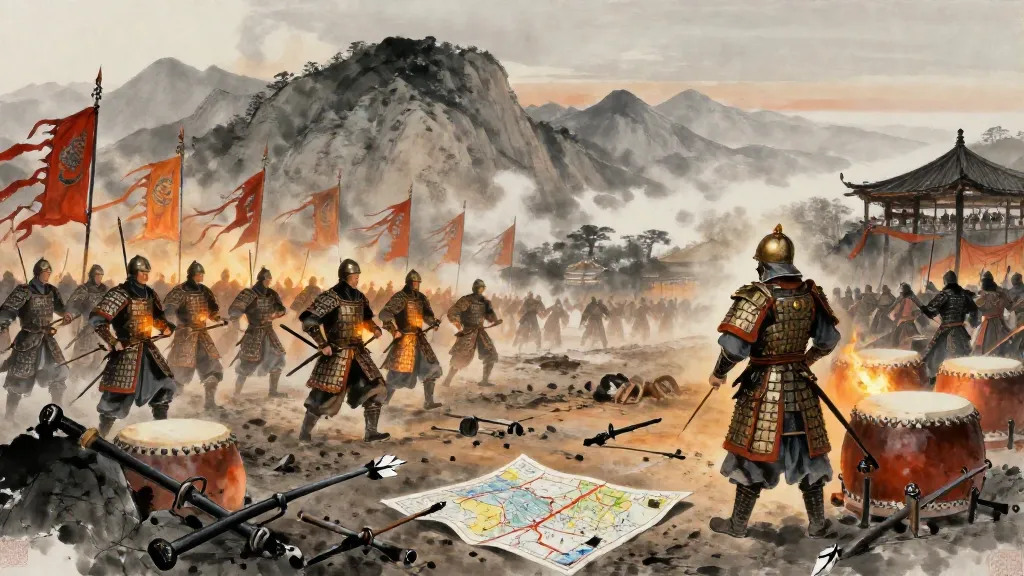
難四 (Objections and Refutations IV) — Chinese ink painting

韓非子 Hanfeizi · Chapter 39

難四

Objections and Refutations IV

View:

衛孫文子聘魯

Sun Wenzi of Wei Visits Lu

衛孫文子聘於魯,公登亦登。叔孫穆子趨進曰:"諸侯之會,寡君未嘗後衛君也。今子不後寡君一等,寡君未知所過也。子其少安。"孫子無辭,亦無悛容。穆子退而告人曰:"孫子必亡。亡臣而不後君,過而不悛,亡之本也。"

Sun Wenzi of Wei came on a diplomatic mission to Lu. When the duke ascended, Sun Wenzi also ascended. Shusun Muzi hastened forward and said: "At gatherings of the feudal lords, our lord has never been ranked behind the lord of Wei. Now you do not defer to our lord even by one degree -- our lord does not know what offense he has committed. Would you please be a little more restrained?" Sun Wenzi offered no apology, nor did he show any expression of remorse. Muzi withdrew and told others: "Sun Wenzi will surely perish. An exiled minister who does not defer to the ruler, who errs and does not repent -- this is the root of destruction."

Notes

1person孫文子Sun Wenzi

Sun Wenzi (孫文子), also known as Sun Lin (孫林父), was a powerful minister of Wei who eventually drove out Duke Xian of Wei and controlled the state's affairs.

2person叔孫穆子Shusun Muzi

Shusun Muzi (叔孫穆子), also known as Shusun Bao (叔孫豹), was a minister of Lu from the Shusun clan, one of the Three Huan families.

或曰:孫子之得失

Objection: Sun Wenzi's Gains and Losses

或曰:天子失道,諸侯伐之,故有湯、武。諸侯失道,大夫伐之,故有齊、晉。臣而伐君者必亡,則是湯、武不王,晉、齊不立也。孫子君於衛,而後不臣於魯,臣之君也。君有失也,故臣有得也。不命亡於有失之君,而命亡於有得之臣,不察。魯不得誅衛大夫,而衛君之明不知不悛之臣。孫子雖有是二也,臣以亡?其所以亡其失,所以得君也。

Someone objects: When the Son of Heaven loses the Way, the feudal lords attack him -- hence there were Tang and Wu. When feudal lords lose the Way, the great officers attack them -- hence there were Qi and Jin. If ministers who attack rulers must perish, then Tang and Wu would never have become kings, and the states of Qi and Jin would never have been established. Sun Wenzi acted as a ruler in Wei, and afterward did not behave as a subject in Lu -- he was his own lord. When the ruler errs, the minister gains. To predict destruction for a minister who has gained, rather than for a ruler who has erred, shows a lack of perception. Lu has no authority to punish Wei's great officers, and Wei's ruler lacks the discernment to recognize an unrepentant minister. Even if Sun Wenzi had both these faults, would he necessarily perish? What he loses through his faults, he gains through becoming his own lord.

Notes

1context

The first 'or says' presents a provocative amoral argument: in a world where ministers regularly overthrow rulers (as Tang overthrew Jie, and Wu overthrew Zhou), the prediction of Sun Wenzi's doom based on his lack of deference is naive. Power, not propriety, determines outcomes.

或曰:分與得之辨

Second Objection: The Distinction Between Due Share and Usurpation

或曰:臣主之施,分也。臣能奪君者,以得相也。故非其分而取者,眾之所奪也;辭其分而取者,民之所予也。是以桀索岷山之女,紂求比干之心,而天下離;湯身易名,武身受詈,而海內服;趙咺走山,田氏外仆,而齊、晉從。則湯、武之所以王,齊晉之所以立,非必以其君也,彼得之而後以君處之也。今未有其所以得,而行其所以處,是倒義而逆德也。倒義,則事之所以敗也;逆德,則怨之所以聚也。敗亡之不察,何也?

Another objects: The relationship between ruler and minister involves due shares. A minister who can seize from the ruler does so because he has won the allegiance of others. Thus one who takes what is not his due share will have it seized by the multitude; one who declines his due share will be given even more by the people. When Jie demanded the women of Min Mountain and Zhou demanded Bi Gan's heart, All-Under-Heaven abandoned them. When Tang risked his own person and changed the dynastic name, and Wu endured personal insults, the whole realm submitted. When Zhao Xuan fled to the mountains and the Tian clan served as external vassals, Qi and Jin followed them. Tang and Wu became kings, and the new Qi and Jin were established, not simply because they were rulers -- they first gained the people's support and only afterward occupied the ruler's position. Now Sun Wenzi has not yet gained what would justify his position, yet he acts as though he already occupies it. This is to invert righteousness and defy virtue. Inverting righteousness is how undertakings fail; defying virtue is how resentment accumulates. That he will perish and fall -- how can one fail to perceive this?

Notes

1person比干Bi Gan

Bi Gan (比干) was a loyal minister of the Shang dynasty whom the tyrant King Zhou had executed and his heart cut out, according to tradition.

2context

This second objection takes the opposite view from the first: Sun Wenzi will indeed perish, but not because of a lack of deference per se. Rather, he acts like a ruler without first having earned the people's support -- he has the arrogance of a usurper without the legitimacy of one.

陽虎奔齊

Yang Hu Flees to Qi

魯陽虎欲攻三桓,不克而奔齊,景公禮之。鮑文子諫曰:"不可。陽虎有寵於季氏而欲伐於季孫,貪其富也。今君富於季孫,而齊大於魯,陽虎所以盡詐也。景公乃囚陽虎。

Yang Hu of Lu wished to attack the Three Huan families. He failed and fled to Qi, where Duke Jing received him with courtesy. Bao Wenzi remonstrated: "This must not be. Yang Hu was favored by the Ji clan yet sought to attack Ji Sun -- out of greed for their wealth. Now our lord is wealthier than Ji Sun, and Qi is larger than Lu -- Yang Hu will exhaust all his treachery here." Duke Jing thereupon imprisoned Yang Hu.

Notes

1person陽虎Yang Hu

Yang Hu (陽虎, also known as Yang Huo 陽貨) was a powerful household steward of the Ji clan in Lu who attempted to seize power around 502 BC. After his failed coup, he fled to several states before eventually serving in the state of Jin.

2person鮑文子Bao Wenzi

Bao Wenzi (鮑文子), also known as Bao Guo (鮑國), was a minister of Qi known for his sagacious advice.

或曰:鮑文子之說反

Objection: Bao Wenzi's Argument Backfires

或曰:千金之家,其子不仁,人之急利甚也。桓公,五伯之上也,爭國而殺其兄,其利大也。臣主之間,非兄弟之親也。劫殺之功,制萬乘而享大利,則群臣孰非陽虎也?事以微巧成,以疏拙敗。群臣之未起難也,其備未具也。群臣皆有陽虎之心,而君上不知,是微而巧也。陽虎貪於天下,以欲攻上,是疏而拙也。不使景公加誅於拙虎,是鮑文子之說反也。臣之忠詐,在君所行也。君明而嚴,則群臣忠;君懦而暗,則群臣詐。知微之謂明,無救赦之謂嚴。不知齊之巧臣而誅魯之成亂,不亦妄乎?

Someone objects: In a family with a thousand gold in wealth, its sons become unvirtuous -- people are desperately eager for profit. Duke Huan, the foremost of the Five Hegemons, fought for the state and killed his brother -- the profit was enormous. The bond between ruler and minister is not the intimacy of brothers. When the reward of a coup is to control a state of ten thousand chariots and enjoy immense profit, which minister is not a Yang Hu at heart? Undertakings succeed through subtlety and skill, and fail through clumsiness and crudeness. That the other ministers have not yet launched rebellions simply means their preparations are not yet complete. All ministers harbor Yang Hu's ambitions while the ruler remains unaware -- this is subtle and skillful. Yang Hu was greedy before the whole world and openly sought to attack his superiors -- this was crude and clumsy. To fail to have Duke Jing execute the clumsy Yang Hu -- this is where Bao Wenzi's argument backfires. Whether ministers are loyal or treacherous depends on how the ruler acts. When the ruler is discerning and strict, ministers are loyal; when the ruler is weak and benighted, ministers are treacherous. Perceiving the subtle is called discernment; granting no pardons is called strictness. To fail to detect Qi's skillful schemers while punishing Lu's bungled rebellion -- is this not absurd?

Notes

1context

Han Fei's argument cuts to the core of Legalist political philosophy: every minister is a potential usurper. Loyalty is not an inherent quality but a product of institutional incentives. The clumsy Yang Hu should have been executed as a warning, while the real danger lies in the subtle ministers already plotting within Qi.

或曰:誅陽虎以威群臣

Second Objection: Execute Yang Hu to Intimidate All Ministers

或曰:仁貪不同心。故公子目夷辭宋,而楚商臣弒父;鄭去疾予弟,而魯桓弒兄。五伯兼併,而以桓律人,則是皆無貞廉也。且君明而嚴,則群臣忠。陽虎為亂於魯,不成而走,入齊而不誅,是承為亂也。君明則誅,知陽虎之可濟亂也,此見微之情也。語曰:"諸侯以國為親。"君嚴則陽虎之罪不可失,此無救赦之實也,則誅陽虎,所以使群臣忠也。未知齊之巧臣而廢明亂之罰,責於未然而不誅昭昭之罪,此則妄矣。今誅魯之罪亂以威群臣之有奸心者,而可以得季、孟、叔孫之親,鮑文之說,何以為反?

Another objects: Benevolence and greed do not share the same heart. Prince Mu Yi declined the throne of Song, while Shang Chen of Chu murdered his father; Qu Ji of Zheng yielded to his brother, while Duke Huan of Lu murdered his brother. The Five Hegemons all annexed territory, yet if we judge everyone by Duke Huan's standard, then none of them possessed integrity or uprightness. Moreover, when the ruler is discerning and strict, ministers are loyal. Yang Hu created disorder in Lu, failed, and fled; entering Qi without being executed is tantamount to sanctioning rebellion. A discerning ruler would execute him, knowing that Yang Hu could foment disorder -- this is the essence of perceiving the subtle. The saying goes: 'Among feudal lords, the state serves as kinship.' A strict ruler cannot let Yang Hu's crime go unpunished -- this is the substance of granting no pardons. Executing Yang Hu would make all ministers loyal. To fail to detect Qi's skillful schemers and therefore abandon the punishment for a manifest crime of rebellion, to demand accountability for what has not yet happened while refusing to punish an obvious offense -- that would truly be absurd. Executing Lu's convicted rebel to intimidate all ministers who harbor treacherous hearts would also win the goodwill of the Ji, Meng, and Shusun clans. How then does Bao Wenzi's advice backfire?

Notes

1person公子目夷Gongzi Mu Yi

Prince Mu Yi (公子目夷) of Song declined the throne in favor of his brother, an exemplar of fraternal virtue. This contrasts with Shang Chen who murdered his father King Cheng of Chu to seize the throne.

2context

This second objection takes the opposite position: Bao Wenzi was right to have Yang Hu imprisoned, but wrong not to demand execution. Punishing a notorious rebel sends a clear signal that deters all would-be usurpers. Both objections, despite disagreeing on Bao Wenzi's advice, share the Legalist premise that institutional deterrence matters more than personal character.

高渠彌弒鄭昭公

Gao Qumi Assassinates Duke Zhao of Zheng

鄭伯將以高渠彌為卿,昭公惡之,固諫不聽。及昭公即位,懼其殺己也,辛卯,弒昭公而立子亶也。君子曰:"昭公知所惡矣。"公子圉曰:"高伯其為戮乎,報惡已甚矣。"

The Earl of Zheng was about to appoint Gao Qumi as a minister. Duke Zhao opposed this and resolutely remonstrated, but was not heeded. When Duke Zhao ascended the throne, fearing that the duke would kill him, Gao Qumi on the xinmao day assassinated Duke Zhao and installed Prince Dan. A gentleman said: "Duke Zhao knew what to hate." Prince Yu said: "Will Gao not be put to death? His retaliation was too extreme."

Notes

1person高渠彌Gao Qumi

Gao Qumi (高渠彌) was a powerful figure in Zheng who assassinated Duke Zhao of Zheng (鄭昭公) in 695 BC.

2person鄭昭公Zheng Zhaogong

Duke Zhao of Zheng (鄭昭公, d. 695 BC) had opposed Gao Qumi's appointment before becoming duke, making himself Gao's enemy.

或曰:昭公報惡不甚

Objection: Duke Zhao's Retaliation Was Not Excessive Enough

或曰:公子圉之言也,不亦反乎?昭公之及於難者,報惡晚也。然則高伯之晚於死者,報惡甚也。明君不懸怒,懸怒,則臣罪輕舉以行計,則人主危。故靈台之飲,衛侯怒而不誅,故褚師作難;食黿之羹,鄭君怒而不誅,故子公殺君。君子之舉"知所惡",非甚之也,曰:知之若是其明也,而不行誅焉,以及於死。故"故所惡",以見其無權也。人君非獨不足於見難而已,或不足於斷制,今昭公見惡,稽罪而不誅,使渠彌含憎懼死以僥倖,故不免於殺,是昭公之報惡不甚也。

Someone objects: Are Prince Yu's words not backwards? Duke Zhao met with disaster because his retaliation came too late. It follows that Gao was slow to die because his retaliation was excessive. An enlightened ruler does not leave his anger hanging. When anger hangs unresolved, ministers with minor offenses act rashly out of desperation, and the ruler is endangered. Thus at the banquet of the Ling Terrace, the Marquis of Wei grew angry but did not execute the offender -- so the Chu Master launched a rebellion. At the turtle soup feast, the lord of Zheng grew angry but did not execute the offender -- so Zigong killed his ruler. When the gentleman said Duke Zhao 'knew what to hate,' this was not praise for excessive retaliation. It meant: his perception was so clear, yet he failed to carry out the execution, and thereby met his death. Therefore 'knowing what to hate' reveals his lack of decisive authority. Rulers fail not only in perceiving danger but sometimes in making decisions. Duke Zhao perceived the threat, delayed punishment without executing, and let Gao Qumi harbor resentment and fear death while hoping for luck -- hence he could not escape being killed. This shows Duke Zhao's retaliation was not excessive but insufficient.

Notes

1context

The Legalist principle of 'not leaving anger hanging' (不懸怒) is critical: if a ruler shows displeasure with a minister but does not act, the minister -- now aware of the ruler's hostility -- is driven to preemptive rebellion out of self-preservation. The ruler must either execute immediately or conceal his feelings entirely.

或曰:報惡甚者之患

Second Objection: The Peril of Excessive Retaliation

或曰:報惡甚者,大誅報小罪。大誅報小罪也者,獄之至也。獄之患,故非在所以誅也,以仇之眾也。是以晉厲公滅三郤而欒、中行作難,鄭子都殺伯咺而食鼎起禍,吳王誅子胥而越句踐成霸。則衛侯之逐,鄭靈之弒,不以褚師之不死而公父之不誅也,以未可以怒而有怒之色,未可誅而有誅之心。怒其當罪,而誅不逆人心,雖懸奚害?夫未立有罪,即位之後,宿罪而誅,齊胡之所以滅也。君行之臣,猶有後患,況為臣而行之君乎?誅既不當,而以盡為心,是與天下有仇也。則雖為戮,不亦可乎!

Another objects: Excessive retaliation means imposing great punishment for minor offenses. Imposing great punishment for minor offenses is the extreme of severity. The danger of such severity lies not in whom one punishes, but in the multitude of enemies one creates. Thus Duke Li of Jin destroyed the three Xi families, but the Luan and Zhonghang clans then launched a rebellion. Zi Du of Zheng killed Bo Xuan, but the Shiding rose up in revolt. The King of Wu executed Wu Zixu, but Goujian of Yue thereby achieved hegemony. The Marquis of Wei's expulsion and Duke Ling of Zheng's assassination occurred not because the Chu Master was left alive or because Gongfu was not executed, but because anger was shown when it was not yet warranted and thoughts of execution harbored when they were not yet justified. If anger is directed at genuine offenses and execution does not go against the people's hearts, then even leaving anger hanging does no harm. But to hold no established crime before taking the throne, then after ascending to settle old grudges with execution -- this is why Duke Hu of Qi was destroyed. When a ruler applies such measures to a minister, there are still consequences -- how much more so when a minister applies them to a ruler? When execution is unwarranted, yet one is bent on thoroughness, this is making oneself the enemy of All-Under-Heaven. Would it not then be fitting to be put to death?

Notes

1person晉厲公Jin Ligong

Duke Li of Jin (晉厲公, r. 580-573 BC) destroyed the powerful Xi (郤) clan but was subsequently overthrown and killed by the Luan (欒) and Zhonghang (中行) clans.

2person句踐Goujian

Goujian (句踐/勾踐, r. 496-465 BC) was King of Yue who endured humiliation under Wu's dominion before ultimately destroying Wu and achieving hegemony.

3context

This second objection takes a more nuanced position than the first: excessive retaliation creates more enemies than it eliminates. The key is proportionality -- punishment must match the crime and accord with the people's sense of justice. This moderates the absolutist Legalist position with practical political wisdom.

侏儒諫衛靈公

The Dwarf Admonishes Duke Ling of Wei

衛靈之時,彌子瑕有寵於衛國。侏儒有見公者曰:"臣之夢淺矣。"公曰:"奚夢?""夢見灶者,為見公也。"公怒曰:"吾聞人主者夢見日,奚為見寡人而夢見灶乎?"侏儒曰:"夫日兼照天下,一物不能當也。人君兼照一國,一人不能壅也。故將見人主而夢日也。夫灶,一人煬焉,則後人無從見矣。或者一人煬君邪?則臣雖夢灶,不亦可乎?"公曰:"善。"遂去雍鉏,退彌子瑕,而用司空狗。

In the time of Duke Ling of Wei, Mi Zixia was a favorite in the state. A dwarf came to see the duke and said: "My dream was a trivial one." The duke asked: "What did you dream?" "I dreamed of a stove, which represents seeing you, my lord." The duke was angered: "I have heard that those about to see a ruler dream of the sun. Why would you dream of a stove when coming to see me?" The dwarf said: "The sun illuminates All-Under-Heaven equally, and no single thing can block it. A ruler illuminates an entire state equally, and no single person can obstruct him. Hence one dreams of the sun before seeing a ruler. But a stove -- once one person warms himself at it, those who come after cannot get near. Could it be that someone is warming himself at my lord's fire? If so, though I dreamed of a stove, is that not fitting?" The duke said: "Well said." He thereupon dismissed Yong Chu, removed Mi Zixia, and employed Sikong Gou.

Notes

1person彌子瑕Mi Zixia

Mi Zixia (彌子瑕) was a famous favorite of Duke Ling of Wei. He appears in several Hanfeizi passages as an archetype of the court favorite who monopolizes the ruler's attention.

2person衛靈公Wei Linggong

Duke Ling of Wei (衛靈公, r. 534-493 BC) was a ruler frequently cited in early Chinese texts for both his flaws and occasional moments of good judgment.

或曰:去所愛用所賢

Objection: Removing the Favored and Employing the Worthy

或曰:侏儒善假於夢以見主道矣,然靈公不知侏儒之言也。去雍鉏,退彌子瑕,而用司空狗者,是去所愛而用所賢也。鄭子都賢慶建而壅焉,燕子噲賢子之而壅焉。夫去所愛而用所賢,未免使一人煬己也。不肖者煬主,不足以害明;今不加知而使賢者煬主己,則賢矣。

Someone objects: The dwarf was skillful in using a dream to reveal the way of rulership, but Duke Ling did not truly understand the dwarf's words. Dismissing Yong Chu, removing Mi Zixia, and employing Sikong Gou means removing the beloved and employing the worthy. But Zi Du of Zheng considered Qing Jian worthy and was obstructed by him; King Kuai of Yan considered Zizhi worthy and was obstructed by him. To remove the beloved and employ the worthy does not free one from having a single person warming himself at one's fire. When an unworthy person monopolizes the ruler, the harm to discernment is limited. But to fail to add discernment and instead let a worthy person monopolize the ruler -- that is truly dangerous.

Notes

1context

The objection makes a subtle point: replacing a favorite with a 'worthy' minister does not solve the structural problem of monopolized access. A competent monopolist is actually more dangerous than an incompetent one, because the ruler's dependence will be greater.

或曰:加知則雖煬不危

Second Objection: With Added Discernment, Even Monopoly Is Not Dangerous

或曰:屈到嗜芰,文王嗜菖蒲菹,非正味也,而二賢尚之,所味不必美。晉靈侯說參無恤,燕噲賢子之,非正士也,而二君尊之,所賢不必賢也。非賢而賢用之,與愛而用之同。賢誠賢而舉之,與用所愛異狀。故楚莊舉叔孫而霸,商辛用費仲而滅,此皆用所賢而事相反也。燕噲雖舉所賢,而同於用所愛,衛奚距然哉?則侏儒之未可見也。君壅而不知其壅也,已見之後而知其壅也,故退壅臣,是加知之也。曰"不加知而使賢者煬己則必危",而今以加知矣,則雖煬己,必不危矣。

Another objects: Qu Dao was fond of water chestnuts, and King Wen was fond of pickled calamus -- neither is a proper delicacy, yet these two worthies esteemed them. What one favors is not necessarily fine. Duke Ling of Jin admired Can Wuxu, and King Kuai of Yan esteemed Zizhi -- neither was a proper officer, yet these two rulers honored them. What one considers worthy is not necessarily worthy. Employing the unworthy whom one considers worthy is the same as employing the beloved. Employing the truly worthy is different from employing the beloved. Thus King Zhuang of Chu promoted Shusun and achieved hegemony, while Shang Xin employed Fei Zhong and perished -- both employed those they considered worthy, yet the outcomes were opposite. Though King Kuai of Yan promoted those he considered worthy, it was no different from employing the beloved. How would Wei's case be any different? The dwarf's advice is therefore not yet vindicated. When the ruler is obstructed and does not know he is obstructed, then sees the dwarf and learns he was obstructed, and thereupon removes the obstructing minister -- this is adding discernment. The argument was: 'without added discernment, letting a worthy person monopolize the ruler is surely dangerous.' But now discernment has been added. With added discernment, even if someone monopolizes access, there is surely no danger.

Notes

1person楚莊王Chu Zhuangwang

King Zhuang of Chu (楚莊王, r. 613-591 BC) was the third of the Five Hegemons (by some counts), known for his dramatic rise from apparent indolence to military dominance.

2context

The second objection resolves the tension: the issue was never the quality of the replacement but the ruler's awareness. Now that Duke Ling has gained discernment (知) through the dwarf's admonition, he can detect future monopolization -- making the specific identity of his minister less critical.

Edition & Source

Text
《韓非子》 Hanfeizi
Edition
中華古詩文古書籍網 transcription, 《四部叢刊》本
Commentary
Han Fei (韓非), Warring States period