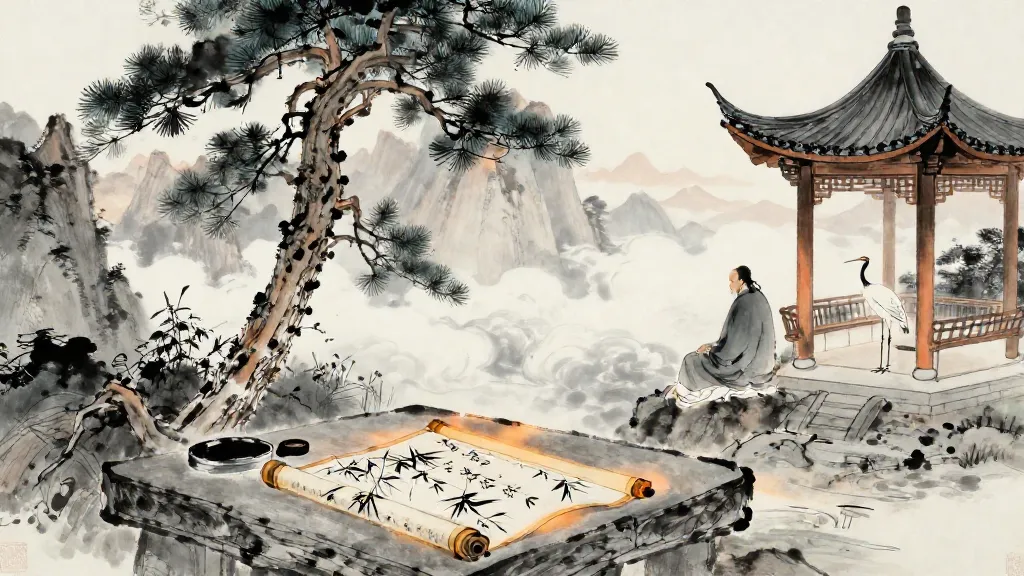
渭水遇太公
Meeting Taigong at the Wei River
文王將田,史編布卜曰:「田於渭陽,將大得焉。非龍、非螭,非虎、非羆,兆得公侯。天遣汝師,以之佐昌,施及三王。」文王曰:「兆致是乎?」史編曰:「編之太祖史疇,為禹占,得皋陶兆比於此。」文王乃齋三日,乘田車,駕田馬,田於渭陽,卒見太公,坐茅以漁。
King Wen was about to go hunting. The court historian Bian cast the divination and said: 'Hunt at the north bank of the Wei River, and you shall gain greatly. Not a dragon, not a hornless dragon, not a tiger, not a great bear — the omen foretells a duke or lord. Heaven sends you a teacher, who shall assist the house of Chang and extend his influence through three kings.' King Wen asked: 'Can the omen really portend this?' Historian Bian replied: 'My great ancestor, the historian Chou, divined for Yu and obtained the omen of Gao Yao, which compares to this one.' King Wen thereupon fasted for three days, mounted his hunting chariot drawn by hunting horses, and hunted at the north bank of the Wei. There he finally encountered Taigong, sitting on rushes and fishing.
Notes
King Wen of Zhou (周文王, personal name Ji Chang 姬昌, c. 1152–1056 BC) was the founding patriarch of the Zhou dynasty. Though he never lived to overthrow the Shang, his virtuous rule and recruitment of talent — especially Jiang Taigong — laid the foundation for Zhou's eventual conquest.
Jiang Taigong (姜太公), also known as Lu Shang (呂尚) or Jiang Ziya (姜子牙), was King Wen's chief strategist and the attributed author of the Liutao. He was enfeoffed as the first lord of Qi after the Zhou conquest of Shang.
Gao Yao (皋陶) was a legendary minister of the sage-emperor Shun and adviser to Yu the Great, regarded as the founder of Chinese law and justice.