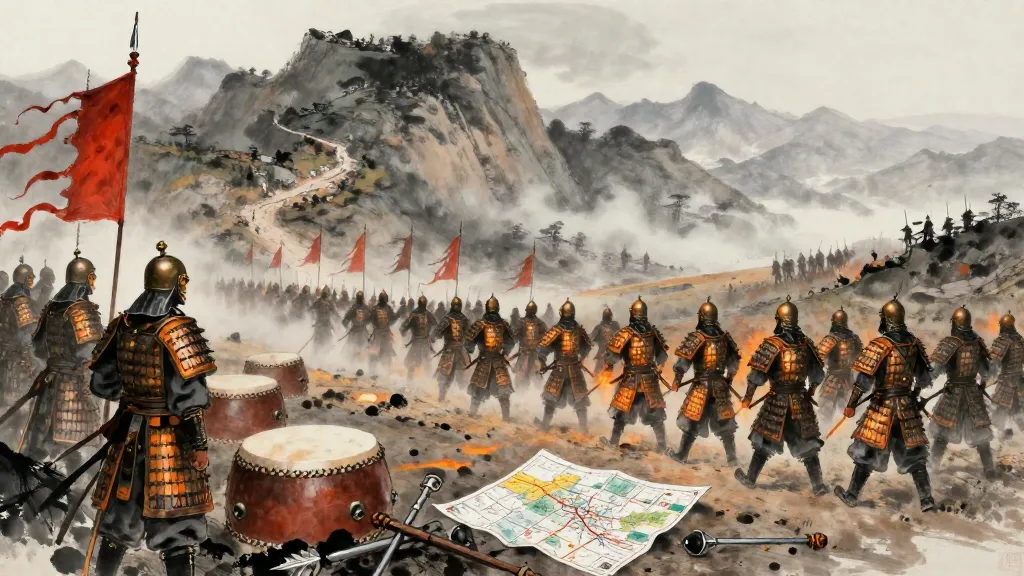
軍勢 (Army Momentum) — Chinese ink painting

六韜 Liutao · Chapter 26

軍勢

Army Momentum

View:

勢因敵動

Momentum Arises from the Enemy's Movement

武王問太公曰:「攻伐之道奈何?」太公曰:「勢因敵家之動,變生於兩陣之間,奇正發於無窮之源。故至事不語,用兵不言。且事之至者,其言不足聽也;兵之用者,其狀不足見也。忽而往,忽而來,能獨專而不制者,兵也。

King Wu asked Taigong: 'What is the way of attack and conquest?' Taigong said: 'Momentum arises from the enemy's own movement. Transformation is born between the two battle lines. The orthodox and the unorthodox spring from an inexhaustible source. Therefore the most critical affairs are never spoken of, and the employment of troops is never discussed. In the most critical affairs, words are not worth hearing. In the employment of troops, their shape is not worth seeing. They depart suddenly, they arrive suddenly. That which can act independently without being controlled — that is the army.'

善戰不待張軍

The Good Commander Does Not Wait to Deploy

「夫兵聞則議,見則圖,知則困,辨則危。故善戰者,不待張軍;善除患者,理於未生;善勝敵者,勝於無形;上戰無與戰。故爭勝於白刃之前者,非良將也;設備於已失之後者,非上聖也;智與眾同,非國師也;技與眾同,非國工也。事莫大於必克,用莫大於玄默,動莫神於不意,謀莫善於不識。夫先勝者,先見弱於敵,而後戰者也,故事半而功倍焉。

When the enemy hears of you, he deliberates. When he sees you, he plans. When he knows your situation, he is cornered. When he can analyze you, he is in danger. Therefore the good commander does not wait until the army is fully deployed. He who is good at eliminating threats addresses them before they sprout. He who is good at defeating the enemy defeats him in formlessness. The supreme battle is fought without an opponent. Therefore he who struggles for victory at the point of clashing blades is not a good general. He who sets up defenses after a loss is not a supreme sage. He whose wisdom is the same as the crowd is not a teacher of the nation. He whose skill is the same as the crowd is not a master craftsman of the nation. In affairs, nothing is greater than certain victory. In employment, nothing is greater than mysterious silence. In movement, nothing is more divine than the unexpected. In strategy, nothing is better than being incomprehensible. He who wins first appears weak before the enemy and fights only afterward — therefore he does half the work and achieves double the result.'

無恐懼無猶豫

Without Fear, Without Hesitation

「聖人征於天地之動,孰知其紀。循陰陽之道而從其候;當天地盈縮因以為常;物有死生,因天地之形。故曰:未見形而戰,雖眾必敗。善戰者,居之不撓,見勝則起,不勝則止。故曰:無恐懼,無猶豫。用兵之害,猶豫最大;三軍之災,莫過狐疑。善者見利不失,遇時不疑,失利後時,反受其殃。故智者從之而不釋,巧者一決而不猶豫,是以疾雷不及掩耳,迅電不及瞑目,赴之若驚,用之若狂,當之者破,近之者亡,孰能御之?

The sage takes his signs from the movements of heaven and earth — who can know his patterns? He follows the way of yin and yang and responds to its signs. He conforms to the waxing and waning of heaven and earth and makes it his constant. Things have death and life according to the forms of heaven and earth. Therefore it is said: to fight before the shape of things is visible — though your numbers be great, you will surely lose. The good commander maintains his position without wavering. When he sees victory, he rises. When he cannot win, he stops. Therefore it is said: have no fear, have no hesitation. In the employment of troops, the greatest harm is hesitation. The greatest disaster for the three armies is indecision. The skilled commander sees advantage and does not let it slip; when the moment arrives, he does not hesitate. If you lose the advantage and miss the moment, the disaster will turn upon you. Therefore the wise man pursues it without relenting, and the skilled man decides at once without wavering. Thus the crack of thunder leaves no time to cover the ears, and the flash of lightning leaves no time to close the eyes. Rush at them as if startled, employ them as if mad — those who stand against it are broken, those who approach are destroyed. Who can withstand this?'

神明之道

The Way of Spiritual Clarity

「夫將有所不言而守者,神也;有所不見而視者,明也。故知神明之道者,野無衡敵,對無立國。」武王曰:「善哉!」

A general who guards what he does not speak of — that is spiritual power. A general who perceives what he does not see — that is clarity. He who knows the way of spiritual clarity will have no equal enemy in the field, and no rival state that can stand against him.' King Wu said: 'Excellent!'

Edition & Source

Text
《六韜》 Liutao
Edition
中華古詩文古書籍網 transcription
Commentary
Traditional military commentaries