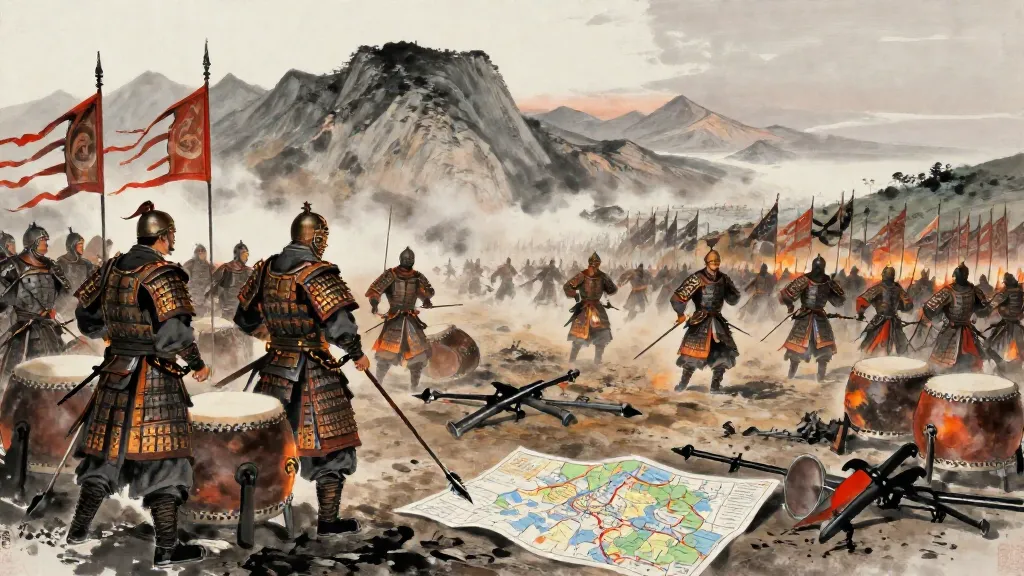
奇兵 (Unorthodox Troops) — Chinese ink painting

六韜 Liutao · Chapter 27

奇兵

Unorthodox Troops

View:

神勢之要

The Essence of Divine Momentum

武王問太公曰:「凡用兵之道,大要何如?」太公曰:「古之善戰者,非能戰於天上,非能戰於地下,其成與敗,皆由神勢,得之者昌,失之者亡。

King Wu asked Taigong: 'What are the great essentials of employing troops?' Taigong said: 'The skilled warriors of antiquity could not fight in the heavens above, nor could they fight in the earth below. Their success and failure all depended on divine momentum. Those who possessed it flourished; those who lost it perished.'

地形奇正之用

The Use of Terrain in Orthodox and Unorthodox Operations

「夫兩陣之間,出甲陳兵,縱卒亂行者,所以為變也;深草蓊翳者,所以逃遁也;溪谷險阻者,所以止車御騎也;隘塞山林者,所以少擊眾也;坳澤窈冥者,所以匿其形也;清明無隱者,所以戰勇力也;疾如流矢,如發柵者,所以破精微也;詭伏設奇,遠張誑誘者,所以破軍擒將也;四分五裂者,所以擊圓破方也;因其驚駭者,所以一擊十也;因其勞倦幕舍者,所以十擊百也;奇技者,所以越深水渡江河也;強弩長兵者,所以逾水戰也;長關遠候,暴疾謬遁者,所以降城服邑也;鼓行喧囂者,所以行奇謀也;大風甚雨者,所以搏前擒後也;偽稱敵使者,所以絕糧道也;謬號令與敵同服者,所以備走北也;戰必以義者,所以勵眾勝敵也;尊爵重賞者,所以勸用命也;嚴刑重罰者,所以進罷怠也;一喜一怒,一與一奪,一文一武,一徐一疾者,所以調和三軍、制一臣下也;處高敞者,所以警守也;保險阻者,所以為固也;山林茂穢者,所以默往來也;深溝高壘,糧多者,所以持久也。

Between two battle lines, deploying armored troops and releasing soldiers in irregular formations is used to create transformation. Dense grass and heavy thickets are used for escape and evasion. Ravines and hazardous terrain are used to halt chariots and control cavalry. Narrow passes and mountain forests are used so the few can strike the many. Sunken marshes and dark hollows are used to conceal one's form. Clear and open ground with no cover is used to fight with raw courage and strength. Striking as fast as arrows in flight, as if bursting through a stockade, is used to shatter the enemy's precision. Setting ambushes and deploying unorthodox forces, casting a wide net of deception and lures, is used to shatter armies and capture generals. Fragmenting into four or five parts is used to strike the enemy's circles and break his squares. Exploiting the enemy's panic is how one strikes ten. Exploiting the enemy's exhaustion when they camp at dusk is how ten strike a hundred. Special techniques are used to cross deep waters and ford rivers. Strong crossbows and long weapons are used to fight across water. Setting distant outposts and distant scouts, then striking suddenly and feigning retreat, is used to force cities to surrender. Marching with drums and clamor is used to execute unorthodox schemes. Great winds and heavy rains are used to strike the van and seize the rear. Impersonating enemy envoys is used to cut supply lines. Using false commands and wearing the same uniforms as the enemy is used to prepare for their rout and flight. Fighting always in the name of righteousness is used to inspire the troops and defeat the enemy. Honoring rank and bestowing heavy rewards is used to encourage men to risk their lives. Severe punishments and heavy penalties are used to drive the weary and idle forward. Alternating joy and anger, giving and taking, civil and martial, slow and fast — this is used to harmonize the three armies and unify subordinates. Occupying high and open ground is used for alert defense. Holding hazardous and obstructed positions is used for fortification. Dense mountain forests are used for secret movement. Deep moats, high ramparts, and ample provisions are used for protracted warfare.'

將者人之司命

The General Commands Men's Fates

「故曰:不知戰攻之策,不可以語敵;不能分移,不可以語奇;不能治亂,不可以語變。「故曰:將不仁,則三軍不親;將不勇,則三軍不銳;將不智,則三軍大疑;將不明,則三軍大傾;將不精微,則三軍失其機;將不常戒,則三軍失其備;將不強力,則三軍失其職。故將者,人之司命,三軍與之俱治,與之俱亂。得賢將者,兵強國昌;不得賢將者,兵弱國亡。」武王曰:「善哉!」

Therefore it is said: one who does not know the strategies of attack cannot discuss the enemy. One who cannot divide and maneuver cannot discuss the unorthodox. One who cannot bring order out of chaos cannot discuss transformation. Therefore it is said: if the general lacks humaneness, the three armies will not feel close to him. If the general lacks courage, the three armies will not be sharp. If the general lacks wisdom, the three armies will be filled with doubt. If the general lacks discernment, the three armies will be thrown into disarray. If the general is not precise and subtle, the three armies will lose their critical moments. If the general is not constantly vigilant, the three armies will lose their readiness. If the general is not vigorous and forceful, the three armies will lose their sense of duty. Therefore the general is the commander of men's fates — the three armies are well-ordered with him and fall into chaos with him. With a worthy general, the army is strong and the state flourishes. Without a worthy general, the army is weak and the state perishes.' King Wu said: 'Excellent!'

Edition & Source

Text
《六韜》 Liutao
Edition
中華古詩文古書籍網 transcription
Commentary
Traditional military commentaries