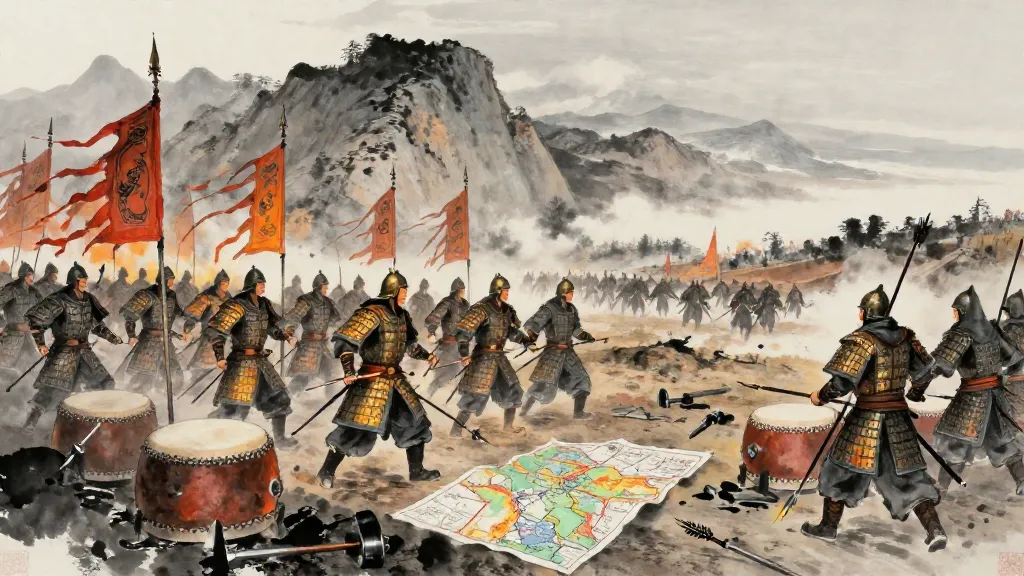
均兵 (Equalizing Troops) — Chinese ink painting

六韜 Liutao · Chapter 55

均兵

Equalizing Troops

View:

車騎步卒換算

Equivalence Ratios of Chariots, Cavalry, and Infantry

武王問太公曰:「以車與步卒戰,一車當幾步卒?幾步卒當一車?以騎與步卒戰,一騎當幾步卒?幾步卒當一騎?以車與騎戰,一車當幾騎?幾騎當一車?」太公曰:「車者,軍之羽翼也,所以陷堅陣,要強敵,遮走北也;騎者,軍之伺候也,所以踵敗軍,絕糧道,擊便寇也。故車騎不敵戰,則一騎不能當步卒一人。三軍之眾,成陣而相當,則易戰之法,一車當步卒八十人,八十人當一車;一騎當步卒八人,八人當一騎;一車當十騎,十騎當一車。險戰之法,一車當步卒四十人,四十人當一車;一騎當步卒四人,四人當一騎;一車當六騎,六騎當一車。夫車騎者,軍之武兵也,十乘敗千人,百乘敗萬人;十騎敗百人,百騎走千人,此其大數也。」

King Wu asked Taigong: "When chariots fight infantry, how many infantry equal one chariot? When cavalry fights infantry, how many infantry equal one cavalryman? When chariots fight cavalry, how many cavalry equal one chariot?" Taigong said: "Chariots are the wings of the army — they breach solid formations, intercept strong enemies, and cut off retreating forces. Cavalry are the army's scouts — they pursue defeated armies, sever supply lines, and strike raiders of opportunity. However, when chariots and cavalry are not engaged on favorable ground, a single cavalryman cannot match even one infantryman. When the three armies form battle lines and face each other on level terrain, the ratios are: one chariot equals eighty infantry, and eighty infantry equal one chariot; one cavalryman equals eight infantry, and eight infantry equal one cavalryman; one chariot equals ten cavalry, and ten cavalry equal one chariot. On difficult terrain, the ratios are: one chariot equals forty infantry, and forty infantry equal one chariot; one cavalryman equals four infantry, and four infantry equal one cavalryman; one chariot equals six cavalry, and six cavalry equal one chariot. Chariots and cavalry are the army's striking force. Ten chariots can defeat a thousand men, a hundred chariots can defeat ten thousand. Ten cavalry can defeat a hundred men, a hundred cavalry can rout a thousand. These are the general figures."

車騎編制陣法

Organization and Formation of Chariots and Cavalry

武王曰:「車騎之吏數,陣法奈何?」太公曰:「置車之吏數,五車一長,十車一吏,五十車一率,百車一將。易戰之法,五車為列,相去四十步,左右十步,隊間六十步。險戰之法,車必循道,十車為聚,二十車為屯,前後相去二十步,左右六步,隊間三十六步;五車一長,縱橫相去二里,各返故道。置騎之吏數,五騎一長,十騎一吏,百騎一率,二百騎一將。易戰之法,五騎為列,前後相去二十步,左右四步,隊間五十步。險戰之法,前後相去十步,左右二步,隊間二十五步;三十騎為一屯,六十騎為一輩,十騎一吏,縱橫相去百步,周環各復故處。」武王曰:「善哉!」

King Wu said: "What are the officer assignments and formation methods for chariots and cavalry?" Taigong said: "For chariot officer assignments: five chariots to one squad leader, ten chariots to one officer, fifty chariots to one captain, one hundred chariots to one general. On level terrain: five chariots form one line, spaced forty paces apart front to rear, ten paces left to right, with sixty paces between formations. On difficult terrain: chariots must follow the roads; ten chariots form one cluster, twenty chariots form one garrison, spaced twenty paces front to rear, six paces left to right, with thirty-six paces between formations. Each group of five chariots has one squad leader, with groups spaced two li apart in every direction, each returning along its designated route. For cavalry officer assignments: five riders to one squad leader, ten riders to one officer, one hundred riders to one captain, two hundred riders to one general. On level terrain: five riders form one line, spaced twenty paces front to rear, four paces left to right, with fifty paces between formations. On difficult terrain: ten paces front to rear, two paces left to right, with twenty-five paces between formations. Thirty riders form one garrison, sixty riders form one brigade, with one officer per ten riders, groups spaced one hundred paces apart in every direction, circling and each returning to its original position." King Wu said: "Excellent!"

Edition & Source

Text
《六韜》 Liutao
Edition
中華古詩文古書籍網 transcription
Commentary
Traditional military commentaries