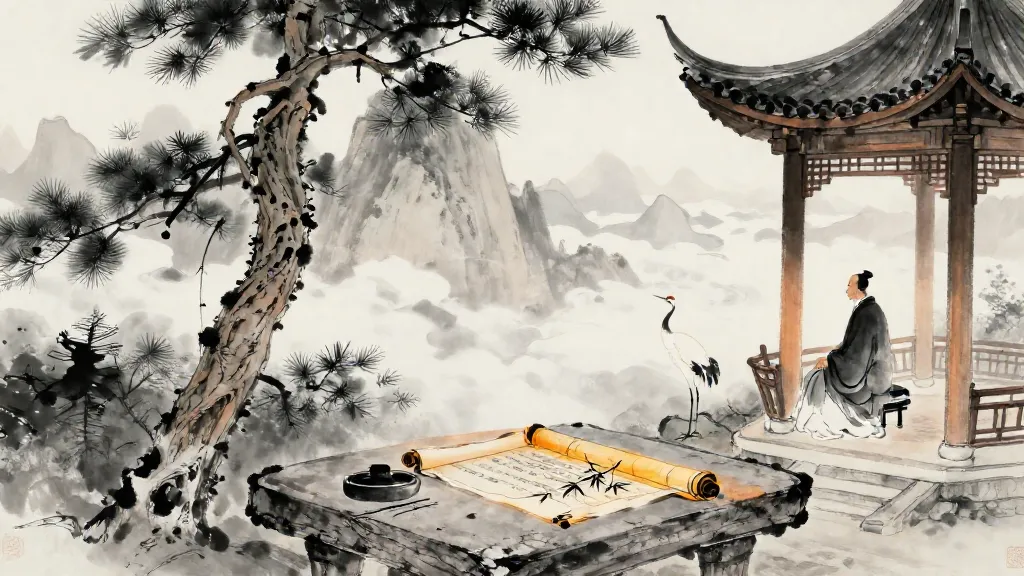
梁惠王上 (King Hui of Liang, Part I) — Chinese ink painting

孟子 Mengzi · Chapter 1

梁惠王上

King Hui of Liang, Part I

View:

孟子見梁惠王

Mencius Meets King Hui of Liang

孟子見梁惠王。王曰:“叟不遠千里而來,亦將有以利吾國乎?”

孟子對曰:“王何必曰利?亦有仁義而已矣。王曰‘何以利吾國’?大夫曰‘何以利吾家’?士庶人曰‘何以利吾身’?上下交征利而國危矣。萬乘之國弒其君者,必千乘之家;千乘之國弒其君者,必百乘之家。萬取千焉,千取百焉,不為不多矣。苟為後義而先利,不奪不饜。未有仁而遺其親者也,未有義而後其君者也。王亦曰仁義而已矣,何必曰利?”

Mencius had an audience with King Hui of Liang. The king said: “Venerable sir, you have not considered a thousand li too far to come. Surely you have something that will profit my state?”

Mencius replied: “Why must Your Majesty speak of profit? There is only benevolence and righteous conduct, nothing more. If the king says ‘How can I profit my state?’, the great officers say ‘How can I profit my house?’, and the common scholars and people say ‘How can I profit myself?’ — when those above and below compete for profit, the state is endangered. In a state of ten thousand chariots, he who murders his lord will be the head of a house of a thousand chariots; in a state of a thousand chariots, the murderer will be from a house of a hundred chariots. To take a thousand from ten thousand, or a hundred from a thousand — that is no small share. Yet if righteous conduct is put last and profit first, they will not be satisfied without seizing everything. There has never been a person of benevolence who abandoned his parents, nor a person of righteous conduct who neglected his lord. Let Your Majesty speak only of benevolence and righteous conduct — why must you speak of profit?”

Notes

1person梁惠王Liáng Huì Wáng

King Hui of Liang (梁惠王, r. 370–319 BC) was the ruler of the state of Wei, which had its capital at Daliang (modern Kaifeng). His reign saw Wei’s decline from dominant Warring States power to a secondary state.

2person孟子Mèng Zǐ

Mencius (孟子, c. 372–289 BC), personal name Meng Ke (孟軻), was the most important Confucian thinker after Confucius himself. He traveled among the Warring States rulers advocating benevolent governance and the innate goodness of human nature.

3context

This opening passage establishes the central Mencian theme: the opposition between profit (利) and benevolence-righteous conduct (仁義). Mencius argues that pursuing profit creates a downward spiral of selfishness that destabilizes the state.

王立於沼上

The King at the Pond

孟子見梁惠王,王立於沼上,顧鴻鴈麋鹿,曰:“賢者亦樂此乎?”

孟子對曰:“賢者而後樂此,不賢者雖有此,不樂也。詩云:‘經始靈台,經之營之,庶民攻之,不日成之。經始勿亟,庶民子來。王在靈囿,麀鹿攸伏,麀鹿濯濯,白鳥鶴鶴。王在靈沼,於牣魚躍。’文王以民力為台為沼。而民歡樂之,謂其台曰靈台,謂其沼曰靈沼,樂其有麋鹿魚鱉。古之人與民偕樂,故能樂也。湯誓曰:‘時日害喪?予及女偕亡。’民欲與之偕亡,雖有台池鳥獸,豈能獨樂哉?”

Mencius had an audience with King Hui of Liang. The king was standing by a pond, gazing at the geese, swans, and deer. He asked: “Do worthy men also take pleasure in such things?”

Mencius replied: “Only after one is worthy can one take pleasure in such things. Those who are not worthy, even if they possess them, cannot truly enjoy them. The Odes say: ‘He began to plan the Numinous Terrace, he laid it out and built it. The common people worked on it and completed it in less than a day. He began without haste, yet the people came as if they were his children. The king was in the Numinous Park: the does lay at rest, sleek and fat, the white birds gleamed. The king was at the Numinous Pond, and it was full of leaping fish.’ King Wen used the labor of the people to build his terrace and pond, yet the people rejoiced in it. The ancients shared their pleasures with the people, and therefore could truly enjoy them. The Oath of Tang says: ‘O sun, when will you perish? We will perish together with you!’ When the people wished to perish alongside their ruler, even if he had terraces, ponds, birds, and beasts, could he enjoy them alone?”

Notes

1context

King Wen of Zhou (周文王) is the paradigmatic virtuous ruler in Confucian thought. The contrast between King Wen, whose people voluntarily built his parks, and the tyrant Jie of Xia, whose people wished to die with the sun rather than live under his rule, illustrates Mencius’s argument that true enjoyment comes from sharing with the people.

五十步笑百步

Fifty Paces Laughing at a Hundred Paces

梁惠王曰:“寡人之於國也,盡心焉耳矣。河內凶,則移其民於河東,移其粟於河內。河東凶亦然。察鄰國之政,無如寡人之用心者。鄰國之民不加少,寡人之民不加多,何也?”

孟子對曰:“王好戰,請以戰喻。填然鼓之,兵刃既接,棄甲曳兵而走。或百步而後止,或五十步而後止。以五十步笑百步,則何如?”

曰:“不可,直不百步耳,是亦走也。”

曰:“王如知此,則無望民之多於鄰國也。不違農時,谷不可勝食也;數罟不入洿池,魚鱉不可勝食也;斧斤以時入山林,材木不可勝用也。谷與魚鱉不可勝食,材木不可勝用,是使民養生喪死無憾也。養生喪死無憾,王道之始也。五畝之宅,樹之以桑,五十者可以衣帛矣;雞豚狗彘之畜,無失其時,七十者可以食肉矣;百畝之田,勿奪其時,數口之家可以無飢矣;謹庠序之教,申之以孝悌之義,頒白者不負戴於道路矣。七十者衣帛食肉,黎民不飢不寒,然而不王者,未之有也。狗彘食人食而不知檢,塗有餓莩而不知發;人死,則曰:‘非我也,歲也。’是何異於刺人而殺之,曰:‘非我也,兵也。’王無罪歲,斯天下之民至焉。”

King Hui of Liang said: “I devote my full attention to governing my state. When there is famine in Henei, I transfer the people to Hedong and move grain to Henei. When there is famine in Hedong, I do likewise. When I examine the governance of neighboring states, none devotes as much care as I do. Yet the people of neighboring states do not decrease, and my people do not increase. Why is this?”

Mencius replied: “Your Majesty is fond of war — allow me to use a military analogy. When the drums thunder and blades clash, a soldier throws down his armor, drags his weapon, and runs. One stops after a hundred paces, another after fifty. What if the one who ran fifty paces laughed at the one who ran a hundred?”

The king said: “That would not do. He merely did not run a hundred paces — he ran all the same.”

Mencius said: “If Your Majesty understands this, then do not hope your people will be more numerous than your neighbors’. Do not interfere with the farming seasons, and there will be more grain than can be eaten. Do not cast fine-meshed nets in the ponds, and there will be more fish and turtles than can be consumed. Let axes enter the mountain forests only in the proper season, and there will be more timber than can be used. When the people can nourish the living and mourn the dead without regret — this is the beginning of the kingly way. Let mulberry trees be planted around homesteads of five mu, and those over fifty can wear silk. Let chickens, pigs, and dogs be bred without missing their seasons, and those over seventy can eat meat. Let the labor on hundred-mu farms not be disrupted, and a family of several mouths can avoid hunger. Attend carefully to education in the schools, and teach the principles of filial piety and respect for elders, and the grey-haired will not be carrying burdens on the roads. When those over seventy wear silk and eat meat, and the common people neither hunger nor freeze, yet the ruler does not become a true king — this has never happened. Now dogs and pigs eat the food of humans while no one knows to restrain them; corpses of the starved lie on the roads while no one knows to open the granaries. When people die, you say: ‘It is not my fault — it was the harvest.’ How is this different from stabbing someone to death and saying: ‘It was not I — it was the weapon’? If Your Majesty stops blaming the harvest, then the people of the whole realm will come to you.”

Notes

1context

The parable of fifty paces laughing at a hundred (五十步笑百步) became one of the most famous Chinese idioms. Mencius argues that King Hui’s minor relief measures are no different in kind from the neglect of neighboring rulers. The ‘kingly way’ (王道) requires systematic policies to ensure the people’s welfare.

率獸而食人

Leading Beasts to Devour the People

梁惠王曰:“寡人願安承教。”

孟子對曰:“殺人以梃與刃,有以異乎?”曰:“無以異也。”“以刃與政,有以異乎?”曰:“無以異也。”

曰:“庖有肥肉,廄有肥馬,民有飢色,野有餓莩,此率獸而食人也。獸相食,且人惡之。為民父母,行政不免於率獸而食人。惡在其為民父母也?仲尼曰:‘始作俑者,其無後乎!’為其象人而用之也。如之何其使斯民飢而死也?”

King Hui of Liang said: “I wish to receive your instruction with an open mind.”

Mencius replied: “Is there any difference between killing someone with a club and killing with a blade?” The king said: “There is no difference.” “Is there any difference between killing with a blade and killing with misgovernment?” The king said: “There is no difference.”

Mencius said: “In your kitchens there is rich meat; in your stables there are fat horses. Yet the people have the look of hunger, and in the wilds there are corpses of the starved. This is to lead beasts to devour human beings. Beasts devour one another, and people find even that detestable. When one who serves as parent to the people governs in a way that amounts to leading beasts to devour humans, where is the parental care in that? Confucius said: ‘May the one who first made burial figurines have no descendants!’ — because they resembled human beings and were used in place of them. How then can you cause these very people to starve to death?”

仁者無敵

The Benevolent Have No Enemies

梁惠王曰:“晉國,天下莫強焉,叟之所知也。及寡人之身,東敗於齊,長子死焉;西喪地於秦七百里;南辱於楚。寡人恥之,願比死者一灑之,如之何則可?”

孟子對曰:“地方百里而可以王。王如施仁政於民,省刑罰,薄稅斂,深耕易耨。壯者以暇日修其孝悌忠信,入以事其父兄,出以事其長上,可使制梃以撻秦楚之堅甲利兵矣。彼奪其民時,使不得耕耨以養其父母,父母凍餓,兄弟妻子離散。彼陷溺其民,王往而征之,夫誰與王敵?故曰:‘仁者無敵。’王請勿疑!”

King Hui of Liang said: “The state of Jin was the strongest under heaven — as you well know, sir. In my time, we were defeated by Qi in the east, and my eldest son died there. We lost seven hundred li of territory to Qin in the west. We were humiliated by Chu in the south. I am ashamed of this and wish to avenge the dead in one stroke. How can this be done?”

Mencius replied: “With a territory of only a hundred li square, one can become a true king. If Your Majesty practices benevolent governance toward the people — reducing punishments, lightening taxes, encouraging deep plowing and thorough weeding — then the able-bodied can use their spare days to cultivate filial piety, respect for elders, loyalty, and trustworthiness: serving their fathers and elder brothers at home, serving their superiors abroad. You could have them take up clubs and thrash the hard armor and sharp weapons of Qin and Chu. Those states seize their people’s time so they cannot plow and weed to feed their parents. Parents freeze and starve, brothers and wives are scattered. They drown and trap their own people — if Your Majesty marches to punish them, who could stand against you? Therefore it is said: ‘The benevolent have no enemies.’ I ask Your Majesty not to doubt this.”

Notes

1context

King Hui refers to Wei as ‘Jin’ (晋國) because Wei was one of the three successor states of the old Jin state. The defeats he mentions include the Battle of Maling (341 BC) against Qi, where Crown Prince Shen was killed.

不嗜殺人者能一之

He Who Takes No Pleasure in Killing Can Unify the Realm

孟子見梁襄王。出,語人曰:“望之不似人君,就之而不見所畏焉。卒然問曰:‘天下惡乎定?’吾對曰:‘定於一。’‘孰能一之?’對曰:‘不嗜殺人者能一之。’‘孰能與之?’對曰:‘天下莫不與也。王知夫苗乎?七八月之間旱,則苗槁矣。天油然作雲,沛然下雨,則苗浡然興之矣。其如是,孰能御之?今夫天下之人牧,未有不嗜殺人者也,如有不嗜殺人者,則天下之民皆引領而望之矣。誠如是也,民歸之,由水之就下,沛然誰能御之?’”

Mencius had an audience with King Xiang of Liang. Afterward, he said to others: “When I looked at him from afar, he did not resemble a ruler of men. When I drew close, I saw nothing to inspire awe. Abruptly he asked: ‘How can the realm be settled?’ I replied: ‘It will be settled through unification.’ ‘Who can unify it?’ I replied: ‘One who takes no pleasure in killing can unify it.’ ‘Who would support such a person?’ I replied: ‘Everyone in the realm would support him. Does Your Majesty understand seedlings? During a drought in the seventh or eighth month, the seedlings wither. But when the sky thickens with clouds and rain pours down, the seedlings spring up vigorously. When this happens, who can stop it? Among the shepherds of the people today, there is not one who does not take pleasure in killing. If there were one who took no pleasure in killing, all the people in the realm would crane their necks looking toward him. If it were truly so, the people would flow to him like water flowing downward — who could hold them back?’”

Notes

1person梁襄王Liáng Xiāng Wáng

King Xiang of Liang (梁襄王, r. 318–296 BC) was the son and successor of King Hui. Mencius’s unflattering private assessment suggests he found King Xiang lacking in regal bearing.

以羊易牛

Substituting a Sheep for the Ox

齊宣王問曰:“齊桓、晉文之事可得聞乎?”

孟子對曰:“仲尼之徒無道桓、文之事者,是以後世無傳焉。臣未之聞也。無以,則王乎?”

曰:“德何如,則可以王矣?”曰:“保民而王,莫之能御也。”曰:“若寡人者,可以保民乎哉?”曰:“可。”曰:“何由知吾可也?”曰:“臣聞之胡齕曰,王坐於堂上,有牽牛而過堂下者,王見之,曰:‘牛何之?’對曰:‘將以釁鐘。’王曰:‘舍之!吾不忍其觳觫,若無罪而就死地。’對曰:‘然則廢釁鐘與?’曰:‘何可廢也?以羊易之!’不識有諸?”曰:“有之。”曰:“是心足以王矣。百姓皆以王為愛也,臣固知王之不忍也。”王曰:“然。誠有百姓者。齊國雖褊小,吾何愛一牛?即不忍其觳觫,若無罪而就死地,故以羊易之也。”曰:“王無異於百姓之以王為愛也。以小易大,彼惡知之?王若隱其無罪而就死地,則牛羊何擇焉?”王笑曰:“是誠何心哉?我非愛其財。而易之以羊也,宜乎百姓之謂我愛也。”曰:“無傷也,是乃仁術也,見牛未見羊也。君子之於禽獸也,見其生,不忍見其死;聞其聲,不忍食其肉。是以君子遠庖廚也。”

King Xuan of Qi asked: “May I hear about the affairs of Duke Huan of Qi and Duke Wen of Jin?”

Mencius replied: “None among the followers of Confucius spoke of the affairs of Huan and Wen, so nothing was transmitted to later generations. Your servant has not heard of them. If I may not avoid speaking, then shall we discuss true kingship?”

The king asked: “What kind of virtue does it take to become a true king?” Mencius said: “One who protects the people and becomes king — nothing can stop him.” The king asked: “Can someone like me protect the people?” “You can.” “How do you know I can?” “Your servant heard from Hu He that Your Majesty was sitting in the upper hall when someone led an ox past below. Your Majesty saw it and asked: ‘Where is the ox going?’ The reply was: ‘It is to be used to consecrate a bell with its blood.’ Your Majesty said: ‘Spare it! I cannot bear its trembling, like an innocent creature going to its death.’ The reply was: ‘Then shall we cancel the bell consecration?’ You said: ‘How can we cancel it? Substitute a sheep.’ Is this true?” The king said: “It is.” Mencius said: “This heart is sufficient to become a true king. The common people all thought Your Majesty was being stingy, but I knew it was because you could not bear the animal’s suffering.” The king said: “Indeed. There really were such people. Though Qi is a narrow state, why would I grudge a single ox? It was that I could not bear its trembling, like an innocent going to its death, so I substituted a sheep.” Mencius said: “Your Majesty should not be surprised that the people took you for stingy. You replaced the large with the small — how could they know your reason? If Your Majesty pitied it as an innocent going to its death, then what is there to choose between ox and sheep?” The king laughed and said: “What was I really thinking? I was not grudging the cost, yet I substituted a sheep for it — no wonder the people called me stingy.” Mencius said: “There is no harm in this. It was in fact the method of benevolence — you had seen the ox but had not seen the sheep. When the noble person sees animals alive, he cannot bear to see them die; when he hears their cries, he cannot bear to eat their flesh. This is why the noble person keeps his distance from the kitchen.”

Notes

1person齊宣王Qí Xuān Wáng

King Xuan of Qi (齊宣王, r. 319–301 BC) was one of the most important rulers Mencius counseled. He maintained the Jixia Academy, the great center of intellectual life in the Warring States period.

2context

This passage is central to Mencius’s moral philosophy. He identifies the king’s spontaneous compassion for the trembling ox as evidence of innate moral feeling (不忍人之心). The key insight is that moral virtue is already present — it needs only to be extended (推) from what is near to what is far.

推恩保四海

Extending Kindness to Protect All Within the Four Seas

王說曰:“詩云:‘他人有心,予忖度之。’夫子之謂也。夫我乃行之,反而求之,不得吾心。夫子言之,於我心有戚戚焉。此心之所以合於王者,何也?”曰:“有復於王者曰:‘吾力足以舉百鈞’,而不足以舉一羽;‘明足以察秋毫之末’,而不見輿薪,則王許之乎?”曰:“否。”“今恩足以及禽獸,而功不至於百姓者,獨何與?然則一羽之不舉,為不用力焉;輿薪之不見,為不用明焉,百姓之不見保,為不用恩焉。故王之不王,不為也,非不能也。”曰:“不為者與不能者之形何以異?”曰:“挾太山以超北海,語人曰‘我不能’,是誠不能也。為長者折枝,語人曰‘我不能’,是不為也,非不能也。故王之不王,非挾太山以超北海之類也;王之不王,是折枝之類也。老吾老,以及人之老;幼吾幼,以及人之幼。天下可運於掌。詩云:‘刑於寡妻,至於兄弟,以御於家邦。’言舉斯心加諸彼而已。故推恩足以保四海,不推恩無以保妻子。古之人所以大過人者無他焉,善推其所為而已矣。今恩足以及禽獸,而功不至於百姓者,獨何與?權,然後知輕重;度,然後知長短。物皆然,心為甚。王請度之!抑王興甲兵,危士臣,構怨於諸侯,然後快於心與?”王曰:“否。吾何快於是?將以求吾所大欲也。”

曰:“王之所大欲可得聞與?”王笑而不言。曰:“為肥甘不足於口與?輕暖不足於體與?抑為采色不足視於目與?聲音不足聽於耳與?便嬖不足使令於前與?王之諸臣皆足以供之,而王豈為是哉?”曰:“否。吾不為是也。”曰:“然則王之所大欲可知已。欲闢土地,朝秦楚,蒞中國而撫四夷也。以若所為求若所欲,猶緣木而求魚也。”曰:“若是其甚與?”曰:“殆有甚焉。緣木求魚,雖不得魚,無後災。以若所為,求若所欲,盡心力而為之,後必有災。”曰:“可得聞與?”曰:“鄒人與楚人戰,則王以為孰勝?”曰:“楚人勝。”曰:“然則小固不可以敵大,寡固不可以敵眾,弱固不可以敵強。海內之地方千里者九,齊集有其一。以一服八,何以異於鄒敵楚哉?蓋亦反其本矣。今王發政施仁,使天下仕者皆欲立於王之朝,耕者皆欲耕於王之野,商賈皆欲藏於王之市,行旅皆欲出於王之塗,天下之欲疾其君者皆欲赴愬於王。其若是,孰能御之?”

王曰:“吾惛,不能進於是矣。願夫子輔吾志,明以教我。我雖不敏,請嘗試之。”曰:“無恆產而有恆心者,惟士為能。若民,則無恆產,因無恆心。苟無恆心,放辟,邪侈,無不為已。及陷於罪,然後從而刑之,是罔民也。焉有仁人在位,罔民而可為也?是故明君制民之產,必使仰足以事父母,俯足以畜妻子,樂歲終身飽,凶年免於死亡。然後驅而之善,故民之從之也輕。今也制民之產,仰不足以事父母,俯不足以畜妻子,樂歲終身苦,凶年不免於死亡。此惟救死而恐不贍,奚暇治禮義哉?王欲行之,則盍反其本矣。五畝之宅,樹之以桑,五十者可以衣帛矣;雞豚狗彘之畜,無失其時,七十者可以食肉矣;百畝之田,勿奪其時,八口之家可以無飢矣;謹庠序之教,申之以孝悌之義,頒白者不負戴於道路矣。老者衣帛食肉,黎民不飢不寒,然而不王者,未之有也。”

The king was pleased and said: “The Odes say: ‘Others have intentions — I measure and fathom them.’ This describes you, Master. I performed the deed myself, and when I reflected and searched for my motive, I could not find my own heart. When you spoke of it, something stirred deeply within me. Why does this heart of mine accord with true kingship?”

Mencius said: “Suppose someone reported to Your Majesty: ‘My strength is sufficient to lift three thousand jin, but not a single feather; my eyesight is sharp enough to discern the tip of an autumn hair, but I cannot see a cartload of firewood.’ Would Your Majesty accept this?” “No.” “Now your kindness reaches animals, yet its benefits do not extend to the common people — why? A feather not lifted is because strength is not applied; firewood not seen is because sight is not used; the people not protected is because kindness is not extended. Therefore Your Majesty’s failure to become a true king is a matter of not doing, not of inability.”

“How does not-doing differ from inability?”

“To tuck Mount Tai under your arm and leap over the North Sea — if you say ‘I cannot,’ that is truly inability. To bend a branch for an elder — if you say ‘I cannot,’ that is not-doing, not inability. Your Majesty’s failure to become king is of the branch-bending variety, not the Mount Tai variety. Treat your own elders as elders, and extend this to the elders of others; treat your own young as young, and extend this to the young of others — then the realm can be turned in the palm of your hand. The Odes say: ‘He set the example for his wife, extended it to his brothers, and thereby governed the clan and state.’ This means nothing more than taking this heart and applying it to others. Extending kindness is sufficient to protect all within the four seas; not extending kindness leaves one unable to protect even wife and children. The reason the ancients so greatly surpassed others was nothing else — they were simply good at extending what they did. Now your kindness reaches animals, yet its benefits do not extend to the people — why? Weigh, and then you know light from heavy; measure, and then you know long from short. All things are thus, and the heart most of all. I ask Your Majesty to measure it. Or would Your Majesty rather raise armies, endanger ministers, and build resentment among the states — is that what satisfies your heart?”

The king said: “No. How would that satisfy me? I do it to pursue my greatest desire.”

“May I hear Your Majesty’s greatest desire?” The king laughed and did not speak. “Is it that rich foods are not enough for your mouth? Light clothing not enough for your body? Beautiful colors not enough for your eyes? Music not enough for your ears? Favorites not enough to attend you? Your ministers can supply all these.” The king said: “No. It is not for these.” “Then Your Majesty’s greatest desire can be known. You wish to expand your territory, make Qin and Chu pay court, preside over the Central States, and subdue the barbarians on all sides. To pursue what you desire by the means you employ is like climbing a tree to seek fish.”

“Is it truly that extreme?” “Perhaps worse. Climbing a tree to seek fish — though you get no fish, there is no disaster afterward. To pursue what you desire by these means, exerting all your strength — there will certainly be disaster.” “May I hear why?” “If the people of Zou fought Chu, who would win?” “Chu.” “So the small cannot oppose the great, the few cannot oppose the many, the weak cannot oppose the strong. Within the seas there are nine territories of a thousand li, and Qi has but one. To use one to subdue eight — how is this different from Zou opposing Chu? Return to the fundamentals. If Your Majesty now issues benevolent governance, causing all the officials in the realm to wish to stand in your court, all the farmers to plow your fields, all the merchants to store goods in your markets, all the travelers to use your roads, and all who are aggrieved by their own rulers to come and appeal to you — who could withstand this?”

The king said: “I am dim-witted and cannot advance to this level. I hope you will assist my aspirations and teach me clearly. Though I am not clever, let me try.”

Mencius said: “Only scholars can maintain a constant heart without constant livelihood. As for the common people, without constant livelihood they lack a constant heart. Without a constant heart, there is no dissipation, depravity, or excess they will not commit. When they fall into crime, to punish them afterward — that is to trap the people. How can a benevolent ruler trap the people? Therefore a wise ruler regulates the people’s livelihood so that above they have enough to serve their parents, and below enough to support wife and children; in good years they are always well-fed, and in bad years they escape death. Only then does he guide them toward goodness, and the people follow easily. Now the people’s livelihood is regulated so that above they cannot serve their parents, below they cannot support wife and children; in good years they toil all their lives, and in bad years they cannot escape death. They merely struggle to survive — what leisure have they for propriety and righteous conduct? If Your Majesty wishes to act, then return to the fundamentals. Plant mulberry trees around five-mu homesteads, and those over fifty can wear silk. Raise chickens, pigs, and dogs without missing their seasons, and those over seventy can eat meat. Do not disrupt the labor on hundred-mu farms, and a family of eight can avoid hunger. Attend carefully to education in the schools, and extend the principles of filial piety and respect for elders, and the grey-haired will not carry burdens on the roads. When the elderly wear silk and eat meat, and the common people neither hunger nor freeze, yet the ruler does not become a true king — this has never happened.”
Notes

1context

This is the longest and most important passage in the chapter, containing several foundational Mencian concepts: the distinction between not-doing and inability (不為/不能); extending kindness from near to far (推恩); ‘Treat your own elders as elders, and extend this to the elders of others’ (老吾老以及人之老); ‘climbing a tree to seek fish’ (緣木求魚); and ‘constant livelihood produces constant hearts’ (有恆產者有恆心).

Edition & Source

Text
《孟子》 Mengzi
Edition
《四部叢刊》本
Commentary
Traditional Confucian commentaries