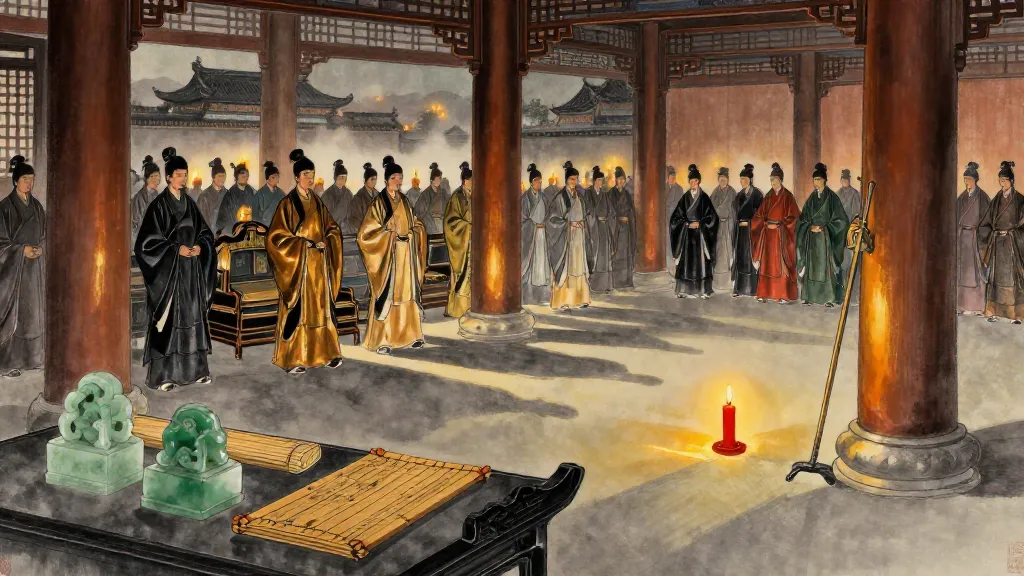
梁惠王下 (King Hui of Liang, Part II) — Chinese ink painting

孟子 Mengzi · Chapter 2

梁惠王下

King Hui of Liang, Part II

View:

與民同樂

Sharing Joy with the People

莊暴見孟子,曰:“暴見於王,王語暴以好樂,暴未有以對也。”曰:“好樂何如?”孟子曰:“王之好樂甚,則齊國其庶幾乎!”

他日見於王曰:“王嘗語莊子以好樂,有諸?”王變乎色,曰:“寡人非能好先王之樂也,直好世俗之樂耳。”曰:“王之好樂甚,則齊其庶幾乎!今之樂猶古之樂也。”曰:“可得聞與?”曰:“獨樂樂,與人樂樂,孰樂?”曰:“不若與人。”曰:“與少樂樂,與眾樂樂,孰樂?”曰:“不若與眾。”

“臣請為王言樂:今王鼓樂於此,百姓聞王鐘鼓之聲,管籥之音,舉疾首蹙頞而相告曰:‘吾王之好鼓樂,夫何使我至於此極也?父子不相見,兄弟妻子離散。’今王田獵於此,百姓聞王車馬之音,見羽旄之美,舉疾首蹙頞而相告曰:‘吾王之好田獵,夫何使我至於此極也?父子不相見,兄弟妻子離散。’此無他,不與民同樂也。

今王鼓樂於此,百姓聞王鐘鼓之聲,管籥之音,舉欣欣然有喜色而相告曰:‘吾王庶幾無疾病與?何以能鼓樂也?’今王田獵於此,百姓聞王車馬之音,見羽旄之美,舉欣欣然有喜色而相告曰‘吾王庶幾無疾病與?何以能田獵也?’此無他,與民同樂也。今王與百姓同樂,則王矣。”

Zhuang Bao visited Mencius and said: “I had an audience with the king. He told me he loves music, and I had nothing to reply.” Mencius asked: “What of loving music?” Mencius said: “If the king’s love of music were great enough, then Qi would be close to well-governed!”

Another day, in audience with the king, Mencius said: “Your Majesty once told Zhuang Bao you love music — is this true?” The king’s color changed and he said: “I am unable to love the music of the ancient kings; I merely love popular music.” Mencius said: “If Your Majesty’s love of music were great enough, then Qi would be close to well-governed! The music of today is no different from the music of antiquity.” The king asked: “May I hear about this?” Mencius said: “Which is more enjoyable — to enjoy music alone, or to enjoy it with others?” “Better with others.” “Which is more enjoyable — to enjoy it with a few, or with the many?” “Better with the many.”

“Allow me to speak to Your Majesty about music. Suppose Your Majesty is making music here, and the people hear the sound of your bells and drums, the notes of your flutes and pipes. They all clutch their aching heads and furrow their brows, telling each other: ‘Our king’s love of music has brought us to this extremity! Fathers and sons cannot see each other; brothers and wives are scattered.’ Suppose Your Majesty is hunting here, and the people hear the sound of your horses and chariots and see the beauty of your plumes and banners. They all clutch their aching heads and furrow their brows, telling each other: ‘Our king’s love of hunting has brought us to this extremity!’ There is no other reason for this — it is because you do not share your pleasures with the people.

Now suppose Your Majesty is making music here, and the people hear the sound of your bells and drums, the notes of your flutes and pipes. They all beam with joy and tell each other: ‘Our king must be in good health! Otherwise how could he be making music?’ Suppose Your Majesty is hunting here, and the people hear the sound of your horses and chariots and see the beauty of your plumes and banners. They all beam with joy and tell each other: ‘Our king must be in good health! Otherwise how could he be hunting?’ There is no other reason — it is because you share your pleasures with the people. If Your Majesty now shares his pleasures with the people, you will be a true king.”

Notes

1person莊暴Zhuāng Bào

Zhuang Bao (莊暴) was an official of Qi who served as an intermediary between Mencius and King Xuan.

文王之囿

King Wen's Park

齊宣王問曰:“文王之囿方七十里,有諸?”孟子對曰:“於傳有之。”曰:“若是其大乎?”曰:“民猶以為小也。”曰:“寡人之囿方四十里,民猶以為大,何也?”曰:“文王之囿方七十里,芻蕘者往焉,雉兔者往焉,與民同之。民以為小,不亦宜乎?臣始至於境,問國之大禁,然後敢入。臣聞郊關之內有囿方四十里,殺其麋鹿者如殺人之罪。則是方四十里,為阱於國中。民以為大,不亦宜乎?”

King Xuan of Qi asked: “Is it true that King Wen’s park was seventy li square?” Mencius replied: “So it is recorded.” The king said: “Was it truly that large?” Mencius said: “The people still considered it small.” The king said: “My park is only forty li square, yet the people consider it large. Why is this?” Mencius said: “King Wen’s park was seventy li square. Those who gathered grass and firewood went there; those who hunted pheasants and rabbits went there — he shared it with the people. That the people considered it small — was that not natural? When I first arrived at the border, I asked about the kingdom’s greatest prohibitions before daring to enter. I heard that within the suburbs there is a park of forty li square, and anyone who kills its deer is punished as if for murder. Then this forty-li park is like a pit trap in the middle of the state. That the people consider it large — is that not natural?”

交鄰國有道

The Way of Dealing with Neighboring States

齊宣王問曰:“交鄰國有道乎?”

孟子對曰:“有。惟仁者為能以大事小,是故湯事葛,文王事昆夷;惟智者為能以小事大,故大王事獯鬻,句踐事吳。以大事小者,樂天者也;以小事大者,畏天者也。樂天者保天下,畏天者保其國。詩云:‘畏天之威,於時保之。’”

王曰:“大哉言矣!寡人有疾,寡人好勇。”

對曰:“王請無好小勇。夫撫劍疾視曰,‘彼惡敢當我哉’!此匹夫之勇,敵一人者也。王請大之!詩云:‘王赫斯怒,爰整其旅,以遏徂莒,以篤周祜,以對於天下。’此文王之勇也。文王一怒而安天下之民。書曰:‘天降下民,作之君,作之師。惟曰其助上帝,寵之四方。有罪無罪,惟我在,天下曷敢有越厥志?’一人衡行於天下,武王恥之。此武王之勇也。而武王亦一怒而安天下之民。今王亦一怒而安天下之民,民惟恐王之不好勇也。”

King Xuan of Qi asked: “Is there a proper way to deal with neighboring states?”

Mencius replied: “There is. Only the benevolent can serve the small with the great — thus Tang served Ge, and King Wen served the Kunyi. Only the wise can serve the great with the small — thus King Tai served the Xunyu, and Goujian served Wu. He who serves the small with the great delights in heaven; he who serves the great with the small stands in awe of heaven. He who delights in heaven protects the whole realm; he who stands in awe of heaven protects his own state. The Odes say: ‘Standing in awe of heaven’s might, thereby he preserved it.’”

The king said: “Grand words! But I have a weakness — I am fond of bravery.”

Mencius replied: “I ask Your Majesty not to be fond of petty bravery. To clasp one’s sword, glare, and say ‘How dare he stand against me!’ — this is the bravery of a common man, sufficient to face a single opponent. I ask Your Majesty to enlarge it! The Odes say: ‘The king blazed with anger, marshaled his forces, halted the march toward Ju, strengthened Zhou’s good fortune, and answered to all under heaven.’ This was the bravery of King Wen. King Wen, with a single burst of anger, brought peace to the people of the realm. The Documents say: ‘Heaven sent down the people, made rulers for them, made teachers for them, saying: Help the Supreme Deity and cherish the people of the four quarters. Whether guilty or innocent, there is only I — who in all the realm dares exceed their proper place?’ When one man rampaged across the realm, King Wu considered it a disgrace. This was King Wu’s bravery. King Wu also, with a single burst of anger, brought peace to the people. If Your Majesty were to bring peace to the people with a single burst of anger, the people would only fear that Your Majesty is not fond enough of bravery.”

Notes

1person句踐Gōu Jiàn

Goujian (句踐, r. 496–465 BC) was the king of Yue who famously endured years of humiliation under Wu before ultimately destroying it — a paradigm of patience and revenge in Chinese history.

樂以天下

Joy Shared with the Realm

齊宣王見孟子於雪宮。王曰:“賢者亦有此樂乎?”

孟子對曰:“有。人不得,則非其上矣。不得而非其上者,非也;為民上而不與民同樂者,亦非也。樂民之樂者,民亦樂其樂;憂民之憂者,民亦憂其憂。樂以天下,憂以天下,然而不王者,未之有也。昔者齊景公問於晏子曰:‘吾欲觀於轉附、朝舞,遵海而南,放於琅邪。吾何修而可以比於先王觀也?’晏子對曰:‘善哉問也!天子適諸侯曰巡狩,巡狩者巡所守也;諸侯朝於天子曰述職,述職者述所職也。無非事者。春省耕而補不足,秋省斂而助不給。夏諺曰:“吾王不游,吾何以休?吾王不豫,吾何以助?一游一豫,為諸侯度。”今也不然:師行而糧食,飢者弗食,勞者弗息。睊睊胥讒,民乃作慝。方命虐民,飲食若流。流連荒亡,為諸侯憂。從流下而忘反謂之流,從流上而忘反謂之連,從獸無厭謂之荒,樂酒無厭謂之亡。先王無流連之樂,荒亡之行。惟君所行也。’景公說,大戒於國,出舍於郊。於是始興發補不足。召大師曰:‘為我作君臣相說之樂!’蓋徵招角招是也。其詩曰:‘畜君何尤?’畜君者,好君也。”

King Xuan of Qi received Mencius at the Snow Palace. The king asked: “Do worthy men also have such pleasures?”

Mencius replied: “They do. When people cannot enjoy them, they blame their superiors. To blame one’s superiors for not obtaining pleasures is wrong; but for a ruler not to share his pleasures with the people is also wrong. He who takes joy in the people’s joy — the people also take joy in his joy. He who worries about the people’s worries — the people also worry about his worries. To rejoice with the whole realm, to grieve with the whole realm — one who does this and does not become a true king, that has never happened.

In the past, Duke Jing of Qi asked Yanzi: ‘I wish to visit Zhuanfu and Chaowu, travel south along the sea, and go as far as Langya. How should I arrange this to compare with the tours of the ancient kings?’ Yanzi replied: ‘What an excellent question! When the Son of Heaven visits the feudal lords, it is called a tour of inspection — inspecting what they guard. When the feudal lords attend the Son of Heaven, it is called reporting duties — reporting what they administer. None of this is without purpose. In spring, inspecting the plowing and supplementing shortages; in autumn, inspecting the harvest and aiding the insufficient. A Xia proverb says: If our king does not tour, how shall we rest? If our king does not travel, how shall we be helped? Each tour and travel sets the standard for the lords. Now it is not so: armies march and consume provisions; the hungry are not fed, the weary get no rest. People glare and slander each other, and the populace turns to wickedness. Defying heaven’s mandate and oppressing the people, consuming food and drink like a torrent — this brings worry to the lords. Drifting downstream and forgetting to return is called dissipation; going upstream and forgetting to return is called indulgence; hunting beasts without satiety is called recklessness; drinking wine without satiety is called debauchery. The ancient kings had neither the pleasures of dissipation and indulgence nor the conduct of recklessness and debauchery. It is for Your Lordship to choose.’ Duke Jing was pleased, made great preparations throughout the state, and went out to camp in the suburbs. Then he began to distribute relief to the needy. He summoned the Grand Music Master and said: ‘Compose music celebrating the harmony between ruler and minister!’ This was the Zhizhao and Jiaozhao. Its lyrics say: ‘What fault is there in restraining the ruler?’ To restrain the ruler is to love the ruler.”

Notes

1person晏子Yàn Zǐ

Yanzi (晏子, c. 578–500 BC) was Yan Ying, the famous chief minister of Qi under Duke Jing, renowned for his frugality and moral courage.

王政可得聞與

May I Hear About Kingly Government?

齊宣王問曰:“人皆謂我毀明堂。毀諸?已乎?”

孟子對曰:“夫明堂者,王者之堂也。王欲行王政,則勿毀之矣。”王曰:“王政可得聞與?”

對曰:“昔者文王之治岐也,耕者九一,仕者世祿,關市譏而不征,澤梁無禁,罪人不孥。老而無妻曰鰥。老而無夫曰寡。老而無子曰獨。幼而無父曰孤。此四者,天下之窮民而無告者。文王發政施仁,必先斯四者。詩云:‘哿矣富人,哀此煢獨。’”王曰:“善哉言乎!”

曰:“王如善之,則何為不行?”王曰:“寡人有疾,寡人好貨。”

對曰:“昔者公劉好貨;詩云:‘乃積乃倉,乃裹餱糧,於橐於囊。思戢用光。弓矢斯張,干戈戚揚,爰方啟行。’故居者有積倉,行者有裹糧也,然後可以爰方啟行。王如好貨,與百姓同之,於王何有?”王曰:“寡人有疾,寡人好色。”

對曰:“昔者大王好色,愛厥妃。詩云:‘古公亶父,來朝走馬,率西水滸,至於岐下。爰及姜女,聿來胥宇。’當是時也,內無怨女,外無曠夫。王如好色,與百姓同之,於王何有?”

King Xuan of Qi asked: “Everyone tells me to demolish the Hall of Light. Should I demolish it or not?”

Mencius replied: “The Hall of Light is the hall of a true king. If Your Majesty wishes to practice kingly government, then do not demolish it.” The king asked: “May I hear about kingly government?”

Mencius replied: “In the past, when King Wen governed Qi, farmers paid one-ninth in tax, officials received hereditary salaries, markets were inspected but not taxed, fishing weirs had no restrictions, and criminals were not punished by enslaving their families. The aged without wives are called widowers. The aged without husbands are called widows. The aged without children are called childless. The young without fathers are called orphans. These four — the most destitute people in the realm with none to turn to. When King Wen issued governance and practiced benevolence, he always attended first to these four. The Odes say: ‘How fortunate are the wealthy! Pity these lonely and desolate.’”

The king said: “Well spoken!”

Mencius said: “If Your Majesty approves of this, why not put it into practice?” The king said: “I have a weakness — I love wealth.”

Mencius replied: “In the past, Gongliu loved wealth. The Odes say: ‘He piled up stores and filled his granaries, he packed dried provisions, in bags and sacks. He gathered his people and displayed his glory. Bows and arrows were strung, shields, halberds, and axes raised, and then he set out on his march.’ Thus those who stayed had full granaries, and those who marched had packed provisions — only then could he set out. If Your Majesty loves wealth but shares it with the people, what obstacle is there to kingship?” The king said: “I have a weakness — I love beauty.”

Mencius replied: “In the past, King Tai loved beauty and cherished his consort. The Odes say: ‘Gugong Danfu came riding his horses at dawn, following the western waterside, arriving at the foot of Mount Qi. Together with Lady Jiang, they came to survey their new home.’ At that time, there were no resentful unmarried women within, and no frustrated bachelors without. If Your Majesty loves beauty but shares this concern with the people, what obstacle is there to kingship?”

Notes

1context

The Hall of Light (明堂) was a ritual structure associated with the governance of the ancient Zhou kings. Mencius uses the king’s successive confessions of weakness — love of wealth, love of beauty — to demonstrate that any desire, if shared with the people, can accord with the kingly way.

王顧左右而言他

The King Looked Left and Right and Changed the Subject

孟子謂齊宣王曰:“王之臣有托其妻子於其友,而之楚游者。比其反也,則凍餒其妻子,則如之何?”王曰:“棄之。”

曰:“士師不能治士,則如之何?”王曰:“已之。”

曰:“四境之內不治,則如之何?”王顧左右而言他。

Mencius said to King Xuan of Qi: “If one of Your Majesty’s ministers entrusted his wife and children to a friend and traveled to Chu, and upon returning found his wife and children cold and starving, what should be done?” The king said: “Cast off the friend.”

Mencius said: “If the Chief of Justice cannot control his subordinates, what should be done?” The king said: “Dismiss him.”

Mencius said: “If the territory within the four borders is not well governed, what should be done?” The king looked left and right and changed the subject.

Notes

1context

This is one of the most famous passages in the Mengzi. Through a series of analogies that trap the king into logical conclusions, Mencius leads him to the inescapable implication that the king himself is responsible for misgovernment. The expression ‘looked left and right and changed the subject’ (王顧左右而言他) became a proverbial Chinese idiom for evasiveness.

國人皆曰賢

When the People of the Entire State Call Someone Worthy

孟子見齊宣王曰:“所謂故國者,非謂有喬木之謂也,有世臣之謂也。王無親臣矣,昔者所進,今日不知其亡也。”

王曰:“吾何以識其不才而舍之?”

曰:“國君進賢,如不得已,將使卑逾尊,疏逾戚,可不慎與?左右皆曰賢,未可也;諸大夫皆曰賢,未可也;國人皆曰賢,然後察之;見賢焉,然後用之。左右皆曰不可,勿聽;諸大夫皆曰不可,勿聽;國人皆曰不可,然後察之;見不可焉,然後去之。左右皆曰可殺,勿聽;諸大夫皆曰可殺,勿聽;國人皆曰可殺,然後察之;見可殺焉,然後殺之。故曰,國人殺之也。如此,然後可以為民父母。”

Mencius said to King Xuan of Qi: “What is meant by ‘an ancient state’ is not one that has tall trees, but one that has hereditary ministers. Your Majesty has no trusted ministers — those you advanced in the past have disappeared today without your even knowing.”

The king asked: “How can I identify those who lack talent and dismiss them?”

Mencius said: “When a ruler advances the worthy, since he will be placing the low above the high and the distant above the close, must he not be cautious? When those at your side all say someone is worthy, that is not enough. When all the great officers say he is worthy, that is not enough. When the people of the entire state say he is worthy, then examine him; if you find him worthy, then employ him. When those at your side all say someone should be dismissed, do not listen. When all the great officers say he should be dismissed, do not listen. When the people of the entire state say he should be dismissed, then examine the matter; if you find he should be dismissed, then dismiss him. When those at your side all say someone deserves death, do not listen. When all the great officers say he deserves death, do not listen. When the people of the entire state say he deserves death, then examine the matter; if you find he deserves death, then execute him. Thus it is said: the people of the state executed him. Only in this way can one be a true parent to the people.”

聞誅一夫紂

I Have Heard of the Execution of the Tyrant Zhou

齊宣王問曰:“湯放桀,武王伐紂,有諸?”孟子對曰:“於傳有之。”曰:“臣弒其君,可乎?”曰:“賊仁者謂之賊,賊義者謂之殘,殘賊之人謂之一夫。聞誅一夫紂矣,未聞弒君也。”

King Xuan of Qi asked: “Is it true that Tang banished Jie and King Wu attacked Zhou of Shang?” Mencius replied: “So it is recorded.” The king said: “Is it permissible for a minister to murder his lord?” Mencius said: “One who mutilates benevolence is called a mutilator; one who cripples righteous conduct is called a crippler. A man who is both mutilator and crippler is called a mere fellow. I have heard of the execution of the mere fellow Zhou, but I have never heard of the murder of a lord.”

Notes

1context

This passage is one of the most politically radical in the entire Confucian canon. Mencius argues that a ruler who destroys benevolence and righteous conduct forfeits the title of ‘ruler’ and becomes merely a ‘fellow’ (一夫) whom it is legitimate to overthrow. This doctrine of justified revolution was deeply influential but also controversial throughout Chinese history.

姑舍女所學

Set Aside What You Have Learned

孟子見齊宣王曰:“為巨室,則必使工師求大木。工師得大木。則王喜,以為能勝其任也。匠人斲而小之,則王怒,以為不勝其任矣。夫人幼而學之,壯而欲行之。王曰‘姑舍女所學而從我’,則何如?今有璞玉於此,雖萬鎰,必使玉人雕琢之。至於治國家,則曰‘姑舍女所學而從我’,則何以異於教玉人雕琢玉哉?”

Mencius said to King Xuan of Qi: “When building a great mansion, you must have the master builder seek large timbers. When the master builder finds them, the king is pleased, thinking the builder is equal to the task. If the carpenters then whittle the timber down to a small size, the king is angry, thinking they are not equal to the task. Now, a man studies something from youth and wishes to practice it in his prime. If the king says ‘Set aside what you have learned and follow my orders’ — what would that be like? Suppose there were a piece of raw jade here, worth ten thousand yi. You would certainly have a jade artisan carve and polish it. Yet when it comes to governing the state, you say ‘Set aside what you have learned and follow my orders.’ How is this different from instructing the jade artisan how to carve jade?”

取之而燕民悅

Take It If the People of Yan Rejoice

齊人伐燕,勝之。宣王問曰:“或謂寡人勿取,或謂寡人取之。以萬乘之國伐萬乘之國,五旬而舉之,人力不至於此。不取,必有天殃。取之,何如?”

孟子對曰:“取之而燕民悅,則取之。古之人有行之者,武王是也。取之而燕民不悅,則勿取。古之人有行之者,文王是也。以萬乘之國伐萬乘之國,簞食壺漿,以迎王師。豈有他哉?避水火也。如水益深,如火益熱,亦運而已矣。”

The men of Qi attacked Yan and conquered it. King Xuan asked: “Some tell me not to annex it; others tell me to annex it. For a state of ten thousand chariots to attack another of ten thousand chariots and conquer it in fifty days — human strength alone could not achieve this. If I do not annex it, there will surely be heavenly calamity. What if I annex it?”

Mencius replied: “If you annex it and the people of Yan rejoice, then annex it. Among the ancients, there was one who did this — King Wu. If you annex it and the people of Yan do not rejoice, then do not annex it. Among the ancients, there was one who acted thus — King Wen. When a state of ten thousand chariots attacks another of ten thousand chariots, and the people bring baskets of food and jugs of drink to welcome the royal army, what other reason could there be? They seek to escape from flood and fire. If the water grows deeper and the fire hotter, the people will simply turn elsewhere.”

反其旄倪

Return Their Elders and Young

齊人伐燕,取之。諸侯將謀救燕。宣王曰:“諸侯多謀伐寡人者,何以待之?”

孟子對曰:“臣聞七十里為政於天下者,湯是也。未聞以千里畏人者也。書曰:‘湯一征,自葛始。’天下信之。‘東面而征,西夷怨;南面而征,北狄怨。曰,奚為後我?’民望之,若大旱之望雲霓也。歸市者不止,耕者不變。誅其君而吊其民,若時雨降,民大悅。書曰:‘徯我後,後來其蘇。’

今燕虐其民,王往而征之。民以為將拯己於水火之中也,簞食壺漿,以迎王師。若殺其父兄,繫纍其子弟,毀其宗廟,遷其重器,如之何其可也?天下固畏齊之強也。今又倍地而不行仁政,是動天下之兵也。王速出令,反其旄倪,止其重器,謀於燕眾,置君而後去之,則猶可及止也。”

The men of Qi attacked Yan and annexed it. The other states were about to conspire to rescue Yan. King Xuan asked: “Many of the states are plotting to attack me. How should I deal with this?”

Mencius replied: “I have heard of one who governed the whole realm from a territory of seventy li — that was Tang. I have never heard of one with a thousand li fearing others. The Documents say: ‘Tang’s first campaign began with Ge.’ The whole realm trusted him. ‘When he marched east, the western tribes complained; when he marched south, the northern tribes complained, saying: Why does he put us last?’ The people looked to him as in a great drought they look for clouds and rainbows. Those going to market did not stop; those plowing did not pause. He punished the rulers and comforted the people — like timely rain descending, the people were overjoyed. The Documents say: ‘We await our lord — when he comes, we shall be revived.’

Now Yan oppressed its people, and Your Majesty went to punish it. The people thought you would rescue them from flood and fire, bringing baskets of food and jugs of drink to welcome your army. But if you kill their fathers and brothers, bind their sons, destroy their ancestral temples, and carry off their treasures — how can this be acceptable? The whole realm already fears Qi’s strength. Now you double your territory without practicing benevolent governance — this will set the armies of the whole realm in motion. I urge Your Majesty to issue orders at once: return their aged and young, halt the removal of their treasures, consult with the people of Yan, install a ruler, and then withdraw. If you do this, it may still be possible to halt the crisis.”

出乎爾者反乎爾者

What Goes Out from You Returns to You

鄒與魯哄。穆公問曰:“吾有司死者三十三人,而民莫之死也。誅之,則不可勝誅;不誅,則疾視其長上之死而不救,如之何則可也?”

孟子對曰:“凶年飢歲,君之民老弱轉乎溝壑,壯者散而之四方者,幾千人矣;而君之倉廩實,府庫充,有司莫以告,是上慢而殘下也。曾子曰:‘戒之戒之!出乎爾者,反乎爾者也。’夫民今而後得反之也。君無尤焉。君行仁政,斯民親其上、死其長矣。”

There was a clash between Zou and Lu. Duke Mu asked: “Thirty-three of my officials died, and not one of the common people died for them. If I punish the people, there are too many to punish. If I do not punish them, they watched their superiors die without lifting a hand. What should I do?”

Mencius replied: “In years of famine, thousands of your people — the old and weak tumbled into the ditches, the able-bodied scattered to the four directions — while your granaries were full and your treasuries overflowing. Not one of your officials reported this. This is for those above to be negligent and cruel to those below. Zengzi said: ‘Beware, beware! What goes out from you will return to you.’ The people have now for the first time been able to return the treatment. Do not blame them, my lord. If you practice benevolent governance, the people will love their superiors and die for their leaders.”

Notes

1person鄒穆公Zōu Mù Gōng

Duke Mu of Zou (鄒穆公) was the ruler of the small state of Zou, Mencius’s home state.

鑿斯池也築斯城也

Dig Your Moats and Build Your Walls

滕文公問曰:“滕,小國也,間於齊楚。事齊乎?事楚乎?”孟子對曰:“是謀非吾所能及也。無已,則有一焉:鑿斯池也,築斯城也,與民守之,效死而民弗去,則是可為也。”

Duke Wen of Teng asked: “Teng is a small state, wedged between Qi and Chu. Should we serve Qi? Or serve Chu?” Mencius replied: “This is a strategy beyond my capacity. But if there is no alternative, then there is one course: dig your moats, build your walls, and defend them together with the people. If you are ready to die and the people do not desert you, then something can be accomplished.”

Notes

1person滕文公Téng Wén Gōng

Duke Wen of Teng (滕文公) was the ruler of the small state of Teng. He was one of Mencius’s most receptive and sympathetic interlocutors.

強為善而已矣

Strive to Do Good, Nothing More

滕文公問曰:“齊人將築薛,吾甚恐。如之何則可?”

孟子對曰:“昔者大王居邠,狄人侵之,去之岐山之下居焉。非擇而取之,不得已也。苟為善,後世子孫必有王者矣。君子創業垂統,為可繼也。若夫成功,則天也。君如彼何哉?強為善而已矣。”

Duke Wen of Teng asked: “Qi is going to fortify Xue. I am very alarmed. What can be done?”

Mencius replied: “In the past, King Tai dwelt at Bin. The Di people invaded, so he moved to the foot of Mount Qi. It was not his choice — he had no alternative. If you do good, among your descendants in later generations there will surely be one who becomes a true king. A noble man founds an enterprise and leaves a legacy that can be continued. As for success, that is from heaven. What can you do about the other states? Simply strive to do good, nothing more.”

效死勿去

Choose Between the Two

滕文公問曰:“滕,小國也。竭力以事大國,則不得免焉。如之何則可?”

孟子對曰:“昔者大王居邠,狄人侵之。事之以皮幣,不得免焉;事之以犬馬,不得免焉;事之以珠玉,不得免焉。乃屬其耆老而告之曰:‘狄人之所欲者,吾土地也。吾聞之也:君子不以其所以養人者害人。二三子何患乎無君?我將去之。’去邠,逾梁山,邑於岐山之下居焉。邠人曰:‘仁人也,不可失也。’從之者如歸市。或曰:‘世守也,非身之所能為也。效死勿去。’君請擇於斯二者。”

Duke Wen of Teng asked: “Teng is a small state. We exhaust our strength serving the great powers, yet cannot gain exemption. What can be done?”

Mencius replied: “In the past, King Tai dwelt at Bin and the Di people invaded. He served them with furs and silks, but could not gain exemption. He served them with dogs and horses, but could not gain exemption. He served them with pearls and jade, but could not gain exemption. Then he gathered his elders and told them: ‘What the Di want is our land. I have heard it said that a noble man does not use what is meant to nourish people as a means of harming them. Why should you worry about being without a ruler? I shall depart.’ He left Bin, crossed Mount Liang, and established a settlement at the foot of Mount Qi. The people of Bin said: ‘He is a benevolent man — we must not lose him.’ Those who followed him were like crowds going to market. Others said: ‘This is land guarded for generations — it is not for one person to decide. Be ready to die rather than leave.’ I ask Your Lordship to choose between these two courses.”

行止非人所能

Going and Stopping Are Not in Human Hands

魯平公將出。嬖人臧倉者請曰:“他日君出,則必命有司所之。今乘輿已駕矣,有司未知所之。敢請。”公曰:“將見孟子。”

曰:“何哉?君所為輕身以先於匹夫者,以為賢乎?禮義由賢者出。而孟子之後喪逾前喪。君無見焉!”公曰:“諾。”

樂正子入見,曰:“君奚為不見孟軻也?”曰:“或告寡人曰,‘孟子之後喪逾前喪’,是以不往見也。”

曰:“何哉君所謂逾者?前以士,後以大夫;前以三鼎,而後以五鼎與?”曰:“否。謂棺槨衣衾之美也。”

曰:“非所謂逾也,貧富不同也。”樂正子見孟子,曰:“克告於君,君為來見也。嬖人有臧倉者沮君,君是以不果來也。”

曰:“行或使之,止或尼之。行止,非人所能也。吾之不遇魯侯,天也。臧氏之子焉能使予不遇哉?”

Duke Ping of Lu was about to go out. His favorite, a man named Zang Cang, asked: “On other occasions when my lord goes out, he always instructs the officials of his destination. Now the carriage is harnessed, but the officials do not know where you are going. May I ask?” The duke said: “I am going to see Mencius.”

Zang Cang said: “What is this? Why would my lord lower himself to call upon a commoner first — do you consider him worthy? Propriety and righteous conduct proceed from the worthy. Yet Mencius’s funeral for his second parent exceeded that for his first. My lord should not see him.” The duke said: “Very well.”

Yuezheng Zi came in and said: “Why has my lord decided not to see Meng Ke?” The duke said: “Someone told me that Mencius’s later funeral exceeded his earlier one, so I am not going.”

Yuezheng Zi said: “What do you mean by ‘exceeded’? The first used the rites for a scholar, the later the rites for a great officer; the first had three sacrificial vessels, the later five?” The duke said: “No. I mean the beauty of the inner and outer coffins and the shroud.”

Yuezheng Zi said: “That is not a matter of excess — it is the difference between being poor and being rich.” Yuezheng Zi then visited Mencius and said: “I informed my lord, and he was about to come see you. But his favorite Zang Cang dissuaded him, so he did not come after all.”

Mencius said: “When one goes, something causes the going; when one is stopped, something blocks the way. Going and stopping are not in human hands. My failure to meet the lord of Lu is heaven’s doing. How could the son of the Zang family cause me not to meet him?”

Notes

1person樂正子Yuèzhèng Zǐ

Yuezheng Zi (樂正子) was a disciple of Mencius who served in the state of Lu.

Edition & Source

Text
《孟子》 Mengzi
Edition
《四部叢刊》本
Commentary
Traditional Confucian commentaries