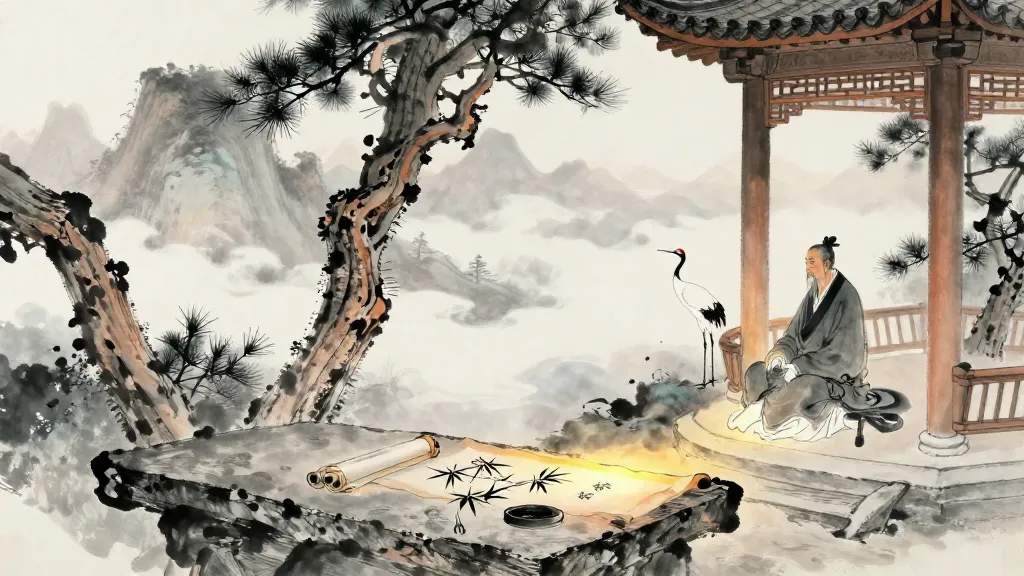
更法 (Reforming the Law) — Chinese ink painting

商君書 Shangjunshu · Chapter 1

更法

Reforming the Law

View:

孝公議變法

Duke Xiao Deliberates on Reforming the Law

孝公平畫,公孫鞅、甘龍、杜摯三大夫御於君。慮世事之變,討正法之本,求使民之道。

Duke Xiao held a council to deliberate policy. The three grand officers Gongsun Yang, Gan Long, and Du Zhi attended upon the lord. They considered the changes in worldly affairs, examined the foundations of correct law, and sought the proper way to govern the people.

Notes

1person秦孝公Qín Xiào Gōng

Duke Xiao of Qin (秦孝公, r. 361–338 BC) was the ruler who employed Shang Yang to carry out the sweeping Legalist reforms that transformed Qin into the dominant Warring States power.

2person公孫鞅Gōngsūn Yāng

Gongsun Yang (公孫鞅, c. 390–338 BC), also known as Shang Yang (商鞅) or Lord Shang, was the chief architect of Qin's Legalist reforms. Originally from Wei, he rose to become chancellor of Qin before being executed after Duke Xiao's death.

3person甘龍Gān Lóng

Gan Long (甘龍) was a conservative grand officer of Qin who opposed Shang Yang's reforms, arguing that sage rulers governed without changing existing customs.

4person杜摯Dù Zhì

Du Zhi (杜摯) was a grand officer of Qin who sided with Gan Long against the proposed reforms, advocating adherence to ancient precedent.

孝公之疑

Duke Xiao's Hesitation

君曰:"代立不忘社稷,君之道也;錯法務明主長,臣之行也。今吾欲變法以治,更禮以教百姓,恐天下之議我也。"

The lord said: "To succeed to the throne and never forget the altars of soil and grain — this is the way of a ruler. To establish laws that serve to illuminate the ruler's lasting authority — this is the conduct of a minister. Now I wish to reform the law to bring order and change the rites to instruct the common people, but I fear that all under heaven will criticize me."

公孫鞅論變法

Gongsun Yang's Argument for Reform

公孫鞅曰:"臣聞之:'疑行無成,疑事無功。'君亟定變法之慮,殆無顧天下之議之也。且夫有高人之行者,固見負於世;有獨知之慮者,必見驁於民。語曰:'愚者暗於成事,知者見於未萌。民不可與慮始,而可與樂成。郭偃之法曰:'論至德者不和於俗,成大功者不謀於眾。'法者所以愛民也,禮者所以便事也。是以聖人苟可以強國,不法其故;苟可以利民,不循其禮。"

Gongsun Yang said: "I have heard it said: 'Hesitation in action yields no accomplishment; hesitation in affairs yields no merit.' Let my lord settle his plans for reforming the law at once, and pay no heed to the criticisms of all under heaven. Moreover, those whose conduct surpasses others are invariably condemned by the world; those whose understanding is unique are inevitably scorned by the people. The saying goes: 'The foolish are blind even to accomplished facts; the wise perceive things before they sprout.' One cannot deliberate beginnings with the people, but one can share with them the joy of completion. The code of Guo Yan says: 'He who discusses the highest virtue does not conform to common custom; he who accomplishes great deeds does not consult with the multitude.' The law exists to care for the people; rites exist to facilitate affairs. Therefore the sage, if he can thereby strengthen the state, does not follow old models; if he can thereby benefit the people, he does not adhere to old rites."

Notes

1person郭偃Guō Yǎn

Guo Yan (郭偃) was a grand officer of the state of Jin during the Spring and Autumn period, known as an advocate of institutional reform.

甘龍反對變法

Gan Long Opposes Reform

孝公曰:"善!"

甘龍曰:"不然。臣聞之:'聖人不易民而教,知者不變法而治。'因民而教者,不勞而功成;據法而治者,吏習而民安。今若變法,不循秦國之故,更禮以教民,臣恐天下之議君,願孰察之。"

Duke Xiao said: "Excellent!"

Gan Long said: "Not so. I have heard it said: 'The sage does not change the people in order to instruct them; the wise man does not alter the law in order to govern.' He who instructs in accordance with the people achieves results without toil; he who governs by established law finds officials competent and the people at ease. Now if you reform the law without following the old ways of Qin and change the rites to instruct the people, I fear all under heaven will criticize my lord. I beg you to consider carefully."

公孫鞅駁甘龍

Gongsun Yang Refutes Gan Long

公孫鞅曰:"子之所言,世俗之言也。夫常人安於故習,學者溺於所聞。此兩者,所以居官而守法,非所與論於法之外也。三代不同禮而王,五霸不同法而霸。故知者作法,而愚者制焉;賢者更禮,而不肖者拘焉。拘禮之人不足與言事,製法之人不足與論變。君無疑矣。"

Gongsun Yang said: "What you speak of is the talk of the common world. Ordinary people are content with old habits; scholars are trapped by what they have heard. These two types are fit to hold office and keep the existing law, but they are not the sort to discuss matters beyond the law. The Three Dynasties each had different rites yet all achieved kingship; the Five Hegemons each had different laws yet all achieved hegemony. Therefore the wise create laws while the foolish are constrained by them; the worthy reform rites while the unworthy are bound by them. Those bound by rites are not worth discussing affairs with; those constrained by existing law are not worth debating change with. Let my lord have no doubts."

Notes

1context

The Three Dynasties (三代) refers to the Xia, Shang, and Zhou. The Five Hegemons (五霸) are traditionally Duke Huan of Qi, Duke Wen of Jin, Duke Mu of Qin, King Zhuang of Chu, and King Helu of Wu (or Duke Xiang of Song in some lists).

杜摯反對與公孫鞅再駁

Du Zhi Objects and Gongsun Yang Refutes Again

杜摯曰:"臣聞之:'利不百,不變法;功不十,不易器'。臣聞:'法古無過,循禮無邪。君其圖之!'"

公孫鞅曰:"前世不同教,何古之法?帝王不相復,何禮之循?伏羲、神農,教而不誅;黃帝、堯、舜,誅而不怒;及至文、武,各當時而立法,因事而制禮。禮、法以時而定;制、令各順其宜;兵甲器備,各便其用。臣故曰:治世不一道,便國不必法古。湯、武之王也,不脩古而興;殷、夏之滅也,不易禮而亡。然則反古者未必可非,循禮者未足多是也。君無疑矣。"

Du Zhi said: "I have heard it said: 'Unless the benefit is a hundredfold, do not change the law; unless the merit is tenfold, do not alter the instruments.' I have heard: 'To model upon antiquity incurs no fault; to follow established rites incurs no deviation.' Let my lord consider well!"

Gongsun Yang said: "Previous ages did not share the same teachings — which antiquity shall we model upon? Emperors and kings did not repeat one another — which rites shall we follow? Fuxi and Shennong instructed without punishing; the Yellow Emperor, Yao, and Shun punished without anger; by the time of Kings Wen and Wu, each established law according to his era and crafted rites according to circumstances. Rites and law were fixed according to the times; institutions and decrees each suited their era; weapons and military equipment each served their purpose. Therefore I say: there is no single Way for governing the world, and benefiting the state need not mean imitating antiquity. When Tang and Wu became kings, they rose without following the old ways; when Yin and Xia perished, they fell without having changed the rites. Thus those who return to antiquity are not necessarily to be condemned, and those who follow the rites are not necessarily to be fully approved. Let my lord have no doubts."

Notes

1context

Fuxi (伏羲) and Shennong (神農) are mythical sage-kings representing the earliest stages of civilization. The Yellow Emperor (黃帝), Yao (堯), and Shun (舜) are the legendary sage-emperors. Kings Wen (文王) and Wu (武王) founded the Zhou dynasty. The progression illustrates that governance methods evolved with the times.

孝公決意變法

Duke Xiao Resolves to Reform

孝公曰:"善!吾聞窮巷多怪,曲學多辯。愚者之笑,智者哀焉;狂夫之樂,賢者喪焉。拘世以議,寡人不之疑矣。"

於是遂出墾草令。

Duke Xiao said: "Excellent! I have heard that narrow lanes breed strange notions and partial learning breeds much argument. The laughter of fools is cause for the wise to grieve; the joy of the mad is cause for the worthy to mourn. Let those constrained by convention debate as they will — I shall have no doubts."

Thereupon he issued the Order to Cultivate Waste Lands.

Notes

1context

The Order to Cultivate Waste Lands (墾草令) was the first of Shang Yang's reform edicts, detailed in chapter 2 of this text. It marks the beginning of the systematic Legalist transformation of the Qin state.

Edition & Source

Text
《商君書》 Shangjunshu
Edition
中華古詩文古書籍網 transcription
Commentary
Traditional commentaries