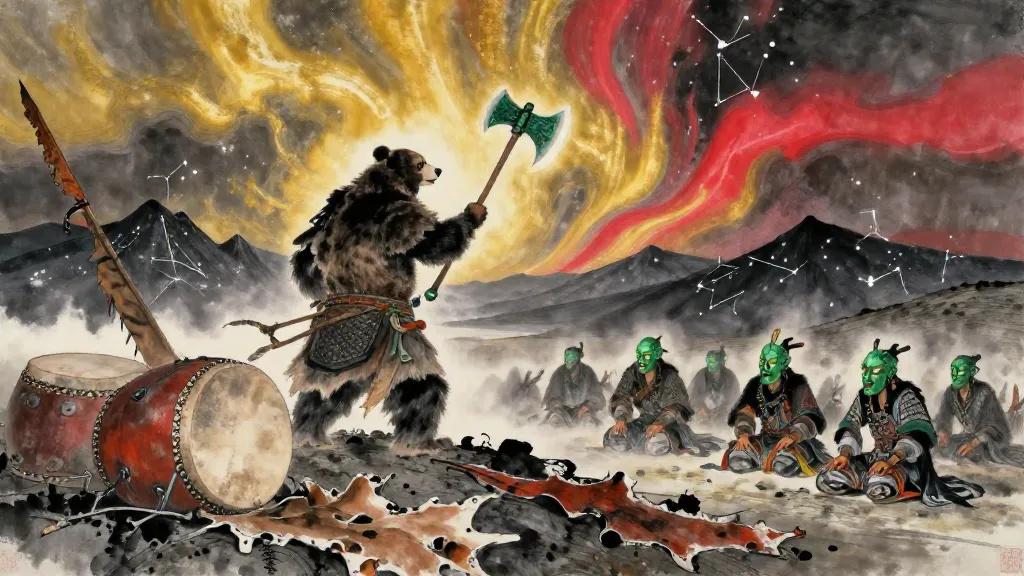
五帝本紀 (Annals of the Five Emperors) — Chinese ink painting

Chapter 1 of 130

五帝本紀

Annals of the Five Emperors

View:

黃帝興起與統一天下

The Rise of the Yellow Emperor and the Unification of All-Under-Heaven

黃帝者,少典之子,姓公孫,名曰軒轅。生而神靈,弱而能言,幼而徇齊,長而敦敏,成而聰明。

軒轅之時,神農氏世衰。諸侯相侵伐,暴虐百姓,而神農氏弗能征。於是軒轅乃習用干戈,以征不享,諸侯咸來賓從。而蚩尤最為暴,莫能伐。炎帝欲侵陵諸侯,諸侯咸歸軒轅。軒轅乃修德振兵,治五氣,藝五種,撫萬民,度四方,教熊羆貔貅貙虎,以與炎帝戰於阪泉之野。三戰然後得其志。蚩尤作亂,不用帝命。於是黃帝乃徵師諸侯,與蚩尤戰於涿鹿之野,遂禽殺蚩尤。而諸侯咸尊軒轅為天子,代神農氏,是為黃帝。天下有不順者,黃帝從而征之,平者去之,披山通道,未嘗寧居。

The Yellow Emperor was the son of Shaodian. His surname was Gongsun and his given name Xuanyuan. From birth he possessed a numinous spirit. As an infant he could speak; as a child he was quick and perceptive; as a youth he was earnest and capable; and when he came of age, he was brilliant.

In Xuanyuan's time, the house of Shennong had declined over generations. The feudal lords attacked and encroached upon one another, brutalizing the common people, and Shennong could not bring them to order. Thereupon Xuanyuan trained in the use of shield and halberd and campaigned against those who would not submit. All the feudal lords came to pay court and follow him. But Chiyou was the most violent of all, and none could subdue him. The Flame Emperor sought to overrun the other lords, and they all turned to Xuanyuan. Xuanyuan then cultivated virtue and strengthened his armies; he regulated the five vital forces, planted the five grains, pacified the myriad people, surveyed the four quarters, and trained bears, grizzlies, pixiu, and tigers. With these forces he fought the Flame Emperor on the plain of Banquan. After three battles he achieved his aim. Chiyou rose in rebellion and refused the emperor's commands. The Yellow Emperor then levied troops from the feudal lords and fought Chiyou on the plain of Zhuolu, where he captured and killed him. All the feudal lords honored Xuanyuan as Son of Heaven, and he replaced Shennong. This was the Yellow Emperor. Wherever in All-Under-Heaven there were those who would not submit, the Yellow Emperor campaigned against them; once they were pacified, he moved on. He cut through mountains and opened roads, never resting in one place.

Notes

1person黃帝Huángdì

The Yellow Emperor (黃帝, Huángdì) is the legendary progenitor of Chinese civilization, traditionally dated to c. 2697–2597 BC. Sima Qian chose him as the starting point of Chinese history, treating him as a quasi-historical figure who established the foundations of government, warfare, and culture.

2person神農Shénnóng

Shennong (神農, 'Divine Farmer') is the legendary inventor of agriculture and herbal medicine, considered the last of the Three August Ones (三皇) before the Five Emperors. His decline marks the transition from a primordial age of peace to one requiring military force.

3person蚩尤Chīyóu

Chiyou (蚩尤) is a legendary war leader often depicted as a monstrous figure with bronze head and iron brow. In some traditions he is the ancestor of the Miao people. His defeat at Zhuolu is one of the foundational myths of Chinese civilization.

4person炎帝Yándì

The Flame Emperor (炎帝, Yándì) is sometimes identified with Shennong or treated as a separate figure. His battle with the Yellow Emperor at Banquan represents the unification of the two great ancestral lineages. Chinese people traditionally call themselves 'descendants of Yan and Huang' (炎黃子孫).

5place

Banquan (阪泉) is traditionally located near modern Zhuolu County, Hebei, though some place it near Yanqing, northwest of Beijing.

6place

Zhuolu (涿鹿) is in modern Zhuolu County, Hebei province, at the foot of the Taihang Mountains. The battle there is one of the most celebrated events in Chinese legendary history.

7translation

'Trained bears, grizzlies, pixiu, and tigers' (教熊羆貔貅貙虎) — most commentators interpret these as clan totems or tribal military units named after fierce animals rather than literal beasts.

黃帝巡行與功業

The Yellow Emperor's Inspections and Achievements

東至于海,登丸山,及岱宗。西至于空桐,登雞頭。南至于江,登熊、湘。北逐葷粥,合符釜山,而邑于涿鹿之阿。遷徙往來無常處,以師兵為營衛。官名皆以雲命,為雲師。置左右大監,監于萬國。萬國和,而鬼神山川封禪與為多焉。獲寶鼎,迎日推筴。舉風后、力牧、常先、大鴻以治民。順天地之紀,幽明之占,死生之說,存亡之難。時播百穀草木,淳化鳥獸蟲蛾,旁羅日月星辰水波土石金玉,勞勤心力耳目,節用水火材物。有土德之瑞,故號黃帝。

To the east he reached the sea and climbed Mount Wan and Mount Dai. To the west he reached Kongtong and ascended Jitou. To the south he reached the Yangtze and climbed Mounts Xiong and Xiang. To the north he drove out the Xunyu, verified tallies at Mount Fu, and established his settlement at the bend of Zhuolu. He moved from place to place with no fixed residence, using his armies as his camp and guard.

He named all his officials after clouds and was called the Cloud Master. He appointed Grand Supervisors of the Left and Right to oversee the myriad states. The myriad states were at peace, and sacrifices of feng and shan to the spirits of mountains and rivers were more numerous than ever before. He obtained the precious tripod, greeted the sun, and calculated the calendar. He raised up Feng Hou, Li Mu, Changxian, and Da Hong to govern the people.

He followed the patterns of heaven and earth, divined the hidden and the manifest, discoursed on life and death, and grappled with survival and ruin. He sowed the hundred grains and plants in their proper seasons, domesticated birds, beasts, and insects, and broadly studied the sun, moon, stars, water, earth, stone, metal, and jade. He labored with all his heart, strength, eyes, and ears, and used water, fire, timber, and other materials frugally. Because an auspicious sign of earth-virtue appeared, he was called the Yellow Emperor.

Notes

1place

Daizong (岱宗) is Mount Tai in Shandong, the most sacred of the Five Sacred Mountains and the site where emperors performed the feng and shan sacrifices to Heaven and Earth.

2place

Kongtong (空桐) is a mountain in modern Gansu, traditionally associated with Daoist immortals. Sima Qian himself visited it during his research travels.

3context

The Xunyu (葷粥) are an early name for the northern nomadic peoples later known as the Xiongnu. The Yellow Emperor's campaign against them establishes the ancient precedent for the north as a zone of military conflict.

4context

The feng and shan (封禪) sacrifices were the most solemn rituals an emperor could perform: feng was the sacrifice to Heaven atop Mount Tai, and shan was the sacrifice to Earth at a lesser mountain nearby. Performing them signified a ruler's supreme legitimacy.

5translation

'Earth-virtue' (土德) — In the Five Phases (wuxing) cosmology, each dynasty is associated with one of the five elements. The Yellow Emperor's association with earth (hence 'yellow,' the color of earth) became the basis for dynastic succession theory: each dynasty's element conquers that of the one it replaces.

黃帝子孫與帝顓頊

The Yellow Emperor's Descendants and Emperor Zhuanxu

黃帝二十五子,其得姓者十四人。

黃帝居于軒轅之丘,而娶于西陵之女,是為嫘祖為黃帝正妃,生二子,其後皆有天下:其一曰玄囂,是為青陽,青陽降居江水;其二曰昌意,降居若水。昌意娶蜀山氏女,曰昌仆,生高陽,高陽有聖德焉。黃帝崩,葬橋山。其孫昌意之子高陽立,是為帝顓頊也。

帝顓頊高陽者,黃帝之孫而昌意之子也。靜淵以有謀,疏通而知事;養材以任地,載時以象天,依鬼神以制義,治氣以教化,絜誠以祭祀。北至于幽陵,南至于交阯,西至于流沙,東至于蟠木。動靜之物,大小之神,日月所照,莫不砥屬。

帝顓頊生子曰窮蟬。顓頊崩,而玄囂之孫高辛立,是為帝嚳。

The Yellow Emperor had twenty-five sons, of whom fourteen received surnames.

The Yellow Emperor dwelt on the Hill of Xuanyuan and married a woman of Xiling — this was Leizu, who became his principal consort. She bore two sons, and both their lines eventually held All-Under-Heaven. The first was Xuanxiao, also known as Qingyang, who went to dwell by the Jiang River. The second was Changyi, who went to dwell by the Ruo River. Changyi married a woman of the Shushan clan, named Changpu, who bore Gaoyang. Gaoyang possessed sagely virtue. When the Yellow Emperor died, he was buried at Mount Qiao. His grandson Gaoyang, the son of Changyi, ascended the throne — this was Emperor Zhuanxu.

Emperor Zhuanxu, styled Gaoyang, was the grandson of the Yellow Emperor and the son of Changyi. He was calm and profound, with great strategic insight; he was perceptive and knowledgeable in affairs. He cultivated resources appropriate to the land, ordered the seasons in accordance with Heaven, followed the spirits in establishing righteousness, regulated the vital forces to transform the people, and purified himself with sincerity in sacrifice. His domain reached north to Youling, south to Jiaozhi, west to the Flowing Sands, and east to Panmu. All things that move or rest, all spirits great and small, everything illuminated by the sun and moon — none failed to submit to his rule.

Emperor Zhuanxu fathered a son named Qiongchan. When Zhuanxu died, Gaoxin, the grandson of Xuanxiao, ascended the throne — this was Emperor Ku.

Notes

1person嫘祖Léizǔ

Leizu (嫘祖) is traditionally credited with the invention of silk cultivation (sericulture). She is one of the most celebrated female figures in Chinese legend.

2person帝顓頊Dì Zhuānxū

Emperor Zhuanxu (顓頊, Zhuānxū) is the second of the Five Emperors. He is credited with religious reforms, particularly the separation of Heaven and Earth — ordering that only designated priests could communicate with the divine, ending the era when anyone could perform sacrifices.

3place

Mount Qiao (橋山) is traditionally identified with a site in modern Huangling County, Shaanxi. The Yellow Emperor's Mausoleum there remains one of the most important ancestral shrines in China.

4place

Jiaozhi (交阯) refers to the region of modern northern Vietnam and Guangxi, representing the southernmost extent of the Chinese cultural sphere.

帝嚳與帝堯

Emperor Ku and Emperor Yao

帝嚳高辛者,黃帝之曾孫也。高辛父曰蟜極,蟜極父曰玄囂,玄囂父曰黃帝。自玄囂與蟜極皆不得在位,至高辛即帝位。高辛於顓頊為族子。

高辛生而神靈,自言其名。普施利物,不於其身。聰以知遠,明以察微。順天之義,知民之急。仁而威,惠而信,修身而天下服。取地之財而節用之,撫教萬民而利誨之,歷日月而迎送之,明鬼神而敬事之。其色郁郁,其德嶷嶷。其動也時,其服也士。帝嚳溉執中而遍天下,日月所照,風雨所至,莫不從服。

帝嚳娶陳鋒氏女,生放勛。娶娵訾氏女,生摯。帝嚳崩,而摯代立。帝摯立,不善(崩),而弟放勛立,是為帝堯。

Emperor Ku, styled Gaoxin, was the great-grandson of the Yellow Emperor. Gaoxin's father was Jiaoji, Jiaoji's father was Xuanxiao, and Xuanxiao's father was the Yellow Emperor. Neither Xuanxiao nor Jiaoji attained the throne; it was Gaoxin who became emperor. In relation to Zhuanxu, Gaoxin was a clan nephew.

Gaoxin was born with a numinous spirit and spoke his own name. He bestowed benefits on all things but sought nothing for himself. He was perceptive enough to know what was distant and discerning enough to detect what was subtle. He followed the righteous principles of Heaven and understood the urgent needs of the people. He was humane yet commanding, generous yet trustworthy. He cultivated his person and All-Under-Heaven submitted. He took the wealth of the earth and used it frugally, nurtured and instructed the myriad people for their benefit, tracked the sun and moon to mark their courses, and honored the spirits with reverent service. His countenance was dignified, his virtue lofty. His actions were timely, his attire befitting a scholar. Emperor Ku held to the center and his influence reached throughout All-Under-Heaven — wherever the sun and moon shone, wherever wind and rain fell, none failed to submit.

Emperor Ku married a woman of the Chenfeng clan and fathered Fangxun. He married a woman of the Juzi clan and fathered Zhi. When Emperor Ku died, Zhi succeeded him. Emperor Zhi's reign was not good, and he died. His younger brother Fangxun then ascended the throne — this was Emperor Yao.

Notes

1person帝嚳Dì Kù

Emperor Ku (帝嚳, Dì Kù), styled Gaoxin, is the third of the Five Emperors. He is notable as the father of both Emperor Yao (through Fangxun) and the ancestor of the Shang dynasty (through Qi/契). His portrayal emphasizes the 'holding to the center' (執中) that became a core Confucian political ideal.

2person帝堯Dì Yáo

Emperor Yao (帝堯), personal name Fangxun (放勳), is the fourth of the Five Emperors and one of the most celebrated sage-kings in Chinese tradition. His reign is the starting point of the Book of Documents (尚書).

帝堯治世與授時

Emperor Yao's Governance and the Regulation of the Seasons

帝堯者,放勛。其仁如天,其知如神。就之如日,望之如雲。富而不驕,貴而不舒。黃收純衣,彤車乘白馬。能明馴德,以親九族。九族既睦,便章百姓。百姓昭明,合和萬國。

乃命羲、和,敬順昊天,數法日月星辰,敬授民時。分命羲仲,居郁夷,曰暘谷。敬道日出,便程東作。日中,星鳥,以殷中春。其民析,鳥獸字微。申命羲叔,居南交。便程南為,敬致。日永,星火,以正中夏。其民因,鳥獸希革。申命和仲,居西土,曰昧谷。敬道日入,便程西成。夜中,星虛,以正中秋。其民夷易,鳥獸毛毨。申命和叔;居北方,曰幽都。便在伏物。日短,星昴,以正中冬。其民燠,鳥獸氄毛。歲三百六十六日,以閏月正四時。信飭百官,眾功皆興。

Emperor Yao — his personal name was Fangxun. His benevolence was like Heaven itself; his wisdom like that of a spirit. To approach him was like approaching the sun; to gaze upon him was like beholding the clouds. He was wealthy but not arrogant, noble but not indolent. He wore a yellow cap and plain robes, rode a vermilion chariot drawn by white horses. He was able to make bright his cultivated virtue and bring harmony to the nine degrees of kinship. When the nine degrees were in accord, he regulated the hundred clans. When the hundred clans were illuminated, he brought together the myriad states in harmony.

He then commanded Xi and He to reverently follow the great Heaven and calculate the patterns of the sun, moon, and stars, so as respectfully to bestow the seasons upon the people. He separately commanded Xi Zhong to reside at Yuyi, called the Valley of the Rising Sun, to respectfully guide the sunrise and regulate the spring planting. When the days are of middle length and the constellation is Niao, it marks the middle of spring. The people spread out, and birds and beasts mate and rear their young. He further commanded Xi Shu to reside at Nanjiao to regulate the summer works and mark the solstice with reverence. When the days are longest and the constellation is Huo, it marks the middle of summer. The people retreat to the highlands, and birds and beasts have thin coats. He further commanded He Zhong to reside in the western land, called the Valley of Darkness, to respectfully guide the sunset and regulate the autumn harvest. When the nights are of middle length and the constellation is Xu, it marks the middle of autumn. The people are at ease, and birds and beasts regrow their plumage. He further commanded He Shu to reside in the north, called the Dark Capital, to oversee the storing of things. When the days are shortest and the constellation is Mao, it marks the middle of winter. The people stay in their warm dwellings, and birds and beasts grow thick fur. The year was three hundred and sixty-six days, and intercalary months were used to correct the four seasons. He faithfully directed the hundred officials, and all endeavors flourished.

Notes

1person羲和Xī Hé

Xi (羲) and He (和) were the legendary astronomers tasked with regulating the calendar. The four officers — Xi Zhong, Xi Shu, He Zhong, He Shu — were stationed at the four cardinal points to observe the solstices and equinoxes. This passage is nearly identical to the 'Canon of Yao' (堯典) in the Book of Documents.

2context

The four marker stars — Niao (鳥, Bird/Hydra), Huo (火, Fire/Antares), Xu (虛, Void), Mao (昴, Pleiades) — are the lodges that culminated at dusk during the equinoxes and solstices around 2300 BC, providing one of the few astronomical checks on the traditional chronology.

3translation

The 'nine degrees of kinship' (九族) is variously interpreted. The most common reading is four generations above ego, four below, plus ego's own generation — covering the extended patrilineal clan.

治水之議與舜之發現

The Debate on Flood Control and the Discovery of Shun

堯曰:「誰可順此事?」放齊曰:「嗣子丹朱開明。」堯曰:「吁!頑凶,不用。」堯又曰:「誰可者?」讙兜曰:「共工旁聚布功,可用。」堯曰:「共工善言,其用僻,似恭漫天,不可。」堯又曰:「嗟,四嶽,湯湯洪水滔天,浩浩懷山襄陵,下民其憂,有能使治者?」皆曰鯀可。堯曰:「鯀負命毀族,不可。」嶽曰:「異哉,試不可用而已。」堯於是聽嶽用鯀。九歲,功用不成。

堯曰:「嗟!四嶽:朕在位七十載,汝能庸命,踐朕位?」嶽應曰:「鄙德忝帝位。」堯曰:「悉舉貴戚及疏遠隱匿者。」眾皆言於堯曰:「有矜在民閒,曰虞舜。」堯曰:「然,朕聞之。其何如?」嶽曰:「盲者子。父頑,母嚚,弟傲,能和以孝,烝烝治,不至姦。」堯曰:「吾其試哉。」於是堯妻之二女,觀其德於二女。舜飭下二女於媯汭,如婦禮。

Yao asked: "Who can carry on this work?" Fang Qi said: "Your heir, Danxhu — he is perceptive." Yao said: "Bah! He is stubborn and vicious. He will not do."

Yao asked again: "Who is able?" Huandou said: "Gonggong has gathered supporters and spread his achievements far and wide. He could serve." Yao said: "Gonggong is clever with words but crooked in practice. He appears respectful but is contemptuous of Heaven. He will not do."

Yao said again: "Alas, you Four Peaks! The surging floodwaters reach to the heavens; their vastness engulfs the mountains and overtops the hills. The people below are in distress. Is there anyone who can bring them under control?" All said: "Gun can." Yao said: "Gun defies orders and destroys his own kin. He will not do." The Peaks replied: "He stands apart — try him, and if he cannot, dismiss him." Yao thereupon heeded the Peaks and employed Gun. After nine years, the work remained unfinished.

Yao said: "Alas, you Four Peaks! I have been on the throne for seventy years. Can you carry out the mandate and take my place?" The Peaks answered: "Our virtue is too base to disgrace the imperial throne." Yao said: "Then nominate everyone — relatives of high or low rank, and those who live in obscurity." All said to Yao: "There is a commoner among the people named Yu Shun." Yao said: "Yes, I have heard of him. What manner of man is he?" The Peaks said: "He is the son of a blind man. His father is obstinate, his mother deceitful, and his half-brother arrogant. Yet he is able to live with them in harmony through filial devotion, governing himself with steadfast goodness and never falling into wickedness." Yao said: "Then let me try him." Thereupon Yao gave him his two daughters in marriage, to observe his virtue through their eyes. Shun directed the two daughters to the bend of the Gui River, where they observed the rites of a wife.

Notes

1person丹朱Dānzhū

Danzhu (丹朱) was Yao's son. His rejection in favor of the virtuous commoner Shun is the paradigmatic example of 'abdication to the worthy' (禪讓, shànràng), a central political ideal in early Confucianism that legitimate rule depends on virtue, not birth.

2personGǔn

Gun (鯀) was the father of Yu the Great. His failure to control the floods and subsequent execution (殛) at Mount Yu is a key narrative setup: the father fails, the son succeeds. The word 殛 can mean execution or exile.

3context

The Four Peaks (四嶽) were Yao's chief ministers, sometimes interpreted as four officials each responsible for one of the sacred mountains, or as a single chief minister (the Grand Councilor). They function as a council of advisors.

4person虞舜Yú Shùn

Shun (舜), also called Yu Shun (虞舜), is the fifth and last of the Five Emperors. His story — rising from poverty and an abusive family to become emperor through sheer moral excellence — is the supreme Confucian exemplar of virtue.

5place

The Gui River (媯水) is in modern Hebei, near Zhuolu. The Gui River bend (媯汭) was where Shun's household was established with Yao's two daughters.

堯試舜與舜攝政

Yao Tests Shun and Shun Serves as Regent

堯善之,乃使舜慎和五典,五典能從。乃遍入百官,百官時序。賓於四門,四門穆穆,諸侯遠方賓客皆敬。堯使舜入山林川澤,暴風雷雨,舜行不迷。堯以為聖,召舜曰:「女謀事至而言可績,三年矣。女登帝位。」舜讓於德不懌。正月上日,舜受終於文祖。文祖者,堯大祖也。

於是帝堯老,命舜攝行天子之政,以觀天命。舜乃在璿璣玉衡,以齊七政。遂類于上帝,禋于六宗,望于山川,辯于群神。揖五瑞,擇吉月日,見四嶽諸牧,班瑞。歲二月,東巡狩,至於岱宗,祡,望秩於山川。遂見東方君長,合時月正日,同律度量衡,修五禮五玉三帛二生一死為摯,如五器,卒乃復。五月,南巡狩;八月,西巡狩;十一月,北巡狩:皆如初。歸,至于祖禰廟,用特牛禮。五歲一巡狩,群后四朝。遍告以言,明試以功,車服以庸。肇十有二州,決川。象以典刑,流宥五刑,鞭作官刑,撲作教刑,金作贖刑。眚災過,赦;怙終賊,刑。欽哉,欽哉,惟刑之靜哉!

Yao was pleased with him and had Shun carefully harmonize the five norms of conduct — and all five were followed. He then had Shun take charge of the hundred officials — and the hundred officials performed their duties in proper order. Shun received guests at the four gates — and the four gates were solemn and dignified, with feudal lords and visitors from distant lands all showing respect. Yao sent Shun into the mountain forests and rivers and marshes, and amid violent storms of wind, thunder, and rain, Shun never lost his way. Yao deemed him a sage and summoned Shun, saying: "For three years your plans have been thorough and your words have proven effective. Ascend to the imperial throne." Shun demurred, saying his virtue was insufficient. On the first day of the first month, Shun received the succession at the Temple of the Accomplished Ancestor — the great ancestor of Yao.

Emperor Yao had grown old and commanded Shun to act as regent, carrying out the government of the Son of Heaven, so as to observe the Mandate of Heaven. Shun then aligned the jade armillary sphere to regulate the Seven Governors. He performed the lei sacrifice to the Supreme Deity, the yin sacrifice to the Six Honored Ones, the wang sacrifice to the mountains and rivers, and offered worship to all the spirits. He received the five jade tablets, chose auspicious days, held audience with the Four Peaks and the regional shepherds, and distributed the jade tablets.

In the second month of each year, he made his eastern tour of inspection, reaching Mount Dai, where he burned firewood and made wang sacrifices to the mountains and rivers in proper order. He then met with the lords of the east, harmonized the months and corrected the calendar, standardized musical pitches, measures of length, capacity, and weight, and regulated the five ritual ceremonies, the five jade tokens, the three silk fabrics, two living and one dead animal for presentation gifts, and the five ceremonial implements. When all was done, he returned.

In the fifth month he toured the south, in the eighth month the west, and in the eleventh month the north — all following the same pattern. On returning, he went to the ancestral temples and offered a single bull. Every five years he made one tour, and in the intervening four years the lords came to court. He gave them instructions by proclamation, tested them by examining their achievements, and rewarded them with chariots and robes according to merit.

He established the twelve provinces and dredged the rivers. He displayed the standard punishments as a warning, commuted the five major punishments to banishment, used the whip as the punishment for officials, the rod as the punishment in schools, and fines in metal as redemption. Offenses due to misfortune or accident were pardoned; those who persisted deliberately in wrongdoing were punished. Be reverent! Be reverent! Let punishments be applied with care!

Notes

1context

The 'Seven Governors' (七政) refers to the sun, moon, and five visible planets (Mercury, Venus, Mars, Jupiter, Saturn). The jade armillary sphere (璿璣玉衡) was an astronomical instrument for celestial observation. This passage emphasizes that the first duty of a new ruler is to regulate the calendar — the connection between cosmic order and political legitimacy.

2context

The 'five norms' (五典) are the five cardinal relationships: father-son, ruler-minister, husband-wife, elder-younger brother, and friend-friend. This became the foundation of Confucian social ethics.

3context

The tours of inspection (巡狩) in the four directions, visiting the sacred mountains at the cardinal points, became the idealized model for imperial progresses. In practice, few emperors completed the full circuit.

舜罰四凶與堯崩

Shun Punishes the Four Villains and Yao Dies

讙兜進言共工,堯曰不可而試之工師,共工果淫辟。四嶽舉鯀治鴻水,堯以為不可,嶽彊請試之,試之而無功,故百姓不便。三苗在江淮、荊州數為亂。於是舜歸而言於帝,請流共工於幽陵,以變北狄;放讙兜於崇山,以變南蠻;遷三苗於三危,以變西戎;殛鯀於羽山,以變東夷:四罪而天下咸服。

堯立七十年得舜,二十年而老,令舜攝行天子之政,薦之於天。堯辟位凡二十八年而崩。百姓悲哀,如喪父母。三年,四方莫舉樂,以思堯。堯知子丹朱之不肖,不足授天下,於是乃權授舜。授舜,則天下得其利而丹朱病;授丹朱,則天下病而丹朱得其利。堯曰:「終不以天下之病而利一人」,而卒授舜以天下。堯崩,三年之喪畢,舜讓辟丹朱於南河之南。諸侯朝覲者不之丹朱而之舜,獄訟者不之丹朱而之舜,謳歌者不謳歌丹朱而謳歌舜。舜曰:「天也」,夫而後之中國踐天子位焉,是為帝舜。

Huandou had recommended Gonggong; Yao had said it was not possible but tried him as Master of Works — and Gonggong proved dissolute and perverse. The Four Peaks had nominated Gun to control the great flood; Yao had thought him unsuitable, but the Peaks insisted on trying him — the trial produced no results, and the people suffered. The Sanmiao in the Jiang-Huai and Jing regions repeatedly caused disorder.

Thereupon Shun returned and spoke to the Emperor. He requested that Gonggong be banished to Youling, to transform the northern Di; that Huandou be exiled to Mount Chong, to transform the southern Man; that the Sanmiao be relocated to Sanwei, to transform the western Rong; and that Gun be put to death at Mount Yu, to transform the eastern Yi. These four punishments were carried out, and All-Under-Heaven submitted.

Yao had been on the throne seventy years when he found Shun. Twenty years later, grown old, he ordered Shun to serve as regent and recommended him to Heaven. Yao stepped down and died twenty-eight years later. The people mourned him as though they had lost a father and mother. For three years, no music was played in any quarter, in memory of Yao.

Yao knew that his son Danxhu was unworthy and not fit to be entrusted with All-Under-Heaven. He therefore weighed the matter and chose to pass the throne to Shun. If he gave it to Shun, All-Under-Heaven would benefit while Danxhu would suffer. If he gave it to Danxhu, All-Under-Heaven would suffer while Danxhu alone would benefit. Yao said: "In the end, I will not make All-Under-Heaven suffer in order to benefit one man." And so he gave All-Under-Heaven to Shun.

After Yao died and the three years of mourning were complete, Shun withdrew and yielded to Danxhu, retreating south of the Southern River. But the feudal lords who came to pay court went not to Danxhu but to Shun. Those who brought lawsuits went not to Danxhu but to Shun. Those who sang songs of praise sang not of Danxhu but of Shun. Shun said: "This is Heaven's will." Only then did he go to the Central Kingdom and take the throne of the Son of Heaven. This was Emperor Shun.

Notes

1context

The 'Four Villains' (四凶) — Gonggong, Huandou, Gun, and the Sanmiao — are banished to the four borders of the known world, each associated with one of the 'barbarian' peoples (Di, Man, Rong, Yi). This reflects the Chinese cosmological model of civilization radiating outward from the center, with punishment expressed as exile to the periphery.

2context

Yao's reasoning — 'I will not make All-Under-Heaven suffer to benefit one man' (終不以天下之病而利一人) — became one of the most celebrated statements of political philosophy in the Chinese tradition. It establishes the principle that the ruler's duty is to the people, not to his family.

3place

Mount Yu (羽山) is traditionally located in modern Donghai County, Jiangsu, on the eastern seaboard.

4place

Sanwei (三危) is identified with mountains near modern Dunhuang, Gansu, at the western end of the Hexi Corridor.

舜之出身與早年

Shun's Origins and Early Life

虞舜者,名曰重華。重華父曰瞽叟,瞽叟父曰橋牛,橋牛父曰句望,句望父曰敬康,敬康父曰窮蟬,窮蟬父曰帝顓頊,顓頊父曰昌意:以至舜七世矣。自從窮蟬以至帝舜,皆微為庶人。

舜父瞽叟盲,而舜母死,瞽叟更娶妻而生象,象傲。瞽叟愛後妻子,常欲殺舜,舜避逃;及有小過,則受罪。順事父及後母與弟,日以篤謹,匪有解。

舜,冀州之人也。舜耕歷山,漁雷澤,陶河濱,作什器於壽丘,就時於負夏。舜父瞽叟頑,母嚚,弟象傲,皆欲殺舜。舜順適不失子道,兄弟孝慈。欲殺,不可得;即求,嘗在側。

Shun of Yu — his name was Chonghua. Chonghua's father was Gusou, Gusou's father was Qiaoniu, Qiaoniu's father was Juwang, Juwang's father was Jingkang, Jingkang's father was Qiongchan, Qiongchan's father was Emperor Zhuanxu, and Zhuanxu's father was Changyi. From Changyi to Shun was seven generations. From Qiongchan down to Shun, all had been commoners of low station.

Shun's father Gusou was blind, and Shun's mother died. Gusou remarried and fathered Xiang, who was arrogant. Gusou favored his second wife's son and constantly sought to kill Shun. Shun would flee and hide; for the slightest offense, he accepted punishment. He served his father, stepmother, and half-brother with devotion that grew more earnest each day and never slackened.

Shun was a man of Jizhou. He plowed at Mount Li, fished at Lei Marsh, made pottery on the banks of the Yellow River, crafted implements at Shouqiu, and traded at Fuxia. His father Gusou was obstinate, his stepmother deceitful, and his brother Xiang arrogant — all wanted to kill him. Yet Shun adapted to every situation without losing the way of a son, treating his brother with both filial respect and kindness. When they tried to kill him, they could never succeed; when they needed him, he was always at their side.

Notes

1person瞽叟Gǔsǒu

Gusou (瞽叟, 'Blind Old Man') is one of the most notorious fathers in Chinese literature. Despite his repeated attempts to murder Shun, Shun never ceased serving him with filial devotion — making Shun the supreme example of xiao (孝, filial piety).

2personXiàng

Xiang (象) is Shun's arrogant half-brother who conspires with Gusou to kill Shun. Despite this, Shun later enfeoffs Xiang as a feudal lord — a detail that troubled Confucian commentators for centuries.

3place

Mount Li (歷山) is variously identified with locations in Shandong, Shanxi, and Zhejiang. The most common identification is with a mountain near modern Jinan, Shandong, or Yuncheng, Shanxi.

4context

The catalogue of Shun's occupations — farmer, fisherman, potter, craftsman, trader — emphasizes that he was a man of the common people who had experienced every walk of life. This is central to the Confucian argument that rulers should be chosen for virtue, not birth.

舜試煉與堯用舜

Shun's Trials and Yao's Employment of Shun

舜年二十以孝聞。三十而帝堯問可用者,四嶽咸薦虞舜,曰可。於是堯乃以二女妻舜以觀其內,使九男與處以觀其外。舜居媯汭,內行彌謹。堯二女不敢以貴驕事舜親戚,甚有婦道。堯九男皆益篤。舜耕歷山,歷山之人皆讓畔;漁雷澤,雷澤上人皆讓居;陶河濱,河濱器皆不苦窳。一年而所居成聚,二年成邑,三年成都。堯乃賜舜絺衣,與琴,為筑倉廩,予牛羊。瞽叟尚復欲殺之,使舜上涂廩,瞽叟從下縱火焚廩。舜乃以兩笠自捍而下,去,得不死。後瞽叟又使舜穿井,舜穿井為匿空旁出。舜既入深,瞽叟與象共下土實井,舜從匿空出,去。瞽叟、象喜,以舜為已死。象曰:「本謀者象。」象與其父母分,於是曰:「舜妻堯二女,與琴,象取之。牛羊倉廩予父母。」象乃止舜宮居,鼓其琴。舜往見之。象鄂不懌,曰:「我思舜正郁陶!」舜曰:「然,爾其庶矣!」舜復事瞽叟愛弟彌謹。於是堯乃試舜五典百官,皆治。

At twenty, Shun was known for his filial piety. At thirty, Emperor Yao asked who could be employed, and the Four Peaks all recommended Shun, saying he was able. Thereupon Yao gave him his two daughters in marriage to observe his conduct within the household, and sent nine of his sons to live with him to observe his conduct without. Shun dwelt at the bend of the Gui River, and his private conduct grew ever more scrupulous. Yao's two daughters did not dare use their noble birth to treat Shun's relatives with arrogance — they were exemplary wives. Yao's nine sons all became more earnest in their conduct.

When Shun plowed at Mount Li, all who farmed there yielded their field boundaries. When he fished at Lei Marsh, all the fishermen yielded their fishing grounds. When he made pottery on the riverbank, none of the vessels were rough or shoddy. After one year, wherever he settled became a hamlet; after two years, a town; after three years, a city.

Yao then gave Shun fine hemp garments and a zither, built him granaries, and gave him cattle and sheep. Yet Gusou still tried to kill him. He sent Shun to plaster the roof of the granary, then set fire to it from below. Shun used two conical hats as wings to shield himself and floated down, escaping death. Afterward, Gusou had Shun dig a well. While Shun was deep in the well, Gusou and Xiang shoveled earth to fill it — but Shun had dug a side tunnel and escaped through it.

Gusou and Xiang were delighted, thinking Shun was dead. Xiang said: "The plan was mine." He divided the spoils with his parents, saying: "Shun's two wives, the daughters of Yao, and his zither — I will take those. The cattle, sheep, and granaries go to our parents." Xiang then moved into Shun's chambers and played his zither. Shun came to see him. Xiang was startled and displeased, but said: "I was just thinking of Shun, and it was weighing on my heart!" Shun said: "Indeed — you are a devoted brother." Shun then served Gusou and loved Xiang with even greater devotion than before. Thereupon Yao tested Shun with the five norms and the hundred officials, and all were well governed.

Notes

1context

The two murder attempts — burning the granary and filling the well — are among the most vivid narrative episodes in early Chinese literature. They show Shun as both resourceful and morally extraordinary: he escapes through cleverness, yet responds to his family's malice with redoubled devotion rather than anger.

2translation

Xiang's claim 'I was just thinking of Shun, and it was weighing on my heart!' (我思舜正郁陶) is transparently false — he was caught dividing Shun's property. Shun's response, 'Indeed — you are a devoted brother' (然,爾其庶矣), demonstrates his characteristic grace. The word 庶 here likely means 'close to/nearly so,' and Shun may be either genuinely accepting the excuse or tactfully allowing Xiang to save face.

3context

The phenomenon of people flocking to wherever Shun settles — hamlet, town, city in three years — illustrates the Confucian concept that a truly virtuous person transforms others by example, without coercion. This is the principle of 德化 (moral transformation through virtue).

舜用賢才與流放四凶

Shun Employs the Worthy and Banishes the Four Villains

昔高陽氏有才子八人,世得其利,謂之「八愷」。高辛氏有才子八人,世謂之「八元」。此十六族者,世濟其美,不隕其名。至於堯,堯未能舉。舜舉八愷,使主后土,以揆百事,莫不時序。舉八元,使布五教于四方,父義,母慈,兄友,弟恭,子孝,內平外成。

昔帝鴻氏有不才子,掩義隱賊,好行凶慝,天下謂之渾沌。少暤氏有不才子,毀信惡忠,崇飾惡言,天下謂之窮奇。顓頊氏有不才子,不可教訓,不知話言,天下謂之梼杌。此三族世憂之。至于堯,堯未能去。縉云氏有不才子,貪于飲食,冒于貨賄,天下謂之饕餮。天下惡之,比之三凶。舜賓於四門,乃流四凶族,遷于四裔,以御螭魅,於是四門辟,言毋凶人也。

In ancient times, the Gaoyang clan had eight talented sons, and the world benefited from them generation after generation — they were called the 'Eight Harmonious Ones.' The Gaoxin clan had eight talented sons, called by the world the 'Eight Originals.' These sixteen families perpetuated their excellence across generations and never lost their renown. Up to Yao's time, Yao had not been able to promote them. Shun raised up the Eight Harmonious Ones and set them to manage the land, directing the hundred affairs — and nothing was out of order. He raised up the Eight Originals and had them spread the five teachings in the four directions: righteousness for fathers, kindness for mothers, friendship for elder brothers, respect for younger brothers, and filial piety for sons. Within, all was at peace; without, all was accomplished.

In ancient times, the Di Hong clan had a worthless son who concealed righteousness and harbored malice, delighting in villainy — All-Under-Heaven called him Hundun. The Shaohao clan had a worthless son who undermined trust and despised loyalty, embellishing slander — All-Under-Heaven called him Qiongqi. The Zhuanxu clan had a worthless son who could not be taught or instructed and would not heed counsel — All-Under-Heaven called him Taowu. These three clans were a source of worry for generations. Up to Yao's time, Yao had not been able to remove them. The Jinyun clan had a worthless son who was greedy for food and drink and covetous of wealth and bribes — All-Under-Heaven called him Taotie. All-Under-Heaven despised him, ranking him with the Three Villains. When Shun received guests at the four gates, he banished these four villainous clans, relocating them to the four remote borders to ward off monsters and demons. Thereupon the four gates were opened, and it was said there were no more evil men.

Notes

1context

The 'Four Villains' (四凶) — Hundun (混沌, Chaos), Qiongqi (窮奇), Taowu (梼杌), and Taotie (饕餮) — became famous as the Four Evil Creatures of Chinese mythology. Taotie in particular became a ubiquitous motif on Shang and Zhou bronzes, though the connection between the mythological figure and the bronze mask design is debated.

2context

The contrast between the Sixteen Worthy Ones and the Four Villains illustrates a key theme: what distinguishes a great ruler from a merely good one is the ability to both promote the talented and remove the wicked. Yao could do neither; Shun accomplished both.

舜即帝位與任命百官

Shun Ascends the Throne and Appoints the Ministers

舜入于大麓,烈風雷雨不迷,堯乃知舜之足授天下。堯老,使舜攝行天子政,巡狩。舜得舉用事二十年,而堯使攝政。攝政八年而堯崩。三年喪畢,讓丹朱,天下歸舜。而禹、皋陶、契、后稷、伯夷、夔、龍、倕、益、彭祖自堯時而皆舉用,未有分職。於是舜乃至於文祖,謀于四嶽,辟四門,明通四方耳目,命十二牧論帝德,行厚德,遠佞人,則蠻夷率服。舜謂四嶽曰:「有能奮庸美堯之事者,使居官相事?」皆曰:「伯禹為司空,可美帝功。」舜曰:「嗟,然!禹,汝平水土,維是勉哉。」禹拜稽首,讓於稷、契與皋陶。舜曰:「然,往矣。」舜曰:「棄,黎民始饑,汝后稷播時百穀。」舜曰:「契,百姓不親,五品不馴,汝為司徒,而敬敷五教,在寬。」舜曰:「皋陶,蠻夷猾夏,寇賊姦軌,汝作士,五刑有服,五服三就;五流有度,五度三居:維明能信。」舜曰:「誰能馴予工?」皆曰垂可。於是以垂為共工。舜曰:「誰能馴予上下草木鳥獸?」皆曰益可。於是以益為朕虞。益拜稽首,讓于諸臣朱虎、熊羆。舜曰:「往矣,汝諧。」遂以朱虎、熊羆為佐。舜曰:「嗟!四嶽,有能典朕三禮?」皆曰伯夷可。舜曰:「嗟!伯夷,以汝為秩宗,夙夜維敬,直哉維靜絜。」伯夷讓夔、龍。舜曰:「然。以夔為典樂,教稚子,直而溫,寬而栗,剛而毋虐,簡而毋傲;詩言意,歌長言,聲依永,律和聲,八音能諧,毋相奪倫,神人以和。」夔曰:「於!予擊石拊石,百獸率舞。」舜曰:「龍,朕畏忌讒說殄偽,振驚朕眾,命汝為納言,夙夜出入朕命,惟信。」舜曰:「嗟!女二十有二人,敬哉,惟時相天事。」三歲一考功,三考絀陟,遠近眾功咸興。分北三苗。

Shun entered the great wilderness, and amid fierce winds, thunder, and rain he did not lose his way. Yao then knew that Shun was fit to receive All-Under-Heaven. When Yao grew old, he had Shun serve as regent and conduct tours of inspection. Shun had been serving in office for twenty years when Yao made him regent. He served as regent for eight years before Yao died. After the three years of mourning, Shun yielded the throne to Danxhu, but All-Under-Heaven turned to Shun.

Now Yu, Gaoyao, Qi, Houji, Boyi, Kui, Long, Chui, Yi, and Pengzu had all been employed since Yao's time but had not yet been assigned specific offices. Shun therefore went to the Temple of the Accomplished Ancestor, consulted the Four Peaks, opened the four gates, and made the eyes and ears of the four quarters clear and accessible. He commanded the twelve regional shepherds to discuss the emperor's virtue, to practice generous virtue, and to keep flatterers at a distance — and the Man and Yi peoples all submitted.

Shun said to the Four Peaks: "Is there one who can exert himself to glorify Yao's work and hold office as chief minister?" All said: "Bo Yu as Minister of Works can glorify the Emperor's achievements." Shun said: "So be it! Yu, you shall bring the waters and lands to order — devote yourself to this!" Yu bowed low, touching his head to the ground, and deferred to Ji, Qi, and Gaoyao. Shun said: "Very well — go and attend to it."

Shun said: "Qi, the people are beginning to starve. You, Houji, shall sow the hundred grains in their proper seasons." Shun said: "Qi, the hundred clans are not close, and the five relationships are not in harmony. You shall be Minister of Education and reverently spread the five teachings. Let there be leniency." Shun said: "Gaoyao, the Man and Yi peoples trouble the Xia lands, and bandits, thieves, and criminals are at large. You shall be Minister of Justice. The five punishments shall have their proper applications, each applied in its appropriate place; the five degrees of banishment shall have their proper measures, each with its appointed destination. Only through clarity can trust be established."

Shun asked: "Who can oversee my craftsmen?" All said: "Chui can." So Chui was made Master of Works. Shun asked: "Who can manage the grasses, trees, birds, and beasts of high and low?" All said: "Yi can." So Yi was made Master of Marshes. Yi bowed and deferred to Zhu Hu and Xiong Pi. Shun said: "Go — work in harmony." And so Zhu Hu and Xiong Pi were made his assistants.

Shun said: "You Four Peaks — who can preside over my three ritual ceremonies?" All said: "Boyi can." Shun said: "Boyi, I make you Master of Ceremonies. Morning and night be reverent; be upright and pure." Boyi deferred to Kui and Long.

Shun said: "Very well. Kui shall be Master of Music. Teach the young: be upright yet gentle, broad yet firm, strong yet not cruel, simple yet not arrogant. Poetry gives voice to thought; song prolongs the words; tones follow the melody; pitch harmonizes the tones. When the eight kinds of instruments are in accord, none overriding another, spirits and men are brought into harmony." Kui said: "Ah! When I strike and tap the stones, the hundred beasts all dance."

Shun said: "Long, I dread and detest slander and falsehood that alarms my people. I command you to be my Herald, issuing and receiving my orders morning and night. Be truthful."

Shun said: "Attend, you twenty-two men! Be reverent, and assist the work of Heaven at the proper times." Every three years he examined their achievements; after three examinations, the unworthy were dismissed and the worthy promoted. The many achievements, near and far, all flourished. The Sanmiao were driven apart and subdued.

Notes

1person

Yu (禹), later known as Yu the Great, was appointed Minister of Works (司空) to control the flood. His success in this task would earn him the succession to Shun and the founding of the Xia dynasty. He is the subject of Chapter 2.

2person皋陶Gāoyáo

Gaoyao (皋陶) was the legendary founder of Chinese jurisprudence, appointed Minister of Justice (士). He established the principle that punishments must be appropriate to the crime and applied with clarity.

3person后稷Hòujì

Houji (后稷, 'Lord of Millet'), personal name Qi (棄), was the legendary ancestor of the Zhou dynasty and the inventor of agriculture. His appointment as Master of Grain establishes the Zhou's ancestral claim to a role in the primordial government.

4personXiè

Qi (契) — not to be confused with Houji's personal name — was the legendary ancestor of the Shang dynasty, appointed Minister of Education (司徒). His appointment similarly establishes the Shang's ancestral claim. He is discussed further in Chapter 3.

5context

The 'twenty-two men' are the officials listed in this passage. Their appointments constitute an idealized model of government: each office corresponds to a fundamental function of the state (water control, agriculture, education, justice, crafts, forestry, ritual, music, communication). This passage from the Book of Documents was the template for all later discussions of ministerial structure.

舜朝政績與功臣

The Achievements of Shun's Reign

此二十二人咸成厥功:皋陶為大理,平,民各伏得其實;伯夷主禮,上下咸讓;垂主工師,百工致功;益主虞,山澤辟;棄主稷,百穀時茂;契主司徒,百姓親和;龍主賓客,遠人至;十二牧行而九州莫敢辟違;唯禹之功為大,披九山,通九澤,決九河,定九州,各以其職來貢,不失厥宜。方五千里,至于荒服。南撫交阯、北發,西戎、析枝、渠廋、氐、羌,北山戎、發、息慎,東長、鳥夷,四海之內咸戴帝舜之功。於是禹乃興九招之樂,致異物,鳳皇來翔。天下明德皆自虞帝始。

All twenty-two men accomplished their tasks. Gaoyao served as Grand Judge, and justice was even — the people each submitted and received their due. Boyi presided over ritual, and high and low alike practiced courtesy. Chui directed the craftsmen, and the hundred trades achieved their purposes. Yi managed the marshes, and the mountains and wetlands were opened. Qi managed the grain, and the hundred grains flourished in their seasons. Qi served as Minister of Education, and the people were close and harmonious. Long managed guests, and people from afar came to court. The twelve regional shepherds carried out their duties, and none in the nine provinces dared to evade or defy.

But Yu's achievements were the greatest. He cut through the nine mountains, opened the nine marshes, channeled the nine rivers, and fixed the nine provinces. Each province brought tribute according to its products, and none exceeded what was proper. The domain extended five thousand li in each direction, reaching as far as the outermost zone of submission. To the south he pacified Jiaozhi and the Beifa; to the west, the Rong, Xizhi, Qusou, Di, and Qiang; to the north, the Mountain Rong, the Fa, and the Xishen; to the east, the Chang and the Island Yi. All within the four seas honored the achievements of Emperor Shun.

Thereupon Yu composed the music of the Nine Summons, which attracted rare creatures, and phoenixes came to soar. All the bright virtue of All-Under-Heaven began with Emperor Shun of Yu.

Notes

1context

The 'five thousand li in each direction' describes an idealized domain of 10,000 li across, divided into concentric zones of diminishing control (the 'five zones of submission'). This became the standard model of imperial territory in Chinese political thought, though it bore little relation to actual geography.

2context

The arrival of phoenixes (鳳皇) signifies that cosmic harmony has been achieved. In Chinese cosmology, the phoenix appears only when a sage rules — its presence is the ultimate validation of a ruler's virtue.

舜晚年與禪讓禹

Shun's Final Years and Abdication to Yu

舜年二十以孝聞,年三十堯舉之,年五十攝行天子事,年五十八堯崩,年六十一代堯踐帝位。踐帝位三十九年,南巡狩,崩於蒼梧之野。葬於江南九疑,是為零陵。舜之踐帝位,載天子旗,往朝父瞽叟,夔夔唯謹,如子道。封弟象為諸侯。舜子商均亦不肖,舜乃豫薦禹於天。十七年而崩。三年喪畢,禹亦乃讓舜子,如舜讓堯子。諸侯歸之,然後禹踐天子位。堯子丹朱,舜子商均,皆有疆土,以奉先祀。服其服,禮樂如之。以客見天子,天子弗臣,示不敢專也。

Shun was known for filial piety at twenty, promoted by Yao at thirty, regent at fifty, and when Yao died at fifty-eight, Shun ascended the throne at sixty-one. He reigned for thirty-nine years, then traveled south on a tour of inspection and died in the wilds of Cangwu. He was buried south of the Yangtze at Jiuyi — this is Lingling.

When Shun had ascended the throne, he bore the Son of Heaven's banner and went to pay court to his father Gusou, deferential and solemn, fulfilling the way of a son. He enfeoffed his brother Xiang as a feudal lord.

Shun's son Shangjun was also unworthy. Shun therefore recommended Yu to Heaven in advance. Seventeen years later, Shun died. When the three years of mourning were complete, Yu likewise yielded to Shun's son, just as Shun had yielded to Yao's son. But the feudal lords turned to Yu, and only then did Yu take the throne of the Son of Heaven.

Yao's son Danxhu and Shun's son Shangjun both retained their territories and maintained the ancestral sacrifices of their fathers. They wore the garments of their houses and performed the rites and music appropriate to them. When they appeared before the Son of Heaven, it was as guests, not as ministers — showing that the Son of Heaven did not presume to claim them as subjects.

Notes

1place

Cangwu (蒼梧) and Jiuyi (九疑, the Nine Doubts Mountains) are in modern Ningyuan County, Hunan. Lingling (零陵) became the name of the commandery. The site remains an important memorial. Legend holds that Shun's two wives, the daughters of Yao, wept for him at the Xiang River, and their tears stained the bamboo — the origin of the 'spotted bamboo' (斑竹) of Hunan.

2context

The repeated pattern — Yao yields to Shun, Shun yields to Yu, and in each case the predecessor's son retains territory but not the throne — establishes the 'abdication' (禪讓) model. Later Confucians fiercely debated whether this was historical fact or a later idealization. The Bamboo Annals presents a much darker version in which Shun seized power from Yao by force.

五帝世系與國號

The Lineages and Dynastic Names of the Five Emperors

自黃帝至舜、禹,皆同姓而異其國號,以章明德。故黃帝為有熊,帝顓頊為高陽,帝嚳為高辛,帝堯為陶唐,帝舜為有虞。帝禹為夏后而別氏,姓姒氏。契為商,姓子氏。棄為周,姓姬氏。

From the Yellow Emperor down to Shun and Yu, all shared the same surname but differed in their dynastic titles, so as to make manifest their virtue. Thus the Yellow Emperor was 'Lord of Youxiong,' Emperor Zhuanxu was 'Gaoyang,' Emperor Ku was 'Gaoxin,' Emperor Yao was 'Tao Tang,' and Emperor Shun was 'You Yu.' Emperor Yu was 'Lord of Xia' and his separate clan name was Si. Qi was 'Shang' and his surname was Zi. Qi was 'Zhou' and his surname was Ji.

Notes

1context

This genealogical summary links the Five Emperors to the three great dynasties: Yu founded Xia (surname Si/姒), Qi/契 founded Shang (surname Zi/子), and Qi/棄 (Houji) founded Zhou (surname Ji/姬). By making all derive from the Yellow Emperor, Sima Qian creates a unified genealogy of Chinese civilization — all legitimate rulers descend from a single ancestor.

2translation

The text uses 棄 (Qi, 'the Abandoned One') for Houji, the Zhou ancestor, and 契 (Xie) for the Shang ancestor. Both are rendered 'Qi' in pinyin but are different characters and different people.

太史公論贊

The Grand Historian's Appraisal

太史公曰:學者多稱五帝,尚矣。然尚書獨載堯以來;而百家言黃帝,其文不雅馴,薦紳先生難言之。孔子所傳宰予問五帝德及帝系姓,儒者或不傳。余嘗西至空桐,北過涿鹿,東漸於海,南浮江淮矣,至長老皆各往往稱黃帝、堯、舜之處,風教固殊焉,總之不離古文者近是。予觀春秋、國語,其發明五帝德、帝系姓章矣,顧弟弗深考,其所表見皆不虛。書缺有閒矣,其軼乃時時見於他說。非好學深思,心知其意,固難為淺見寡聞道也。余并論次,擇其言尤雅者,故著為本紀書首。

The Grand Historian says: Many scholars speak of the Five Emperors — it is a tradition of great antiquity. Yet the Book of Documents records only from Yao onward. The various schools speak of the Yellow Emperor, but their writings are not refined or reliable, and gentlemen-scholars find it difficult to discuss them. What Confucius transmitted — Zai Yu's questions on the 'Virtue of the Five Emperors' and the 'Lineages of the Emperors' — some Confucians do not transmit.

I myself have traveled west to Kongtong, north past Zhuolu, east to the sea, and south across the Yangtze and Huai. Everywhere, the elders point out the places associated with the Yellow Emperor, Yao, and Shun — though local customs and traditions differ greatly, those accounts that accord with the ancient texts seem closest to the truth.

I have examined the Spring and Autumn Annals and the Discourses of the States, and they clearly illuminate the 'Virtue of the Five Emperors' and the 'Lineages of the Emperors.' It is just that people have not investigated them deeply. What these works reveal is not baseless. Though the written records have gaps, what has been lost still turns up from time to time in other sources.

Unless one is devoted to learning and deep in thought, grasping the meaning with one's own mind, it is truly difficult to explain these things to those of narrow view and limited knowledge. I have synthesized and ordered the accounts, selecting those that are most refined, and have therefore placed this as the first of the Basic Annals.

Notes

1person司馬遷Sīmǎ Qiān

The Grand Historian (太史公) is Sima Qian (司馬遷, c. 145–86 BC), author of the Shiji. His concluding appraisals (論贊) appear at the end of every chapter and are among the most personal and revealing passages in the work. Here he defends his decision to begin Chinese history with the Yellow Emperor rather than with Yao, as the Book of Documents does.

2context

Sima Qian's methodology is strikingly modern: he traveled to the sites mentioned in the legends, interviewed local elders, compared their oral traditions with written sources, and selected the most reliable accounts. His admission that the sources are imperfect but not baseless reflects a historian's honest engagement with uncertain material.

3context

The 'Virtue of the Five Emperors' (五帝德) and the 'Lineages of the Emperors' (帝系姓) are texts attributed to Confucius's disciple Zai Yu. They survive as chapters in the Da Dai Liji (大戴禮記) and were key sources for Sima Qian's account.

Edition & Source

Text
《史記》 Shiji
Edition
中華古詩文古書籍網 transcription
Commentary
裴駰《史記集解》、司馬貞《史記索隱》、張守節《史記正義》(Three Commentaries)