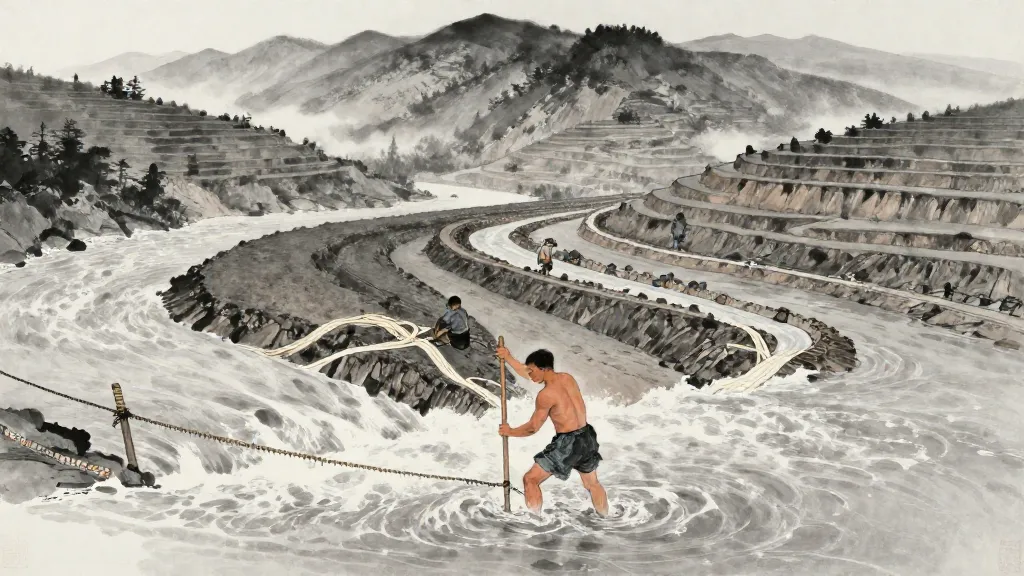
夏本紀 (Annals of the Xia) — Chinese ink painting

Chapter 2 of 130

夏本紀

Annals of the Xia

View:

禹之世系與受命治水

Yu's Lineage and Commission to Control the Flood

夏禹,名曰文命。禹之父曰鯀,鯀之父曰帝顓頊,顓頊之父曰昌意,昌意之父曰黃帝。禹者,黃帝之玄孫而帝顓頊之孫也。禹之曾大父昌意及父鯀皆不得在帝位,為人臣。

當帝堯之時,鴻水滔天,浩浩懷山襄陵,下民其憂。堯求能治水者,群臣四嶽皆曰鯀可。堯曰:「鯀為人負命毀族,不可。」四嶽曰:「等之未有賢於鯀者,願帝試之。」於是堯聽四嶽,用鯀治水。九年而水不息,功用不成。於是帝堯乃求人,更得舜。舜登用,攝行天子之政,巡狩。行視鯀之治水無狀,乃殛鯀於羽山以死。天下皆以舜之誅為是。於是舜舉鯀子禹,而使續鯀之業。

Yu of Xia — his name was Wenming. Yu's father was Gun, Gun's father was Emperor Zhuanxu, Zhuanxu's father was Changyi, and Changyi's father was the Yellow Emperor. Thus Yu was the great-great-grandson of the Yellow Emperor and the grandson of Emperor Zhuanxu. Yu's great-grandfather Changyi and his father Gun had both failed to attain the imperial throne and served as ministers.

In the time of Emperor Yao, the great flood reached to the heavens — its vastness engulfing the mountains and overtopping the hills. The people below were in distress. Yao sought someone who could control the waters. His ministers and the Four Peaks all said Gun could do it. Yao said: "Gun is a man who defies orders and ruins his own kin. He will not do." The Four Peaks said: "Among his peers, none is more capable than Gun. We hope the Emperor will try him." Thereupon Yao heeded the Four Peaks and employed Gun to control the flood. After nine years the waters had not subsided and the work was unfinished.

Emperor Yao then sought another man and found Shun. Shun was elevated and employed, serving as regent and conducting tours of inspection. When he went to observe Gun's flood control, he found it to be without results, and put Gun to death at Mount Yu. All-Under-Heaven regarded Shun's punishment as just. Thereupon Shun raised up Gun's son Yu and tasked him with continuing his father's work.

Notes

1person

Yu the Great (大禹, Dà Yǔ) is one of the most celebrated figures in Chinese civilization — the tamer of the Great Flood and founder of the Xia dynasty, the first hereditary dynasty in Chinese tradition. His personal name Wenming (文命) literally means 'cultured mandate.'

2context

The Great Flood (鴻水/洪水) is the defining event of Chinese legendary history. Unlike the Biblical flood narrative, this is not a story of divine punishment but of hydraulic engineering and political legitimacy — controlling the waters is the supreme test of rulership. Gun tried to dam the waters (堵) and failed; Yu succeeded by channeling them (疏).

3context

The dramatic irony of Shun executing Gun and then appointing Gun's son Yu to complete the work is a key narrative element. It establishes that merit transcends family guilt, and that Yu's success is all the more remarkable given his father's failure and disgrace.

舜命禹治水

Shun Commands Yu to Control the Flood

堯崩,帝舜問四嶽曰:「有能成美堯之事者使居官?」皆曰:「伯禹為司空,可成美堯之功。」舜曰:「嗟,然!」命禹:「女平水土,維是勉之。」禹拜稽首,讓於契、后稷、皋陶。舜曰:「女其往視爾事矣。」

禹為人敏給克勤;其德不違,其仁可親,其言可信;聲為律,身為度,稱以出;亹亹穆穆,為綱為紀。

After Yao died, Emperor Shun asked the Four Peaks: "Who can complete and glorify Yao's work and hold office?" All said: "Bo Yu as Minister of Works can bring Yao's achievements to completion." Shun said: "So be it!" He commanded Yu: "You shall bring the waters and lands to order. Devote yourself to this." Yu bowed low, touching his head to the ground, and deferred to Qi, Houji, and Gaoyao. Shun said: "Go now and see to your task."

Yu as a man was quick, resourceful, and tireless in effort. His virtue never strayed; his benevolence drew others to him; his words could be trusted. His voice was a standard of pitch, his person a standard of measure, and by these he went forth. Diligent and dignified, he served as the warp and weft of order.

Notes

1translation

'His voice was a standard of pitch, his person a standard of measure' (聲為律,身為度) — this idealized description means that Yu's conduct was so perfectly regulated that he himself embodied the standards by which others measured themselves. It also reflects the ancient belief that the sage's body resonated with cosmic order.

禹治水之功業

Yu's Labors in Flood Control

禹乃遂與益、后稷奉帝命,命諸侯百姓興人徒以傅土,行山表木,定高山大川。禹傷先人父鯀功之不成受誅,乃勞身焦思,居外十三年,過家門不敢入。薄衣食,致孝于鬼神。卑宮室,致費於溝淢。陸行乘車,水行乘船,泥行乘橇,山行乘檋。左準繩,右規矩,載四時,以開九州,通九道,陂九澤,度九山。令益予眾庶稻,可種卑溼。命后稷予眾庶難得之食。食少,調有餘相給,以均諸侯。禹乃行相地宜所有以貢,及山川之便利。

Yu then proceeded with Yi and Houji to carry out the Emperor's command. He ordered the feudal lords and common people to raise labor gangs for the earthworks, traversed the mountains and marked the trees, and determined the positions of the great mountains and rivers.

Grieving that his father Gun had failed in the work and been punished with death, Yu labored his body and strained his mind. He lived away from home for thirteen years and did not dare enter his own door when he passed it. He wore the poorest clothes and ate the simplest food, but devoted himself with filial reverence to the spirits. He kept his dwelling humble, but lavished expense on ditches and waterways.

On land he traveled by cart, on water by boat, through mud by sled, and in the mountains by sedan. With leveling cord in his left hand and compass and square in his right, and keeping the four seasons in mind, he opened up the nine provinces, cleared the nine routes, embanked the nine marshes, and surveyed the nine mountains.

He ordered Yi to distribute rice seed among the people for planting in the low, wet lands. He commanded Houji to distribute food that was hard to come by among the people. When food was scarce, he transferred surpluses from one region to supply another, equalizing the feudal lords. Yu then went about inspecting the land to determine what each region could produce as tribute, and assessed the advantages of the mountains and rivers.

Notes

1context

Yu's legendary devotion — passing his own door three times without entering (三過家門而不入) — became one of the most famous anecdotes in Chinese culture, an exemplar of selfless dedication to duty. The original text says thirteen years away and 'not daring to enter,' which later tradition crystallized into the 'three passings' motif.

2translation

The four conveyances — cart, boat, sled (橇), and mountain sedan (檋) — represent Yu's mastery of every terrain. The sled (橇) was for traversing mud flats, and the 檋 was a frame with spikes used for climbing mountains.

3person

Yi (益), also called Boyi (伯益), was Yu's chief assistant in flood control and the management of forests and marshes. He would later contend with Yu's son Qi for the succession to the throne.

九州貢賦(上):冀州至徐州

The Tributes of the Nine Provinces (I): Ji, Yan, Qing, and Xu

禹行自冀州始。冀州:既載壺口,治梁及岐。既修太原,至于嶽陽。覃懷致功,至於衡漳。其土白壤。賦上上錯,田中中,常、衛既從,大陸既為。鳥夷皮服。夾右碣石,入于海。

濟、河維沇州:九河既道,雷夏既澤,雍、沮會同,桑土既蠶,於是民得下丘居土。其土黑墳,草繇木條。田中下,賦貞,作十有三年乃同。其貢漆絲,其篚織文。浮於濟、漯,通於河。

海岱維青州:堣夷既略,濰、淄其道。其土白墳,海濱廣潟,厥田斥鹵。田上下,賦中上。厥貢鹽絺,海物維錯,岱畎絲、枲、鉛、松、怪石,萊夷為牧,其篚酓絲。浮於汶,通於濟。

海岱及淮維徐州:淮、沂其治,蒙、羽其藝。大野既都,東原底平。其土赤埴墳,草木漸包。其田上中,賦中中。貢維土五色,羽畎夏狄,嶧陽孤桐,泗濱浮磬,淮夷蠙珠臮魚,其篚玄纖縞。浮于淮、泗,通于河。

Yu began his work from Jizhou.

Jizhou: Once Hukou was brought under control, he regulated the Liang and Qi mountains. Having restored Taiyuan, he proceeded to the south of Mount Yue. The Tanhuai region was brought to order as far as the Heng and Zhang rivers. Its soil is white loam. Its tax grade is the highest with mixed assessments; its field grade is middle-middle. The Chang and Wei rivers were channeled, and the Great Land marsh was drained. The Bird Yi people wear fur garments. The route follows the right side of Jieshi and enters the sea.

Yanzhou lies between the Ji and Yellow Rivers: the Nine Rivers were channeled, Lei Marsh was formed into a lake, the Yong and Ju rivers were brought together, and the mulberry lands were made fit for silkworms — thereupon the people could come down from the hills and settle on the land. Its soil is black and rich; the grasses are luxuriant and the trees tall. Its field grade is middle-lower; its tax was stabilized only after thirteen years. Its tribute is lacquer and silk; its baskets contain patterned textiles. Transport is by the Ji and Luo rivers, connecting to the Yellow River.

Qingzhou lies between the sea and Mount Dai: the Yuyi people were brought to order, and the Wei and Zi rivers were channeled. Its soil is white and rich; the seacoast has broad salt flats, and the fields are alkaline. Its field grade is upper-lower; its tax grade is middle-upper. Its tribute is salt and fine hemp cloth, along with a variety of sea products. From the valleys of Dai come silk, hemp, lead, pine, and rare stones. The Lai Yi people are herders. Its baskets contain dark silk. Transport is by the Wen River, connecting to the Ji.

Xuzhou lies between the sea, Mount Dai, and the Huai River: the Huai and Yi rivers were brought under control, and the Meng and Yu mountains were cultivated. Lake Daye was managed, and the Eastern Plain was leveled. Its soil is red clay, rich and loamy; the grasses and trees grow increasingly lush. Its field grade is upper-middle; its tax grade is middle-middle. Its tribute includes earth of five colors, pheasant feathers from the Yu valley, the solitary paulownia of the sunny slope of Mount Yi, floating chime-stones from the banks of the Si, pearls and fish from the Huai Yi people, and its baskets contain black and fine white silk. Transport is by the Huai and Si rivers, connecting to the Yellow River.

Notes

1context

This passage is drawn directly from the 'Tribute of Yu' (禹貢) chapter of the Book of Documents, the oldest geographical text in Chinese literature. It describes the nine provinces of the idealized Xia domain, their soils, products, tax grades, and tribute routes. Though the description reflects later Zhou-period knowledge projected back onto a legendary era, it remains invaluable as the earliest systematic description of China's geography.

2place

Jizhou (冀州) was the central province, roughly corresponding to modern Shanxi and Hebei. As Yu's starting point, it represents the political center of the realm.

3place

Hukou (壺口) is the famous gorge on the Yellow River at the border of Shanxi and Shaanxi, where the river narrows dramatically. The Hukou Waterfall there remains one of China's most spectacular natural sites.

4place

Jieshi (碣石) is a coastal mountain traditionally identified with a site in modern Changli County, Hebei, on the Bohai Sea coast.

九州貢賦(下):揚州至雍州

The Tributes of the Nine Provinces (II): Yang, Jing, Yu, Liang, and Yong

淮海維揚州:彭蠡既都,陽鳥所居。三江既入,震澤致定。竹箭既布。其草惟夭,其木惟喬,其土涂泥。田下下,賦下上上雜。貢金三品,瑤、琨、竹箭,齒、革、羽、旄,島夷卉服,其篚織貝,其包橘、柚錫貢。均江海,通淮、泗。

荊及衡陽維荊州:江、漢朝宗于海。九江甚中,沱、涔已道,云土、夢為治。其土涂泥。田下中,賦上下。貢羽、旄、齒、革,金三品,杶、榦、栝、柏,礪、砥、砮、丹,維箘簬、楛,三國致貢其名,包匭菁茅,其篚玄纁璣組,九江入賜大龜。浮于江、沱、涔、(于)漢,踰于雒,至于南河。

荊河惟豫州:伊、雒、瀍、澗既入于河,滎播既都,道荷澤,被明都。其土壤,下土墳壚。田中上,賦雜上中。貢漆、絲、絺、紵,其篚纖絮,錫貢磬錯。浮於雒,達於河。

華陽黑水惟梁州:汶、嶓既藝,沱、涔既道,蔡、蒙旅平,和夷厎績。其土青驪。田下上,賦下中三錯。貢璆、鐵、銀、鏤、砮、磬,熊、羆、狐、貍、織皮。西傾因桓是來,浮于潛,踰于沔,入于渭,亂于河。

黑水西河惟雍州:弱水既西,涇屬渭汭。漆、沮既從,灃水所同。荊、岐已旅,終南、敦物至于鳥鼠。原隰厎績,至于都野。三危既度,三苗大序。其土黃壤。田上上,賦中下。貢璆、琳、瑯玕。浮于積石,至于龍門西河,會于渭汭。織皮昆侖、析支、渠搜,西戎即序。

Yangzhou lies between the Huai and the sea: Lake Pengli was managed, and it became a nesting ground for the sun-birds. The Three Rivers flowed together, and Zhen Marsh was brought to rest. Bamboo and arrow-bamboo were widespread. Its grasses are lush, its trees tall, and its soil is muddy clay. Its field grade is lower-lower; its tax grade is lower-upper with mixed upper assessments. Its tribute includes metals of three grades, jade, jasper, bamboo arrows, ivory, leather, feathers, and yak tail, and the Island Yi people wear garments of plant fiber. Its baskets contain woven cowrie shells, and its wrapped gifts of oranges and pomelos are presented in tribute. Transport crosses the Yangtze and sea, connecting to the Huai and Si.

Jingzhou lies between the Jing Mountains and the south side of Mount Heng: the Yangtze and Han rivers pay their tribute to the sea. The Nine Rivers flow through the central region; the Tuo and Cen rivers are channeled; the Yunmeng wetlands are regulated. Its soil is muddy clay. Its field grade is lower-middle; its tax grade is upper-lower. Its tribute includes feathers, yak tail, ivory, and leather; metals of three grades; chun, gan, gua, and cypress timbers; whetstones, grindstones, arrowheads, and cinnabar; jun and lu bamboos and hu arrows — three states send these in tribute by name. Wrapped gifts include the sacred jingmao grass. Its baskets contain black and crimson jade beads and braids. The region of the Nine Rivers presents its gift of great turtles. Transport is by the Yangtze, Tuo, Cen, and Han rivers, crossing overland to the Luo and reaching the Southern River.

Yuzhou lies between the Jing Mountains and the Yellow River: the Yi, Luo, Chan, and Jian rivers flow into the Yellow River. The Ying marsh is managed and Lake He is channeled, extending to Mingdu. Its upper soil is loam; the subsoil is rich clay. Its field grade is middle-upper; its tax grade is mixed upper-middle. Its tribute includes lacquer, silk, fine hemp, and ramie. Its baskets contain fine floss. Chime-stones are presented as gifts. Transport is by the Luo River, reaching the Yellow River.

Liangzhou lies between the south of Mount Hua and the Black River: the Wen and Bo mountains are cultivated; the Tuo and Cen rivers are channeled; Mounts Cai and Meng are surveyed and leveled, and the He Yi people are brought to order. Its soil is blue-black. Its field grade is lower-upper; its tax grade is lower-middle with triple mixed assessments. Its tribute includes jade, iron, silver, engraved metals, arrowheads, and chime-stones, as well as bear, grizzly, fox, and wildcat skins and woven hides. Transport comes eastward from the Xiqing Mountains following the Huan route, floating on the Qian River, crossing overland to the Mian, entering the Wei, and joining the Yellow River.

Yongzhou lies between the Black River and the Western River: the Ruo River flows west; the Jing River joins the Wei at the bend. The Qi and Ju rivers are channeled; the Feng River flows together with them. The Jing and Qi mountains are surveyed; Zhongnan and Dunwu extend to Niaoshu. The plateau and lowlands are brought to order as far as Duye. The Sanwei region is pacified and the Sanmiao people are well governed. Its soil is yellow loam. Its field grade is upper-upper; its tax grade is middle-lower. Its tribute includes jade, precious jade, and langgan gems. Transport floats on the river from Jishi, reaching Longmen on the Western River and joining the Wei at the bend. The fur-clad peoples of Kunlun, Xizhi, and Qusou — the Western Rong — are brought into the system.

Notes

1place

Pengli (彭蠡) is the ancient name for Poyang Lake in Jiangxi, the largest freshwater lake in China.

2place

Zhen Marsh (震澤) is the ancient name for Lake Tai (太湖) in Jiangsu, the third-largest freshwater lake in China.

3place

Yunmeng (云夢) was a vast marshland in modern Hubei, much of which has since been drained or silted up. In the Warring States period it was still a famous hunting ground of the Chu kings.

4place

Longmen (龍門, 'Dragon Gate') is the gorge where the Yellow River cuts through the Lüliang Mountains at the border of Shanxi and Shaanxi. In Chinese legend, carp that leap the rapids at Longmen are transformed into dragons — the origin of the metaphor for success in the imperial examinations.

5context

The Tribute of Yu establishes a tax and field grading system with nine levels (upper-upper through lower-lower). Yongzhou has the highest field grade (upper-upper) but only a middle-lower tax, reflecting the principle that productive land should not be overtaxed — a lesson later dynasties frequently ignored.

導山導水

Channeling the Mountains and Rivers

道九山:汧及岐至于荊山,踰于河;壺口、雷首至于太嶽;砥柱、析城至于王屋;太行、常山至于碣石,入于海;西傾、朱圉、鳥鼠至于太華;熊耳、外方、桐柏至于負尾;道嶓冢,至于荊山;內方至于大別;汶山之陽至衡山,過九江,至于敷淺原。

道九川:弱水至於合黎,餘波入于流沙。道黑水,至于三危,入于南海。道河積石,至于龍門,南至華陰,東至砥柱,又東至于盟津,東過雒汭,至于大邳,北過降水,至于大陸,北播為九河,同為逆河,入于海。嶓冢道瀁,東流為漢,又東為蒼浪之水,過三澨,入于大別,南入于江,東匯澤為彭蠡,東為北江,入于海。汶山道江,東別為沱,又東至于醴,過九江,至于東陵,東迆北會于匯,東為中江,入于梅。道沇水,東為濟,入于河,泆為滎,東出陶丘北,又東至于荷,又東北會于汶,又東北入于海。道淮自桐柏,東會于泗、沂,東入于海。道渭自鳥鼠同穴,東會于灃,又東北至于涾,東過漆、沮,入于河。道雒自熊耳,東北會于澗、瀍,又東會于伊,東北入于河。

He channeled the nine mountain ranges: from Qian and Qi to Mount Jing, crossing the Yellow River; from Hukou and Leishou to Mount Taiyue; from Dizhu and Xicheng to Wangwu; from Taihang and Changshan to Jieshi, reaching the sea; from Xiqing, Zhuyu, and Niaoshu to Mount Taihua; from Xiong'er, Waifang, and Tongbai to Fuwei; he channeled from Bozhong to Mount Jing; from Neifang to Dabie; from the south slope of Mount Wen to Mount Heng, past the Nine Rivers, reaching Fuqian Plain.

He channeled the nine rivers: the Ruo River flows to Heli, its remaining waters entering the Flowing Sands. He channeled the Black River to Sanwei, entering the Southern Sea. He channeled the Yellow River from Jishi to Longmen, south to Huayin, east to Dizhu, then further east to Mengjin, east past the bend of the Luo to Dapi, north past the Jiang River to the Great Land marsh, where it spreads north into the Nine Rivers and converges into the Reverse River before entering the sea.

From Bozhong he channeled the Yang River, which flows east to become the Han, then east again to become the Canglang River. It passes the Three Shi, enters Dabie, flows south into the Yangtze, and east into the marshes forming Lake Pengli. It continues east as the Northern Yangtze and enters the sea.

From Mount Wen he channeled the Yangtze, which branches east into the Tuo, then east to Li, past the Nine Rivers to Dongling. It flows northeast to join the marshes, becoming the Middle Yangtze, and enters the sea.

He channeled the Yan River, which flows east to become the Ji, enters the Yellow River, overflows as the Ying, exits east of Taoqiu to the north, then east to Lake He, northeast to join the Wen, and northeast again to enter the sea.

He channeled the Huai from Tongbai, flowing east to join the Si and Yi, then east into the sea.

He channeled the Wei from the Niaoshu-Tongxue mountain, flowing east to join the Feng, northeast to the Ta, east past the Qi and Ju, and into the Yellow River.

He channeled the Luo from Mount Xiong'er, flowing northeast to join the Jian and Chan, then east to join the Yi, and northeast into the Yellow River.

Notes

1place

Dizhu (砥柱, 'Pillar of Stone') was a famous rock formation in the Yellow River gorge in modern Sanmenxia, Henan. It was a navigation hazard that became a metaphor for steadfastness (中流砥柱, 'pillar in midstream').

2place

Mengjin (盟津) is the ancient ford of the Yellow River near modern Mengjin District, Luoyang, Henan. It was where King Wu of Zhou later mustered his army of eight hundred lords before conquering the Shang.

3context

This section traces the courses of China's major rivers with remarkable geographical accuracy for an ancient text. The description of the Yellow River's course from its source at Jishi (積石, modern Qinghai) through the Longmen gorge, past the great cities of the central plain, and finally spreading into the Nine Rivers of the Hebei plain before reaching the sea, remained the standard description for centuries.

九州統一與五服制

The Unification of the Nine Provinces and the Five Zones of Submission

於是九州攸同,四奧既居,九山刊旅,九川滌原,九澤既陂,四海會同。六府甚修,眾土交正,致慎財賦,咸則三壤成賦。中國賜土姓:「祗臺德先,不距朕行。」

令天子之國以外五百里甸服:百里賦納總,二百里納銍,三百里納秸服,四百里粟,五百里米。甸服外五百里侯服:百里采,二百里任國,三百里諸侯。侯服外五百里綏服:三百里揆文教,二百里奮武衛。綏服外五百里要服:三百里夷,二百里蔡。要服外五百里荒服:三百里蠻,二百里流。

東漸于海,西被于流沙,朔、南暨:聲教訖于四海。於是帝錫禹玄圭,以告成功于天下。天下於是太平治。

And so the nine provinces were unified; the four corners were settled. The nine mountain ranges were surveyed and made traversable, the nine rivers were dredged to their sources, the nine marshes were embanked, and the four seas were brought into communion. The six treasuries were well maintained, the many lands were mutually assessed, resources and tribute were carefully determined, and all were taxed according to the three grades of soil.

The Central Kingdom was granted lands and surnames, with the pronouncement: "Reverence for my virtue comes first — do not oppose my ways."

Beyond the Son of Heaven's domain, the first five hundred li were the Dian Zone of direct service: within the first hundred li, tribute was whole stalks of grain; at two hundred li, cut grain; at three hundred li, straw for service; at four hundred li, unhusked millet; at five hundred li, husked rice. Beyond the Dian Zone, the next five hundred li were the Hou Zone of feudal service: the first hundred li for imperial estates, the next two hundred li for appointed states, and the remaining three hundred li for feudal lords. Beyond the Hou Zone, five hundred li were the Sui Zone of pacification: three hundred li for cultural and educational influence, two hundred li for military defense. Beyond the Sui Zone, five hundred li were the Yao Zone of controlled allegiance: three hundred li for the Yi peoples, two hundred li for the Cai peoples. Beyond the Yao Zone, five hundred li were the Huang Zone of the wild frontier: three hundred li for the Man peoples, two hundred li for the banished.

To the east it reached the sea, to the west the Flowing Sands, and north and south it extended to the uttermost limits. The influence of voice and teaching reached to the four seas. Thereupon the Emperor bestowed upon Yu the dark jade tablet, announcing the completion of his work to All-Under-Heaven. All-Under-Heaven was then at great peace.

Notes

1context

The Five Zones of Submission (五服) is one of the most influential political models in Chinese history. It envisions the empire as concentric rings radiating outward from the capital, with decreasing levels of control and increasing cultural distance. Though idealized, this model shaped how Chinese emperors thought about their relationship to frontier peoples for millennia.

2translation

The 'dark jade tablet' (玄圭) was a ritual object of black jade. The bestowal signifies Shun's formal recognition of Yu's achievement — it is effectively the transfer of legitimacy that precedes the transfer of the throne itself.

3context

The tribute grades by distance — whole stalks, cut grain, straw, unhusked millet, husked rice — reflect a practical logic: the further the distance, the more processed (and lighter) the grain must be to justify transport costs.

皋陶與禹論治國之道

Gaoyao and Yu Discuss the Principles of Governance

皋陶作士以理民。帝舜朝,禹、伯夷、皋陶相與語帝前。皋陶述其謀曰:「信其道德,謀明輔和。」禹曰:「然,如何?」皋陶曰:「於!慎其身修,思長,敦序九族,眾明高翼,近可遠在已。」禹拜美言,曰:「然。」皋陶曰:「於!在知人,在安民。」禹曰:「吁!皆若是,惟帝其難之。知人則智,能官人;能安民則惠,黎民懷之。能知能惠,何憂乎驩兜,何遷乎有苗,何畏乎巧言善色佞人?」皋陶曰:「然,於!亦行有九德,亦言其有德。」乃言曰:「始事事,寬而栗,柔而立,願而共,治而敬,擾而毅,直而溫,簡而廉,剛而實,彊而義,章其有常,吉哉。日宣三德,蚤夜翊明有家。日嚴振敬六德,亮采有國。翕受普施,九德咸事,俊乂在官,百吏肅謹。毋教邪淫奇謀。非其人居其官,是謂亂天事。天討有罪,五刑五用哉。吾言厎可行乎?」禹曰:「女言致可績行。」皋陶曰:「余未有知,思贊道哉。」

Gaoyao served as Minister of Justice to govern the people. At Emperor Shun's court, Yu, Boyi, and Gaoyao conversed before the Emperor. Gaoyao set forth his counsel: "Trust in virtue and moral principle, and the plans will be clear and the assistance harmonious." Yu said: "Indeed, but how?" Gaoyao said: "Ah! Be careful in cultivating one's own person, think of the long term, earnestly order the nine degrees of kinship, and the many worthy men will support and assist from on high — what is near can be managed, and what is far rests with oneself."

Yu bowed and praised these words, saying: "Indeed." Gaoyao said: "The key lies in knowing men and in giving the people peace." Yu said: "Alas! Both are as you say, yet even the Emperor finds them difficult. To know men is wisdom — then one can appoint the right officials. To give the people peace is benevolence — then the common people will cherish the ruler. If one can both know men and act with benevolence, why worry about a Huandou? Why exile a Sanmiao? Why fear the flatterer with clever words and a pleasing face?"

Gaoyao said: "Indeed! In conduct there are nine virtues, and one must speak of possessing them." He then said: "To begin every task with diligence; to be broad yet firm; to be gentle yet resolute; to be deliberate yet respectful; to be tractable yet determined; to be upright yet warm; to be simple yet incorruptible; to be strong yet true; to be bold yet righteous — to display these with constancy, that is auspicious. If one daily practices three of these virtues, rising early and working late, one can hold a noble house. If one daily maintains with reverence six of these virtues, one can illuminate and govern a state. If one gathers and universally applies all nine virtues, then the talented and worthy fill the offices, and the hundred officials are solemn and diligent. Do not teach crooked, licentious, or cunning schemes. If the wrong man occupies an office, that is called bringing chaos to Heaven's work. Heaven punishes the guilty — use the five punishments in their five applications. Can my words be put into practice?"

Yu said: "Your words can assuredly be carried out with lasting effect." Gaoyao said: "I do not yet possess understanding — I only aspire to assist the Way."

Notes

1context

This dialogue corresponds to the 'Counsels of the Great Yu' (大禹謨) and 'Counsels of Gaoyao' (皋陶謨) in the Book of Documents. The nine virtues (九德) became a standard framework for evaluating officials and were cited throughout Chinese political history.

2translation

Each of the nine virtues is stated as a pair of opposing qualities held in balance: 'broad yet firm' (寬而栗), 'gentle yet resolute' (柔而立), etc. The ideal official is not simply virtuous in one direction but holds complementary virtues in tension — a concept of moral balance that runs throughout Chinese political thought.

禹與舜論治水與為政

Yu and Shun Discuss Flood Control and Government

帝舜謂禹曰:「女亦昌言。」禹拜曰;「於,予何言!予思日孳孳。」皋陶難禹曰:「何謂孳孳?」禹曰:「鴻水滔天,浩浩懷山襄陵,下民皆服於水。予陸行乘車,水行乘舟,泥行乘橇,山行乘檋,行山刊木。與益予眾庶稻鮮食。以決九川致四海,浚畎澮致之川。與稷予眾庶難得之食。食少,調有餘補不足,徙居。眾民乃定,萬國為治。」皋陶曰:「然,此而美也。」

禹曰:「於,帝!慎乃在位,安爾止。輔德,天下大應。清意以昭待上帝命,天其重命用休。」帝曰:「吁,臣哉,臣哉!臣作朕股肱耳目。予欲左右有民,女輔之。余欲觀古人之象。日月星辰,作文繡服色,女明之。予欲聞六律五聲八音,來始滑,以出入五言,女聽。予即辟,女匡拂予。女無面諛。退而謗予。敬四輔臣。諸眾讒嬖臣,君德誠施皆清矣。」禹曰:「然。帝即不時,布同善惡則毋功。」

Emperor Shun said to Yu: "Speak freely as well." Yu bowed and said: "Ah, what can I say? I think only of working tirelessly day by day." Gaoyao challenged him: "What do you mean by tirelessly?" Yu said: "When the great flood reached to the heavens, its vastness engulfing mountains and overtopping hills, the people below were all overwhelmed by the waters. On land I rode in carts, on water in boats, through mud on sleds, and in the mountains on sedans. I traversed the mountains and cleared the trees. With Yi, I provided the people with rice and fresh food. I opened the nine rivers to reach the four seas and dredged the ditches and canals to feed the rivers. With Houji, I provided the people with food that was hard to come by. When food was scarce, I transferred surpluses to make up deficits, and relocated people as needed. The masses then settled, and the myriad states were brought to order."

Gaoyao said: "Indeed — this achievement of yours is magnificent."

Yu said: "Ah, Emperor! Be careful in your position and secure in your conduct. Support virtue, and All-Under-Heaven will greatly respond. With a pure mind and clear intent, await the command of the Supreme Deity, and Heaven will renew its mandate with blessings." The Emperor said: "Ministers! Ministers! Ministers are my arms, legs, eyes, and ears. I wish to assist and protect the people — you shall help me. I wish to observe the patterns of the ancients — the sun, moon, and stars, the embroidered designs on ritual garments — you shall make them clear to me. I wish to hear the six pitches, five tones, and eight instruments, and to detect the onset of disorder through the coming and going of the five kinds of speech — you shall listen for me. If I stray from the right path, you shall correct and admonish me. Do not flatter me to my face and slander me behind my back. Respect the four chief ministers. As for the many slanderers and favorites — when the ruler's virtue is sincerely practiced, all will be pure."

Yu said: "Indeed. If the Emperor does not act at the right time and treats good and evil alike, then nothing will be accomplished."

Notes

1translation

'Ministers are my arms, legs, eyes, and ears' (臣作朕股肱耳目) — this metaphor of the body politic, in which the ruler is the head and ministers are the limbs and senses, became one of the most enduring political metaphors in Chinese history. It appears repeatedly in later imperial discourse.

2context

Shun's injunction to 'correct me if I stray, do not flatter me to my face and slander me behind my back' (女匡拂予。女無面諛。退而謗予) became the standard against which ministerial conduct was measured. The duty of remonstrance (諫) — speaking truth to power — was considered the highest obligation of a minister.

舜禹歌詩與天下歸禹

The Songs of Shun and Yu, and All-Under-Heaven Turns to Yu

帝曰:「毋若丹朱傲,維慢游是好,毋水行舟,朋淫于家,用絕其世。予不能順是。」禹曰:「予(辛壬)娶涂山,[辛壬]癸甲,生啟予不子,以故能成水土功。輔成五服,至于五千里,州十二師,外薄四海,咸建五長,各道有功。苗頑不即功,帝其念哉。」帝曰:「道吾德,乃女功序之也。」

皋陶於是敬禹之德,令民皆則禹。不如言,刑從之。舜德大明。

於是夔行樂,祖考至,群后相讓,鳥獸翔舞,簫韶九成,鳳皇來儀,百獸率舞,百官信諧。帝用此作歌曰:「陟天之命,維時維幾。」乃歌曰:「股肱喜哉,元首起哉,百工熙哉!」皋陶拜手稽首揚言曰:「念哉,率為興事,慎乃憲,敬哉!」乃更為歌曰:「元首明哉,股肱良哉,庶事康哉!」(舜)又歌曰:「元首叢脞哉,股肱惰哉,萬事墮哉!」帝拜曰:「然,往欽哉!」於是天下皆宗禹之明度數聲樂,為山川神主。

The Emperor said: "Do not be like Danxhu in his arrogance — he delighted only in idle roaming. Without water, he would go boating; he debauched with companions at home, and thereby cut off his line. I could not abide this." Yu said: "On the day xinren I married a woman of Tushan, and by the days guijia she bore my son Qi. I did not act as a father to him — and for this reason I was able to complete the work of water and land. I helped establish the Five Zones extending five thousand li, appointed twelve commanders to the provinces, and reached outward to the four seas, establishing five chiefs in each region, each with its own achievements. Yet the Miao remain stubborn and will not submit — may the Emperor give this thought." The Emperor said: "The spread of my virtue — it is through the ordering of your achievements."

Gaoyao thereupon honored Yu's virtue and commanded the people to take Yu as their model. Those who did not comply with this pronouncement were punished. The virtue of Shun shone greatly.

Thereupon Kui performed the music. The spirits of ancestors came; the lords yielded to one another in courtesy. Birds and beasts soared and danced. When the Shao music reached its ninth movement, phoenixes appeared in ceremony and the hundred beasts all danced. The hundred officials were in true harmony.

The Emperor composed a song for this occasion, saying: "Ascending to Heaven's mandate — it is all timing and the critical moment." He then sang: "The limbs rejoice! The head rises! The hundred works all prosper!" Gaoyao bowed with hands clasped, touched his head to the ground, and proclaimed: "Be mindful! Lead all endeavors with vigor, and be careful of your laws — be reverent!" He then sang in turn: "When the head is wise, the limbs are good, and the myriad affairs are at peace!" Shun sang again: "When the head is muddled, the limbs grow lazy, and the ten thousand affairs all fail!"

The Emperor bowed and said: "Indeed. Go forth, and be reverent!" Thereupon All-Under-Heaven looked to Yu as master of the clear measures, numbers, sounds, and music, and he became lord of the spirits of mountains and rivers.

Notes

1person

Qi (啟) was Yu's son and the founder of hereditary succession in the Xia dynasty. Yu's remark that he 'did not act as a father' (不子) — because he was away controlling the flood — highlights the tension between public duty and family obligation that runs throughout the chapter.

2context

The Shao music (韶樂) was the legendary music of Shun, considered the most sublime music ever composed. Confucius, upon hearing it in the state of Qi, reportedly 'did not notice the taste of meat for three months' (三月不知肉味). The nine movements (九成) represent perfection.

3context

The paired songs of ruler and minister — head (元首) and limbs (股肱) — express the ideal of mutual dependence between sovereign and officials. The warning song about a muddled head and lazy limbs introduces a note of caution even at the moment of greatest triumph.

4person涂山氏Túshān shì

The woman of Tushan (涂山氏) was Yu's wife. The Tushan clan was located in modern Bengbu, Anhui or possibly Chongqing. Yu's marriage was notoriously brief — he left his bride almost immediately to continue the flood work.

禹即位與傳位之爭

Yu Ascends the Throne and the Succession Dispute

帝舜薦禹於天,為嗣。十七年而帝舜崩。三年喪畢,禹辭辟舜之子商均於陽城。天下諸侯皆去商均而朝禹。禹於是遂即天子位,南面朝天下,國號曰夏后,姓姒氏。

帝禹立而舉皋陶薦之,且授政焉,而皋陶卒。封皋陶之後於英、六,或在許。而后舉益,任之政。

十年,帝禹東巡狩,至于會稽而崩。以天下授益。三年之喪畢,益讓帝禹之子啟,而辟居箕山之陽。禹子啟賢,天下屬意焉。及禹崩,雖授益,益之佐禹日淺,天下未洽。故諸侯皆去益而朝啟,曰:「吾君帝禹之子也」。於是啟遂即天子之位,是為夏后帝啟。

Emperor Shun recommended Yu to Heaven as his successor. Seventeen years later, Emperor Shun died. When the three years of mourning were complete, Yu withdrew and yielded to Shun's son Shangjun, retiring to Yangcheng. But all the feudal lords in All-Under-Heaven left Shangjun and came to pay court to Yu. Thereupon Yu ascended the throne of the Son of Heaven, facing south to receive the allegiance of All-Under-Heaven. His dynastic name was Lord of Xia, and his clan name was Si.

When Emperor Yu took the throne, he raised up Gaoyao, recommended him, and was about to entrust him with the government — but Gaoyao died. He enfeoffed Gaoyao's descendants at Ying and Liu, and some were at Xu. He then raised up Yi and entrusted him with the government.

In his tenth year, Emperor Yu traveled east on a tour of inspection, reached Kuaiji, and died. He bequeathed All-Under-Heaven to Yi. When the three years of mourning were complete, Yi yielded to Emperor Yu's son Qi and withdrew to the south side of Mount Ji.

But Yu's son Qi was worthy, and All-Under-Heaven had set its heart on him. When Yu died, although Yi had been designated successor, Yi had served Yu only a short time and had not yet won the allegiance of All-Under-Heaven. Therefore all the feudal lords left Yi and came to pay court to Qi, saying: "He is the son of our lord Emperor Yu." Thereupon Qi ascended the throne of the Son of Heaven — this was Xia Lord Emperor Qi.

Notes

1context

This passage narrates the most consequential political transition in Chinese legendary history: the end of 'abdication to the worthy' (禪讓) and the beginning of hereditary succession. Yu nominally passes the throne to his minister Yi, but the feudal lords choose Yu's son Qi instead. Sima Qian presents this as natural and voluntary, but later traditions — especially the Bamboo Annals — suggest Qi seized power by force, killing Yi.

2place

Kuaiji (會稽) is in modern Shaoxing, Zhejiang. According to tradition, Yu convened the feudal lords here ('Kuaiji' means 'to gather and reckon'), and it became his burial place. The Yu Temple (禹廟) at Kuaiji remains an important memorial.

3place

Yangcheng (陽城) is traditionally identified with a site in modern Gaocheng, Hebei, or Dengfeng, Henan. The Erlitou archaeological site near Dengfeng is often identified as a Xia capital.

夏朝諸帝

The Rulers of the Xia Dynasty

夏后帝啟,禹之子,其母涂山氏之女也。

有扈氏不服,啟伐之,大戰於甘。將戰,作甘誓,乃召六卿申之。啟曰:「嗟!六事之人,予誓告女:有扈氏威侮五行,怠棄三正,天用勦絕其命。今予維共行天之罰。左不攻于左,右不攻于右,女不共命。御非其馬之政,女不共命。用命,賞于祖;不用命,僇于社,予則帑僇女。」遂滅有扈氏。天下咸朝。

夏后帝啟崩,子帝太康立。帝太康失國,昆弟五人,須于洛汭,作五子之歌。

太康崩,弟中康立,是為帝中康。帝中康時,羲、和湎淫,廢時亂日。胤往征之,作胤征。

中康崩,子帝相立。帝相崩,子帝少康立。帝少康崩,子帝予立。帝予崩,子帝槐立。帝槐崩,子帝芒立。帝芒崩,子帝泄立。帝泄崩,子帝不降立。帝不降崩,弟帝扃立。帝扃崩,子帝廑立。帝廑崩,立帝不降之子孔甲,是為帝孔甲。帝孔甲立,好方鬼神,事淫亂。夏后氏德衰,諸侯畔之。天降龍二,有雌雄,孔甲不能食,未得豢龍氏。陶唐既衰,其后有劉累,學擾龍于豢龍氏,以事孔甲。孔甲賜之姓曰御龍氏,受豕韋之後。龍一雌死,以食夏后。夏后使求,懼而遷去。

Xia Lord Emperor Qi was the son of Yu. His mother was a woman of the Tushan clan.

The Youhu clan refused to submit. Qi attacked them, and a great battle was fought at Gan. Before the battle, he composed the Oath at Gan and summoned the six ministers to hear it. Qi said: "Attend, you men of the six commands! I solemnly declare to you: the Youhu clan has insulted and defied the Five Phases and abandoned the three standards. Heaven has therefore decreed the destruction of their mandate. Now I merely carry out Heaven's punishment. If those on the left do not attack on the left, or those on the right do not attack on the right, you disobey orders. If your charioteers fail to control their horses properly, you disobey orders. Those who obey orders will be rewarded at the ancestral temple; those who disobey will be executed at the altar of earth — and I will enslave your families." The Youhu were destroyed. All-Under-Heaven submitted.

When Emperor Qi died, his son Emperor Taikang succeeded him. Emperor Taikang lost the kingdom. His five brothers waited at the bend of the Luo River and composed the Songs of the Five Sons.

When Taikang died, his brother Zhongkang succeeded him — this was Emperor Zhongkang. In Emperor Zhongkang's time, the Xi and He astronomers had become dissolute and neglectful, abandoning the calendar and misaligning the days. The lord of Yin led a punitive expedition against them, recorded as the Punitive Expedition of Yin.

When Zhongkang died, his son Emperor Xiang succeeded him. When Emperor Xiang died, his son Emperor Shaokang succeeded him. When Shaokang died, his son Emperor Yu succeeded him. When Emperor Yu died, his son Emperor Huai succeeded him. When Huai died, his son Emperor Mang succeeded him. When Mang died, his son Emperor Xie succeeded him. When Xie died, his son Emperor Bujiang succeeded him. When Bujiang died, his brother Emperor Jiong succeeded him. When Jiong died, his son Emperor Jin succeeded him. When Jin died, the son of Bujiang, Kongjia, was enthroned — this was Emperor Kongjia.

When Emperor Kongjia took the throne, he was fond of shamanic rites and spirit worship, and his conduct was dissolute. The virtue of the Xia lords declined, and the feudal lords rebelled. Heaven sent down two dragons, male and female. Kongjia could not feed them and had not obtained the services of the Dragon-Keeper clan. The house of Tao Tang had declined, but among its descendants was Liu Lei, who had learned to rear dragons from the Dragon-Keeper clan. He served Kongjia. Kongjia granted him the surname Yulong, 'Dragon-Charioteer,' and he received the fiefdom of Shiwei. When the female dragon died, he served it as food to the Xia lord. When the Xia lord sent for more, Liu Lei was afraid and fled.

Notes

1context

The Oath at Gan (甘誓) is one of the earliest military proclamations preserved in the Book of Documents. The battle at Gan, traditionally located near modern Hu County, Shaanxi, established Qi's authority over the feudal lords who resisted hereditary rule.

2context

Emperor Taikang 'losing the kingdom' (失國) is a cryptic reference to what later traditions elaborate as the usurpation by Hou Yi (后羿), the legendary archer. Sima Qian's account is strikingly compressed here, omitting the dramatic details found in other sources.

3context

The Xi and He astronomers neglecting the calendar is a serious political matter: in Chinese cosmology, the calendar is the foundation of legitimate rule. Failing to maintain it amounts to dereliction of the ruler's most sacred duty.

4context

The dragon-keeping episode under Kongjia is one of the most peculiar passages in the Shiji. Whether 'dragons' (龍) refers to actual animals (perhaps crocodiles or large reptiles) or is purely mythological remains debated. The Liu Lei clan later became the ancestors of the state of Fan and, through them, the Liu family that founded the Han dynasty.

夏桀亡國

The Fall of Jie and the End of the Xia

孔甲崩,子帝皋立。帝皋崩,子帝發立。帝發崩,子帝履癸立,是為桀。帝桀之時,自孔甲以來而諸侯多畔夏,桀不務德而武傷百姓,百姓弗堪。乃召湯而囚之夏臺,已而釋之。湯修德,諸侯皆歸湯,湯遂率兵以伐夏桀。桀走鳴條,遂放而死。桀謂人曰:「吾悔不遂殺湯於夏臺,使至此。」湯乃踐天子位,代夏朝天下。湯封夏之後,至周封於杞也。

When Kongjia died, his son Emperor Gao succeeded him. When Emperor Gao died, his son Emperor Fa succeeded him. When Emperor Fa died, his son Emperor Lügui succeeded him — this was Jie.

In Emperor Jie's time, from Kongjia onward the feudal lords had increasingly rebelled against the Xia. Jie did not attend to virtue but used military force to harm the people. The people could not bear it. He summoned Tang and imprisoned him at Xiatai, but later released him.

Tang cultivated virtue, and all the feudal lords turned to him. Tang then led his armies to attack Jie of the Xia. Jie fled to Mingtiao, where he was exiled and died. Jie said to those around him: "I regret that I did not kill Tang at Xiatai — that it has come to this."

Tang then ascended the throne of the Son of Heaven, replacing the Xia as ruler of All-Under-Heaven. Tang enfeoffed the descendants of the Xia — the Zhou dynasty later enfeoffed them at Qi.

Notes

1personJié

Jie (桀), personal name Lügui (履癸), is the archetypal tyrant of Chinese history, paired with Zhou of Shang (紂) as the 'Two Villains.' His overthrow by Tang established the precedent that Heaven's Mandate (天命) can be withdrawn from an unworthy ruler — the foundational principle of Chinese political legitimacy.

2person成湯Chéng Tāng

Tang (湯), later known as Cheng Tang (成湯), was the founder of the Shang dynasty. His story is told in Chapter 3. His imprisonment at Xiatai and subsequent release parallels King Wen of Zhou's later imprisonment at Youli under the Shang tyrant Zhou.

3place

Mingtiao (鳴條) is traditionally located near modern Yuncheng, Shanxi, or Fengqiu, Henan. It was the site of the decisive battle between Tang and Jie.

4place

The state of Qi (杞) was a small state in modern Qi County, Henan (later relocated to Shandong), maintained by the Zhou dynasty as the ritual successor of the Xia. The idiom 'Qi ren you tian' (杞人憂天, 'the man of Qi worries the sky will fall') comes from this state.

太史公論贊

The Grand Historian's Appraisal

太史公曰:禹為姒姓,其後分封,用國為姓,故有夏后氏、有扈氏、有男氏、斟尋氏、彤城氏、褒氏、費氏、杞氏、繒氏、辛氏、冥氏、斟(氏)戈氏。孔子正夏時,學者多傳夏小正云。自虞、夏時,貢賦備矣。或言禹會諸侯江南,計功而崩,因葬焉,命曰會稽。會稽者,會計也。

The Grand Historian says: Yu's surname was Si. His descendants were enfeoffed and took their states as surnames. Thus there arose the clans of Xiahou, Youhu, Younan, Zhenxun, Tongcheng, Bao, Fei, Qi, Zeng, Xin, Ming, and Zhenge.

Confucius corrected the Xia calendar, and many scholars transmit the Lesser Calendar of the Xia. From the times of Yu and the Xia onward, the tribute and tax systems were fully established.

Some say that Yu assembled the feudal lords south of the Yangtze to reckon their achievements and died there — and was buried there. The place was named Kuaiji. Kuaiji means 'to assemble and reckon.'

Notes

1context

The etymology of Kuaiji (會稽) as 'to assemble and reckon' (會計) is one of Sima Qian's characteristic etymological notes. The modern Chinese word for 'accounting' (會計, kuàijì) derives from this same phrase — a striking linguistic survival.

2context

The Lesser Calendar of the Xia (夏小正) is an agricultural calendar attributed to the Xia dynasty but likely compiled during the Warring States period. It is preserved in the Da Dai Liji (大戴禮記) and remains an important source for understanding early Chinese seasonal practices.

Edition & Source

Text
《史記》 Shiji
Edition
中華古詩文古書籍網 transcription
Commentary
裴駰《史記集解》、司馬貞《史記索隱》、張守節《史記正義》(Three Commentaries)