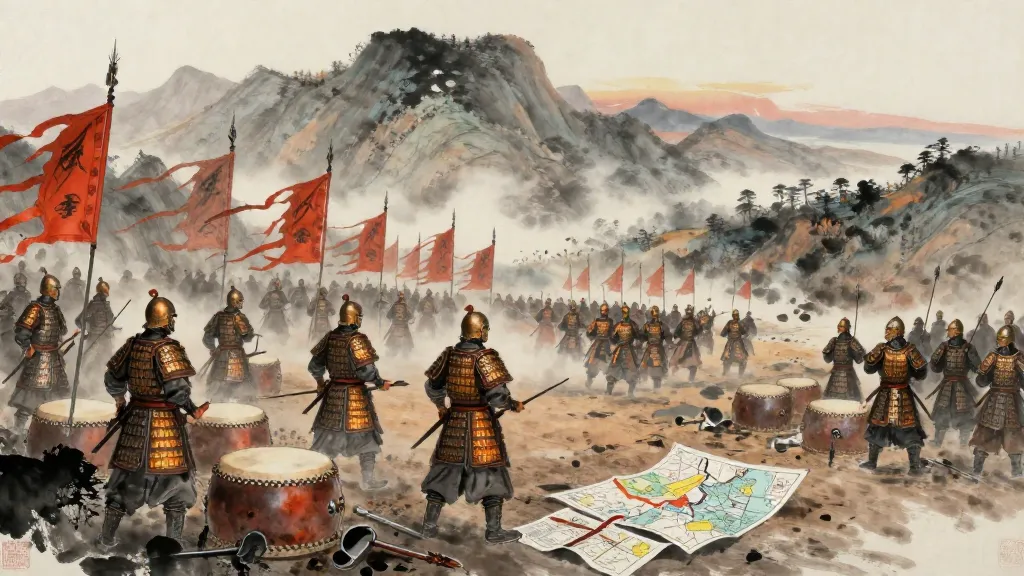
匈奴列傳(下) (Account of the Xiongnu (Part 2)) — Chinese ink painting

Chapter 110 of 130

匈奴列傳(下)

Account of the Xiongnu (Part 2)

View:

文帝時期的和親與衝突

Heqin and Conflicts Under Emperor Wen

至孝文帝初立,復修和親之事。其三年五月,匈奴右賢王入居河南地,侵盜上郡葆塞蠻夷,殺略人民。於是孝文帝詔丞相灌嬰發車騎八萬五千,詣高奴,擊右賢王。右賢王走出塞。

When Emperor Wen first took the throne, he renewed the heqin agreement. In the fifth month of his third year, the Xiongnu’s Wise King of the Right crossed into the territory south of the Yellow River, raiding and plundering among the border garrison peoples of Shang Commandery and killing or capturing many. Emperor Wen ordered the Chancellor Guan Ying to deploy eighty-five thousand cavalry to Gaonu to attack the Wise King of the Right. The Wise King of the Right fled beyond the frontier.

Notes

1person漢文帝Hàn Wén Dì

Emperor Wen of Han (漢文帝, Liu Heng 劉恆, r. 180–157 BC) was one of the most admired rulers in Chinese history, known for his frugality and compassion. His reign, along with Emperor Jing’s, was later celebrated as the ‘Governance of Wen and Jing.’

中行說之叛與匈奴論辯

The Defection of Zhonghang Yue and the Xiongnu Debate

後頃之,冠頓死,子稺粥立,號曰老上單于。

老上稺粥單于初立,孝文皇帝復遣宗室女公主為單于閼氏,使宦者燕人中行說僅公主。說不欲行,漢強使之。說曰:“必我行也,為漢患者。”中行說既至,因降單于,單于甚親幸之。

初,匈奴好漢繒絮食物,中行說曰:“匈奴人眾不能當漢之一郡,然所以強者,以衣食異,無仰於漢也。今單于變俗好漢物,漢物不過什二,則匈奴盡歸於漢矣。其得漢繒絮,以馳草棘中,衣袴皆裂斃,以示不如氈裘之完善也。得漢食物皆去之,以示不如湧酪之便美也。”

After a time, Modu died and his son Jiyu succeeded, taking the title Old Supreme Chanyu.

When the Old Supreme Chanyu first came to power, Emperor Wen again sent a princess of the imperial clan to be the Chanyu’s consort and dispatched the eunuch Zhonghang Yue, a man of Yan, to escort her. Zhonghang Yue did not wish to go, but the Han court forced him. Yue said: “If you insist on sending me, I will become a source of trouble for Han.” Once Zhonghang Yue arrived among the Xiongnu, he defected to the Chanyu, who treated him with great favor.

At first, the Xiongnu had developed a liking for Chinese silk, textiles, and foodstuffs. Zhonghang Yue said: “The entire Xiongnu population does not equal one Chinese commandery, yet the reason they are strong is that their clothing and food are different from China’s — they depend on nothing from Han. If the Chanyu now changes his customs and develops a taste for Chinese goods, and Chinese goods amount to no more than a fifth of your resources, then the Xiongnu will end up entirely subject to Han. When you get Chinese silk and brocade, ride through thorns and briars in it so your robes and trousers are torn to shreds — to demonstrate that it is inferior to felt and fur. When you get Chinese food, throw it away — to demonstrate that it is inferior to your kumiss and cheese.”

Notes

1person中行說Zhōngháng Yuè

Zhonghang Yue (中行說) was a Han eunuch forced to escort a princess to the Xiongnu. His defection and subsequent role as anti-Chinese adviser to the Chanyu made him one of the most notorious traitors in Chinese history.

2context

Zhonghang Yue’s argument — that cultural dependence on Chinese luxury goods would undermine Xiongnu independence — is a remarkable early articulation of what modern scholars call ‘soft power’ or economic imperialism. The Han court deliberately used the heqin gifts to create dependency.

匈奴大舉入寇與文帝議和

Major Xiongnu Raids and Emperor Wen's Peace Overtures

漢孝文皇帝十四年,匈奴單于十四萬騎入朝、蕭關,殺北地都尉卼,擄人民畜產甚多,遂至彭陽。使奇兵入燒回中宮,候騎至雍甘泉。於是文帝以中尉周舍、郎中令張武為將軍,發車千乘,騎十萬,軍長安旁以備胡寇。

In the fourteenth year of Emperor Wen, the Xiongnu Chanyu invaded with one hundred forty thousand cavalry through the Chao and Xiao passes. He killed the Commandant of Beidi, Ang, and captured an immense number of people and livestock, then advanced to Pengyang. He sent raiding forces to burn the Huizhong Palace, and Xiongnu scouts reached the Yong and Ganquan areas. Emperor Wen appointed Zhou She, the Commandant of the Capital, and Zhang Wu, the Superintendent of the Imperial Household, as generals, deploying a thousand chariots and a hundred thousand cavalry to defend the area around Chang’an against the barbarian raiders.

Notes

1place

Ganquan (甘泉) Palace, northwest of modern Chunhua, Shaanxi, was a Han imperial retreat. That Xiongnu scouts reached this close to Chang’an showed the severity of the incursion.

軍臣單于與武帝之前的對峰

The Junchen Chanyu and Confrontations Before Emperor Wu

後四歲,老上稺粥單于死,子軍臣立為單于。既立,孝文皇帝復與匈奴和親。而中行說復事之。

軍臣單于立四歲,匈奴復絕和親,大入上郡、雲中各三萬騎,所殺略甚眾而去。於是漢使三將軍軍屯北地,代屯句注,趙屯飛狐口,緣邊亦各堅守以備胡寇。又置三將軍,軍長安西細柳、渭北棘門、霸上以備胡。

Four years later, the Old Supreme Chanyu died and his son Junchen succeeded as Chanyu. After his succession, Emperor Wen again concluded a heqin with the Xiongnu. Zhonghang Yue continued to serve the new Chanyu.

In the fourth year of the Junchen Chanyu, the Xiongnu broke the heqin agreement and launched a major invasion, sending thirty thousand cavalry each into Shang Commandery and Yunzhong, killing and capturing many people before withdrawing. Han deployed three armies to garrison Beidi, Juzhu at Dai, and Feihu Pass, with border defenses strengthened everywhere against Xiongnu raids. Three more armies were stationed at Xiliu west of Chang’an, Jimen north of the Wei, and Bashang to defend against the Hu.

Notes

1context

The garrison at Xiliu (細柳) was commanded by Zhou Yafu (周亞夫), whose strict discipline there impressed Emperor Wen — the famous ‘Xiliu camp’ episode recorded in the Annals of Emperor Wen.

馬邑之謀與漢匈戰爭之始

The Mayi Ambush and the Beginning of the Han-Xiongnu Wars

今帝即位,明和親約束,厚遇,通關市,饒給之。匈奴自單于以下皆親漢,往來長城下。

漢使馬邑下人聶翁壹奸蘭出物與匈奴交,詳為賣馬邑城以誘單于。單于信之,而貪馬邑財物,乃以十萬騎入武州塞。漢伏兵三十餘萬馬邑旁,御史大夫韓安國為護軍,護四將軍以伏單于。單于既入漢塞,未至馬邑百餘里,見畜布野而無人牧者,怪之,乃攻亭。是時雁門尉史行徼,見寇,葆此亭,知漢兵謀,單于得,欲殺之,尉史乃告單于漢兵所居。單于大驚曰:“吾固疑之。”乃引兵還。

When the present Emperor came to the throne, he honored the heqin agreement, treated the Xiongnu generously, opened the frontier markets, and provided them with ample gifts. The Xiongnu, from the Chanyu down, all maintained friendly relations with Han and came and went along the Great Wall.

Han used a man of Mayi named Nie Wengyi to trade secretly with the Xiongnu, pretending to offer the sale of Mayi’s city to lure the Chanyu. The Chanyu believed him and, greedy for Mayi’s wealth, entered through Wuzhou Pass with a hundred thousand cavalry. Han had concealed more than three hundred thousand troops around Mayi. The Grand Secretary Han Anguo served as protector of the army, commanding four generals lying in wait for the Chanyu. The Chanyu entered the Han frontier, but before reaching Mayi, about a hundred li out, he noticed livestock scattered across the fields with no one herding them. Finding this suspicious, he attacked a watchtower. At that moment, a captain of Yanmen was patrolling the border. When he saw the enemy, he took shelter at the watchtower. The Chanyu captured him and was about to kill him, but the captain revealed the disposition of the Han ambush. The Chanyu was greatly alarmed: “I knew something was wrong.” He withdrew his army.

Notes

1context

The Mayi Ambush (馬邑之謀) of 133 BC was the critical turning point that ended six decades of heqin diplomacy and launched the full-scale Han-Xiongnu wars under Emperor Wu. The ambush failed because the Chanyu discovered the trap.

2person漢武帝Hàn Wǔ Dì

The ‘present Emperor’ is Emperor Wu of Han (漢武帝, Liu Che 劉徹, r. 141–87 BC), the most militarily aggressive Han ruler, who pursued an offensive strategy against the Xiongnu for decades.

衛青霄去病的北伐戰役

Wei Qing and Huo Qubing's Northern Campaigns

自馬邑軍後五年之秋,漢使四將軍各萬騎擊胡關市下。將軍衛青出上谷,至蘢城,得胡首擄七百人。…其明年秋,匈奴二萬騎入漢,殺遼西太守,略二千餘人。…其明年,衛青復出雲中以西至隴西,擊胡之樓煩、牡羊王於河南,得胡首虎數千,牛羊百餘萬。於是漢遂取河南地,築朔方,復繕故秦時蒙恃所為塞,因河為固。

Five years after the Mayi affair, in autumn, Han sent four generals with ten thousand cavalry each to attack the Xiongnu at the frontier markets. General Wei Qing marched out of Shanggu and reached Longcheng, taking seven hundred Xiongnu heads and prisoners. ... The following autumn, the Xiongnu sent twenty thousand cavalry into Han, killing the Grand Administrator of Liaoxi and capturing more than two thousand people. ... The next year, Wei Qing marched out of Yunzhong westward to Longxi, attacking the Loufan and the King of Muyang south of the Yellow River. He took several thousand Xiongnu heads and captured over a million cattle and sheep. Han then seized all the land south of the Yellow River, constructed the fortress of Shuofang, and restored the old fortifications that Meng Tian had built for Qin, using the Yellow River as a natural barrier.

Notes

1person衛青Wèi Qīng

Wei Qing (衛青, d. 106 BC) was Emperor Wu’s greatest general, who rose from humble origins (his mother was a slave) to become Grand General. He won decisive victories recovering the Ordos region south of the Yellow River.

2place

Shuofang (朔方) was a major Han frontier commandery and fortress established in the Ordos loop of the Yellow River, in modern northern Shaanxi/Inner Mongolia.

漠北決戰

The Decisive Battle North of the Gobi

其明年春,漢謀曰“翽侯信為單于計,居幕北,以為漢兵不能至”。乃粟馬發十萬騎,私從馬凡十四萬匹,糧重不與焉。令大將軍青、驃騎將軍去病中分軍,大將軍出定襄,驃騎將軍出代,咸約絕幕擊匈奴。單于聞之,遠其輜重,以精兵待於幕北。與漢大將軍接戰一日,會暮,大風起,漢兵縱左右翼圍單于。單于自度戰不能如漢兵,單于遂獨身與壯騎數百潰漢圍西北遁走。漢兵夜追不得。行斜捕匈奴首虎萬九千級,北至闐顏山趙信城而還。

漢驃騎將軍之出代二千餘里,與左賢王接戰,漢兵得胡首虎凡七萬餘級,左賢王將皆遁走。驃騎封於狼居胥山,禪姑衍,臨翰海而還。

The following spring, Han strategists reasoned: “The Marquis of Xi, Zhao Xin, has been advising the Chanyu to stay deep in the Gobi, thinking Han forces cannot reach him there.” They therefore fattened up the horses, assembled a hundred thousand cavalry with an additional hundred forty thousand privately owned horses, not counting the supply wagons. The Grand General Wei Qing and the General of Swift Cavalry Huo Qubing divided the army between them. The Grand General marched out from Dingxiang and the General of Swift Cavalry from Dai. Both were under orders to cross the Gobi and strike the Xiongnu. The Chanyu, hearing of this, moved his baggage train far to the rear and waited with his elite troops north of the Gobi. He engaged the Han Grand General in battle for a day. At dusk, a great sandstorm arose. The Han forces extended their left and right wings to encircle the Chanyu. The Chanyu judged that he could not overcome the Han army. He broke through the encirclement to the northwest with several hundred of his strongest riders and fled. The Han forces pursued through the night but could not catch him. They killed and captured nineteen thousand Xiongnu in total, advancing north to Tianyan Mountain and the stronghold of Zhao Xin before turning back.

The General of Swift Cavalry marched more than two thousand li from Dai and engaged the Wise King of the Left. The Han forces killed and captured more than seventy thousand Xiongnu, and the Wise King of the Left and his generals all fled. Huo Qubing conducted a sacrifice at Wolf-Residence Mountain, made offerings at Mount Guyan, and reached the shores of Lake Baikal before returning.

Notes

1person霍去病Huò Qùbìng

Huo Qubing (霍去病, 140–117 BC) was Wei Qing’s nephew and the most dashing cavalry commander in Han history. He died at only 23, but his campaigns destroyed Xiongnu power in the Hexi Corridor and drove them north of the Gobi.

2place

Wolf-Residence Mountain (狼居胥山) where Huo Qubing performed his famous sacrifice is in modern central Mongolia. ‘Hanhai’ (翰海) likely refers to Lake Baikal or a large body of water in northern Mongolia.

3context

The Battle North of the Gobi in 119 BC was the decisive engagement of the Han-Xiongnu wars. Combined, the two Han armies killed or captured nearly 90,000 Xiongnu. After this, the Chanyu withdrew far to the north, and ‘south of the Gobi there was no Xiongnu royal court.’

戰後與太史公評論

Aftermath and the Grand Historian's Assessment

是後匈奴遠遁,而幕南無王庭。漢度河自朔方以西至令居,往往通渠置田,官吉卒五六萬人,稍蠶食,地接匈奴以北。

初,漢兩將軍大出圍單于,所殺虎八九萬,而漢士卒物故亦數萬,漢馬死者十餘萬。匈奴雖病,遠去,而漢亦馬少,無以復往。

太史公曰:孔氏著春秋,隱桓之間則章,至定哀之際則微,為其切當世之文而罔褒,忌諾之辭也。世俗之言匈奴者,患其徼一時之權,而務納其說,以便偏指,不參彼己;將率席中國廣大,氣奮,人主因以決策,是以建功不深。堯雖賢,興事業不成,得禹而九州寧。且欲興聖統,唯在擇任將相哉!唯在擇任將相哉!

After this, the Xiongnu fled far away, and south of the Gobi there was no Xiongnu royal court. Han extended its reach from Shuofang westward to Lingju, building irrigation channels and establishing agricultural colonies manned by fifty to sixty thousand soldiers and officials, gradually encroaching northward until the territory bordered the Xiongnu.

Originally, when the two Han generals launched their great expedition to encircle the Chanyu, they killed and captured eighty to ninety thousand. But Han’s own casualties were also in the tens of thousands, and more than a hundred thousand Han horses died. Though the Xiongnu were weakened and had retreated far away, Han too had lost so many horses that it could not mount another campaign.

The Grand Historian remarks: When Confucius composed the Spring and Autumn Annals, the events of the Yin and Huan periods are written clearly, but those of the Ding and Ai periods are made obscure — because the text touched too closely on his own times and he feared to praise openly; this was the language of avoidance and reticence. Those who speak of the Xiongnu in our time err in seizing upon momentary advantage to push their arguments, using one-sided evidence without comparing both sides of the situation. Generals and commanders rely on China’s vast size and stir themselves up with bluster, and the sovereign uses these arguments to make policy. This is why achievements have not been deep. Yao himself was a worthy ruler, yet his undertakings could not be completed — only when he had Yu could the Nine Provinces find peace. If one wishes to establish a sage’s legacy, everything depends on choosing the right generals and ministers! Everything depends on choosing the right generals and ministers!

Notes

1context

Sima Qian’s closing assessment is both veiled and daring. Writing during Emperor Wu’s reign, he could not openly criticize the disastrous costs of the northern campaigns. His repeated ‘everything depends on choosing the right generals and ministers’ implies that the current leadership has failed in this regard — a dangerous observation under an autocratic emperor.

2context

Sima Qian had personal reason for bitterness: he was castrated in 99 BC for defending the general Li Ling, who had surrendered to the Xiongnu. His seemingly objective account of the Han-Xiongnu wars thus carries undercurrents of personal anguish about the human costs of imperial expansion.

Edition & Source

Text
《史記》 Shiji
Edition
中華古詩文古書籍網 transcription
Commentary
裴駰《史記集解》、司馬貞《史記索隱》、張守節《史記正義》(Three Commentaries)