孝武本紀(下) (Annals of Emperor Wu (Part 2)) — Chinese ink painting

Chapter 12 of 130

孝武本紀(下)

Annals of Emperor Wu (Part 2)

View:

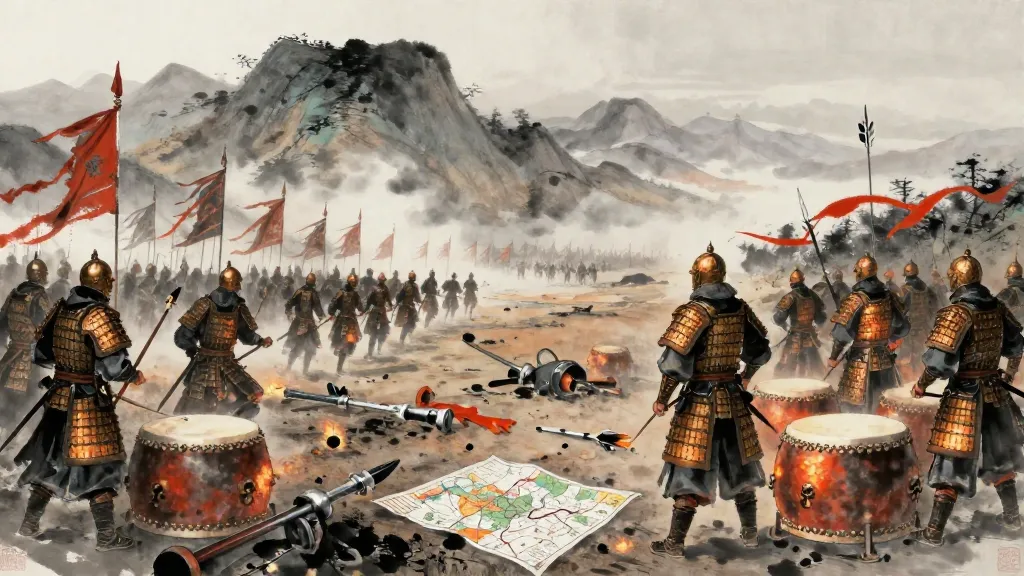
北巡朔方,振兵祭黃帝

Northern Tour to Shuofang: Reviewing Troops and Sacrificing at the Yellow Emperor's Tomb

其來年冬,上議曰:“古者先振兵澤旅,然後封禪。”乃遂北巡朔方,勒兵十餘萬,還祭黃帝冢橋山,澤兵須如。上曰:“吾聞黃帝不死,今有冢,何也?”或對曰:“黃帝已仙上天,群臣葬其衣冠。”即至甘泉,為且用事泰山,先類祠泰一。

The following year in winter, the Emperor declared: “In antiquity, one first reviewed the troops and purified the army, and only then performed the feng and shan sacrifices.” He then toured north to Shuofang, reviewed over one hundred thousand soldiers, returned to sacrifice at the Yellow Emperor’s tomb on Bridge Mountain, and purified the troops at Xuru. The Emperor said: “I have heard that the Yellow Emperor did not die. Why then is there a tomb?” Someone replied: “The Yellow Emperor had already become an immortal and ascended to heaven. His ministers merely buried his cap and robes.” Upon reaching Ganquan, in preparation for the ceremony at Mount Tai, the Emperor first performed a lei sacrifice to Taiyi.

Notes

1context

The phrase 振兵澤旅 refers to the ancient ritual requirement that a ruler should first review and purify his army before performing the feng and shan sacrifices — demonstrating both martial readiness and ritual worthiness.

2place

Shuofang (朔方) was a commandery in the Ordos loop region along the northern frontier, established by Emperor Wu in 127 BC after Wei Qing drove the Xiongnu north of the Yellow River bend.

3place

Bridge Mountain (橋山) is the traditional site of the Yellow Emperor’s tomb. It remains a major ceremonial site to this day.

4place

Xuru (須如) was a location where troops were ritually purified (澤兵). The exact site is uncertain but was likely in the northern frontier region.

5place

Ganquan (甘泉) was a palace complex northwest of Chang’an, one of Emperor Wu’s most important ritual sites. It housed the Taiyi altar and other shrines.

6context

A lei (類) sacrifice was a special sacrificial rite performed to announce or report to a deity before undertaking a major action — here, to notify Taiyi before the feng and shan ceremonies at Mount Tai.

議封禪之儀,群儒被黜

Debating the Feng and Shan Ritual — The Confucian Scholars Are Dismissed

自得寶鼎,上與公卿諸生議封禪。封禪用希曠絕,莫知其儀禮,而群儒采封禪尚書、周官、王制之望祀射牛事。齊人丁公年九十餘,曰:“封者,合不死之名也。秦皇帝不得上封。陛下必欲上,稍上即無風雨,遂上封矣。”上於是乃令諸儒習射牛,草封禪儀。數年,至且行。天子既聞公孫卿及方士之言,黃帝以上封禪,皆致怪物與神通,欲放黃帝以嘗接神仙人蓬萊士,高世比德於九皇,而頗采儒術以文之。群儒既以不能辯明封禪事,又牽拘於詩書古文而不敢騁。上為封祠器示群儒,群儒或曰“不與古同”,徐偃又曰“太常諸生行禮不如魯善”,周霸屬圖封事,於是上絀偃、霸,盡罷諸儒弗用。

Ever since the precious tripod had been obtained, the Emperor discussed the feng and shan sacrifices with his ministers and scholars. Because the feng and shan had been so rarely performed, no one knew the proper ritual. The Confucian scholars gathered references to the suburban wang sacrifice and the shooting of the sacrificial ox from the Book of Documents, the Rites of Zhou, and the Royal Regulations. A man of Qi named Master Ding, over ninety years old, said: “The feng sacrifice is connected with the name of immortality. The First Emperor of Qin was unable to ascend to perform the feng. If Your Majesty truly wishes to ascend, go up gradually — if there is no wind or rain, then proceed with the feng ceremony.”

The Emperor thereupon ordered the Confucians to practice the ox-shooting rite and draft a feng and shan ritual. After several years, the time to act arrived. Having heard from Gongsun Qing and the fangshi that all rulers from the Yellow Emperor onward who performed the feng and shan had attracted marvels and communed with the spirits, the Emperor wished to emulate the Yellow Emperor in seeking immortals and the adepts of Penglai, to transcend the age and match his virtue with the Nine Sovereigns of old — and merely to use Confucian learning to ornament the occasion. The Confucian scholars, for their part, could not clearly explain the feng and shan ceremony, and were too constrained by the Odes, the Documents, and the ancient texts to venture freely. When the Emperor displayed the sacrificial vessels he had made, some of the Confucians said: “These do not match the ancient practice.” Xu Yan further said: “The students under the Grand Master of Ceremonies perform the rites less well than those of Lu.” Zhou Ba took it upon himself to draft plans for the feng ceremony. At this, the Emperor dismissed Xu Yan and Zhou Ba and cashiered all the Confucians, refusing to employ them.

Notes

1person丁公Dīng Gōng

Master Ding (丁公) of Qi, over ninety years old, was consulted as an elder authority on the feng and shan rites. His practical advice — go up gradually and only if the weather cooperates — contrasts with the scholars’ textual debates.

2person徐偃Xú Yǎn

Xu Yan (徐偃) was a Confucian scholar who criticized the ritual preparations, comparing them unfavorably with Lu’s traditions. His candor cost him his position.

3person周霸Zhōu Bà

Zhou Ba (周霸) was a Confucian scholar who took it upon himself to draw up plans for the feng ceremony without authorization. He was dismissed along with Xu Yan.

4context

The Nine Sovereigns (九皇) are legendary sage-rulers of deep antiquity, predating even the Yellow Emperor. Emperor Wu’s desire to ‘match his virtue’ with them reveals the scale of his ambition — he sought not merely to equal the historical kings but to rival primordial paragons.

5person公孫卿Gōngsūn Qìng

Gongsun Qing (公孫卿) was a fangshi from Qi who presented Emperor Wu with a book of prophecies linking the Han dynasty to the Yellow Emperor’s cosmic cycles. He became a trusted court ritualist and was appointed Gentleman (郎).

登中嶽太室,東上泰山

Ascending Mount Taishi of the Central Peak, Then East to Mount Tai

三月,遂東幸緱氏,禮登中嶽太室。從官在山下聞若有言“萬歲”雲。問上,上不言;問下,下不言。於是以三百戶封太室奉祠,命曰崇高邑。東上泰山,山之草木葉未生,乃令人上石立之泰山顛。

In the third month, the Emperor proceeded east to Goushi, where he performed rites and ascended Mount Taishi, the Central Peak. Attendants at the base of the mountain heard what sounded like a voice calling “Ten thousand years!” When asked, those above denied speaking; when asked, those below also denied it. Thereupon three hundred households were enfeoffed to maintain the sacrifices at Mount Taishi, and the place was named Chonggao — “Lofty Heights” — District. The Emperor then went east and ascended Mount Tai. Since the grasses and trees on the mountain had not yet put forth their leaves, he ordered men to haul a stone up and erect it at the summit of Mount Tai.

Notes

1place

Goushi (緼氏) was a county near Mount Taishi. It was also the location where Gongsun Qing claimed to have seen immortal footprints.

2place

Mount Taishi (太室) is the main peak of Mount Song (嵩山), the Central Peak of the Five Sacred Mountains. The name Chonggao (崇高) later evolved into the modern name Songshan.

3context

The mysterious cry of ‘Ten thousand years!’ (萬歲) — with no identifiable source — was interpreted as an auspicious supernatural confirmation of the Emperor’s ritual worthiness. This kind of ambiguous portent served the court’s need to validate Emperor Wu’s unprecedented feng and shan ceremonies.

4place

Mount Tai (泰山), the Eastern Peak and most sacred of the Five Sacred Mountains, was the traditional site for the feng and shan sacrifices. Its summit was believed to be the closest point to Heaven.

東巡海上,求蓬萊仙人

Eastern Tour Along the Coast — Seeking the Immortals of Penglai

上遂東巡海上,行禮祠八神。齊人之上疏言神怪奇方者以萬數,然無驗者。乃益發船,令言海中神山者數千人求蓬萊神人。公孫卿持節常先行候名山,至東萊,言夜見一人,長數丈,就之則不見,見其跡甚大,類禽獸雲。群臣有言見一老父牽狗,言“吾欲見巨公”,已忽不見。上既見大跡,未信,及群臣有言老父,則大以為仙人也。宿留海上,與方士傳車及間使求仙人以千數。

The Emperor then continued east, touring along the coast and performing sacrificial rites at the shrines of the Eight Spirits. Men of Qi who submitted memorials claiming knowledge of marvels and extraordinary techniques numbered in the tens of thousands, yet none produced any verified results. The Emperor nevertheless dispatched still more ships and ordered several thousand people who claimed knowledge of the divine mountains in the sea to search for the immortals of Penglai.

Gongsun Qing, carrying the imperial tally, constantly traveled ahead to scout the famous mountains. Arriving at Donglai, he reported that at night he had seen a figure several zhang tall, but when he approached it, it vanished — he could only see its tracks, which were very large and resembled those of a beast or bird. Some courtiers also reported seeing an old man leading a dog who said: “I wish to see the Great Lord,” and then suddenly vanished. The Emperor had seen the large tracks but was not yet convinced; when his courtiers reported the old man, however, he became firmly persuaded it was an immortal. He lingered by the sea, and the fangshi traveling by relay carriage, along with secret emissaries sent to find immortals, numbered in the thousands.

Notes

1context

The Eight Spirits (八神) were a set of deities traditionally worshipped in the Qi region of Shandong. They included the Lord of Heaven, Lord of Earth, Lord of War, Lord of Yin, Lord of Yang, Lord of the Moon, Lord of the Sun, and Lord of the Four Seasons.

2place

Donglai (東萊) was a commandery on the Shandong peninsula, the closest point on the mainland to the legendary immortal islands of Penglai.

3context

A zhang (丈) is approximately 2.31 meters (about 7.5 feet) in Han measurements. A figure ‘several zhang tall’ would be a giant of supernatural proportions.

4context

Penglai (蓬萊) was one of three legendary islands in the Eastern Sea believed to be inhabited by immortals who possessed the elixir of life. The others were Fangzhang (方丈) and Yingzhou (瀛洲). The search for Penglai was a persistent obsession of Emperor Wu.

封泰山,禪肅然山

The Feng Sacrifice on Mount Tai and the Shan Sacrifice at Mount Suran

四月,還至奉高。上念諸儒及方士言封禪人人殊,不經,難施行。天子至梁父,禮祠地主。乙卯,令侍中儒者皮弁薦紳,射牛行事。封泰山下東方,如郊祠泰一之禮。封廣丈二尺,高九尺,其下則有玉牒書,書祕。禮畢,天子獨與侍中奉車子侯上泰山,亦有封。其事皆禁。明日,下陰道。丙辰,禪泰山下阯東北肅然山,如祭后土禮。天子皆親拜見,衣上黃而盡用樂焉。江淮間一茅三脊為神藉。五色土益雜封。縱遠方奇獸蜚禽及白雉諸物,頗以加祠。兕旄牛犀象之屬弗用。皆至泰山然後去。封禪祠,其夜若有光,晝有白雲起封中。

In the fourth month, the Emperor returned to Fenggao. He reflected that what the Confucians and fangshi each said about the feng and shan was inconsistent with one another, lacked canonical basis, and was difficult to put into practice.

The Emperor arrived at Liangfu, where he performed rites and sacrificed to the Lord of the Earth. On the yimao day, he ordered the Palace Attendant Confucians to don leather caps and sashes and shoot the sacrificial ox to begin proceedings. The feng sacrifice was performed on the east side at the base of Mount Tai, following the rite used for the suburban sacrifice to Taiyi. The altar was twelve feet wide and nine feet high; beneath it were jade tablets inscribed with a text that was kept secret. When the rite was complete, the Emperor alone, accompanied only by his Palace Attendant and the Chariot Attendant Zihou, ascended Mount Tai, where another feng ceremony was performed. The details of this ceremony were all kept secret.

The next day, they descended by the northern path. On the bingchen day, the shan sacrifice was performed at Mount Suran, northeast of the base of Mount Tai, following the rites used for sacrifices to the Sovereign Earth. The Emperor personally performed the prostrations, wearing yellow upper garments, and music was used throughout. Three-ridged rushes from between the Yangtze and Huai rivers served as the sacred matting. Soils of five colors were added and mixed into the altar mound. Exotic beasts, flying birds, and white pheasants from distant regions were released as additional offerings to the ceremony. Rhinoceroses, yaks, and elephants were not used. All offerings were brought to Mount Tai and then released. During the night of the feng and shan sacrifices there appeared to be a luminous glow, and by day white clouds rose from within the altar mound.

Notes

1place

Fenggao (奉高) was the administrative seat nearest to Mount Tai, serving as the staging ground for the feng and shan ceremonies.

2place

Liangfu (梁父) is a smaller mountain south of Mount Tai, traditionally the site of the shan (禪) sacrifice to earth, though here it is used for a preliminary rite to the Lord of the Earth (地主).

3person奉車子侯Fèngchē Zǐhóu

The Chariot Attendant Zihou (奉車子侯) was a relative of Emperor Wu who accompanied him on the secret ascent of Mount Tai. He died suddenly shortly after the ceremony, which some interpreted as an ill omen.

4context

The jade tablets (玉牙) with their secret inscriptions were central to the feng ceremony. Their contents — likely prayers for immortality — were deliberately kept from the public and from court officials. This secrecy was unprecedented and controversial.

5place

Mount Suran (肅然山) was a small hill northeast of the base of Mount Tai where the shan (禪) sacrifice to earth was performed.

6context

The three-ridged rush (一茅三脊) from the Yangtze-Huai region was considered a sacred plant associated with the ancient feng and shan ceremonies. The five-colored soils symbolized the five directions and the unity of All-Under-Heaven under imperial rule.

封禪還,坐明堂,大赦

Return from the Feng and Shan — Audience in the Bright Hall and General Amnesty

天子從封禪還,坐明堂,群臣更上壽。於是制詔御史:“朕以眇眇之身承至尊,兢兢焉懼弗任。維德菲薄,不明於禮樂。脩祀泰一,若有象景光,籙如有望,依依震於怪物,欲止不敢,遂登封泰山,至於梁父,而後禪肅然。自新,嘉與士大夫更始,賜民百戶牛一酒十石,加年八十孤寡布帛二匹。復博、奉高、蛇丘、歷城,毋出今年租稅。其赦天下,如乙卯赦令。行所過毋有復作。事在二年前,皆勿聽治。”又下詔曰:“古者天子五載一巡狩,用事泰山,諸侯有朝宿地。其令諸侯各治邸泰山下。”

When the Emperor returned from the feng and shan sacrifices, he took his seat in the Bright Hall and the assembled ministers offered their congratulations in turn. Thereupon he issued an edict to the Imperial Secretary:

“We, in Our insignificant person, have inherited the supreme position, and tremblingly fear that We are not equal to it. Our virtue is thin and meager; We lack clarity in matters of ritual and music. In performing the sacrifices to Taiyi, there appeared auspicious images and radiant light, and the omens seemed to confirm Our hopes. Drawn by these marvels and unable to hold back, We ascended to perform the feng on Mount Tai, proceeded to Liangfu, and then performed the shan at Suran. Let this mark a renewal. We are pleased to share a new beginning with all officials and scholars. Grant to the common people one ox per hundred households and ten shi of wine. To those aged eighty and above, and to orphans and widows, give two bolts of cloth and silk. Exempt Bo, Fenggao, Sheqiu, and Licheng from this year’s taxes. Let a general amnesty be proclaimed throughout All-Under-Heaven, following the yimao amnesty decree. In places We have passed through, let there be no further corvée labor. Cases from more than two years ago shall no longer be heard.”

A further edict was issued: “In antiquity, the Son of Heaven made an inspection tour once every five years and performed ceremonies at Mount Tai, and the feudal lords had lodging places for their court audiences. Let each feudal lord now build a residence at the foot of Mount Tai.”

Notes

1context

The Bright Hall (明堂) was an idealized ritual structure from antiquity where the sovereign was to receive feudal lords and perform cosmic governance. Emperor Wu would later build one near Mount Tai based on an alleged ancient diagram.

2context

The edict’s language of humility — ‘insignificant person’ (眨眨之身), ‘thin virtue’ (德菲薄) — follows standard imperial convention. Yet the content reveals Emperor Wu’s conviction that heaven had validated his rule through supernatural signs.

3place

Bo (博), Fenggao (奉高), Sheqiu (蛇丘), and Licheng (歷城) were all counties in the vicinity of Mount Tai that received tax exemptions as an imperial favor after the feng and shan.

復東至海上,子侯暴死,元封元年

Return to the Coast — Zihou’s Sudden Death and the Proclamation of Yuanfeng 1

天子既已封禪泰山,無風雨菑,而方士更言蓬萊諸神山若將可得,於是上欣然庶幾遇之,乃復東至海上望,冀遇蓬萊焉。奉車子侯暴病,一日死。上乃遂去,並海上,北至碣石,巡自遼西,歷北邊至九原。五月,返至甘泉。有司言寶鼎出為元鼎,以今年為元封元年。

Now that the Emperor had completed the feng and shan at Mount Tai without incident of wind, rain, or calamity, the fangshi declared anew that the divine mountains of Penglai seemed within reach. The Emperor was elated at the prospect of encountering them and traveled east once more to gaze out over the sea, hoping to reach Penglai.

The Chariot Attendant Zihou fell suddenly ill and died within a single day. The Emperor then departed, traveling along the coast northward to Jieshi, touring from Liaoxi, passing along the northern frontier to Jiuyuan. In the fifth month, he returned to Ganquan. The responsible officials proposed that since the precious tripod had appeared, the era should be called Yuanding (“Origin of the Tripod”), and that the present year should become the first year of Yuanfeng (“Origin of the Feng Sacrifice”).

Notes

1context

Zihou’s sudden death — within one day of falling ill, and so soon after the secret summit ceremony — was widely seen as ominous. Sima Qian’s spare narration, without comment, allows the reader to draw implications about what the gods thought of the proceedings.

2place

Jieshi (碁石) was a prominent rocky headland on the Bohai Sea coast, a famous landmark since antiquity. It was where the First Emperor of Qin also made an inspection.

3place

Liaoxi (遼西) was a commandery in the far northeast of the Han empire, roughly corresponding to western Liaoning.

4place

Jiuyuan (九原) was a commandery on the northern frontier in the Yellow River bend region.

5context

Yuanfeng (元封) literally means ‘Origin of the Feng Sacrifice,’ marking the first year (110 BC) of a new reign-era commemorating the feng and shan. This reflects the Han practice of changing era names to mark auspicious events.

德星出,泰一贊饗

Auspicious Stars Appear — Hymn to Taiyi

其秋,有星茀於東井。後十餘日,有星茀於三能。望氣王朔言:“候獨見其星出如瓠,食頃復入焉。”有司言曰:“陛下建漢家封禪,天其報德星雲。”

其來年冬,郊雍五帝,還,拜祝祠泰一。贊饗曰:“德星昭衍,厥維休祥。壽星仍出,淵耀光明。信星昭見,皇帝敬拜泰祝之饗。”

That autumn, a bushy star appeared in the Eastern Well constellation. More than ten days later, another bushy star appeared in the Three Legs constellation. The qi-observer Wang Shuo said: “In my watch I alone saw a star emerge shaped like a gourd; after the space of a meal, it re-entered.” The responsible officials declared: “Your Majesty has established the feng and shan sacrifices for the house of Han. Heaven has responded with virtue-stars.”

The following year in winter, the Emperor performed the suburban sacrifice to the Five Emperors at Yong, and upon his return performed rites and prayers at the shrine of Taiyi. The hymn of offering said: “The virtue-stars shine and spread forth — these are auspicious signs. The longevity-star appears again, its deep brilliance shining bright. The faithfulness-star is clearly seen. The Emperor reverently bows in this grand offering of prayer.”

Notes

1context

The Eastern Well (東井) is a constellation in the traditional Chinese lunar-mansion system, roughly corresponding to parts of Gemini. The Three Legs (三能, also written 三台) correspond to parts of Ursa Major. Bushy stars (星茄) likely refer to comets, which could be interpreted as auspicious or ominous depending on context.

2person王朔Wáng Shuò

Wang Shuo (王朔) was a qi-observer (望氣者) — a specialist in interpreting clouds, vapors, and celestial phenomena as omens for the court.

3context

The ‘virtue-star’ (德星), ‘longevity-star’ (壽星), and ‘faithfulness-star’ (信星) are auspicious stellar phenomena interpreted as heaven’s endorsement of Emperor Wu’s sacrificial program. The hymn weaves these into a liturgical confirmation of imperial legitimacy.

公孫卿復言見神人,至東萊

Gongsun Qing Again Claims to See a Spirit — The Emperor Travels to Donglai

其春,公孫卿言見神人東萊山,若雲“見天子”。天子於是幸緱氏城,拜卿為中大夫。遂至東萊,宿留之數日,毋所見,見大人跡。復遣方士求神怪采芝藥以千數。是歲旱。於是天子既出毋名,乃禱萬里沙,過祠泰山。還至瓠子,自臨塞決河,留二日,沈祠而去。使二卿將卒塞決河,河徙二渠,復禹之故跡焉。

In spring, Gongsun Qing reported that he had seen a spirit on the mountains of Donglai, and that the spirit had seemingly said: “I wish to see the Emperor.” The Emperor thereupon visited Goushi and promoted Gongsun Qing to Grand Palace Gentleman. He then proceeded to Donglai and lingered for several days, but saw nothing — only the large footprints appeared again. He once more dispatched fangshi by the thousands to seek marvels and gather magical mushrooms and drugs.

That year there was a drought. The Emperor, having come out on no specific pretext, prayed at Wanli Sands, then passed by to sacrifice at Mount Tai. Returning to Huzi, he personally oversaw the blocking of the breach in the Yellow River. He stayed for two days, performed a sinking sacrifice, and departed. He ordered two ministers to lead soldiers in closing the breach. The river was diverted into two channels, restoring the old courses of Yu the Great.

Notes

1person公孫卿Gōngsūn Qìng

Gongsun Qing (公孫卿) continued to serve as Emperor Wu’s primary intermediary with the spirit world despite repeatedly failing to produce tangible results. His promotion to Grand Palace Gentleman (中大夫) rewarded him for the Donglai sighting claim.

2place

Huzi (瓠子) was the site of a catastrophic breach in the Yellow River that had flooded vast areas for over twenty years (from 132 BC). Emperor Wu’s personal visit to oversee its repair in 109 BC was a major event. Sima Qian himself was present.

3place

Wanli Sands (萬里沙) was a sacrificial site, likely a sandy area along the coast or riverbank where prayers for rain or safe passage were offered.

4context

The ‘sinking sacrifice’ (沈祠) involved submerging offerings — typically jade, silk, or animals — into the river to propitiate the water spirits. The repair of the Huzi breach was one of Emperor Wu’s genuine public works achievements, in contrast to his fruitless pursuit of immortals.

越巫雞卜

The Yue Shaman and Chicken-Bone Divination

是時既滅南越,越人勇之乃言“越人俗信鬼,而其祠皆見鬼,數有效。昔東甌王敬鬼,壽至百六十歲。後世謾怠,故衰秏”。乃令越巫立越祝祠,安台無壇,亦祠天神上帝百鬼,而以雞卜。上信之,越祠雞卜始用焉。

At this time, since the Nanyue kingdom had been destroyed, a Yue man named Yong Zhi declared: “The Yue people customarily believe in ghosts, and in their sacrifices they actually see ghosts — repeatedly with proven efficacy. In former times, the King of Dong’ou revered the ghosts and lived to one hundred and sixty years of age. Later generations grew lax and negligent, and thus declined.”

Thereupon the Emperor ordered Yue shamans to establish Yue-style prayer shrines. These had platforms but no earthen altars, and sacrificed to the heavenly spirits, the High God, and the hundred ghosts, using chicken-bone divination. The Emperor believed in it, and from this time the Yue sacrificial rites and chicken-bone divination came into use at court.

Notes

1person勇之Yǒng Zhī

Yong Zhi (勇之) was a man from the recently conquered Yue (越) territories in the far south who introduced southern shamanic practices to the Han court.

2context

Dong’ou (東甌) was a Yue kingdom in the area of modern Wenzhou, Zhejiang. It had been absorbed into the Han empire in 138 BC.

3context

Chicken-bone divination (雞卜) was a southern Yue practice of reading cracks in heated chicken bones to foretell the future — analogous to the northern Chinese oracle-bone tradition using turtle plastrons and ox scapulae. Its adoption at the Han court shows the eclectic, even indiscriminate, character of Emperor Wu’s religious experimentation.

公孫卿言仙人好樓居,造觀台

Gongsun Qing Says Immortals Prefer Towers — Construction of Observatories and Terraces

公孫卿曰:“仙人可見,而上往常遽,以故不見。今陛下可為觀,如緱氏城,置脯棗,神人宜可致。且仙人好樓居。”於是上令長安則作蜚廉桂觀,甘泉則作益延壽觀,使卿持節設具而候神人,乃作通天台,置祠具其下,將招來神仙之屬。於是甘泉更置前殿,始廣諸宮室。夏,有芝生殿防內中。天子為塞河,興通天台,若有光雲,乃下詔曰:“甘泉防生芝九莖,赦天下,毋有復作。”

Gongsun Qing said: “Immortals can be seen, but Your Majesty has always been in a hurry when traveling, and this is why they have not appeared. If Your Majesty were to build an observatory, like the one at Goushi, and set out dried meats and dates, the spirit-people could surely be attracted. Moreover, immortals prefer to dwell in tall towers.”

The Emperor thereupon ordered the Feilian and Gui observatories to be built at Chang’an, and the Yiyan Longevity Observatory to be built at Ganquan. He sent Gongsun Qing with an imperial tally to set up ritual equipment and watch for spirit-people. He also built the Heaven-Reaching Terrace and placed sacrificial equipment at its base, intending to attract immortals and their kind. At Ganquan, a new front hall was added, and all the palace buildings began to be expanded.

In summer, magical mushrooms grew on the balustrade within the inner palace. Because the Emperor had blocked the river breach and raised the Heaven-Reaching Terrace, and something like a luminous cloud had appeared, he issued an edict: “Nine stalks of magical mushrooms have grown on the Ganquan balustrade. Let a general amnesty be proclaimed throughout All-Under-Heaven, and let there be no further corvée labor.”

Notes

1context

The Feilian Observatory (蓑廉觀) was named after Feilian, a wind god. The Gui Observatory (桂觀) was named for the cassia tree (桂), associated with immortality. The Yiyan Longevity Observatory (益延壽觀) literally means ‘Further Extend Longevity’ — a name revealing its purpose.

2context

The Heaven-Reaching Terrace (通天台) at Ganquan was an enormously tall structure designed to provide a platform for communion with celestial beings — a physical instantiation of Emperor Wu’s desire to bridge heaven and earth.

3context

The magical mushroom or lingzhi (芝) was regarded as a potent omen of celestial favor. Its spontaneous growth within palace grounds was taken as a sign that heaven approved of the Emperor’s ritual and construction activities. The nine stalks specifically echo the auspicious number nine.

伐朝鮮,旱災,乾封

The Campaign Against Chaoxian — Drought and the ‘Dry Feng’

其明年,伐朝鮮。夏,旱。公孫卿曰:“黃帝時封則天旱,乾封三年。”上乃下詔曰:“天旱,意乾封乎?其令天下尊祠靈星焉。”

The following year, a campaign was launched against Chaoxian. In summer, there was a drought. Gongsun Qing said: “When the Yellow Emperor performed the feng sacrifice, there was likewise a drought — the ‘dry feng’ lasted three years.” The Emperor thereupon issued an edict: “The drought — could this be the ‘dry feng’? Let All-Under-Heaven reverently sacrifice to the Spirit Star.”

Notes

1context

Chaoxian (朝鮮) refers to the Wiman Joseon kingdom in the northern part of the Korean peninsula, which was conquered by Han forces in 108 BC and replaced by four commanderies.

2context

The ‘dry feng’ (乾封) was Gongsun Qing’s invention — he reframed a natural disaster (drought) as a mystical consequence of the sacred feng ceremony, just as it had supposedly occurred after the Yellow Emperor’s feng. This is a characteristic example of fangshi rhetoric: any outcome can be turned into confirmation of their theories.

3context

The Spirit Star (靈星) is generally identified with the star Tianshe (天社) or the Dragon constellation, associated with agriculture. Sacrificing to it was a prayer for rain and good harvests.

巡南郡,登天柱山,脩封泰山

Southern Tour — Ascending Mount Tianzhu, Then Renewing the Feng at Mount Tai

其明年,上郊雍,通回中道,巡之。春,至鳴澤,從西河歸。

其明年冬,上巡南郡,至江陵而東。登禮潛之天柱山,號曰南嶽。浮江,自尋陽出樅陽,過彭蠡,祀其名山川。北至琅邪,並海上。四月中,至奉高脩封焉。

The following year, the Emperor performed the suburban sacrifice at Yong, opened the Huizhong road, and toured along it. In spring, he reached Mingze and returned via Xihe.

The next year in winter, the Emperor toured the southern commanderies. He reached Jiangling and turned east. He ascended and performed rites at Mount Tianzhu of Qian, designating it the Southern Peak. He floated down the Yangtze, emerging from Xunyang to Zongyang, passing by Lake Pengli, and sacrificing at the famous mountains and rivers along the way. He went north to Langya and along the coast. In the middle of the fourth month, he arrived at Fenggao and renewed the feng sacrifice.

Notes

1place

Huizhong (回中) was a strategic route through the mountains connecting the Wei River valley with the northwestern frontier. Opening it facilitated both military communication and imperial tours.

2place

Jiangling (江陵) was the administrative center of the southern commandery of Nan, on the middle Yangtze.

3place

Mount Tianzhu (天柱山), the ‘Pillar of Heaven Mountain,’ was designated the Southern Peak (南嶽) by Emperor Wu, replacing the earlier designation of Mount Heng (衡山) in Hunan.

4place

Lake Pengli (彭蠡) is the ancient name for Poyang Lake, the largest freshwater lake in China.

5place

Langya (琅邪) was a commandery on the Shandong coast, famous as the site where the First Emperor of Qin also made an inspection and erected a stele.

明堂圖與泰山明堂祠

The Bright Hall Blueprint and the Ritual at the Bright Hall on Mount Tai

初,天子封泰山,泰山東北阯古時有明堂處,處險不敞。上欲治明堂奉高旁,未曉其制度。濟南人公玉帶上黃帝時明堂圖。明堂圖中有一殿,四面無壁,以茅蓋,通水,圜宮垣為衤復道,上有樓,從西南入,命曰崑崙,天子從之入,以拜祠上帝焉。於是上令奉高作明堂汶上,如帶圖。及五年脩封,則祠泰一、五帝於明堂上坐,令高皇帝祠坐對之。祠后土於下房,以二十太牢。天子從崑崙道入,始拜明堂如郊禮。禮畢,燎堂下。而上又上泰山,有祕祠其顛。而泰山下祠五帝,各如其方,黃帝並赤帝,而有司侍祠焉。泰山上舉火,下悉應之。

Originally, when the Emperor first performed the feng at Mount Tai, there was an ancient Bright Hall site at the northeast base of the mountain, but the terrain was rugged and not spacious. The Emperor wished to build a Bright Hall near Fenggao but did not know the proper design. A man from Jinan named Gongyu Dai submitted a diagram of the Bright Hall from the time of the Yellow Emperor.

The diagram showed a single hall with no walls on any of its four sides, roofed with thatch, with water channeled around it and a circular palace wall forming a covered corridor. Above was a tower. Entry was from the southwest, and the passage was called Kunlun. The Emperor would enter through it to bow and sacrifice to the High God.

The Emperor thereupon ordered the Bright Hall to be built above the Wen River at Fenggao, following Gongyu Dai’s diagram. When the five-year renewal of the feng ceremony came, sacrifices were performed to Taiyi and the Five Emperors in the upper seats of the Bright Hall, with a spirit-seat for Emperor Gaozu placed facing them. Sacrifices to the Sovereign Earth were performed in the lower chamber, using twenty sets of the Grand Sacrifice. The Emperor entered by the Kunlun passage and first performed prostrations in the Bright Hall following the suburban sacrifice rite. When the rites were complete, offerings were burned at the base of the hall.

The Emperor then ascended Mount Tai again, where he performed a secret sacrifice at the summit. At the base of Mount Tai, the Five Emperors were worshipped, each according to his proper direction, with the Yellow Emperor sharing a place with the Red Emperor. The responsible officials attended and assisted the rites. When fire was raised at the summit of Mount Tai, all below responded in kind.

Notes

1person公玉帶Gōngyù Dài

Gongyu Dai (公玉帶) was a man from Jinan who presented what he claimed was a diagram of the Yellow Emperor’s Bright Hall. The diagram’s authenticity was questionable, but the Emperor adopted it as the blueprint for his own Bright Hall.

2context

The Kunlun passage (崑崙道) within the Bright Hall was named after Mount Kunlun, the mythical axis mundi of Chinese cosmology. The circular design, thatched roof, flowing water, and directional entries all symbolize cosmic principles — the hall was intended as a microcosm.

3context

Placing Emperor Gaozu (Liu Bang, founder of the Han dynasty) in a spirit-seat facing the Five Cosmic Emperors was a potent statement: it positioned the Han founder as a peer of the cosmic deities, legitimizing the dynasty on the highest level.

4context

The Grand Sacrifice (太牢) consisted of an ox, a sheep, and a pig — the three principal sacrificial animals. Twenty sets was an extraordinary scale of offering.

5place

The Wen River (汶水) flows south of Mount Tai. The Bright Hall was built on its banks near Fenggao.

甲子冬至祠明堂,復東至海上

The Jiazi Winter Solstice Sacrifice at the Bright Hall — Again East to the Sea

其後二歲,十一月甲子朔旦冬至,推歷者以本統。天子親至泰山,以十一月甲子朔旦冬至日祠上帝明堂,每脩封禪。其贊饗曰:“天增授皇帝泰元神筴,周而復始。皇帝敬拜泰一。”東至海上,考入海及方士求神者,莫驗,然益遣,冀遇之。

Two years later, on the jiazi day, the first day of the eleventh month, which fell on the winter solstice, the calendar experts took this as the origin of the fundamental cycle. The Emperor came in person to Mount Tai and on this jiazi first-day winter solstice sacrificed to the High God in the Bright Hall, renewing the feng and shan ceremonies as before.

The hymn of offering said: “Heaven once more bestows upon the Emperor the grand primordial divine tallies. The cycle comes full and begins anew. The Emperor reverently bows to Taiyi.”

He traveled east to the coast and examined the results of those who had gone to sea and the fangshi who had sought spirits. None had produced any verification, yet he dispatched still more, hoping to encounter them.

Notes

1context

The coincidence of the jiazi day (first of the sixty-day cycle), the first day of the month (朔), and the winter solstice (冬至) was extremely rare and was regarded as a cosmic reset — the moment when all temporal cycles realigned. This was exactly what Gongsun Qing had predicted using the Yellow Emperor’s calendar.

2context

The ‘divine tallies’ (神策) were mystical counting-rods or calendrical instruments supposedly used by the Yellow Emperor. The hymn frames the Emperor’s calendar reform as a direct transmission from Heaven, linking Emperor Wu to the Yellow Emperor’s cosmic governance.

柏梁災,禪高里,臨渤海

The Bailiang Fire — Shan Sacrifice at Gaoli and Gazing Across the Bohai Sea

十一月乙酉,柏梁災。十二月甲午朔,上親禪高里,祠后土。臨渤海,將以望祠蓬萊之屬,冀至殊庭焉。

On the yiyou day of the eleventh month, the Bailiang Hall was destroyed by fire. On the jiawu day, the first of the twelfth month, the Emperor personally performed the shan sacrifice at Gaoli and sacrificed to the Sovereign Earth. He went to the shore of the Bohai Sea, intending to perform a distance sacrifice toward Penglai and its companion islands, hoping to reach the extraordinary courts of the immortals.

Notes

1context

The Bailiang Hall (柏梁台) was a grand copper-pillared hall in the Weiyang Palace at Chang’an. Its destruction by fire in 104 BC was a significant omen. Its loss prompted the construction of the even grander Jianzhang Palace.

2place

Gaoli (高里) was a hill near Mount Tai where the shan sacrifice to earth could be performed.

3context

The ‘extraordinary courts’ (殊庭) refers to the courts or palaces of the immortals on the island of Penglai and other legendary islands. The phrase conveys the otherworldly, unearthly nature of these destinations.

建章宮

The Jianzhang Palace

上還,以柏梁災故,朝受計甘泉。公孫卿曰:“黃帝就青靈台,十二日燒,黃帝乃治明庭。明庭,甘泉也。”方士多言古帝王有都甘泉者。其後天子又朝諸侯甘泉,甘泉作諸侯邸。勇之乃曰:“越俗有火災,復起屋必以大,用勝服之。”於是作建章宮,度為千門萬戶。前殿度高未央,其東則鳳闕,高二十餘丈。其西則唐中,數十里虎圈。其北治大池,漸台高二十餘丈,名曰泰液池,中有蓬萊、方丈、瀛洲、壺梁,象海中神山龜魚之屬。其南有玉堂、璧門、大鳥之屬。乃立神明台、井幹樓,度五十餘丈,輦道相屬焉。

The Emperor returned, and because of the Bailiang fire, held the annual accounting audience at Ganquan instead. Gongsun Qing said: “The Yellow Emperor built the Azure Spirit Terrace; after twelve days it burned down, and the Yellow Emperor then governed from the Bright Court. The Bright Court is Ganquan.” Many fangshi also claimed that ancient emperors had made their capital at Ganquan. Thereafter the Emperor received the feudal lords’ court audiences at Ganquan as well, and residences for the feudal lords were built there.

Yong Zhi then said: “Among the Yue people, when there is a fire, the custom is to rebuild on an even grander scale, using size to overpower and subdue the calamity.” Thereupon the Jianzhang Palace was built, designed with a thousand gates and ten thousand doors. Its front hall was built to exceed the Weiyang Palace in height. To its east rose the Phoenix Gate-towers, over twenty zhang tall. To its west lay the Tangzhong grounds, with beast parks extending for dozens of li. To its north a great pool was constructed, with the Gradual Terrace rising over twenty zhang — the pool was named the Grand Liquid Pool. In it were islands called Penglai, Fangzhang, Yingzhou, and Huliang, made in the image of the divine mountains in the sea with their turtles and fish. To its south were the Jade Hall, the Jade-Disc Gate, and great bird statues. The Spirit Brilliance Terrace and the Well-Crib Tower were also erected, rising over fifty zhang, with covered carriage-roads connecting them all.

Notes

1context

The Jianzhang Palace (建章宮) was Emperor Wu’s grandest architectural project, replacing the burned Bailiang Hall with an entire palace complex that rivaled and surpassed the original Weiyang Palace. Its construction expressed imperial power on a cosmic scale.

2context

The Grand Liquid Pool (泰液池, later written 太液池) with its artificial islands representing the three legendary immortal mountains — Penglai, Fangzhang, and Yingzhou — became the model for imperial garden design throughout later Chinese history. The concept of creating miniature sacred landscapes within palace grounds persisted for two millennia.

3context

A zhang (丈) was approximately 2.31 meters in Han measurements. The Phoenix Gate-towers at 20+ zhang (46+ meters) and the Well-Crib Tower at 50+ zhang (115+ meters) were extraordinary feats of Han engineering, though the figures may be exaggerated.

4context

The Weiyang Palace (未央宮) was the primary imperial palace of the Western Han, built by Emperor Gaozu. That the Jianzhang Palace’s front hall was designed to surpass its height was a deliberate statement of Emperor Wu’s ambition beyond all his predecessors.

改歷太初,以方祠詛

The Taichu Calendar Reform and Ritual Curses Against the Enemy

夏,漢改歷,以正月為歲首,而色上黃,官名更印章以五字。因為太初元年。是歲,西伐大宛。蝗大起。丁夫人、雒陽虞初等以方祠詛匈奴、大宛焉。

In summer, the Han reformed the calendar, making the first month the beginning of the year, and elevating yellow as the dynastic color. Official titles and seals were changed to use five-character formats. This became the first year of the Taichu era. That year, a western campaign was launched against Dayuan. A great locust plague arose. Lady Ding, Yu Chu of Luoyang, and others used ritual arts and sacrifices to cast curses against the Xiongnu and Dayuan.

Notes

1context

The Taichu (太初, ‘Grand Inception’) calendar reform of 104 BC was one of Emperor Wu’s most consequential acts. It replaced the Qin-era Zhuanxu calendar, restored the first month as the start of the year (the Qin had used the tenth month), adopted yellow as the imperial color according to Five Phases theory (earth phase), and recalculated astronomical constants. This calendar remained the basis of Chinese timekeeping for generations.

2context

Dayuan (大宛) was the Ferghana Valley kingdom in Central Asia, famous for its ‘blood-sweating’ horses. Emperor Wu launched two campaigns (104 and 102 BC) to obtain these horses, which he believed were the ‘heavenly horses’ needed for communication with the immortals.

3person虞初Yú Chū

Yu Chu (虞初) of Luoyang was a fangshi who specialized in ritual curses (詛祝) — magical warfare aimed at weakening enemies through supernatural means.

祠畤改制,木禺馬代駒

Reform of the Altar Sacrifices — Wooden Horses Replace Live Colts

其明年,有司言雍五畤無牢熟具,芬芳不備。乃命祠官進畤犢牢具,五色食所勝,而以木禺馬代駒焉。獨五帝用駒,行親郊用駒。及諸名山川用駒者,悉以木禺馬代。行過,乃用駒。他禮如故。

The following year, the responsible officials reported that at the five altars of Yong there were no proper cooked sacrificial offerings, and the aromatic preparations were incomplete. The Emperor thereupon ordered the sacrificial officials to supply the altars with calves and complete sacrifice sets, with foods of each of the five colors conquering the appropriate phase, and to replace live colts with wooden puppet-horses. Only the sacrifices to the Five Emperors used live colts, as did the Emperor’s personal suburban sacrifices. For all the various famous mountains and rivers that had previously used colts, wooden puppet-horses were substituted in every case. Only when the Emperor passed through in person were live colts used. All other rites continued as before.

Notes

1place

The Five Altars of Yong (雍五疄) were the traditional sacrificial altars established by the Qin dynasty near their old capital of Yong (modern Fengxiang, Shaanxi), dedicated to the Five Emperors of the cosmic directions. They remained in use under the Han.

2context

The substitution of wooden puppet-horses (木禺馬) for live colts represents a rationalization of the sacrificial system — reducing cost and logistical burden while maintaining the ritual form. The exception for imperial ceremonies and the Five Emperors preserved a hierarchy of sacredness.

復東巡海上,作迎年

Another Eastern Coastal Tour — Building the ‘Welcoming the Year’ Structure

其明年,東巡海上,考神仙之屬,未有驗者。方士有言“黃帝時為五城十二樓,以候神人於執期,命曰迎年”。上許作之如方,名曰明年。上親禮祠上帝,衣上黃焉。

The following year, the Emperor toured east along the coast and examined the results of those seeking immortals — none had produced any verification. A fangshi claimed: “In the time of the Yellow Emperor, five walled compounds with twelve towers were built to await spirit-people at the appointed time, and the structure was called ‘Welcoming the Year.’” The Emperor approved its construction according to the fangshi’s specifications, naming it Mingnian (“Next Year”). The Emperor personally performed rites and sacrificed to the High God, wearing yellow upper garments.

Notes

1context

The five-city, twelve-tower structure purportedly from the Yellow Emperor’s time was almost certainly an invention of the fangshi. The name ‘Welcoming the Year’ (迎年) and the Emperor’s renaming to ‘Mingnian’ (明年, literally ‘next year’ or ‘bright year’) suggest a ritual calendar function — perhaps a site to receive the new year’s cosmic energies.

東泰山不封,禪石閭

The Eastern Mount Tai Is Rejected — Shan Sacrifice at Stone Gate

公玉帶曰:“黃帝時雖封泰山,然風后、封鉅、岐伯令黃帝封東泰山,禪凡山合符,然後不死焉。”天子既令設祠具,至東泰山,東泰山卑小,不稱其聲,乃令祠官禮之,而不封禪焉。其後令帶奉祠候神物。夏,遂還泰山,脩五年之禮如前,而加禪祠石閭。石閭者,在泰山下阯南方,方士多言此仙人之閭也,故上親禪焉。

Gongyu Dai said: “Although the Yellow Emperor performed the feng at Mount Tai, his ministers Feng Hou, Feng Ju, and Qi Bo directed the Yellow Emperor to perform the feng at Eastern Mount Tai and the shan at Mount Fan to match the talismans — and only then did he achieve immortality.”

The Emperor ordered sacrificial equipment to be set up and went to Eastern Mount Tai. But Eastern Mount Tai was low and small, unworthy of its reputation, so the Emperor ordered the sacrificial officials to perform rites there without conducting the feng and shan. Afterward he ordered Gongyu Dai to remain and tend the sacrifices while watching for divine manifestations.

In summer, the Emperor returned to Mount Tai and renewed the five-year rites as before, adding a shan sacrifice at Stone Gate. Stone Gate was at the southern base of Mount Tai, and the fangshi widely claimed it was the gateway of the immortals. For this reason, the Emperor personally performed the shan there.

Notes

1place

Eastern Mount Tai (東泰山) was a separate, smaller mountain in the Shandong region, distinct from the main Mount Tai. Its identity is uncertain — it may refer to a peak in the Donglai area.

2person風後、封鉅、岐伯Fēng Hòu, Fēng Jù, Qí Bó

Feng Hou (風後), Feng Ju (封鉅), and Qi Bo (岐伯) are legendary ministers of the Yellow Emperor. Qi Bo is particularly famous as the interlocutor of the Yellow Emperor in the Huangdi Neijing (Yellow Emperor’s Inner Canon), the foundational text of Chinese medicine.

3place

Stone Gate (石閭) was a rock formation at the southern base of Mount Tai believed by fangshi to be a portal to the realm of the immortals.

後五年復至泰山

Five Years Later — Another Visit to Mount Tai

其後五年,復至泰山脩封,還過祭常山。

Five years later, the Emperor again came to Mount Tai to renew the feng sacrifice, and on his return passed by to sacrifice at Mount Chang.

Notes

1place

Mount Chang (常山), also known as Mount Heng (恆山), is the Northern Peak of the Five Sacred Mountains. In Han times it was called Changshan to avoid the taboo name of Emperor Wen (Liu Heng).

總論祠祀制度

Summary of the Sacrificial System

今天子所興祠,泰一、后土,三年親郊祠,建漢家封禪,五年一脩封。薄忌泰一及三一、冥羊、馬行、赤星,五,寬舒之祠官以歲時致禮。凡六祠,皆太祝領之。至如八神諸神,明年、凡山他名祠,行過則祀,去則已。方士所興祠,各自主,其人終則已,祠官弗主。他祠皆如其故。今上封禪,其後十二歲而還,遍於五嶽、四瀆矣。而方士之候祠神人,入海求蓬萊,終無有驗。而公孫卿之候神者,猶以大人跡為解,無其效。天子益怠厭方士之怪迂語矣,然終羈縻弗絕,冀遇其真。自此之後,方士言祠神者彌眾,然其效可睹矣。

The sacrifices currently maintained by the Emperor are as follows: Taiyi and the Sovereign Earth, at which the Emperor performs the suburban sacrifice in person every three years; the feng and shan sacrifices established for the house of Han, renewed once every five years. The Taiyi sacrifice of Bo Ji along with the Three Ones, the Dark Sheep, the Horse Procession, and the Red Star — five in number — have their seasonal rites performed by Kuan Shu’s sacrificial officials. In all, six sacrificial systems are overseen by the Grand Invocator.

As for the Eight Spirits and other deities — the Mingnian structure, Mount Fan, and the various other named shrines — when the Emperor passes through he sacrifices; when he departs, the rites cease. Sacrifices established by fangshi are each managed by the fangshi himself; when the man dies, the sacrifice ends, and the sacrificial officials do not maintain it. All other sacrifices continue as before.

Since the present Emperor performed the feng and shan, twelve years have passed, and he has made the circuit of all the Five Peaks and Four Great Rivers. Yet the fangshi who watched and prayed for spirit-people and went to sea seeking Penglai never produced any verified result. And Gongsun Qing, who was supposed to be watching for spirits, still offered the giant footprints as his excuse, with nothing to show for it.

The Emperor grew increasingly weary and disgusted with the fangshi’s bizarre and far-fetched claims. Yet in the end he could never bring himself to sever ties with them entirely, always hoping that he might encounter the genuine article. From this time on, fangshi who claimed to be able to invoke spirits through sacrifice grew ever more numerous — but their results speak for themselves.

Notes

1person薄忌、寬舒Bó Jì, Kuān Shū

Bo Ji (薄忌, also read Bó Jì) was the fangshi from Bo who originally proposed the Taiyi sacrifice. Kuan Shu (寬舒) was the sacrificial official who managed many of the rites established during Emperor Wu’s reign.

2context

The ‘Three Ones’ (三一) — Heaven One, Earth One, and Taiyi — were cosmic deities. The Dark Sheep (冥羊), Horse Procession (馬行), and Red Star (赤星) were associated sacrificial rites whose precise nature is debated by scholars.

3context

The Five Peaks (五嶽) are the Five Sacred Mountains: Mount Tai (east), Mount Hua (west), Mount Heng/衡 (south), Mount Heng/恆 (north), and Mount Song (center). The Four Great Rivers (四瀆) are the Yangtze, Yellow River, Huai, and Ji.

4context

This passage, summarizing the entire sacrificial system and delivering the devastating judgment that none of the fangshi ever produced results, is widely regarded as Sima Qian’s own editorial voice. The final line — ‘their results speak for themselves’ (其效可睹矣) — is one of the most quietly damning assessments in the entire Shiji, all the more effective for its understatement.

太史公曰

The Grand Historian’s Assessment

太史公曰:余從巡祭天地諸神名山川而封禪焉。入壽宮侍祠神語,究觀方士祠官之言,於是退而論次自古以來用事於鬼神者,具見其表里。後有君子,得以覽焉。至若俎豆珪幣之詳,獻酬之禮,則有司存焉。

The Grand Historian says: I personally accompanied the imperial tours to sacrifice to the gods of heaven and earth, the famous mountains and rivers, and the feng and shan ceremonies. I entered the Longevity Palace to attend upon the spirit-séances and hear the divine utterances. I thoroughly observed the claims of the fangshi and the sacrificial officials. Having done so, I withdrew and composed this ordered account of those who from antiquity to the present have dealt with ghosts and spirits, setting forth both the outward show and the inner reality of these matters. Should a discerning reader come after me, he will be able to see it all clearly here. As for the precise details of the sacrificial vessels, jade tablets, and silk offerings, and the rites of presentation and libation — these are preserved in the records of the responsible officials.

Notes

1person司馬遷Sīmǎ Qiān

The Grand Historian (太史公) is Sima Qian (司馬遷, c. 145–c. 86 BC), author of the Shiji. This closing assessment is notable for its eyewitness authority — Sima Qian was physically present at many of the events described in this chapter.

2context

The Longevity Palace (壽宮) housed the mysterious ‘Spirit Lady’ (神君) mentioned earlier in the chapter. Sima Qian’s claim to have personally attended these séances gives his skeptical account the force of eyewitness testimony.

3context

The phrase ‘outward show and inner reality’ (表裡) is the key to this closing: Sima Qian has presented both the elaborate ritual surface and the hollowness behind it. His restrained prose — declining to condemn directly — is characteristic of his historiographical method, leaving the judgment to the reader. The chapter as a whole stands as one of the Shiji’s most sustained critiques of imperial folly, documenting Emperor Wu’s decades-long pursuit of immortality through a long parade of charlatans, none of whom delivered.

Edition & Source

Text
《史記》 Shiji
Edition
中華古詩文古書籍網 transcription
Commentary
裴駰《史記集解》、司馬貞《史記索隱》、張守節《史記正義》(Three Commentaries)