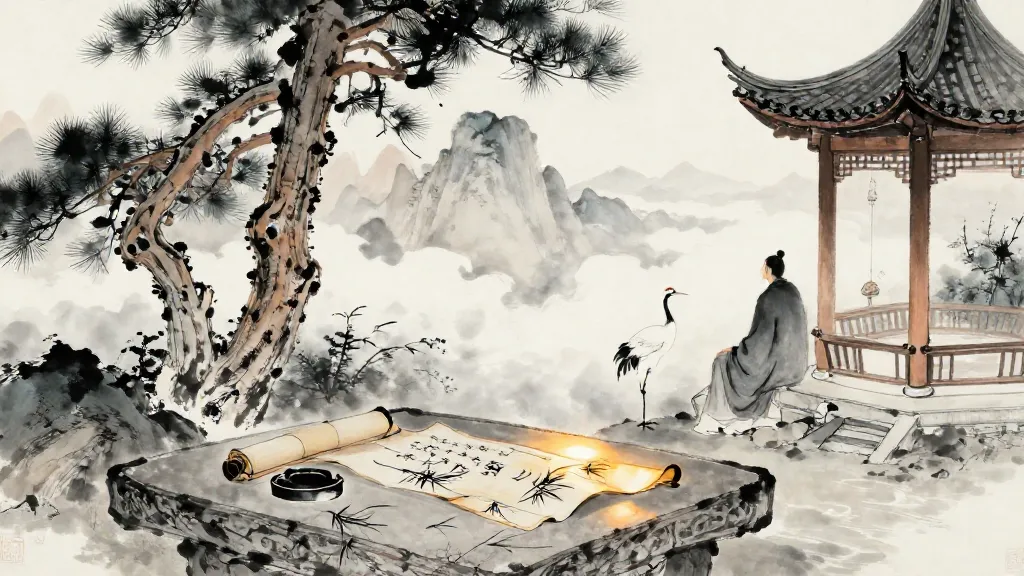
太史公自序(下) (The Grand Historian's Preface (Part 2)) — Chinese ink painting

Chapter 130 of 130

太史公自序(下)

The Grand Historian's Preface (Part 2)

View:

十二本紀綱要

Summaries of the Twelve Basic Annals

維昔黃帝,法天則地,四聖遵序,各成法度;唐堯遜位,虞舜不台;厥美帝功,萬世載之。作五帝本紀第一。

維禹之功,九州攸同,光唐虞際,德流苗裔;夏桀淫驕,乃放鳴條。作夏本紀第二。

漢興五世,隆在建元,外攘夷狄,內脫法度,封禪,改正朔,易服色。作今上本紀第十二。

The Yellow Emperor of old took Heaven as his model and Earth as his measure. Four sages followed in order, each establishing their own institutions. Yao yielded his position; Shun would not presume. To praise the merits of the Emperors so that ten thousand generations would record them — this is the First of the Basic Annals: the Five Emperors.

The achievements of Yu brought the Nine Provinces into harmony. His glory illuminated the age of Yao and Shun, and his virtue flowed to his descendants. But Jie of Xia was licentious and arrogant, and was exiled to Mingtiao. This is the Second: the Xia.

...

Han rose in its fifth generation; its greatness was established in the Jianyuan era. Abroad it drove back the Yi and Di; at home it reformed the institutions, performed the Feng and Shan sacrifices, changed the calendar, and altered the colors of ceremony. This is the Twelfth: the Present Emperor.

Notes

1context

These compressed summaries of the 130 chapters of the Shiji serve as both a table of contents and a manifesto. Each summary in four-character verse distills the essence of the chapter and explains why it was written. This is the Grand Historian’s own guide to reading his masterwork.

三十世家綱要(選)

Selected Summaries of the Thirty Hereditary Houses

太伯避歷,江蠻是適;文武攸興,古公王跡。…嘉伯之讓,作吳世家第一。

申、呂肖矣,尚父側微,卒歸西伯,文武是師。…嘉父之謀,作齊太公世家第二。

…嵇、紂失其道而湯、武作,周失其道而春秋作。秦失其政,而陳涉發跡,諸侯作難,風起雲蒸,卒亡秦族。天下之端,自涉發難。作陳涉世家第十八。

Taibo fled the succession and went to the wilds of the Yangtze. The achievements of Kings Wen and Wu trace to the Ancient Duke’s journey. ... Praising Taibo’s yielding, this is the First of the Hereditary Houses: Wu.

The houses of Shen and Lü had dwindled, yet the Revered Father rose from obscurity. He at last came to the Lord of the West, and became the Teacher of Wen and Wu. ... Praising the father’s stratagems, this is the Second: The Grand Duke of Qi.

... Jie and Zhou lost the Way and Tang and Wu arose; Zhou lost the Way and the Spring and Autumn Annals were composed. Qin lost its governance and Chen She launched his enterprise. The lords rose in rebellion — wind and clouds surging — and in the end destroyed the house of Qin. The turning point of All-Under-Heaven began when Chen She started his uprising. This is the Eighteenth: Chen She.

Notes

1context

Sima Qian’s decision to place Chen She — a peasant rebel — among the Hereditary Houses rather than the Biographies was a bold historiographical statement: that the common man who begins a revolution deserves the same status as the great feudal lords.

七十列傳綱要(選)

Selected Summaries of the Seventy Biographies

末世爭利,維彼奔義;讓國餓死,天下稱之。作伯夷列傳第一。

…楚人迫我京索,而信拔魏趙,定燕齊,使漢三分天下有其二,以滅項籍。作淮陰侯列傳第三十二。

…布衣匹夫之人,不害於政,不妨百姓,取與以時而息財富,智者有采焉。作貨殖列傳第六十九。

In an age of decadence when all chase profit, there were those who ran toward righteousness. They yielded kingdoms and starved to death, and All-Under-Heaven honors them. This is the First of the Biographies: Bo Yi.

... When Chu pressed us at Jing and Suo, Han Xin conquered Wei and Zhao, pacified Yan and Qi, and enabled Han to hold two-thirds of All-Under-Heaven, destroying Xiang Ji. This is the Thirty-Second: The Marquis of Huaiyin.

... Commoners who harm neither the government nor the people, who buy and sell in accordance with the seasons and rest upon their accumulated wealth — the wise may draw lessons from them. This is the Sixty-Ninth: The Money-Makers.

Notes

1context

The chapter summaries for the biographies translated in this batch — the Marquis of Huaiyin (Juan 92), the Xiongnu (Juan 110), Sima Xiangru (Juan 117), and the Money-Makers (Juan 129) — each receive their capsule description here, tying together the entire Shiji.

全書總綱與自評

Overview of the Complete Work and Self-Assessment

維我漢繼五帝末流,接三代業。周道廢,秦撥去古文,焚滅詩書,故明堂石室金匱玉版圖籍散亂。於是漢興,蕭何次律令,韓信申軍法,張蒼為章程,叔孫通定禮儀,則文學彬彬稍進…太史公仍父子相續纂其職。曰:“於戲!余維先人嘗掌斯事,顯於唐虞,至於周,復典之,故司馬氏世主天官。至於余乎,欽念哉!欽念哉!”罔羅天下放失舊聞,王跡所興,原始察終,見盛觀衰,論考之行事,略推三代,錄秦漢,上記軒轅,下至於茲,著十二本紀,既科條之矣。並時異世,年差不明,作十表。禮樂損益,律曆改易,兵權山川鬼神,天人之際,承斃通變,作八書。二十八宿環北辰,三十輻共一轂,運行無窮,輔拂股肱之臣配焉,忠信行道,以奉主上,作三十世家。扶義俶儉,不令己失時,立功名於天下,作七十列傳。凡百三十篇,五十二萬六千五百字,為太史公書。序略,以拾遺補,成一家之言,厥協六經異傳,整齊百家雜語,藏之名山,副在京師,俟後世聖人君子。第七十。

太史公曰:余述歷黃帝以來至太初而訖,百三十篇。

Our Han succeeds the last current of the Five Emperors and carries forward the enterprise of the Three Dynasties. The Way of Zhou was abandoned; Qin swept away the ancient texts and burned the Odes and Documents. The records of the Bright Hall, the Stone Chamber, the Golden Cabinet, and the Jade Plates were scattered and lost. When Han arose, Xiao He organized the laws and ordinances, Han Xin codified the military regulations, Zhang Cang established the weights and measures, and Shusun Tong fixed the ceremonial protocols — and literature and learning gradually revived. ... The Grand Historian, father and son, continued one after another in this office. He said: “Ah! Our ancestors held this office since the time of Yao and Shun, and through the Zhou they maintained it. The Sima family has presided over the celestial records from generation to generation. As for me — I must be reverent! I must be reverent!” He cast his net over the lost records and forgotten traditions of All-Under-Heaven, traced the rise of royal endeavors, examined origins and observed conclusions, saw the flourishing and watched the decline, evaluated deeds and events. He sketched the Three Dynasties, recorded the Qin and Han, reaching up to the Yellow Emperor and down to the present. He wrote twelve Basic Annals, laying out the main threads. For parallel events in different periods where chronology was unclear, he wrote ten Tables. For the evolution of ritual and music, changes in the calendar, military affairs, mountains, rivers, and spirits — the juncture of Heaven and humanity — and for tracing transformations through times of decline, he wrote eight Treatises. As the twenty-eight mansions circle the Pole Star, and thirty spokes share one hub, turning without cease, the assisting ministers can be matched to these: loyal and true, walking the path, serving the sovereign above — for them he wrote thirty Hereditary Houses. For those who upheld righteousness with daring, who did not let their moment pass, and who established merit and fame in All-Under-Heaven — for them he wrote seventy Biographies. In all, one hundred thirty chapters, five hundred twenty-six thousand five hundred characters: the book of the Grand Historian. This epilogue gathers up what was left out and fills the gaps, completing a coherent system of thought. It harmonizes the variant traditions of the Six Classics and brings order to the miscellaneous sayings of the Hundred Schools. One copy is stored in a famous mountain; the other is kept in the capital — awaiting the sages and gentlemen of a later age. Chapter Seventy.

The Grand Historian says: I have recounted the events from the Yellow Emperor down to the Taichu era, one hundred thirty chapters in all.
Notes

1context

The structure of the Shiji — 12 Basic Annals, 10 Tables, 8 Treatises, 30 Hereditary Houses, 70 Biographies = 130 chapters — became the model for all subsequent Chinese dynastic histories. Sima Qian invented the biographical-annalistic format that would be used for two thousand years.

2translation

“藏之名山,副在京師,俟後世聖人君子” — ‘One copy is stored in a famous mountain; the other is kept in the capital, awaiting the sages and gentlemen of a later age.’ This is Sima Qian’s final statement of purpose: the Shiji was written for posterity, not for his own time. The ‘famous mountain’ copy was a safeguard against destruction.

3context

The total of 526,500 characters makes the Shiji one of the longest works of ancient historiography in any civilization. For comparison, Thucydides’ History of the Peloponnesian War is roughly 150,000 words.

Edition & Source

Text
《史記》 Shiji
Edition
中華古詩文古書籍網 transcription
Commentary
裴駰《史記集解》、司馬貞《史記索隱》、張守節《史記正義》(Three Commentaries)