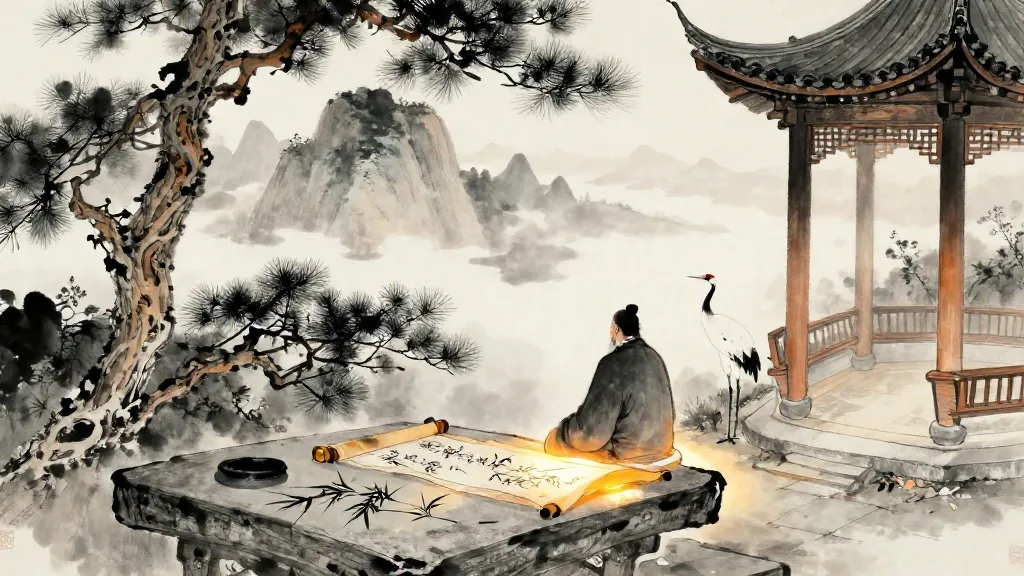
太史公自序(上) (The Grand Historian's Preface (Part 1)) — Chinese ink painting

Chapter 130 of 130

太史公自序(上)

The Grand Historian's Preface (Part 1)

View:

司馬氏世系

The Sima Family Lineage

昔在顋頊,命南正重以司天,北正黎以司地。唐虞之際,紹重黎之後,使復典之,至於夏商,故重黎氏世序天地。其在周,程伯休甫其後也。當周宣王時,失其守而為司馬氏。司馬氏世典周史。惠襄之間,司馬氏去周適晉。晉中軍隨會奔秦,而司馬氏入少梁。

自司馬氏去周適晉,分散,或在衛,或在趙,或在秦。其在衛者,相中山。在趙者,以傳劍論顯,蒯聩其後也。在秦者名錯,與張儀爭論,於是惠王使錯將伐蜀,遂拔,因而守之。…喜生談,談為太史公。

Long ago, in the time of Zhuanxu, the Southern Director Chong was appointed to govern the heavens, and the Northern Director Li was appointed to govern the earth. In the age of Yao and Shun, the successors of Chong and Li were commissioned to continue these duties, and through the Xia and Shang dynasties the Chong-Li clan maintained the celestial and terrestrial records in sequence. In the Zhou dynasty, the Duke of Cheng, Xiufu, was their descendant. During King Xuan of Zhou’s reign, the family lost its hereditary office and took the surname Sima. The Sima clan served as hereditary historians of Zhou. Between Kings Hui and Xiang, the Sima family left Zhou and went to Jin. When the Jin Central Army leader Sui Hui fled to Qin, the Sima family entered Shaoliang.

After the Sima family left Zhou for Jin, they scattered — some went to Wei, some to Zhao, some to Qin. Those in Wei served as ministers of Zhongshan. Those in Zhao became famous for their transmission of swordsmanship — Kuai Kui was their descendant. The one in Qin was named Cuo. He debated with Zhang Yi, and King Hui sent Cuo to lead an expedition against Shu, which he conquered and then governed. ... Xi fathered Tan, and Tan became Grand Historian.

Notes

1person司馬談Sīmǎ Tán

Sima Tan (司馬談, d. 110 BC) was Sima Qian’s father and predecessor as Grand Historian (太史公). His intellectual legacy — especially his essay on the Six Schools — profoundly influenced his son’s historical method.

2context

By tracing his family back to the mythical Chong and Li — primordial officials governing heaven and earth — Sima Qian establishes his hereditary right to the historian’s office as extending to the very origins of civilization.

司馬談論六家

Sima Tan's Essay on the Six Schools

太史公學天官於唐都,受易於楊何,習道論於黃子。太史公仕於建元元封之間,憫學者之不達其意而師悌,乃論六家之要指曰:

易大傳:“天下一致而百慮,同歸而殊塗。”夫陰陽、儒、墨、名、法、道德,此務為治者也,直所從言之異路,有省不省耳。…道家使人精神專一,動合無形,贍足萬物。其為術也,因陰陽之大順,采儒墨之善,撮名法之要,與時遷移,應物變化,立俗施事,無所不宜,指約而易操,事少而功多。

The Grand Historian [Sima Tan] studied celestial phenomena under Tang Du, received instruction in the Changes from Yang He, and studied Daoist philosophy under Master Huang. He served during the Jianyuan and Yuanfeng periods. Grieved that scholars failed to comprehend the essential meanings and went astray following false teachers, he composed his essay on the essential principles of the Six Schools:

“The Great Commentary of the Changes says: ‘All-Under-Heaven arrives at the same destination by a hundred different paths of thought; it reaches unity through diverse routes.’ The Yin-Yang school, the Confucians, the Mohists, the Logicians, the Legalists, and the Daoists — all seek to achieve good governance. They simply differ in the paths they take, with varying degrees of insight. ... The Daoist school causes a man to concentrate his spirit and become one, to move in harmony with the formless, and to sustain all things. Its method takes the grand patterns of Yin and Yang, selects the best of Confucianism and Mohism, distills the essentials of the Logicians and Legalists, shifts with the times, adapts to changes in things, and establishes customs and manages affairs with universal applicability. Its principles are concise and easy to follow; its demands are few and its achievements great.”

Notes

1context

Sima Tan’s ‘Discussion of the Essentials of the Six Schools’ (論六家之要指) is one of the most important early Chinese essays on intellectual history. His ranking of Daoism as the most comprehensive philosophy — incorporating the best of all other schools — reflects the Huang-Lao (黃老) intellectual milieu of the early Han court.

司馬遷之壯遊與父之遨命

Sima Qian's Grand Tour and His Father's Deathbed Commission

太史公既掌天官,不治民。有子曰遷。

遷生龍門,耕牧河山之陽。年十歲則誦古文。二十而南遊江、淮,上會稽,探禹穴,窪九疑,浮於沅、湘;北涉汶、泗,講業齊、魯之都,觀孔子之遺風,鄉射鄒、嶶;彄困鄱、薛、彭城,過梁、楚以歸。於是遷仕為郎中,奉使西征巴、蜀以南,南略郛、筰、坤明,還報命。

是歲天子始建漢家之封,而太史公留滞周南,不得與從事,故發憤且卒。而子遷適使反,見父於河洛之間。太史公執遷手而泣曰:“余先周室之太史也。自上世嘗顯功名於虞夏,典天官事。後世中衰,絕於予乎?汝復為太史,則續吾祖矣。今天子接千歲之統,封泰山,而余不得從行,是命也夫,命也夫!余死,汝必為太史;為太史,無忘吾所欲論著矣。…”遷俯首流涕曰:“小子不敏,請悉論先人所次舊聞,弗敢闕。”

The Grand Historian [Sima Tan] held the office of Celestial Observer and did not govern the people. He had a son named Qian.

Qian was born at Longmen. He herded cattle and farmed on the sunny side of the hills along the Yellow River. At ten he was already reciting the ancient texts. At twenty he traveled south to the Yangtze and Huai rivers, climbed Mount Kuaiji, explored the Cave of Yu, and peered into the Nine Doubts. He sailed the Yuan and Xiang rivers. Northward he crossed the Wen and Si, studied in the capitals of Qi and Lu, observed the surviving customs of Confucius, and practiced archery ceremonies at Zou and Yi. He suffered hardship at Po, Xue, and Pengcheng, and traveled through Liang and Chu before returning home. He then entered service as a Gentleman of the Interior and was sent west to Ba and Shu and south to Qiong, Zuo, and Kunming, before reporting back.

That year the Emperor first performed the Feng sacrifice of the Han dynasty, but the Grand Historian was detained in the south and unable to participate. He was stricken with grief and on the point of death. His son Qian, returning from a mission, met his father between the Yellow River and the Luo. The Grand Historian took Qian’s hand and wept: “Our ancestors were Grand Historians of the Zhou royal house. From the earliest ages they won distinction in the time of Yu and Xia, maintaining the records of heaven. In later generations the family declined — will it end with me? If you become Grand Historian after me, you will continue what our ancestors began. Now the Emperor carries on a tradition of a thousand years and performs the Feng sacrifice at Mount Tai, yet I could not accompany him. This is fate! This is fate! When I die, you must become Grand Historian. As Grand Historian, do not forget what I wished to set down in writing. ...” Qian bowed his head, weeping: “Your unworthy son lacks talent, but I beg to set forth in full the records our ancestors compiled. I shall not dare to leave gaps.”

Notes

1person司馬遷Sīmǎ Qiān

Sima Qian (司馬遷, c. 145–86 BC) is the author of the Shiji and one of the greatest historians in world literature. Born at Longmen (modern Hancheng, Shaanxi), he inherited the position of Grand Historian from his father.

2place

Longmen (龍門) is modern Hancheng, Shaanxi, on the Yellow River. It is also where Yu the Great legendarily cut a channel through the mountains.

3context

Sima Qian’s ‘grand tour’ at age twenty was a deliberate preparation for his historical work. He personally visited the sites of the events he would later record, examined local traditions, and verified geographical details. This empirical approach was unprecedented in ancient historiography.

述春秋與述作之志

On the Spring and Autumn Annals and the Purpose of the Work

太史公曰:“先人有言:‘自周公卒五百歲而有孔子。孔子卒後至於今五百歲,有能紹明世,正易傳,繼春秋,本詩書禮樂之際?’ 意在斯乎!意在斯乎!小子何敢讓焉。”

…壺遂曰:“孔子之時,上無明君,下不得任用,故作春秋,垂空文以斷禮義,當一王之法。今夫子上遇明天子,下得守職,萬事既具,咸各序其宜,夫子所論,欲以何明?”

太史公曰:“…且余嘗掌其官,廢明聖盛德不載,滅功臣世家賢大夫之業不述,墮先人所言,罪莫大焉。余所謂述故事,整齊其世傳,非所謂作也,而君比之於春秋,謬矣。”

The Grand Historian said: “My late father used to say: ‘Five hundred years after the Duke of Zhou died, Confucius appeared. Five hundred years after Confucius died, will there be one who can illuminate our age, correct the tradition of the Changes, continue the Spring and Autumn Annals, and ground it in the Odes, Documents, Ritual, and Music?’ He meant this as my charge! He meant this as my charge! How dare I, a mere son, refuse?”

... The Senior Grand Master Hu Sui asked: “In Confucius’s time there was no enlightened sovereign above, and below he could not gain employment. Therefore he composed the Spring and Autumn Annals, bequeathing an empty text to adjudicate ritual and right, as the standard of a true king. Now you serve an enlightened Son of Heaven above and hold your hereditary office below. All things are properly arranged — what do you intend to illuminate with your work?”

The Grand Historian replied: “... Moreover, I once held this office. To fail to record the brilliant virtue of a sage and glorious sovereign, to neglect to transmit the deeds of meritorious ministers, hereditary houses, and worthy statesmen, to let fall what my father wished to say — no crime could be greater. What I call ‘recounting past events and arranging their transmission’ is not what is called ‘creating’ — and for you to compare it to the Spring and Autumn Annals is mistaken.”

Notes

1person壺遂Hú Suì

Hu Sui (壺遂) was a senior official who challenged Sima Qian’s right to compose history. Sima Qian’s reply — that he is merely ‘arranging’ existing traditions, not ‘creating’ in the manner of Confucius — is a modesty formula that also protects him from the charge of presumption.

2context

Sima Qian’s claim of a 500-year cycle (Zhou → Confucius → himself) positions the Shiji as the successor to the Spring and Autumn Annals — the most audacious claim a Han scholar could make.

發憤著書

Writing from Anguish

於是論次其文。七年而太史公遭李陵之禍,幽於繲絸。乃喟然而嘆曰:“是余之罪也夫!是余之罪也夫!身毀不用矣。”退而深惟曰:“夫詩書隱約者,欲遂其志之思也。昔西伯拘羑里,演周易;孔子厄陳蔡,作春秋;屈原放逐,著離騷;左丘失明,厥有國語;孫子賓腳,而論兵法;不韋遷蜀,世傳呂覽;韓非囚秦,說難、孤憤;詩三百篇,大抵賢聖發憤之所為作也。此人皆意有所鬱結,不得通其道也,故述往事,思來者。”於是卒述陶唐以來,至於麟止,自黃帝始。

And so he began ordering and arranging his text. In the seventh year, the Grand Historian suffered the calamity of the Li Ling affair and was confined in prison. He sighed deeply and said: “This is my punishment! This is my punishment! My body is ruined and I am of no further use.” He withdrew into deep reflection and said: “The reason the Odes and Documents are written with hidden and compressed meaning is that their authors wished to work out the fullness of their thought through their anguish. Long ago, the Lord of the West was imprisoned at Youli and expanded the Zhou Changes. Confucius was besieged between Chen and Cai, and he composed the Spring and Autumn Annals. Qu Yuan was exiled and wrote the Encountering Sorrow. Zuo Qiu lost his sight, and only then produced the Discourses of the States. Sun Bin had his feet cut off, and only then set down the Art of War. Lü Buwei was banished to Shu, and his Collected Surveys was transmitted to later ages. Han Feizi was imprisoned in Qin, and he wrote ‘The Difficulties of Persuasion’ and ‘The Solitary Man’s Indignation.’ The three hundred poems of the Book of Odes were, broadly speaking, all written by sages and worthies working through their anguish. All these men had something knotted in their hearts that they could not resolve. Unable to achieve their Way, they recounted the past and thought of those who would come after.” And so he completed his account from the age of Tao-Tang down to the capture of the unicorn, beginning with the Yellow Emperor.

Notes

1context

The ‘Li Ling affair’ (李陵之禍): In 99 BC, General Li Ling (李陵) surrendered to the Xiongnu after a desperate battle. Sima Qian defended him at court, enraging Emperor Wu, who sentenced him to castration. This ‘bodily mutilation’ (身毀) became the defining trauma of his life and the driving force behind the completion of the Shiji.

2context

The ‘writing from anguish’ (發憤著書) passage is one of the most celebrated statements in Chinese literary history. By listing the great works produced by persecuted geniuses — from King Wen to Qu Yuan to Han Feizi — Sima Qian transforms his personal catastrophe into a universal principle: the greatest literature is born from suffering.

Edition & Source

Text
《史記》 Shiji
Edition
中華古詩文古書籍網 transcription
Commentary
裴駰《史記集解》、司馬貞《史記索隱》、張守節《史記正義》(Three Commentaries)