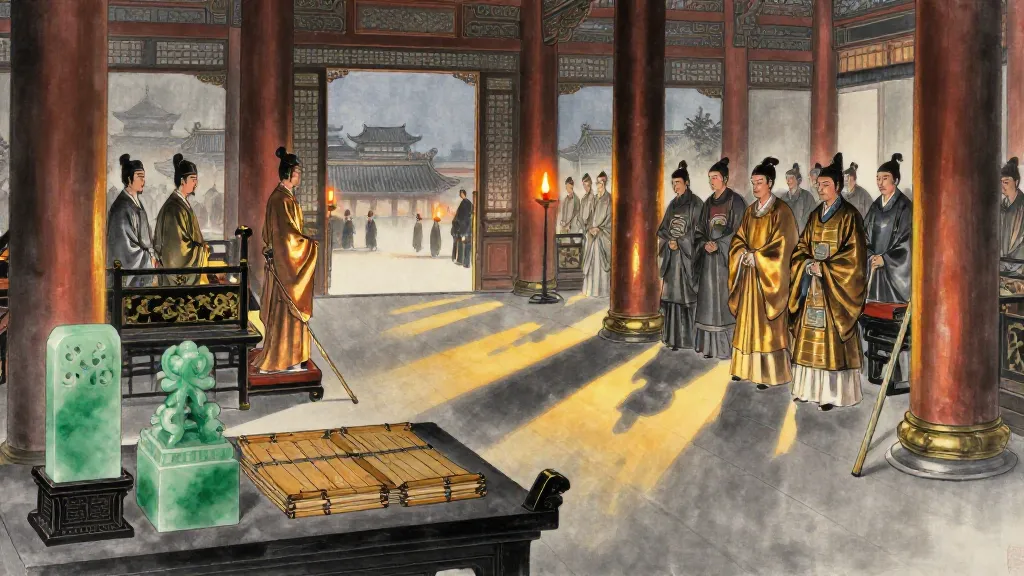
中宮紫微與北斗
The Central Palace — Purple Tenuity and the Northern Dipper
中宮天極星,其一明者,太一常居也;旁三星三公,或曰子屬。後句四星,末大星正妃,餘三星後宮之屬也。環之匡衛十二星,籓臣。皆曰紫宮。
前列直斗口三星,隨北端兌,若見若不,曰陰德,或曰天一。紫宮左三星曰天槍,右五星曰天棓,後六星絕漢抵營室,曰閣道。
北斗七星,所謂「鏇、璣、玉衡以齊七政「。杓攜龍角,衡殷南斗,魁枕參首。用昏建者杓;杓,自華以西南。夜半建者衡;衡,殷中州河、濟之間。平旦建者魁;魁,海岱以東北也。斗為帝車,運於中央,臨制四鄉。分陰陽,建四時,均五行,移節度,定諸紀,皆系於斗。
In the Central Palace, the Celestial Pole Star — its brightest member is the constant abode of the Great Unity (Taiyi). The three stars beside it represent the Three Dukes, or some say the Sons. Behind it curve four stars: the large star at the end represents the Principal Consort, and the remaining three are the Ladies of the Inner Palace. The twelve stars encircling them as guardians represent the screen-vassal ministers. This entire grouping is called the Purple Palace.
In the row before it, three stars aligned with the Dipper's mouth — following the northern tip to a point, sometimes visible, sometimes not — are called Hidden Virtue, or some say Celestial Unity. Three stars to the left of the Purple Palace are called the Celestial Lance; five stars to the right, the Celestial Staff. Behind, six stars spanning the Milky Way to reach the Encampment constellation form the Gallery Road.
The seven stars of the Northern Dipper are what the classics call 'the Lathe, the Armillary, and the Jade Crossbar, by which the Seven Luminaries are regulated.' The Handle connects to the Dragon's Horn; the Beam aligns with the Southern Dipper; the Bowl rests against the head of Orion. At dusk, the direction the Handle points establishes the month — the Handle governs the region from Mount Hua southwest. At midnight, the direction the Beam points establishes the month — the Beam governs the central provinces between the Yellow River and the Ji. At dawn, the direction the Bowl points establishes the month — the Bowl governs from the sea and Mount Tai northeast. The Dipper is the Emperor's Chariot, revolving at the center, presiding over the four directions. Dividing Yin and Yang, establishing the four seasons, equalizing the Five Phases, shifting the nodes and measures, setting the various cycles — all depend upon the Dipper.
Notes
This chapter is China's earliest surviving comprehensive star catalog and astrological treatise. It maps the heavens onto earthly politics, with each celestial region corresponding to a terrestrial territory and each star's behavior portending specific earthly events. The 'Central Palace' corresponds to the circumpolar region around Polaris.
The 'Purple Palace' (紫宮, Zǐ Gōng) corresponds roughly to the modern constellation Ursa Minor and surrounding circumpolar stars. It was considered the celestial counterpart of the emperor's forbidden palace — hence the later name 'Purple Forbidden City' (紫禁城) for the imperial palace in Beijing.
The Northern Dipper (北斗) consists of the seven brightest stars of Ursa Major. In Chinese cosmology, it was the most important asterism after the Pole Star, functioning as a celestial clock whose changing orientation through the night and across seasons governed the calendar.