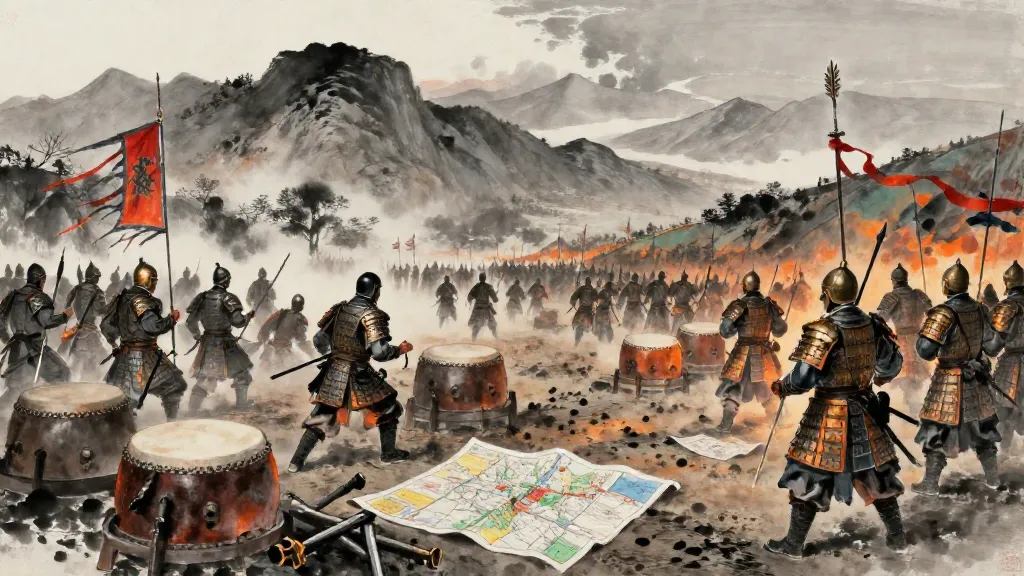
劉敬叔孫通列傳 (Biographies of Liu Jing and Shusun Tong) — Chinese ink painting

Chapter 99 of 130

劉敬叔孫通列傳

Biographies of Liu Jing and Shusun Tong

View:

婁敬獻都關中之策

Lou Jing Proposes Moving the Capital to Guanzhong

劉敬者,齊人也。漢五年,戍隴西,過洛陽。婁敬脫輓輅,衣其羊裘,見齊人虞將軍。婁敬說曰:“陛下都洛陽,豈欲與周室比隆哉?”“今陛下起豐沛,以之逕往而卷蜀漢,定三秦,與項羽大戰七十,小戰四十,使天下之民肝腦塗地,而欲比隆於成康之時,臣竊以為不侔也。且夫秦地被山帶河,四塞以為固。今陛下入關而都,案秦之故地,此亦搤天下之亢而拊其背也。”高帝問群臣,群臣皆山東人,爭言不如都周。及留侯明言入關便,即日車駕西都關中。

Liu Jing was a man of Qi. In the fifth year of Han, while being sent to garrison Longxi, he passed through Luoyang. Lou Jing unhitched himself from the transport cart, put on his sheepskin coat, and gained an audience. He argued: "Does Your Majesty intend to rival the glory of the Zhou house by making Luoyang your capital? You rose from Feng and Pei, fought seventy major and forty minor battles with Xiang Yu, and left the people's brains smeared across the ground. To compare yourself with the peaceful reigns of Kings Cheng and Kang is not fitting. The Qin heartland is shielded by mountains and girded by rivers, with four passes as its barriers. If Your Majesty enters the Pass and makes it your capital, you seize the realm by the throat and strike its back." The Emperor consulted his ministers, who were all easterners and argued for Zhou. But when the Marquis of Liu explicitly endorsed the advantages of the Pass, the Emperor moved west to Guanzhong that very day.

Notes

1person劉敬Liú Jìng

Liu Jing (劉敬, originally Lou Jing 婁敬) was a common soldier whose strategic argument for moving the Han capital to Guanzhong proved decisive. Emperor Gaozu gave him the imperial Liu surname and the title Lord of Fengchun.

2context

The debate over the capital location was one of the most consequential decisions of the early Han. Lou Jing's argument that Guanzhong's natural defenses made it inherently superior to Luoyang for a dynasty not yet secure prevailed — but only after Zhang Liang endorsed it.

劉敬和親匈奴與徙民實關中

Liu Jing's Marriage Alliance with the Xiongnu and Relocation Policy

高帝罷平城歸,冒頓兵彊,控弦三十萬,數苦北邊。劉敬曰:“天下初定,士卒罷於兵,未可以武服也。獨可以計久遠子孫為臣耳。陛下誠能以適長公主妻之。冒頓在,固為子婿;死,則外孫為單于。豈嘗聞外孫敢與大父抗禮者哉?”高帝曰:“善。”

劉敬又言“匈奴河南牡羊、樓煩王,去長安近者七百里。願陛下徙齊諸田,楚昭、屈、景,燕、趙、韓、魏後,及豪桀名家居關中。此彊本弱末之術也”。上曰:“善。”乃徙關中十餘萬口。

After Emperor Gaozu returned from the Pingcheng disaster, the Xiongnu under Maodun had three hundred thousand mounted archers and continually ravaged the northern border. Liu Jing said: "The realm is newly pacified and the soldiers are war-weary; military force cannot subdue the Xiongnu. The only option is a long-term strategy for future generations. If Your Majesty gives your eldest daughter in marriage, while Maodun lives he will be your son-in-law; when he dies, your grandson will be the Chanyu. Has anyone ever heard of a grandson daring to oppose his grandfather?" The Emperor agreed.

Liu Jing also argued: "The Xiongnu cavalry south of the Yellow River is only seven hundred li from Chang'an. I urge Your Majesty to relocate the great clan families of Qi, Chu, Yan, Zhao, Han, and Wei to Guanzhong, along with other powerful houses. This is the strategy of strengthening the trunk and weakening the branches." The Emperor agreed and relocated over a hundred thousand people to Guanzhong.

Notes

1context

The marriage alliance (和親) policy that Liu Jing proposed became the foundation of Han-Xiongnu relations for over sixty years, until Emperor Wu launched his military campaigns against the steppe. Though often derided as appeasement, it bought the Han dynasty time to consolidate.

2context

The forced relocation of powerful eastern clans to the capital region was a deliberate weakening of potential regional power bases. It followed the Qin precedent of relocating defeated aristocrats and became a recurrent Han policy.

叔孫通制朝儀

Shusun Tong Creates Court Ritual

叔孫通者,薛人也。秦時以文學徵,待詔博士。二世召博士諸儒生問。叔孫通前曰:“此特群盜鼠竊狗盜耳,何足置之齒牙間。”二世喜。通已出宮,諸生曰:“先生何言之諛也?”通曰:“公不知也,我幾不脫於虎口!”乃亡去。

漢五年,已並天下。群臣飲酒爭功,醉或妄呼,拔劍擊柱,高帝患之。叔孫通說上曰:“臣原徵魯諸生,與臣弟子共起朝儀。”魯有兩生不肯行,曰:“禮樂所由起,積德百年而後可興也。”叔孫通笑曰:“若真鄙儒也,不知時變。”

漢七年,長樂宮成,諸侯群臣皆朝十月。竟朝置酒,無敢讙譁失禮者。於是高帝曰:“吾乃今日知為皇帝之貴也。”乃拜叔孫通為太常。

Shusun Tong was a man of Xue. Under Qin, he was recruited as a scholar and waited at court as an academician. When the Second Emperor asked his scholars about Chen Sheng's revolt, Shusun Tong said: "These are merely petty thieves and pilferers — not worth mentioning." The Second Emperor was pleased. When his colleagues asked afterward why he had been so sycophantic, Shusun Tong replied: "You don't understand — I barely escaped the tiger's jaws!"

In the fifth year of Han, the realm was unified, but at court feasts the ministers drank and quarreled over merit, some shouting wildly and drawing swords to hack at pillars. Emperor Gaozu was troubled. Shusun Tong proposed: "Let me recruit scholars from Lu and, with my disciples, design a court ceremony." Two scholars from Lu refused to participate: "Ritual must grow from a hundred years of accumulated virtue." Shusun Tong laughed: "You are truly pedantic scholars who do not understand the times."

In the seventh year of Han, the Changle Palace was completed and all lords and ministers attended the tenth-month audience. The ceremony proceeded without a single breach of decorum. Emperor Gaozu said: "Only today do I understand the honor of being Emperor." He appointed Shusun Tong as Grand Master of Ceremonies.

Notes

1person叔孫通Shūsūn Tōng

Shusun Tong (叔孫通, fl. 209-195 BC) was a Confucian scholar who served six different masters before settling with Liu Bang. His creation of Han court ritual marked the beginning of Confucianism's institutional role in the Chinese state.

2context

Sima Qian's assessment quotes Laozi: 'The greatest straightness seems crooked; the Way is always winding.' Shusun Tong's willingness to flatter tyrants and compromise with circumstances, all to achieve a larger goal, embodied a pragmatic Confucianism at odds with the purists — yet it was his approach that shaped the Han state.

Edition & Source

Text
《史記》 Shiji
Edition
中華古詩文古書籍網 transcription
Commentary
裴駰《史記集解》、司馬貞《史記索隱》、張守節《史記正義》(Three Commentaries)