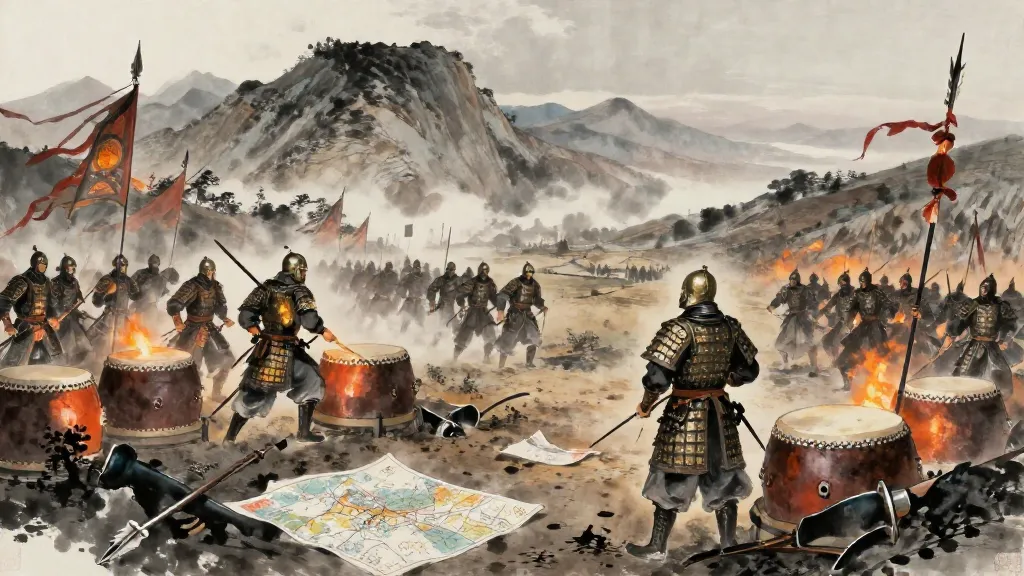
傅靳蒯成列傳 (Biographies of Fu Kuan, Jin She, and the Marquis of Kuaicheng) — Chinese ink painting

Chapter 98 of 130

傅靳蒯成列傳

Biographies of Fu Kuan, Jin She, and the Marquis of Kuaicheng

View:

傅寬從騎破項

Fu Kuan's Cavalry Campaigns Against Xiang Yu

陽陵侯傅寬,以魏五大夫騎將從,為舍人,起橫陽。從攻安陽、槓里,擊趙賁軍於開封,及擊楊熊曲遇、陽武。從至霸上。漢王賜寬封號共德君。從入漢中,遷為右騎將。屬淮陰,擊破齊歷下軍。因定齊地,剖符封為陽陵侯。為齊右丞相,備齊。

Fu Kuan, Marquis of Yangling, joined as a cavalry commander with the rank of Fifth Grand Officer of Wei, serving as a retainer from Hengyang. He fought at Anyang, Gangli, Kaifeng against Zhao Ben, and at Quyu and Yangwu against Yang Xiong. He reached Bashang with the army. The King of Han gave him the title Lord of Gongde. He followed into Hanzhong and was promoted to Right Cavalry Commander. Under Han Xin's command, he helped destroy the Qi army at Lixia and pacified the Qi territory. He received a perpetual tally as Marquis of Yangling and served as Right Chancellor of Qi.

Notes

1person傅寬Fù Kuān

Fu Kuan (傅寬, d. 190 BC), Marquis of Yangling, was a cavalry specialist who served under both Liu Bang and Han Xin. His grandson was executed for involvement in the Huainan King's conspiracy.

靳歙百戰功勳

Jin She's Hundred Battles

信武侯靳歙,以中涓從,起宛朐。攻濟陽,破李由軍。擊秦軍亳南、開封東北,斬騎千人將一人。至霸上。漢王賜歙爵建武侯。從定三秦。別西擊章平軍於隴西,破之。別之河內,擊趙將賁郝。還軍敖倉,破項籍軍成皋南。略地東至繒、郯、下邳,南至蘄。別定江陵,降江陵柱國。剖符世世勿絕,定食四千六百戶,號信武侯。以騎都尉從擊代。凡斬首九十級,虜百三十二人;別破軍十四,降城五十九。

Jin She, Marquis of Xinwu, joined as a personal attendant from Yuanqu. He fought at Jiyang, destroyed Li You's army, and struck Qin forces south of Bo and northeast of Kaifeng, killing a cavalry commander. He reached Bashang and was given the title Marquis of Jianwu. He helped pacify the Three Qins. In independent commands, he defeated Zhang Ping's army in Longxi, struck Zhao generals in Henei, and broke Xiang Yu's forces south of Chenggao. He campaigned east to Zeng, Tan, and Xiapi, and south to Qi. He pacified Jiangling and accepted the surrender of its chief minister. He received a perpetual tally with 4,600 households as Marquis of Xinwu. As cavalry commandant, he fought in Dai. In total: 90 heads taken, 132 prisoners; in independent commands: 14 armies broken, 59 cities surrendered.

Notes

1person靳歙Jìn Xī

Jin She (靳歙, d. 183 BC), Marquis of Xinwu, was one of the most prolific combat commanders of the Han founding. His staggering tally of independent victories — 14 armies broken and 59 cities taken — was among the highest of any Han general.

蒯成侯周緤忠心耿耿

The Steadfast Loyalty of Zhou She, Marquis of Kuaicheng

蒯成侯緤者,沛人也,姓周氏。常為高祖參乘,以舍人從起沛。東絕甬道,從出度平陰,終無離上心。上欲自擊陳豨,蒯成侯泣曰:“始秦攻破天下,未嘗自行。今上常自行,是為無人可使者乎?”上以為“愛我”,賜入殿門不趨,殺人不死。

太史公曰:蒯成侯周緤操心堅正,身不見疑,上欲有所之,未嘗不垂涕,此有傷心者然,可謂篤厚君子矣。

Zhou She, Marquis of Kuaicheng, was a man of Pei, surnamed Zhou. He always served as Emperor Gaozu's bodyguard charioteer, rising from retainer status at the start in Pei. He cut off supply corridors, fought through Pingyin, and never once wavered in his devotion. When the Emperor planned to personally campaign against Chen Xi, the Marquis of Kuaicheng wept: "When Qin conquered the realm, the First Emperor never campaigned in person. Now Your Majesty constantly takes the field yourself — is it because there is no one you can send?" The Emperor considered this 'the words of a man who loves me' and granted him the privilege of entering the palace without hurrying and immunity from capital punishment.

The Grand Historian remarks: Zhou She, Marquis of Kuaicheng, was steadfast and upright in heart, and was never once suspected of disloyalty. Whenever the Emperor was about to campaign, Zhou She never failed to weep — the response of a man with a tender heart. He can truly be called a devoted gentleman.

Notes

1person周緤Zhōu Xiè

Zhou She (周緤), Marquis of Kuaicheng, was Gaozu's personal chariot bodyguard from the earliest days. Unlike the other generals profiled in this chapter, his distinction was not battlefield prowess but unwavering personal loyalty.

2context

Sima Qian's warm assessment of Zhou She contrasts with the military tallies that dominate this chapter. In a world of ambitious generals, Zhou She's simple devotion stands out as a different kind of virtue.

Edition & Source

Text
《史記》 Shiji
Edition
中華古詩文古書籍網 transcription
Commentary
裴駰《史記集解》、司馬貞《史記索隱》、張守節《史記正義》(Three Commentaries)