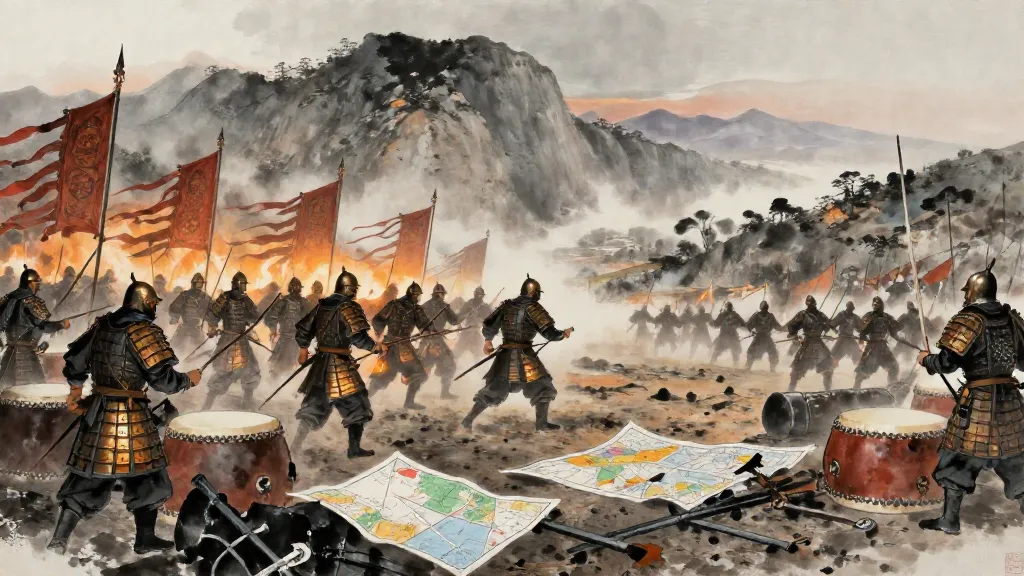
威王問 (King Wei's Questions) — Chinese ink painting

孫臏兵法 Sun Bin Bingfa · Chapter 3

威王問

King Wei's Questions

View:

威王九問

King Wei's Nine Questions

齊威王問用兵孫子曰:"兩軍相當,兩將相望,皆堅而固,莫敢先舉,為之奈何?"孫子答曰:"以輕卒嘗之,賤而勇者將之,期於北,毋期於得。為之微陣以觸其側。是謂大得。"威王曰:"用眾用寡有道乎?"孫子曰:"有。"威王曰:"我強敵弱,我眾敵寡,用之奈何?"孫子再拜曰:"明王之問!夫眾且強,猶問用之,則安國之道也,命之曰贊師。毀卒亂行,以順其志,則必戰矣。"威王曰:"敵眾我寡,敵強我弱,用之奈何?"孫子曰:"命曰讓威。必臧其尾,令之能歸。長兵在前,短兵在□,為之流夸,以助其急者。□□毋動,以待敵能。"

King Wei of Qi asked Sun Bin about the use of troops: 'When two armies are equally matched and two generals face each other, both entrenched and solid, neither daring to make the first move — what should be done?' Sun Bin replied: 'Send light troops to probe them, commanded by men of low rank but great courage. Plan for retreat, not for gain. Deploy a concealed formation to strike their flank. This is called achieving a great gain.' King Wei asked: 'Is there a method for using large and small forces?' Sun Bin said: 'There is.' King Wei asked: 'If we are strong and the enemy weak, we numerous and the enemy few — how should we proceed?' Sun Bin bowed twice and said: 'This is the question of an enlightened king! To be numerous and strong yet still ask how to employ them — this is the way to secure the state. It is called assisting the army. Disrupt their troops and disorder their ranks by following their intentions, and they will be compelled to fight.' King Wei asked: 'If the enemy is numerous and we are few, the enemy strong and we weak — how should we proceed?' Sun Bin said: 'This is called yielding authority. You must protect your rear and ensure the troops can withdraw. Place long weapons in front and short weapons behind [lacuna], deploy mobile screens to support the hard-pressed. [Lacuna] Do not move, and await the enemy's capability to be exhausted.'

Notes

1context

This chapter preserves a dialogue format where King Wei poses nine tactical questions and Tian Ji poses seven. The structure echoes the question-and-answer format common in Chinese military texts. The □ symbols represent characters lost from the bamboo strips.

威王續問

King Wei's Further Questions

威王曰:"我出敵出,未知眾少,用之奈何?"孫子[曰]:"命曰.."威王曰:"擊窮寇奈何?"孫子[曰]:"..可以侍生計矣。"威王曰:"擊均奈何?"孫子曰:"營而離之,我並卒而擊之,毋令敵知之。然而不離,按而止。毋擊疑。"威王曰:"以一擊十,有道乎?"孫子曰:"有。攻其無備,出其不意。"威王曰:"地平卒齊,合而北者,何也?"孫子曰:"其陣無鋒也。"威王曰:"令民素聽,奈何?"孫子曰:"素信。"威王曰:"善哉言!兵勢不窮。"

King Wei asked: 'If both sides deploy simultaneously and we do not know whether the enemy is numerous or few — what should be done?' Sun Bin said: 'This is called [lacuna]...' King Wei asked: 'How does one strike a cornered enemy?' Sun Bin said: '[lacuna]...one may thereby plan for survival.' King Wei asked: 'How does one strike an evenly matched enemy?' Sun Bin said: 'Encamp and divide them. Concentrate our troops and strike, without letting the enemy know. If they do not divide, hold position and stop. Do not attack when in doubt.' King Wei asked: 'Is there a method for one to strike ten?' Sun Bin said: 'There is. Attack where they are unprepared; appear where they do not expect.' King Wei asked: 'On level ground with equal troops, engaging yet being defeated — why is this?' Sun Bin said: 'Because the formation lacks a cutting edge.' King Wei asked: 'How does one ensure the people habitually obey?' Sun Bin said: 'Through habitual trustworthiness.' King Wei said: 'Excellently spoken! The potential of military force is inexhaustible.'

Notes

1context

The phrase 'attack where they are unprepared, appear where they do not expect' (攻其無備,出其不意) is identical to Sun Tzu's Sunzi Bingfa Chapter 1, confirming the intellectual lineage between the two Sun family texts.

田忌七問

Tian Ji's Seven Questions

..田忌問孫子曰:"患兵者何也?困敵者何也?壁延不得者何也?失天者何也?失地者何也?失人者何也?請問此六者有道乎?"孫子曰:"有。患兵者地也,困敵者險也。故曰,三里沮洳將患軍..涉將留大甲。故曰,患兵者地也,困敵者險也,壁延不得者寒也。□.."

Tian Ji asked Sun Bin: 'What troubles an army? What traps an enemy? What prevents ramparts from extending? What is the loss of heaven? What is the loss of ground? What is the loss of the people? Is there a method for these six things?' Sun Bin said: 'There is. What troubles an army is terrain. What traps an enemy is obstacles. Therefore it is said: three li of marshland will trouble an army [...] fording will delay heavy armor. Therefore it is said: what troubles an army is terrain, what traps an enemy is obstacles, and what prevents ramparts from extending is cold. [Lacuna]...'

田忌問陣法

Tian Ji Asks About Formations and Command

.."奈何?"孫子曰:"鼓而坐之,十而揄之。"田忌曰:"行陣已定,動而令士必聽,奈何?"孫子曰:"嚴而示之利。"田忌曰:"賞罰者,兵之急者耶?"孫子曰:"非。夫賞者,所以喜眾,令士忘死也。罰者,所以正亂,令民畏上也。可以益勝,非其急者也。"田忌曰:"權、勢、謀、詐,兵之急者耶?"孫子曰:"非也。夫權者,所以聚眾也。勢者,所以令士必斗也。謀者,所以令敵無備也。詐者,所以困敵也。可以益勝,非其急者也。"田忌忿然作色:"此六者,皆善者所用,而子大夫曰非急者也。然則其急者何也?"孫子曰:"料敵計險,必察遠近,..將之道也。必攻不守,兵之急者也。..骨也。"

'...What should be done?' Sun Bin said: 'Sound the drums and have them sit; after ten [drum beats], lead them forward.' Tian Ji asked: 'Once formations are set and the troops are moving, how does one ensure the soldiers obey commands?' Sun Bin said: 'Be strict and show them the advantage.' Tian Ji asked: 'Are rewards and punishments the most urgent matters in warfare?' Sun Bin said: 'No. Rewards make the troops glad and cause soldiers to forget death. Punishments correct disorder and make the people fear their superiors. These can enhance victory but are not the most urgent matters.' Tian Ji asked: 'Are authority, momentum, strategy, and deception the most urgent matters in warfare?' Sun Bin said: 'No. Authority is how you gather the multitude. Momentum is how you compel soldiers to fight. Strategy is how you ensure the enemy has no defenses. Deception is how you entrap the enemy. These can enhance victory but are not the most urgent matters.' Tian Ji flushed with anger: 'These six things are all what skilled commanders employ, yet you say none of them is the most urgent. Then what is the most urgent?' Sun Bin said: 'Assessing the enemy and calculating the terrain, always surveying distances [...] this is the way of the general. To always attack where the enemy does not defend — this is the most urgent matter in warfare. [...is its] bone.'

Notes

1context

Sun Bin's insistence that assessing the enemy and striking undefended points outweighs rewards, punishments, authority, momentum, strategy, and deception reveals a hierarchy of military priorities. The 'bone' metaphor at the end (fragmentary) likely means this principle is the skeleton supporting all other tactical elements.

田忌問陣勢

Tian Ji Asks About Deployment and Formations

田忌問孫子曰:"張軍毋戰有道?"孫子曰:"有。倅險增壘,淨戒毋動,毋可□□,毋可怒。"田忌曰:"敵眾且武,必戰有道乎?"孫子曰:"有。埤壘廣志,嚴正輯眾,避而驕之,引而勞之,攻其無備,出其不意,必以為久。"

Tian Ji asked Sun Bin: 'Is there a method for deploying the army without fighting?' Sun Bin said: 'There is. Occupy rugged positions and strengthen your ramparts. Maintain strict vigilance and do not move. Do not [let yourself be provoked], do not let yourself be angered.' Tian Ji asked: 'If the enemy is numerous and fierce, is there a method for forcing battle?' Sun Bin said: 'There is. Lower your ramparts and broaden your resolve. Be strict, correct, and unified in your forces. Avoid the enemy to make him arrogant; lure him to exhaust him. Attack where he is unprepared; appear where he does not expect. You must be prepared for a prolonged engagement.'

錐行雁行諸陣

The Wedge, the Goose, and Other Formations

田忌問孫子曰:"錐行者何也,雁行者何也?篡卒力士者何也?勁弩趨發者何也?飄風之陣者何也?眾卒者何也?"孫子曰:"錐行者,所以沖堅毀銳也。雁行者,所以觸側應□[也]。篡卒力士者,所以絕陣取將也。勁弩趨發者,所以甘戰持久也。飄風之陣者,所以回□□□[也]。眾卒者,所以分功有勝也。"孫子曰:"明主、知道之將,不以眾卒幾功。"

Tian Ji asked Sun Bin: 'What is the wedge formation? What is the goose formation? What are elite shock troops? What are rapid-firing strong crossbowmen? What is the whirlwind formation? What is the mass infantry?' Sun Bin said: 'The wedge formation is for breaking through solid defenses and smashing strong points. The goose formation is for striking flanks and responding [lacuna]. Elite shock troops are for cutting through formations and capturing generals. Rapid-firing strong crossbowmen are for sustaining prolonged engagement. The whirlwind formation is for encircling [lacuna]. Mass infantry is for dividing tasks and achieving victory.' Sun Bin said: 'An enlightened ruler and a general who understands the Way do not rely on mass infantry alone to seek merit.'

Notes

1context

The six tactical elements discussed here — wedge (錐行), goose (雁行), elite troops (篡卒), crossbowmen (勁弩), whirlwind (飄風), and mass infantry (眾卒) — form a comprehensive tactical toolkit. Each serves a distinct battlefield purpose, and Sun Bin emphasizes that understanding when to use each is more important than raw numbers.

孫子評威王田忌

Sun Bin's Assessment of King Wei and Tian Ji

孫子出而弟子問曰:"威王、田忌臣主之問何如?"孫子曰:"威王問九,田忌問七,幾知兵矣,而未達於道也。吾聞素信者昌,立義..用兵無備者傷,窮兵者亡。齊三世其憂矣。"

When Sun Bin came out, his disciples asked: 'How were the questions from King Wei and the minister Tian Ji?' Sun Bin said: 'King Wei asked nine questions and Tian Ji asked seven. They have nearly attained an understanding of warfare, but have not yet reached the Way. I have heard that those who practice habitual trustworthiness will flourish, and those who establish righteousness [...]. Those who wage war without preparation will be harmed; those who exhaust their military will perish. Within three generations, Qi will have cause for worry.'

Notes

1context

Sun Bin's prophecy that Qi would decline within three generations proved remarkably accurate. After the reigns of King Wei and King Xuan — during which Qi was a dominant power — the state declined sharply under King Min (r. 314–284 BC), who overextended Qi militarily until a coalition of five states nearly destroyed it in 284 BC.

Edition & Source

Text
《孫臏兵法》 Sun Bin Bingfa
Edition
中華古詩文古書籍網 transcription (Yinqueshan bamboo strips reconstruction)
Commentary
Modern reconstruction from 1972 Yinqueshan tomb excavation