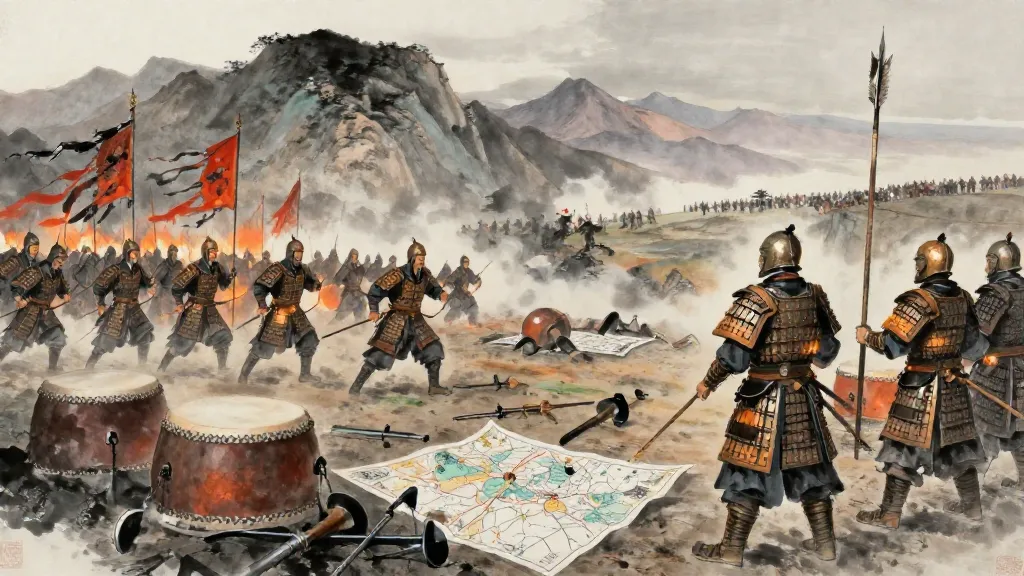
篡卒 (Selecting Troops) — Chinese ink painting

孫臏兵法 Sun Bin Bingfa · Chapter 5

篡卒

Selecting Troops

View:

兵之勝在於篡卒

Victory Lies in Selecting Troops

孫子曰:兵之勝在於篡卒,其勇在於制,其巧在於勢,其利在於信,其德在於道,其富在於亟歸;其強在於休民,其傷在於數戰。

Sun Bin said: The victory of an army lies in selecting the right troops. Its courage lies in discipline. Its skill lies in momentum. Its advantage lies in trustworthiness. Its virtue lies in the Way. Its wealth lies in returning swiftly from campaign. Its strength lies in giving the people rest. Its harm lies in fighting too many battles.

德行信義

Virtue, Trustworthiness, and Righteousness

孫子曰:德行者,兵之厚積也。信者,兵之明賞也。惡戰者,兵之王器也。取眾者,勝囗囗囗也。

Sun Bin said: Virtuous conduct is the deep reserve of an army. Trustworthiness is the clear reward system of an army. Reluctance to fight is the royal instrument of an army. Winning the masses is the [lacuna] of victory.

Notes

1context

The concept that 'reluctance to fight is the royal instrument' (惡戰者,兵之王器也) echoes the Laozi's warning that 'fine weapons are instruments of ill omen.' The paradox — that the best military commanders are those who dislike war — is a consistent theme across early Chinese military thought.

恆勝五條

Five Constants of Victory

孫子曰:恆勝有五:得主專制,勝。知道,勝,得眾,勝。左右和,勝。量敵計險,勝。

Sun Bin said: There are five constants of victory. Having the ruler's trust and full authority — victory. Understanding the Way — victory. Winning the people's support — victory. Harmony among subordinates — victory. Assessing the enemy and calculating the terrain — victory.

恆不勝五條

Five Constants of Defeat

孫子曰:恆不勝有五:御將不勝。不知道不勝。乖將不勝。不用間不勝。不得眾不勝。

Sun Bin said: There are five constants of defeat. A general controlled by his ruler will not win. Not understanding the Way will not win. A general at odds with his officers will not win. Not using spies will not win. Not having the people's support will not win.

勝之要訣

The Essentials of Victory

孫子曰:勝在盡囗,明賞,選卒,乘敵之囗。是謂太武之葆。

Sun Bin said: Victory lies in [exhausting the enemy's lacuna], clear rewards, selecting troops, and exploiting the enemy's [lacuna]. This is called the treasure of supreme military power.

忠信敢三令

The Three Commands: Loyalty, Trustworthiness, and Daring

孫子曰:不得主弗將也..(以下為散簡、缺文)..令,一曰信,二曰忠,三曰敢。安忠?忠王。安信?信賞。安敢?敢去不善。不忠於王,不敢用其兵。不信於賞,百姓弗德。不敢去不善,百姓弗畏。

Sun Bin said: Without the ruler's mandate, do not take command. [The following are scattered bamboo strips with lacunae.] ...The commands are three: first, trustworthiness; second, loyalty; third, daring. What is loyalty? Loyalty to the king. What is trustworthiness? Keeping faith with rewards. What is daring? Daring to remove the unworthy. Without loyalty to the king, one dare not employ the troops. Without keeping faith with rewards, the people will feel no gratitude. Without daring to remove the unworthy, the people will feel no awe.

Notes

1context

This section survives only as scattered bamboo strips (散簡). The three commands — trustworthiness (信), loyalty (忠), and daring (敢) — form a hierarchy of military leadership virtues that Sun Bin considers prerequisites for command.

Edition & Source

Text
《孫臏兵法》 Sun Bin Bingfa
Edition
中華古詩文古書籍網 transcription (Yinqueshan bamboo strips reconstruction)
Commentary
Modern reconstruction from 1972 Yinqueshan tomb excavation