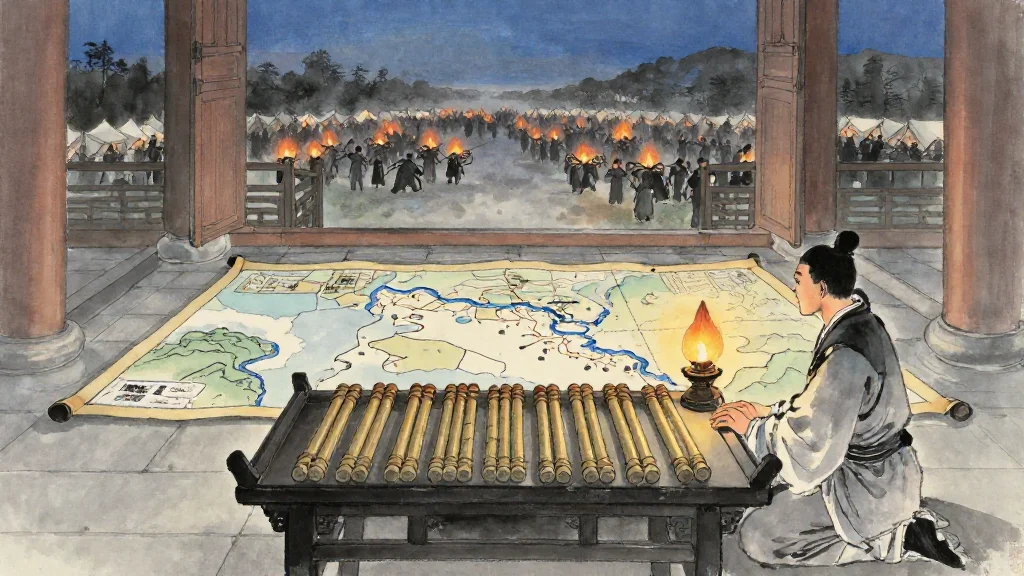
始計 (Laying Plans) — Chinese ink painting

Chapter 1 of 13

始計

Laying Plans

View:

兵者國之大事

War Is a Matter of Vital Importance

孫子曰:兵者,國之大事,死生之地,存亡之道,不可不察也。故經之以五事,校之以七計,而索其情:一曰道,二曰天,三曰地,四曰將,五曰法。

Master Sun said: War is a matter of vital importance to the state — the province of life and death, the road to survival or ruin. It must be thoroughly examined.

Therefore, appraise it through five fundamental factors, compare by means of seven calculations, and so assess its true nature. The first factor is moral cause; the second, Heaven; the third, Earth; the fourth, the general; the fifth, method and discipline.

Notes

1context

兵 (bing) here means 'war' or 'military affairs' in the broadest sense — not merely 'soldiers' or 'weapons'. The opening line establishes warfare as a matter of statecraft requiring the most serious deliberation.

2context

The Five Factors (五事) form the core analytical framework of the Sunzi. They recur throughout the text and were adopted by virtually all later Chinese military theorists.

3translation

道 (dao) is translated as 'moral cause' following the explanation in the next section: it is the bond between ruler and people that makes them willing to fight and die. This is distinct from the Daoist metaphysical sense of dao.

五事七計

The Five Factors and Seven Calculations

道者,令民與上同意,可與之死,可與之生,而不畏危也。天者,陰陽、寒暑、時制也。地者,高下、遠近、險易、廣狹、死生也。將者,智、信、仁、勇、嚴也。法者,曲制、官道、主用也。凡此五者,將莫不聞,知之者勝,不知者不勝。故校之以七計而索其情,曰:主孰有道?將孰有能?天地孰得?法令孰行?兵眾孰強?士卒孰練?賞罰孰明?吾以此知勝負矣。

Moral cause is what makes the people share the same purpose as their ruler: they will die with him, they will live with him, and they will not fear danger.

Heaven encompasses yin and yang, cold and heat, the cycle of the seasons.

Earth encompasses high and low ground, far and near distances, difficult and easy terrain, wide and narrow passes, the chances of life and death.

The general encompasses wisdom, trustworthiness, benevolence, courage, and strictness.

Method and discipline encompass military organization, chains of command, and logistics.

No general can be ignorant of these five factors. He who grasps them will be victorious; he who does not will be defeated. Therefore, compare by means of seven calculations and assess the situation: Which ruler possesses moral cause? Which general has greater ability? Who has gained the advantages of Heaven and Earth? Whose regulations and orders are more strictly enforced? Whose forces are stronger? Whose officers and men are better trained? Whose system of rewards and punishments is clearer? From these I can foretell victory and defeat.

Notes

4context

The five virtues of the general (智信仁勇嚴) became canonical in Chinese military thought. Cao Cao's commentary notes these must be balanced: courage without wisdom leads to recklessness, benevolence without strictness to weakness.

5translation

曲制 (qu zhi) refers to the organizational structure of the army — the division into units and the regulations governing each. 官道 (guan dao) refers to the chain of command and the duties of officers. 主用 (zhu yong) refers to the management of supplies and expenditures.

6context

The Seven Calculations (七計) are a diagnostic checklist for comparing one's own state against the enemy before committing to war. They transform the abstract Five Factors into concrete, comparative questions.

詭道十二法

The Way of Deception

將聽吾計,用之必勝,留之;將不聽吾計,用之必敗,去之。計利以聽,乃為之勢,以佐其外。勢者,因利而制權也。兵者,詭道也。故能而示之不能,用而示之不用,近而示之遠,遠而示之近。利而誘之,亂而取之,實而備之,強而避之,怒而撓之,卑而驕之,佚而勞之,親而離之。攻其無備,出其不意。此兵家之勝,不可先傳也。

If a general heeds my calculations, employ him — he will surely win. Retain him. If a general does not heed my calculations, employ him and he will surely be defeated. Dismiss him.

Once the advantage of my plans is accepted, create strategic momentum to assist the campaign abroad. Momentum is the art of seizing opportunity and exercising control according to advantage.

War is the way of deception. Therefore: when capable, feign incapability; when active, feign inactivity; when near, make the enemy believe you are far away; when far away, make him believe you are near. Lure him with advantage. Strike him when he is in disorder. If he is solid, prepare against him. If he is strong, avoid him. If he is angry, provoke him further. If he is humble, make him arrogant. If he is rested, exhaust him. If his forces are united, divide them.

Attack where he is unprepared. Appear where you are not expected. These are the strategist's keys to victory — they cannot be fixed in advance.

Notes

7context

詭道 (gui dao, 'the way of deception') is one of the Sunzi's most famous concepts. It asserts that warfare is fundamentally deceptive — honesty and fair play are liabilities. This was a radical claim in a culture that valued ritual propriety (li) even in war.

8translation

勢 (shi) is one of the most difficult terms in Chinese strategic thought. It combines the ideas of strategic advantage, positional energy, and momentum — the configuration of power that makes victory almost inevitable. Here translated as 'strategic momentum' and 'opportunity.'

9context

The twelve paired stratagems (能而示之不能 through 親而離之) form a mnemonic catalogue of tactical deceptions. Each pair follows the pattern: [when the enemy has quality X], [do Y]. They became a standard training tool for Chinese military officers.

10translation

不可先傳 literally 'cannot be transmitted in advance.' Sunzi means that these principles must be applied flexibly — there is no fixed formula. The specific application depends on the situation at hand.

廟算定勝負

Victory Is Determined by Temple Calculations

夫未戰而廟算勝者,得算多也;未戰而廟算不勝者,得算少也。多算勝,少算不勝,而況於無算乎?吾以此觀之,勝負見矣。

He who makes many calculations in the temple before battle will win. He who makes few calculations beforehand will lose. Many calculations lead to victory, few calculations to defeat — how much more so no calculations at all! By examining the matter in this way, I can foresee who will win and who will lose.

Notes

11context

廟算 (miao suan, 'temple calculations') refers to strategic planning conducted in the ancestral temple before a military campaign. In ancient China, war was sanctioned by ritual: the ruler would deliberate with his ministers in the temple, consult divination, and only then commit to action. Sunzi transforms this ritual into a rational planning process.

12textual

The Yinqueshan bamboo strip text (銀雀山漢簡, discovered 1972) preserves a version of this chapter largely consistent with the received text, confirming its antiquity. Minor character variants exist but do not affect the meaning.

Edition & Source

Text
《孫子兵法》 Sunzi Bingfa
Edition
《武經七書》(Seven Military Classics) canonical text
Commentary
Cao Cao (曹操) and the Eleven Commentators tradition