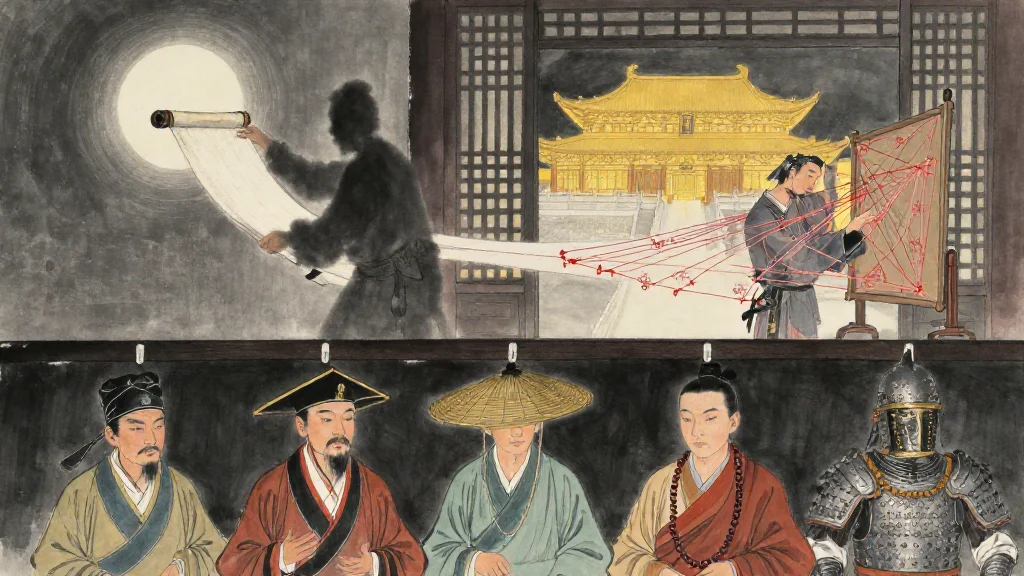
用間 (Use of Spies) — Chinese ink painting

Chapter 13 of 13

用間

Use of Spies

View:

先知之道

The Imperative of Foreknowledge

孫子曰:凡興師十萬,出征千里,百姓之費,公家之奉,日費千金,內外騷動,怠于道路,不得操事者,七十萬家。相守數年,以爭一日之勝,而愛爵祿百金,不知敵之情者,不仁之至也,非人之將也,非主之佐也,非勝之主也。故明君賢將,所以動而勝人,成功出於眾者,先知也。先知者,不可取於鬼神,不可象於事,不可驗於度,必取於人,知敵之情者也。

Master Sun said: When you raise an army of a hundred thousand and march a thousand li, the cost to the common people and the expenditure of the state treasury run to a thousand gold pieces a day. There is turmoil at home and abroad, men exhausted on the roads, and seven hundred thousand households unable to pursue their livelihoods.

To hold this stalemate for years, contending for victory in a single day, and yet begrudge the outlay of ranks, emoluments, and a hundred pieces of gold — thereby remaining ignorant of the enemy's situation — this is the height of inhumanity. Such a man is no one's general, no ruler's support, and no master of victory.

The reason wise sovereigns and able generals move and conquer, achieving success beyond the reach of ordinary men, is foreknowledge. Foreknowledge cannot be extracted from ghosts and spirits. It cannot be inferred from analogies. It cannot be verified by celestial calculations. It must be obtained from men — those who know the enemy's situation.

Notes

1context

The figure of 700,000 households disrupted by an army of 100,000 reflects the enormous logistical burden of ancient warfare. Commentators estimate a ratio of roughly 7:1 between support population and field troops, accounting for conscript labour, supply transport, and lost agricultural production.

2translation

不仁之至也 ('the height of inhumanity'): Sunzi inverts the conventional moral framing. Spending money on espionage is not immoral — refusing to spend on intelligence, and thereby sacrificing armies through ignorance, is the truly inhumane act. This is a characteristic Sunzi move: redefining virtue in strategic terms.

3translation

不可取於鬼神,不可象於事,不可驗於度: Three methods of divination are rejected. 鬼神 refers to spiritual consultation and oracle practices; 象於事 means reasoning by analogy from past events; 驗於度 means verification through astronomical or mathematical calculations. Sunzi insists that only human intelligence — spies — can reveal the enemy's true condition.

五間之名

The Five Types of Spy

故用間有五:有鄉間,有內間,有反間,有死間,有生間。五間俱起,莫知其道,是謂「神紀」,人君之寶也。鄉間者,因其鄉人而用之;內間者,因其官人而用之;反間者,因其敵間而用之;死間者,為誑事於外,令吾間知之,而傳於敵間也;生間者,反報也。

There are five types of spy: local spies, inside spies, double agents, expendable spies, and living spies. When all five operate simultaneously and no one can trace their methods, this is called the 'divine web' — the sovereign's treasure.

Local spies are recruited from among the enemy's own people. Inside spies are recruited from among the enemy's officials. Double agents are enemy spies who have been turned to your service. Expendable spies are agents who are deliberately fed false information, which they carry to the enemy. Living spies are those who return with their reports.

Notes

1context

The five categories form a complete intelligence system. 鄉間 (local spies) provide ground-level information from the civilian population; 內間 (inside spies) penetrate the enemy's bureaucracy; 反間 (double agents) corrupt the enemy's own intelligence network; 死間 (expendable spies) are unwitting carriers of disinformation; 生間 (living spies) are professional operatives who survive to report back.

2translation

神紀: Literally 'divine thread' or 'spirit's warp.' 紀 originally refers to the warp threads on a loom — the hidden structural threads that hold everything together. The metaphor suggests an invisible web of intelligence that binds the entire operation. Translated as 'divine web' to capture both the invisibility and the systematic nature.

3translation

死間 ('expendable spies'): The literal meaning is 'dead spies.' These agents are not necessarily killed, but they are sacrificed in the sense that they unknowingly carry planted disinformation. When the enemy discovers the deception, the agent is typically executed — hence 'dead.' The term is translated as 'expendable' to convey the operational logic.

用間之道

The Principles of Running Spies

故三軍之事,莫親於間,賞莫厚於間,事莫密於間,非聖智不能用間,非仁義不能使間,非微妙不能得間之實。微哉!微哉!無所不用間也。間事未發而先聞者,間與所告者皆死。

In the entire army, no one should be closer to the commander than his spies. No one should be more generously rewarded than his spies. No business should be more secret than espionage.

Without superior wisdom, you cannot employ spies. Without benevolence and righteousness, you cannot direct spies. Without subtlety and insight, you cannot obtain the truth from spies.

Subtle indeed! Subtle indeed! There is nowhere that espionage cannot be used.

If an intelligence operation is leaked before it is launched, the spy and everyone he told must be put to death.

Notes

1context

The triad of requirements — 聖智 (sagely wisdom), 仁義 (benevolence and righteousness), and 微妙 (subtlety) — elevates espionage from a dirty trade to a discipline requiring the highest human qualities. This passage is the foundation of Sunzi's argument that intelligence work is the noblest function of command.

2translation

莫親於間: 親 means 'close' or 'intimate.' The spymaster must have a closer personal relationship with his agents than with anyone else in the army. This is both operational necessity (agents must trust their handler absolutely) and a statement about the centrality of intelligence to command.

3textual

The abrupt shift to the death penalty for leaks (間事未發而先聞者) may seem harsh after the lofty language about wisdom and benevolence. But the juxtaposition is deliberate: the 'benevolence' required to run spies is not softness — it is the ability to inspire loyalty while enforcing absolute secrecy.

反間為上

The Primacy of Double Agents

凡軍之所欲擊,城之所欲攻,人之所欲殺,必先知其守將、左右、謁者、門者、舍人之姓名,令吾間必索知之。必索敵人之間來間我者,因而利之,導而舍之,故反間可得而用也;因是而知之,故鄉間、內間可得而使也;因是而知之,故死間為誑事,可使告敵;因是而知之,故生間可使如期。五間之事,主必知之,知之必在於反間,故反間不可不厚也。

Whenever there is an army you wish to strike, a city you wish to attack, or a person you wish to assassinate, you must first learn the names of the garrison commander, his aides-de-camp, the gate officers, the sentries, and the household retainers. Order your spies to discover all of this without fail.

You must seek out the enemy's spies who have been sent to operate against you. Bribe them, guide them, and give them lodging. In this way double agents can be recruited and employed.

Through the intelligence gained from double agents, local spies and inside spies can be recruited and directed. Through this intelligence, expendable spies can be fed disinformation and sent to deceive the enemy. Through this intelligence, living spies can be dispatched and return on schedule.

The sovereign must understand the workings of all five types of spy. The key to this understanding lies invariably with the double agent. Therefore, double agents must be treated with the utmost generosity.

Notes

1context

守將、左右、謁者、門者、舍人: This is a precise inventory of an enemy command structure. 守將 is the garrison commander; 左右 are his personal attendants and advisors; 謁者 are officials who control access (reception officers); 門者 are gate guards; 舍人 are household retainers. Knowing their names enables targeted recruitment, bribery, or assassination.

2context

The double agent (反間) is the keystone of Sunzi's intelligence architecture. Every other type of spy depends on information gained through turned enemy agents. Double agents reveal the enemy's intelligence priorities, their operational methods, and the identities of their other operatives — enabling the entire network to be built or compromised.

3translation

因而利之,導而舍之: Literally 'exploit them through benefit, guide them and house them.' The sequence describes the classic recruitment of a double agent: first bribe (利), then direct (導), then provide safe harbour (舍). The process converts an enemy asset through incentives rather than coercion.

4translation

反間不可不厚也: 厚 means 'generous' or 'substantial' — double agents must receive the richest rewards because they take the greatest risks and provide the most strategically valuable intelligence. The double negative (不可不) adds emphasis: this is non-negotiable.

上智為間

The Highest Intelligence as the Ultimate Weapon

昔殷之興也,伊摯在夏;周之興也,呂牙在殷。故明君賢將,能以上智為間者,必成大功。此兵之要,三軍之所恃而動也。

In ancient times, the rise of the Yin dynasty was due to Yi Zhi, who had served in the Xia court. The rise of the Zhou dynasty was due to Lü Ya, who had served in the Yin court.

Therefore, the wise sovereign and the able general who can employ men of superior intelligence as spies are certain to achieve great things. This is the essence of warfare — that on which the entire army depends before it can move.

Notes

1context

伊摯 (Yi Zhi) is Yi Yin (伊尹), the legendary minister who helped Tang of Shang (商湯) overthrow the Xia dynasty (c. 1600 BC). According to tradition, Yi Yin first served at the Xia court, learned its weaknesses from within, then defected to Shang with critical intelligence. Sunzi frames him as history's greatest spy.

2context

呂牙 (Lü Ya) is Lü Shang (呂尚), better known as Jiang Ziya (姜子牙) or the Grand Duke (太公望). He served as strategist to King Wen and King Wu of Zhou in their overthrow of the Shang dynasty (c. 1046 BC). The Liutao (六韜), a military treatise attributed to him, is another of the Seven Military Classics alongside the Sunzi.

3context

Sunzi's historical examples are carefully chosen. Both Yi Yin and Lü Ya were men of the highest calibre — statesmen and strategists, not mere informants. The term 上智 ('superior intelligence') means not just clever spies but the most brilliant minds of the age, deployed in intelligence roles. The implication: espionage is too important for second-rate men.

4context

The final line — 此兵之要,三軍之所恃而動也 ('This is the essence of warfare — that on which the entire army depends before it can move') — is the conclusion of the entire Sunzi Bingfa. That the text ends not with a chapter on tactics or formations but on intelligence operations is itself the ultimate statement of Sunzi's philosophy: knowledge precedes and determines all action.

5textual

Some editions read 伊摯 as a reference to Yi Yin's personal name (摯 = Zhi), while others treat 摯 as a descriptor meaning 'earnest' or 'devoted.' The mainstream commentarial tradition, following Cao Cao, takes it as a proper name.

Edition & Source

Text
《孫子兵法》 Sunzi Bingfa
Edition
《武經七書》(Seven Military Classics) canonical text
Commentary
Cao Cao (曹操) and the Eleven Commentators tradition