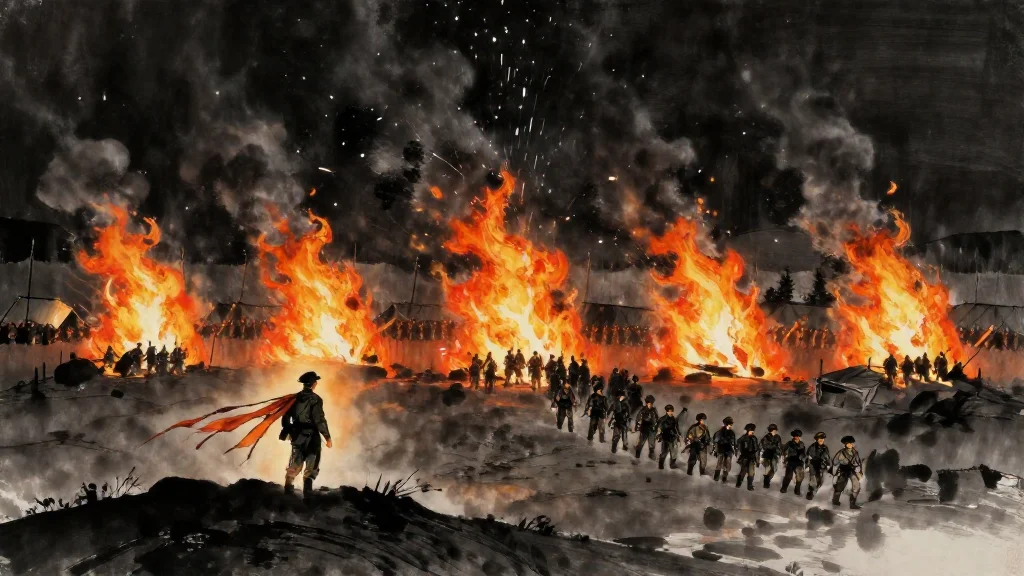
五火之法
The Five Methods of Fire Attack
孫子曰:凡火攻有五:一曰火人,二曰火積,三曰火輜,四曰火庫,五曰火隊。行火必有因,烟火必素具。發火有時,起火有日。時者,天之燥也。日者,月在箕、壁、翼、軫也。凡此四宿者,風起之日也。
Master Sun said: There are five methods of fire attack. The first is to burn personnel. The second is to burn stores. The third is to burn baggage trains. The fourth is to burn arsenals. The fifth is to burn formations.
To launch a fire attack, certain conditions must be met. Incendiary materials must be prepared in advance. There is a right season to start fires and a right day to raise them. The season is when the weather is dry. The day is when the moon passes through the constellations Ji, Bi, Yi, or Zhen. When the moon is in these four lunar mansions, it is a day when winds will rise.
Notes
The five fire targets (火人、火積、火輜、火庫、火隊) represent a systematic classification of incendiary warfare. 火人 targets enemy soldiers in their encampments; 火積 targets accumulated grain and provisions; 火輜 targets supply wagons and logistics; 火庫 targets weapons depots and storehouses; 火隊 targets troop formations in the field or their lines of communication.
箕 (Ji), 壁 (Bi), 翼 (Yi), and 軫 (Zhen) are four of the twenty-eight lunar mansions (二十八宿) in Chinese astronomy. Traditional military theory held that when the moon occupied these positions, dry winds were likely. This reflects the integration of astronomical observation into ancient Chinese military planning.
行火必有因: 因 here means 'conditions' or 'agents' — some commentators read it as requiring human agents (inside men to start the fires), others as requiring favourable conditions. The translation preserves the ambiguity.