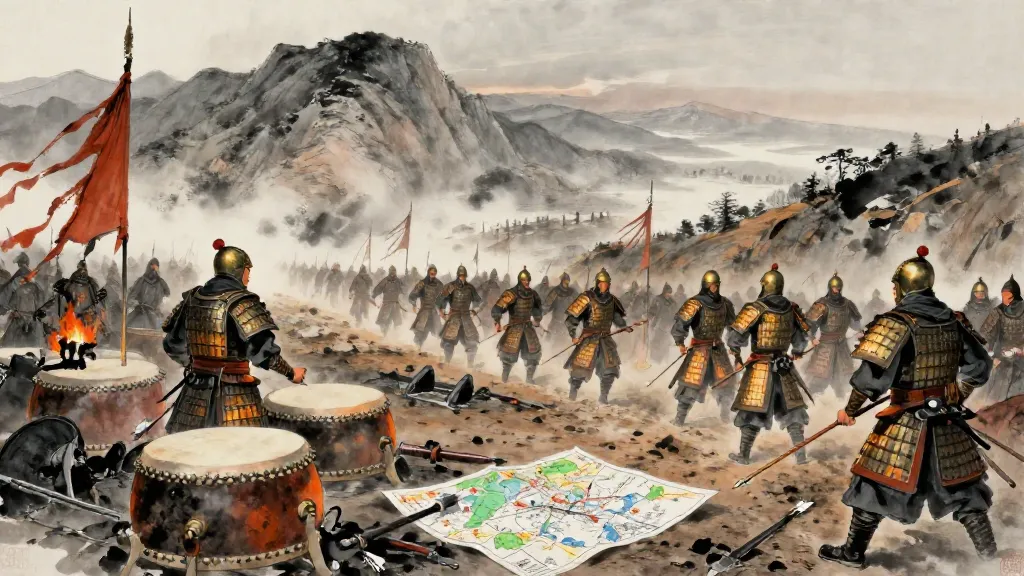
守權 (The Principles of Defense) — Chinese ink painting

尉繚子 Weiliaozi · Chapter 6

守權

The Principles of Defense

View:

守者不失險

Defenders Must Not Lose Their Strongpoints

凡守者,進不郭(圍)[圉],退不亭障,以御戰,非善者也。豪傑雄俊,堅甲利兵,勁弩(疆)[強]矢,盡在郭中,乃收窖廩,毀拆而入保,令客氣十百倍,而主之氣不半焉。敵攻者,傷之甚也。然而世將弗能知。

夫守者,不失險者也。守法:城一丈,十人守之,工食不與焉。出者不守,守者不出。一而當十,十而當百,百而當千,千而當萬。故為城郭者,非特費於民聚土壤也,誠為守也。千丈之城,則萬人之守。池深而廣,城堅而厚,士民備,薪食給,弩堅矢強,矛戟稱之,此守法也。

A defender who advances to the outer walls to intercept or retreats to outposts and watchtowers to fight is not a skilled defender. Concentrating all the brave warriors, strong armor, sharp weapons, powerful crossbows, and sturdy arrows inside the inner walls, withdrawing stores from outlying granaries, demolishing suburbs and bringing everything into the citadel -- this hands the attacker ten to a hundred times the morale advantage while the defender retains less than half. The attacker suffers greatly from this. Yet ordinary generals do not understand this principle.

Defense means not losing your strongpoints. The rule of defense: for every ten feet of wall, station ten men -- not counting engineers and supply personnel. Those who sortie do not defend; those who defend do not sortie. One defender counters ten attackers; ten counter a hundred; a hundred counter a thousand; a thousand counter ten thousand.

Therefore building city walls is not merely an expense of labor and earth -- it exists precisely for defense. A city with a thousand feet of wall requires ten thousand defenders. Deep and wide moats, solid and thick walls, fully equipped soldiers and civilians, adequate fuel and food supplies, sturdy crossbows and strong arrows, matched with spears and halberds -- this is the method of defense.

Notes

1context

The opening passage challenges the common instinct to fight outside the walls. Wei Liao argues this actually strengthens the attacker's morale. Instead, the defender should concentrate all resources inside the citadel, destroying anything outside that the enemy might use. This scorched-earth approach maximizes defensive advantage.

2translation

The 1:10 defender-to-attacker ratio (一而當十) is a standard principle of ancient siege warfare: fortifications multiply defensive combat power by a factor of ten. Hence 10,000 defenders behind walls can hold against 100,000 attackers.

必救之軍與必守之城

Certain Relief Forces and Certain Defense

攻者不下十餘萬之眾,其有必救之軍者,則有必守之城;無必救之軍者,則無必守之城。若彼[城]堅而救誠,則愚夫愚婦無不蔽城盡資血城者。期年之城,守余於攻者,救余於守者。若彼城堅而救不誠,則愚夫愚婦無不守陰而泣下,此人之常情也。遂發其窖廩救撫,則亦不能止矣。必鼓其豪傑雄俊,堅甲利兵,勁弩強矢並於前,(分歷)[麼么]毀瘠者並於後。

An attacker needs at least a hundred thousand troops. Where there is a guaranteed relief force, there is a city that can be held. Where there is no guaranteed relief force, there is no city that can be held.

If the walls are strong and relief is truly coming, then even ordinary men and women will shield the walls with their bodies and pour out every resource in bloody defense. A city under year-long siege can outlast its attackers if the defenders outlast through belief in relief.

But if the walls are strong yet relief is not genuinely coming, then even ordinary men and women will hide in the shadows weeping -- this is human nature. Once people reach this state, even if you open the granaries and distribute supplies to reassure them, you cannot stop the collapse.

Therefore, place the brave warriors with strong armor, sharp weapons, powerful crossbows, and sturdy arrows at the front, and station the weak and infirm at the rear.

Notes

3context

The psychological insight here is remarkable: a city's defensive capability depends less on its physical fortifications than on the garrison's belief that relief is coming. Without that belief, the strongest walls are useless because morale collapses. This makes credible alliance commitments a strategic asset.

守權之謂

The Meaning of Defensive Principles

十萬之軍頓於城下,救必開之,守必出之。(據出)[出據]要塞,但救其後,無絕其糧道,中外相應。此救而示之不誠。[示之不誠,]則倒敵而待之者也。後其壯,前其老,彼敵無前,守不得而止矣。此守權之謂也。

When a hundred thousand enemy troops are encamped beneath the walls, the relief force must break through to them, and the garrison must sortie to link up. Move out to seize key positions, protect the rear, and keep supply lines open. Coordinate between forces inside and outside the city.

If the relief force merely makes a show of coming without genuine commitment -- displaying insincerity -- then the enemy will simply turn and wait for the relief force to exhaust itself. If you put the strong in the rear and the old in front, the enemy will face no real threat ahead, and the garrison cannot hold.

This is what is meant by the principles of defense.

Notes

4context

This chapter establishes that defense is not purely passive. Successful defense requires: (1) concentration of all resources inside fortifications, (2) credible external relief to sustain morale, and (3) active coordination between garrison and relief force. The principle 守權 ('defensive authority') means controlling the situation even while in a defensive posture.

Edition & Source

Text
《尉繚子》 Weiliaozi
Edition
中華古詩文古書籍網 transcription
Commentary
Traditional military commentaries