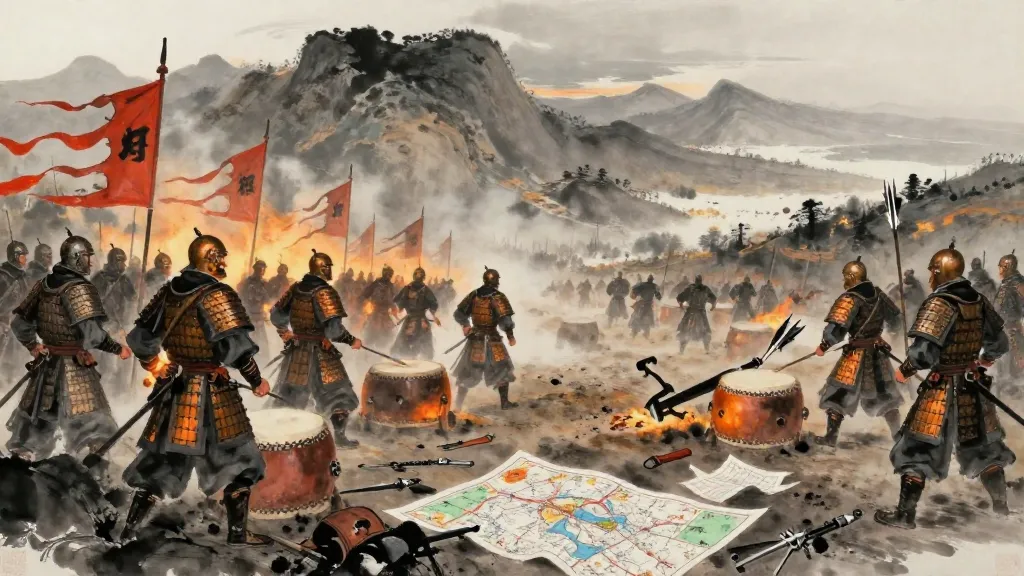
攻權 (The Principles of Attack) — Chinese ink painting

尉繚子 Weiliaozi · Chapter 5

攻權

The Principles of Attack

View:

靜以固專以勝

Stillness Builds Strength, Focus Wins Victory

兵以靜(勝國)[固],以專勝。力分者弱,心疑者背。夫力弱,故進退不豪,縱敵不(禽)[擒]。將吏士卒,動靜一身。心(既)疑[必]背,則計決而不動,動決而不禁。異口虛言,將無修容,卒無常試,發攻必衄。是謂疾陵之兵,無足與斗。

An army uses stillness to consolidate and concentration to win. When strength is divided, it weakens; when resolve is divided, men desert.

Weakened strength means advances and retreats lack force, and released enemies cannot be captured. Officers and soldiers must act as a single body in both movement and stillness.

When doubt takes root, decisions are made but not acted on, and actions are taken but not controlled. Orders contradict, talk is empty, the general lacks composure, the soldiers lack training -- any attack launched will fail. This is called a rash and reckless army, not worth fighting alongside.

Notes

1context

The opening maxim 靜以固,專以勝 ('stillness to consolidate, concentration to win') establishes two complementary principles: disciplined patience builds strength, while unified focus delivers victory. This is the defensive-offensive duality that runs through the Weiliaozi.

將帥者心也

The Commander Is the Mind

將帥者,心也;群下者,支節也。其心動以誠,則支節必力;其心動以疑,則支節必背。夫將不心制,卒不節動,雖勝,幸勝也,非攻權也。

The commander is the mind; the subordinates are the limbs. When the mind acts with conviction, the limbs necessarily exert their full strength. When the mind acts with doubt, the limbs necessarily fail.

If the general does not control through mental resolve and the soldiers do not move in disciplined coordination, then even a victory is merely a lucky win -- it is not the principle of attack.

Notes

2context

The body-politic metaphor (commander as mind, troops as limbs) appears across Chinese military literature but the Weiliaozi gives it a specific twist: the quality of the commander's conviction directly determines the quality of the troops' performance. Doubt in command physically manifests as disorder in execution.

畏侮之權

The Balance of Fear and Contempt

夫民無兩畏也。畏我侮敵,畏敵侮我,見侮者敗,立威者勝。凡將能其道者,吏畏其將也;吏畏其將者,民畏其吏也;民畏其吏者,敵畏其民也。是故知勝敗之道者,必先知畏侮之權。

People cannot fear two things at once. If they fear us, they will despise the enemy; if they fear the enemy, they will despise us. Whoever is despised loses; whoever establishes authority wins.

When a general masters this principle: the officers fear their general; because officers fear their general, the soldiers fear their officers; because soldiers fear their officers, the enemy fears our soldiers. Therefore, whoever understands the way of victory and defeat must first understand the balance of fear and contempt.

Notes

3context

畏侮之權 ('the balance of fear and contempt') is a key concept: people have a fixed amount of fear. If internal discipline is strict enough that soldiers fear their own officers more than the enemy, they will fight. If internal discipline is lax, soldiers will fear the enemy more than their own officers, and flee. The chain of fear (將→吏→民→敵) shows how authority cascades downward and outward.

愛與威

Benevolence and Authority

夫不愛說其心者,不我用也;不嚴畏其心者,不我舉也。愛在下順,威在上立。愛故不二,威故不犯。故善將者,愛與威而已。

If you do not win hearts through benevolence, men will not serve you. If you do not instill awe through severity, men will not follow your lead. Benevolence flows downward and produces obedience; authority stands above and commands respect. Because of benevolence, loyalty is undivided; because of authority, rules are not violated. The art of the good general consists of nothing more than benevolence and authority.

Notes

4context

愛與威 ('benevolence and authority') is the Weiliaozi's formula for command. It synthesizes the Confucian emphasis on moral leadership (愛) with the Legalist emphasis on strict enforcement (威). Neither alone suffices: benevolence without authority breeds contempt, while authority without benevolence breeds resentment.

戰攻之慎

Caution in Offensive Operations

戰不必勝,不可以言戰;攻不必拔,不可以言攻。不然,雖刑賞不足信也。信在期前,事在未兆。故眾已聚不虛散,兵已出不徒歸,求敵若求亡子,擊敵若救溺人。(分)[囚]險者無戰心,(挑)[佻]戰者無全氣,鬥戰者無勝兵。

Do not speak of battle unless victory is certain. Do not speak of attack unless the objective can be taken. Otherwise, even the system of rewards and punishments cannot be trusted. Credibility must be established before the deadline; action must be taken before signs appear.

Once troops are assembled, do not disband them for nothing. Once an army has marched out, do not bring it back empty-handed. Seek the enemy as if searching for a lost child. Strike the enemy as if rescuing a drowning man.

Those confined in dangerous positions have no will to fight. Those who provoke battle recklessly lack full morale. Those who fight on impulse have no victorious army.

Notes

5translation

求敵若求亡子 ('seek the enemy as if searching for a lost child') conveys desperate urgency and single-minded focus. 擊敵若救溺人 ('strike the enemy as if rescuing a drowning man') conveys speed and commitment -- you cannot hesitate when someone is drowning.

義戰與私怨

Righteous War versus Private Grudges

凡挾義而戰者,(應)[貴從]我起;爭私結怨,(應)[貴以]不得已;怨結(雖)[難]起,待之貴後。故爭必當待之,息必當備之。

When fighting for a righteous cause, it is best to take the initiative. When fighting over private disputes and grudges, it is best to treat it as a last resort. When a grudge is hard to resolve, it is best to wait.

Therefore in a contest, you must wait for the right moment; in a truce, you must prepare for the next conflict.

Notes

6context

This passage distinguishes between wars of principle (義戰) and wars of grievance (私怨). In the former, seizing the initiative is advantageous because you have moral authority; in the latter, delay and restraint are better because passions can be exploited by the enemy.

去備徹威有法勝

Victory Through System, Not Display

兵有勝於朝廷,有勝於原野,有勝於市井。斗則[得,服則]失,幸以不敗,此不意彼驚懼而曲勝之也。曲勝,言非全也。非全勝者,無權名。故明主戰攻[之]日,合鼓合[角],節以兵刃,不求勝而勝也。

兵有去備徹威而勝者,以其有法故也。有器用之早定也,其應敵也周,其總率也極。故五人而伍,十人而什,百人而卒,千人而率,萬人而將,已(用)[周]已極。其朝死則朝代,暮死則暮代。權敵審將,而後舉兵。

Wars can be won at court, on the open field, or in the marketplace. Winning through brute force while losing through surrender, surviving only by luck -- this is merely startling the enemy into a partial victory. A partial victory carries no lasting authority.

Therefore when an enlightened ruler goes to war, he sounds drums and horns in unison and controls with weapons and discipline. He does not seek victory, yet victory comes.

Some armies win even when they strip away fortifications and drop all display of force -- because they have a system. Their equipment is prepared in advance, their response to the enemy is thorough, their chain of command is perfected. Five men form a squad, ten a platoon, a hundred a company, a thousand a battalion, ten thousand an army -- complete and perfected. If men die in the morning, they are replaced by morning; if they die in the evening, they are replaced by evening. Assess the enemy and evaluate your general, and only then commit to war.

Notes

7context

去備徹威而勝 ('winning even when stripping away defenses and display') is a paradox that makes the Weiliaozi's central point: a well-organized army does not need impressive fortifications or intimidating shows of force. The system itself -- rapid replacement of casualties, clear chain of command, instant responsiveness -- is what makes it invincible.

攻城之法

The Method of Besieging Cities

故凡集兵千里者旬日,百里者一日,必集敵境。卒聚將至,深入其地,錯絕其道,棲其大城大邑,使之登城逼危,男女數重,各逼地形,而攻要塞。據一城邑而數道絕,從而攻之。敵將帥不能信,吏卒不能和,刑有所不從者,則我敗之矣。敵救未至,而一城已降。

津梁未發,要塞未修,城險未設,渠答未張,則雖有城無守矣。遠堡未入,戍客未歸,則雖有人無人矣。六畜未聚,五穀未收,財用未斂,則雖有資無資矣。夫城邑空虛而資盡者,我因其虛而攻之。法曰:「獨出獨入,敵不接刃而致之。」此之謂也。

When concentrating forces from a thousand li away, allow ten days; from a hundred li, one day -- and always assemble at the enemy's border. Once troops gather and the general arrives, penetrate deep into enemy territory. Cut off their roads, press against their major cities and towns. Force their population onto the walls in layers of men and women, pressing them against the terrain, and attack the fortified points.

Seize one city while cutting off multiple roads, then assault from multiple directions. When the enemy's commanders cannot maintain trust, officers and soldiers cannot cooperate, and discipline breaks down, then we have defeated them. Before the enemy's relief force arrives, the city has already surrendered.

If fords and bridges have not been secured, strategic passes have not been fortified, city defenses have not been erected, and abatis have not been laid -- then even with a city, there is no defense. If outlying forts have not been occupied and garrison troops have not returned -- then even with people, there are no people. If livestock have not been gathered, grain has not been harvested, and supplies have not been collected -- then even with resources, there are no resources.

When a city is empty and its resources exhausted, exploit its emptiness and attack. The principle states: 'Strike and withdraw at will -- the enemy cannot even cross blades with you before being brought to submission.' This is what it means.

Notes

8translation

渠答 (qu da): abatis or chevaux-de-frise -- sharpened stakes or timber barriers placed outside fortifications to impede attackers. A standard defensive preparation in ancient Chinese siege warfare.

9context

The three 'even with X, there is no X' formulations (有城無守, 有人無人, 有資無資) describe a window of vulnerability when defenses exist on paper but are not yet operational. The Weiliaozi advocates striking during this transition period -- before the enemy can convert potential strength into actual strength.

Edition & Source

Text
《尉繚子》 Weiliaozi
Edition
中華古詩文古書籍網 transcription
Commentary
Traditional military commentaries