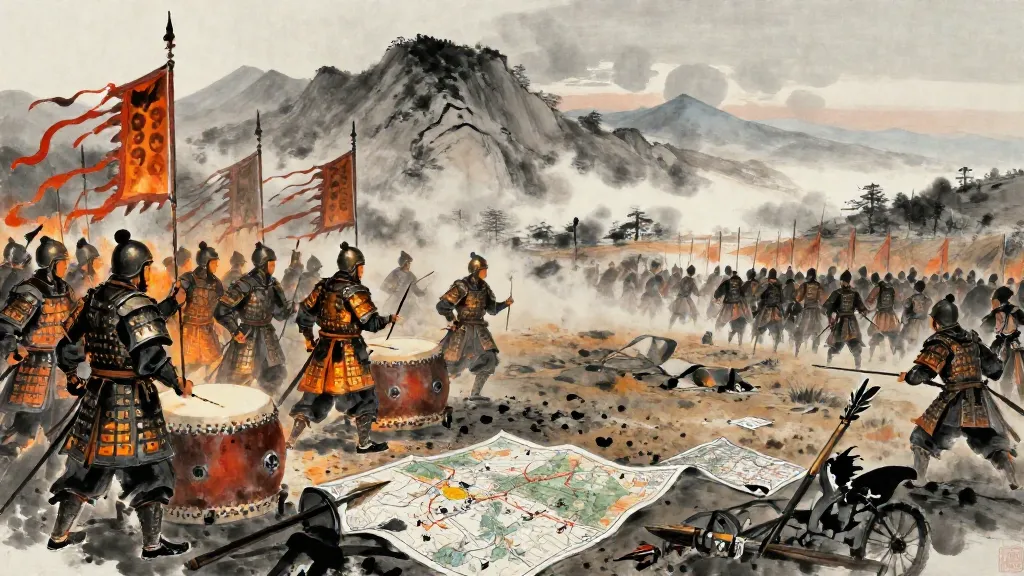
兵令下 (Military Orders, Part II) — Chinese ink painting

尉繚子 Weiliaozi · Chapter 24

兵令下

Military Orders, Part II

View:

前禦與邊備

Forward Defense and Border Security

諸去大軍為前御之備者,邊縣列候,相去三、五里。聞大軍為前御之備,戰則皆禁行,所以安內也。

All units that leave the main army to serve as forward defensive positions shall be stationed along the border counties as observation posts, spaced three to five li apart. When it is known that the main army is establishing forward defenses, all civilian movement is prohibited during the campaign. This is the means of securing the interior.

Notes

1context

列候 (lie hou, 'observation posts') were the Warring States equivalent of early warning stations, positioned along the frontier at intervals of 3-5 li (approximately 1.2-2 km). This spacing ensured visual and signal contact between posts. The automatic civilian lockdown upon mobilization connects back to the 分塞 (sector control) doctrine of Chapter 15.

戍卒之法

Regulations for Garrison Troops

內卒出戍,令將吏授旗鼓戈甲。發日,後將吏及出縣封界者,以坐後戍法。兵戍邊一歲,遂亡不候代者,法比亡軍。父母妻子知之,與同罪;弗知,赦之。卒後將吏而至大將所一日,父母妻子盡同罪。卒逃歸至家一日,父母妻子弗捕執及不言,亦同罪。

When interior troops are dispatched for garrison duty, the commanding officers issue flags, drums, halberds, and armor. On the day of departure, any officer or soldier who falls behind the column or passes beyond the county boundary is punished under the law for delayed garrison arrival.

Troops garrisoned on the border for one year who then desert without waiting for their replacement are punished under the law for military desertion. If their parents, wife, and children know of the desertion, they share the same crime; if they did not know, they are pardoned.

If a soldier arrives at the supreme general's headquarters one day behind his officer, his parents, wife, and children all share the same crime. If a soldier deserts and returns home, and after one day his parents, wife, and children have not arrested him or reported him, they too share the same crime.

Notes

2context

The one-year garrison rotation (兵戍邊一歲) matches the standard Qin military service obligation documented in the Shuihudi legal texts. The elaborate family-liability provisions create a web of accountability: even reaching home does not bring safety, because the family is required by law to turn the deserter in.

3context

The distinction between knowing (知之, shared guilt) and not knowing (弗知, pardoned) shows that the Weiliaozi's collective punishment system, while severe, contains a principle of mens rea -- only those who knowingly harbor a deserter are guilty.

亡將棄卒之法

Regulations for Lost Commanders and Abandoned Troops

諸戰而亡其將吏者,及將吏棄卒獨北者,盡斬之。前吏棄其卒而北,後吏能斬之而奪其卒者,賞。軍無功者,戍三歲。

When troops lose their commanding officers in battle, and when officers abandon their troops to flee alone, all are beheaded. If a forward officer abandons his men to flee, and a rear officer can execute him and take command of his troops, the rear officer is rewarded. Troops who gain no merit in campaign shall serve three years of garrison duty.

Notes

4context

The provision allowing rear officers to execute and replace fleeing forward officers creates an instant self-correcting mechanism: cowardice at the front is immediately punished by initiative from behind. The three-year garrison penalty (戍三歲) for troops with no combat achievement turns non-performance into a tangible cost.

大將死之法

Regulations When the Supreme General Falls

三軍大戰,若大將死,而從吏五百人以上不能死敵者斬,大將左右近卒在陳中者皆斬,余士卒有軍功者奪一級,無軍功者戍三歲。戰亡伍人,及伍人戰死不得其屍,同伍盡奪其功,得其屍,罪皆赦。

In a major engagement of all three divisions, if the supreme general is killed and his staff of five hundred or more fail to die fighting the enemy, they are all beheaded. The general's personal guard and nearby troops who were in the formation are all beheaded. The remaining soldiers who have military merit have one rank deducted; those with no merit serve three years of garrison duty.

When a squad member is killed in battle and the squad cannot recover his body, the entire squad forfeits all merit. If they recover the body, all offenses are pardoned.

Notes

5context

The regulation requiring the general's entire staff (從吏五百人以上) to die fighting if the general falls ensures that the command group has no incentive to let the general be killed or to flee once he falls. This creates a 'die together' pact that binds the headquarters staff to the general's fate.

6context

The requirement to recover comrades' bodies (得其屍) served both practical and ritual purposes. Practically, it prevented the enemy from displaying corpses as trophies or using head-counts to claim rewards. Ritually, it ensured proper burial rites could be performed.

名實之弊

The Problem of Name versus Reality in Military Rosters

軍之利害,在國之名實。今名在官,而實在家,官不得其實,家不得其名。聚卒為軍,有空名而無實,外不足以禦敵,內不足以守國,此軍之所以不給,將之所以奪威也。

Whether the army is effective or not depends on the correspondence between the state's registers and reality. Today, the names are on the official rolls while the actual men remain at home. The government does not have the men it claims, and the families do not receive the exemptions they are owed. When soldiers are gathered into an army, there are empty names without substance. Externally it is insufficient to resist the enemy; internally it is insufficient to defend the state. This is why the army is undersupplied and the general's authority is undermined.

Notes

7context

名實 (ming shi, 'name and reality') is a fundamental concept in Legalist political philosophy. Here it refers specifically to the discrepancy between military registration rolls and actual manpower. Ghost soldiers on the roster -- whose pay and rations are pocketed by officers -- was a chronic problem in Chinese armies from the Warring States through the Qing dynasty.

止逃與三勝

Preventing Desertion and the Three Victories

臣以謂卒逃歸者,同舍伍人及吏罰入糧為饒,名為軍實,是有一軍之名,而有二實之出。國內空虛,自竭民歲,曷以免奔北之禍乎?今以法止逃歸、禁亡軍,是兵之一勝也。什伍相聯,及戰鬥,則卒吏相救,是兵之二勝也。將能立威,卒能節制,號令明信,攻守皆得,是兵之三勝也。

Your servant observes that when soldiers desert and return home, their barracks-mates and officers are fined by having to contribute grain to make up the deficit, recorded as 'military provisions.' Thus there is one army in name but a double burden in reality. The state's interior is emptied, the people's annual output is exhausted -- how then can you avoid the disaster of rout and flight?

Now, using law to prevent desertion and prohibit military flight -- this is the army's first victory. Squads and sections linked together so that in battle, soldiers and officers rescue each other -- this is the army's second victory. When the general can establish authority, the soldiers can maintain discipline, orders are clear and trusted, and both attack and defense are effective -- this is the army's third victory.

Notes

8context

The 'three victories' (三勝) summarize the entire Weiliaozi system: legal deterrence (institutional control), mutual solidarity (unit cohesion), and command authority (leadership). These three pillars correspond roughly to the three parts of the text: chapters on regulations, chapters on organization, and chapters on generalship.

殺半威天下

Killing Half Commands All-Under-Heaven

臣聞古之善用兵者,能殺士卒之半,其次殺其十三,其下殺其十一。能殺其半者,威加海內;殺其十三者,力加諸侯;殺其十一者,令行士卒。故曰:百萬之眾不用命,不如萬人之斗也;萬人之斗,不如百人之奮也。賞如日月,信如四時,令如斧鉞,利如干將,士卒不用命者,未之有也。

Your servant has heard that the ancients who excelled at employing armies could execute half their soldiers for violations. The next best could execute three in ten. The lowest could execute one in ten. He who could execute half commanded awe throughout the four seas. He who could execute three in ten imposed his strength on all the lords. He who could execute one in ten could make his orders obeyed by the troops.

Therefore it is said: a million men who will not obey orders are not as good as ten thousand who will fight; ten thousand who will fight are not as good as a hundred who will go all out. When rewards are as constant as the sun and moon, when trustworthiness is as reliable as the four seasons, when orders are as sharp as the executioner's axe, and when weapons are as keen as the sword Ganjiang -- that soldiers should refuse to obey orders has never been known to happen.

Notes

9context

The escalating scale of execution -- 10%, 30%, 50% -- is not meant as a literal prescription but as a measure of a commander's willingness to enforce discipline absolutely. The higher the commander's resolve to punish, the less he actually needs to punish, because the certainty of enforcement produces compliance.

10context

干將 (Gān Jiàng): A legendary swordsmith of the Wu kingdom during the Spring and Autumn period. Together with his wife Mo Ye (莫邪), he forged the two most famous swords in Chinese legend. The sword Ganjiang became a byword for supreme sharpness.

Edition & Source

Text
《尉繚子》 Weiliaozi
Edition
中華古詩文古書籍網 transcription
Commentary
Traditional military commentaries