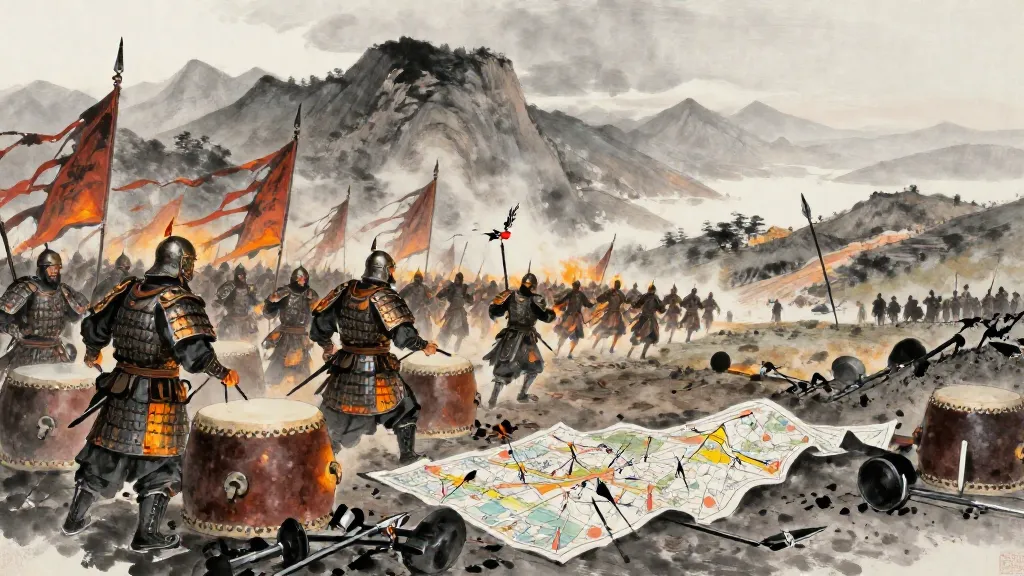
兵令上 (Military Orders, Part I) — Chinese ink painting

尉繚子 Weiliaozi · Chapter 23

兵令上

Military Orders, Part I

View:

兵者兇器

Weapons Are Instruments of Ill Omen

兵者,兇器也;爭者,逆德也。事必有本,故王者伐暴亂,本仁義焉。戰國則以立威抗敵相圖,而不能廢兵也。

Weapons are instruments of ill omen; conflict is contrary to virtue. Every undertaking must have its foundation, and therefore when true kings campaign against tyranny and disorder, their foundation is benevolence and righteousness. In the Warring States, however, states seek to establish their authority and resist their enemies by plotting against each other -- and so warfare cannot be abolished.

Notes

1context

兵者兇器也 ('weapons are instruments of ill omen') echoes the Laozi (Chapter 31: 夫兵者不祥之器). But where the Laozi counsels avoidance of war, the Weiliaozi accepts its necessity in the current age. This pragmatic Confucian-Legalist synthesis -- acknowledging war's evil while preparing for it systematically -- distinguishes the text from both pure Daoist pacifism and pure Legalist militarism.

文武表裏

Civil and Military as Exterior and Interior

兵者,以武為植,以文為種。武為表,文為里。能審此二者,知勝敗矣。文所以視利害、辨安危;武所以犯強敵、力攻守也。

In warfare, the military is the trunk and the civil is the seed. The military is the exterior; the civil is the interior. He who can carefully discern these two will know victory and defeat. The civil sphere is the means to assess advantage and harm, to distinguish safety from danger. The military sphere is the means to confront powerful enemies and to exert force in attack and defense.

Notes

2context

以武為植以文為種 uses agricultural metaphors: 植 (zhi, 'trunk/stem') is the visible structure, 種 (zhong, 'seed') is the hidden source of growth. This places civil governance (intelligence assessment, strategic planning, institutional design) as the generative force that military power merely expresses.

專一與疏密

Unity of Purpose, and Density versus Openness

專一則勝,離散則敗。陳以密則固,鋒以疏則達。卒畏將甚於敵者勝,卒畏敵甚於將者敗。所以知勝敗者,稱將於敵也。敵與將,猶權衡焉。

Unity of purpose brings victory; dispersal brings defeat. Formations that are dense are solid; spearheads that are open can penetrate. When soldiers fear their general more than the enemy, victory follows. When soldiers fear the enemy more than their general, defeat follows.

The way to predict victory or defeat is to weigh the general against the enemy. The enemy and the general are like the two pans of a scale.

Notes

3context

卒畏將甚於敵者勝 ('when soldiers fear their general more than the enemy, victory follows') restates the core Legalist military principle from Chapter 13. The scale metaphor (權衡) makes explicit that war is a weighing of opposing forces, where the quality of generalship is the decisive weight.

常令與陳法

Standing Orders and Formation Doctrine

安靜則治,暴疾則亂。出卒陳兵有常令,行伍疏數有常法,先後之次有適宜。常令者,非追北襲邑攸用也。前後不次,則失也。亂先後,斬之。

Calm and order produce good governance; violence and haste produce chaos. Deploying troops and forming up have their standing orders. Spacing of ranks and files has its standard regulations. The sequence of front and rear has its proper arrangement.

Standing orders are not for use during pursuit of a routed enemy or surprise attacks on towns. Disrupting the order of front and rear is a punishable failure. Anyone who throws the sequence into disorder is beheaded.

Notes

4context

The distinction between 常令 (standing orders for standard operations) and exceptional situations (追北襲邑, 'pursuit and surprise attacks') shows tactical flexibility within a rigid regulatory framework. Discipline is absolute in standard operations but relaxed for exploitation and raids.

內外立坐之陳

Inward, Outward, Standing, and Sitting Formations

常陳皆向敵,有內向,有外向,有立陳,有坐陳。夫內向,所以顧中也;外向,所以備外也。立陳,所以行也;坐陳,所以止也。立坐之陳,相參進止,將在其中。坐之兵劍斧,立之兵戟弩,將亦居中。

Standard formations all face the enemy. There are inward-facing formations and outward-facing formations; there are standing formations and sitting formations.

Inward-facing formations protect the center. Outward-facing formations guard against external threats. Standing formations are for movement. Sitting formations are for holding position. Standing and sitting formations alternate between advance and halt, with the general positioned in the center.

Sitting troops are armed with swords and axes. Standing troops are armed with halberds and crossbows. The general also remains in the center.

Notes

5context

The weapons assignment reflects tactical function: 坐之兵 (sitting troops with swords and axes) form a close-defense perimeter that fights at arm's length, while 立之兵 (standing troops with halberds and crossbows) provide both reach weapons and ranged fire. The general's central position allows him to command both elements.

正兵先合

The Orthodox Force Engages First

善禦敵者,正兵先合,而後扼之,此必勝之術也。

He who excels at resisting the enemy first engages with the orthodox force, then seizes the decisive point. This is the art of certain victory.

Notes

6context

正兵先合而後扼之: the orthodox force (正兵) fixes the enemy in place through direct engagement, then the commander exploits the situation by seizing (扼) the critical terrain or moment. This is the standard Chinese military doctrine of using 正 (orthodox/fixing force) to create conditions for 奇 (unorthodox/decisive maneuver).

威斧旗章

The Authority of Axes, Flags, and Badges

陳之斧鉞,飾之旗章,有功必賞,犯令必死。存亡死生,在桴之端。雖天下有善兵者,莫能御此矣。

Deploy the executioner's axes in the formation. Adorn the ranks with flags and badges. Those with merit are always rewarded; those who violate orders always die. Survival and destruction, death and life -- all hang upon the tip of the drumstick. Even the finest soldiers in All-Under-Heaven cannot withstand such an army.

Notes

7context

在桴之端 ('at the tip of the drumstick') means that life and death are decided by the drumbeat that commands advance or halt. The drumstick becomes a metaphor for the general's absolute authority: a single stroke determines the fate of thousands.

虛實秘

Empty, Solid, and Secret

矢射未交,長刃未接,前噪者謂之虛,後噪者謂之實,不噪者謂之秘。虛、實、秘者,兵之體也。

Before arrows are exchanged and before long blades clash: those who shout from the front are 'empty.' Those who shout from the rear are 'solid.' Those who do not shout are 'secret.' Empty, solid, and secret -- these are the fundamental dispositions of the army.

Notes

8context

The three dispositions form a tactical deception framework. 虛 (empty/feint) troops make noise at the front to draw attention. 實 (solid/main force) troops shout from behind, signaling depth and reserves. 秘 (secret) troops remain silent, concealing their position and intent. This triad maps onto the Sunzi's 虛實 (Empty and Solid) chapter, extended with the third category of concealment.

Edition & Source

Text
《尉繚子》 Weiliaozi
Edition
中華古詩文古書籍網 transcription
Commentary
Traditional military commentaries