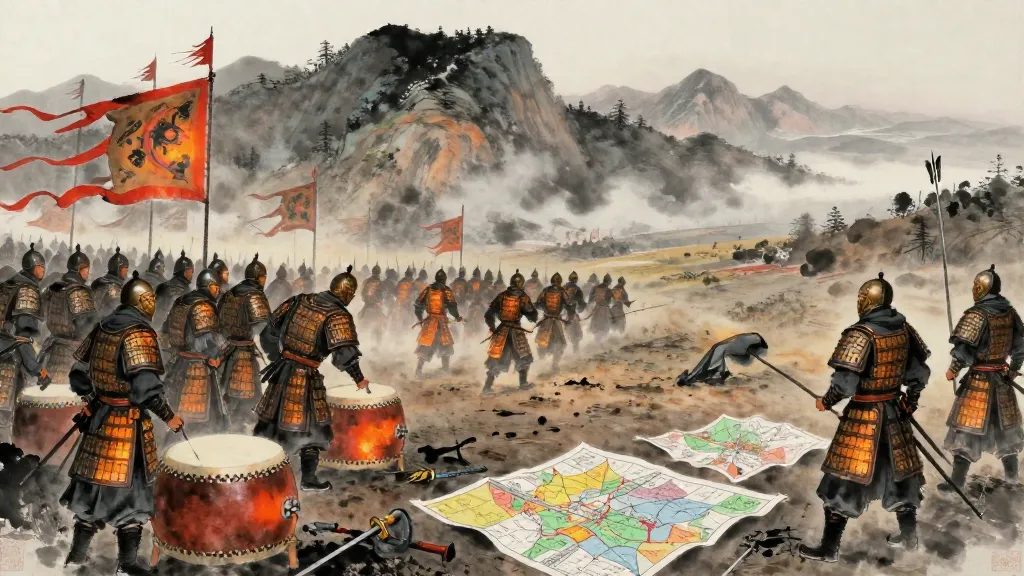
圖國 (Planning for the State) — Chinese ink painting

吳子 Wuzi · Chapter 1

圖國

Planning for the State

View:

吳起見魏文侯

Wu Qi's Audience with Marquis Wen of Wei

吳起儒服,以兵機見魏文侯。文侯曰:“寡人不好軍旅之事。“起曰:“臣以見占隱,以往察來,主君何言與心違。今君四時使斬離皮革,掩以朱漆,畫以丹青,爍以犀象。冬日衣之則不溫,夏日衣之則不涼。以長戟二丈四尺,短戟一丈二尺。革車奄戶,縵輪籠轂,觀之於目則不麗,乘之以田則不輕,不識主君安用此也?若以備進戰退守,而不求用者,譬猶伏雞之搏狸,乳犬之犯虎,雖有斗心,隨之死矣。昔承桑氏之君,修德廢武,以滅其國;有扈氏之君,恃眾好勇,以喪其社稷。明主鑒茲,必內修文德,外治武備。故當敵而不進,無逮於義也;殭屍而哀之,無逮於仁也。”

Wu Qi dressed in Confucian robes and sought an audience with Marquis Wen of Wei to discuss military strategy. Marquis Wen said: "I take no pleasure in military affairs." Wu Qi replied: "I judge what is hidden from what is visible, and infer the future from the past — why does my lord say what contradicts his heart? Now year-round you have hides cut and stitched, lacquered in vermilion, painted in cinnabar and blue-green, inlaid with rhinoceros horn and ivory. Worn in winter these give no warmth; worn in summer they give no coolness. You have long halberds of twenty-four feet and short halberds of twelve feet. You have leather-covered war chariots with curtained wheels and caged hubs — not beautiful to look at, not light for hunting. I cannot understand what my lord uses all this for. If you maintain equipment for advancing to battle and retreating to defend, yet refuse to seek commanders who can employ it, this is like a brooding hen attacking a wildcat, or a nursing puppy charging a tiger — you may have the will to fight, but death will follow. In ancient times, the lord of the Chengsang clan cultivated virtue but abandoned military preparedness, and his state was destroyed. The lord of the Youhu clan relied on numbers and glorified bravery, and lost his altars of soil and grain. A wise ruler takes warning from these examples: he must cultivate civil virtue within and maintain military preparedness without. To face an enemy and not advance — that falls short of duty. To stand over corpses and mourn them — that falls short of compassion."

Notes

1person吳起Wú Qǐ

Wu Qi (吳起, c. 440–381 BC) was one of the greatest military commanders and reformers of the Warring States period. He served successively in Lu, Wei, and Chu, winning every campaign he commanded. He was assassinated by Chu aristocrats after implementing sweeping reforms under King Dao of Chu.

2person魏文侯Wèi Wén Hóu

Marquis Wen of Wei (魏文侯, r. 445–396 BC) was the first ruler of the state of Wei after the tripartite division of Jin. He was renowned for recruiting talented men, including Wu Qi, Li Kui, and Ximen Bao, making Wei the dominant power of the early Warring States.

3context

The Chengsang (承桑氏) and Youhu (有扈氏) are semi-legendary ancient clans used as cautionary examples. The Youhu clan famously resisted the Xia dynasty and were destroyed by King Qi of Xia.

文侯拜將

Marquis Wen Appoints Wu Qi as General

於是文侯身自布席,夫人捧觴,醮吳起於廟,立為大將,守西河。與諸侯大戰七十六,全勝六十四,余則鈞解。闢土四面,拓地千里,皆起之功也。

Thereupon Marquis Wen personally spread the mat, his consort held the wine cup, and they performed the libation ceremony for Wu Qi in the ancestral temple, appointing him Grand General and assigning him to defend the Western River region. He fought seventy-six major battles against the other states, winning outright in sixty-four and fighting to a draw in the rest. He expanded territory in all four directions and extended the borders by a thousand li — all of this was Wu Qi's achievement.

Notes

1place

The Western River (西河) region refers to the area west of the Yellow River in modern Shaanxi, a critical frontier zone between Wei and Qin. Wu Qi served as governor of this region for over twenty years.

四不和

The Four Disharmonies

吳子曰:“昔之圖國家者,必先教百姓而親萬民。有四不和:不和於國,不可以出軍;不和于軍,不可以出陳;不和於陳,不可以進戰;不和於戰,不可以決勝。是以有道之主,將用其民,先和而造大事。不敢信其私謀,必告於祖廟,啟於元龜,參之天時,吉乃後舉。民知君之愛其命,惜其死,若此之至,而與之臨難,則士以進死為榮,退生為辱矣。”

Wu Qi said: "Those who planned for the state in ancient times invariably began by instructing the people and building closeness with the populace. There are four disharmonies: if there is no harmony within the state, you cannot deploy the army; if there is no harmony within the army, you cannot deploy into formation; if there is no harmony within the formation, you cannot advance to battle; if there is no harmony in battle, you cannot achieve victory. Therefore a ruler who possesses the Way, when he intends to employ his people, first establishes harmony before undertaking great endeavors. He does not trust his private calculations alone — he must report to the ancestral temple, consult the great tortoise oracle, and verify against the patterns of heaven. Only when the signs are favorable does he act. When the people know that their lord values their lives and cherishes them against death to this degree, and then he leads them into danger, the soldiers will regard advancing to death as glory and retreating to survive as disgrace."

道義謀要

The Way, Duty, Strategy, and Essentials

吳子曰:“夫道者,所以反本復始;義者,所以行事立功;謀者,所以違害就利;要者,所以保業守成。若行不合道,舉不合義,而處大居貴,患必及之。是以聖人綏之以道,理之以義,動之以禮,撫之以仁。此四德者,修之則興,廢之則衰,故成湯討桀而夏民喜悅,周武伐紂而殷人不非。舉順天人,故能然矣。”

Wu Qi said: "The Way is what returns us to fundamentals and origins. Duty is what enables us to accomplish deeds and establish merit. Strategy is what enables us to avoid harm and pursue advantage. Essentials are what enable us to preserve achievements and maintain what has been built. If one's conduct does not accord with the Way and one's undertakings do not accord with duty, yet one holds great position and occupies high rank, disaster will inevitably follow. Therefore the sage pacifies through the Way, governs through duty, mobilizes through propriety, and nurtures through compassion. These four virtues — cultivate them and the state will flourish; abandon them and the state will decline. Thus when Tang punished Jie, the Xia people rejoiced; when King Wu of Zhou attacked Zhou of Shang, the Yin people did not condemn him. Their actions accorded with heaven and with the people — that is why they succeeded."

Notes

1context

Tang (成湯) was the founder of the Shang dynasty who overthrew Jie (桀), the last Xia ruler. King Wu of Zhou (周武王) overthrew Zhou (紂), the last Shang ruler. Both transitions were paradigmatic examples of just dynastic revolution.

禮義與勝敗

Propriety, Duty, and the Paradox of Victory

吳子曰:“凡治國治軍,必教之以禮,勵之以義,使有恥也。夫人有恥,在大足以戰,在小足以守矣。然戰勝易,守勝難。故曰:天下戰國,五勝者禍,四勝者弊,三勝者霸,二勝者王,一勝者帝。是以數勝得天下者稀,以亡者眾。”

Wu Qi said: "In governing the state and governing the army, you must instruct them with propriety and encourage them with duty, so they develop a sense of shame. When people have a sense of shame, on a large scale it is sufficient for offensive warfare, and on a small scale it is sufficient for defense. Yet winning battles is easy; preserving the gains of victory is hard. Therefore it is said: among the warring states of the realm, those who win five times invite disaster, those who win four times are weakened, those who win three times become hegemons, those who win twice become kings, and those who win once become emperors. Thus those who gained the realm through repeated victories are few; those who perished through them are many."

Notes

1context

This paradox — that excessive military victory leads to ruin — is a distinctive theme in Wu Qi's thought. Repeated campaigns drain the treasury, exhaust the people, and provoke coalitions among neighboring states. The passage echoes Laozi's warning that weapons are instruments of ill omen.

五起五名

Five Causes of War, Five Types of Armies

吳子曰:“凡兵者之所以起者有五:一曰爭名,而曰爭利,三曰積惡,四曰內亂,五曰因飢。其名有五:一曰義兵,二曰強兵,三曰剛兵,四曰暴兵,五曰逆兵。禁暴救亂曰義,恃眾以伐曰強,因怒興師曰剛,棄禮貪利曰暴,國亂人疲,舉事動眾曰逆。五者之服,各有其道,義必以禮服,強必以謙服,剛必以辭服,暴必以詐服,逆必以權服。”

Wu Qi said: "There are five causes from which warfare arises: first, contention over reputation; second, contention over profit; third, accumulated hatred; fourth, internal disorder; fifth, famine. Armies likewise have five designations: first, a righteous army; second, an aggressive army; third, a belligerent army; fourth, a violent army; fifth, a rebellious army. Suppressing tyranny and rescuing the disordered is called righteous. Relying on superior numbers to attack is called aggressive. Raising troops out of anger is called belligerent. Abandoning propriety and coveting profit is called violent. Mobilizing the masses when the state is in chaos and the people exhausted is called rebellious. Each of these five is subdued by its own method: the righteous must be subdued through propriety; the aggressive must be subdued through humility; the belligerent must be subdued through persuasion; the violent must be subdued through deception; the rebellious must be subdued through strategic authority."

料民備戰

Assessing the People and Preparing for War

武侯問曰:“願聞治兵、料人、固國之道。“起對曰:“古之明王,必謹君臣之禮,飾上下之儀,安集吏民,順俗而教,簡寡良才,以備不虞。昔齊桓募士五萬,以霸諸侯;晉文召為前行四萬,以獲其志;秦繆置陷陳三萬,以服鄰敵。故強國之君,必料其民。民有膽勇氣力者,聚為一卒。樂以進戰效力,以顯其忠勇者,聚為一卒。能逾高超遠,輕足善走者,聚為一卒。王臣失位而欲見功於上者,聚為一卒。棄城去守,欲除其醜者,聚為一卒。此五者,軍之練銳也。有此三千人,內出可以決圍,外入可以屠城矣。”

Marquis Wu asked: "I wish to hear about the methods for controlling the military, assessing the people, and securing the state." Wu Qi replied: "The wise kings of antiquity were meticulous about the proprieties between ruler and minister, refined the ceremonies of superior and subordinate, settled and gathered their officials and people, governed according to local customs, and selected the best talent to prepare against the unexpected. In the past, Duke Huan of Qi recruited fifty thousand warriors and became hegemon over the lords. Duke Wen of Jin assembled forty thousand for his vanguard and achieved his ambitions. Duke Mu of Qin maintained thirty thousand formation-breakers and subdued his neighboring enemies. Therefore the ruler of a strong state must assess his people. Those with courage and physical strength — gather them into one unit. Those who are eager to advance into battle and prove their loyalty and valor — gather them into one unit. Those who can scale heights, leap distances, and run with speed and agility — gather them into one unit. Officials who have lost their positions and wish to demonstrate merit to their superiors — gather them into one unit. Those who abandoned their cities and wish to redeem their disgrace — gather them into one unit. These five categories form the army's elite strike force. With three thousand such men, sallying from within you can break a siege, and attacking from without you can storm a city."

Notes

1person魏武侯Wèi Wǔ Hóu

Marquis Wu of Wei (魏武侯, r. 395–370 BC) was the son and successor of Marquis Wen. He continued to employ Wu Qi but eventually grew suspicious of him, leading Wu Qi to flee to Chu.

2person齊桓公Qí Huán Gōng

Duke Huan of Qi (齊桓公, r. 685–643 BC) was the first of the Five Hegemons of the Spring and Autumn period, guided by his chief minister Guan Zhong.

3person晉文公Jìn Wén Gōng

Duke Wen of Jin (晉文公, r. 636–628 BC) was the second of the Five Hegemons, famous for his victory at the Battle of Chengpu (632 BC) against Chu.

4person秦繆公Qín Mù Gōng

Duke Mu of Qin (秦繆公/秦穆公, r. 659–621 BC) expanded Qin's power westward and was counted among the Five Hegemons in some traditions.

定陳固守勝戰

Securing Formations, Strengthening Defense, Winning Battles

武侯問曰:“願聞陳必定、守必固、戰必勝之道。“起對曰:“立見且可,豈直聞乎!君能使賢者居上,不肖者處下,則陳已定矣;民安其田宅,親其有司,則守已固矣。百姓皆是吾君而非鄰國,則戰已勝矣。”

Marquis Wu asked: "I wish to hear the method for making formations certain, defense solid, and victory assured." Wu Qi replied: "You could see the results immediately, not merely hear about them. If my lord can place the worthy in high positions and the unworthy in low positions, then your formations are already secured. If the people are content with their fields and homes and feel close to their officials, then your defense is already solid. If the common people all affirm their own lord and reject the neighboring state, then your victory is already won."

楚莊王之憂

The Worry of King Zhuang of Chu

武侯嘗謀事,群臣莫能及,罷朝而有喜色。起進曰:“昔楚莊王嘗謀事,群臣莫能及,退朝而有憂色。申公問曰:'君有憂色,何也?'曰:'寡人聞之,世不絕聖,國不乏賢,能得其師者王,得其友者霸。今寡人不才,而群臣莫及者,楚國其殆矣!'此楚莊王之所憂,而君說之,臣竊懼矣。“於是武侯有慚色。

Marquis Wu once deliberated on a matter of policy, and none of his ministers could match his reasoning. He retired from court with a pleased expression. Wu Qi stepped forward and said: "In the past, King Zhuang of Chu once deliberated on a matter of policy, and none of his ministers could match him. He retired from court with a worried expression. The Duke of Shen asked: 'My lord looks worried — why?' King Zhuang said: 'I have heard that the world is never without sages, and no state is ever without worthy men. He who can find a teacher among them will become a king; he who can find a friend among them will become a hegemon. Now I am a man of no great ability, yet none of my ministers can match me — Chu is in peril!' This is what worried King Zhuang of Chu, and yet my lord is pleased by the same situation. I am privately afraid." At this, Marquis Wu looked ashamed.

Notes

1person楚莊王Chǔ Zhuāng Wáng

King Zhuang of Chu (楚莊王, r. 613–591 BC) was the most powerful of the Chu monarchs and one of the Five Hegemons. He is famous for the saying 'not singing for three years, then soaring' (三年不鳴,一鳴驚人), describing his deliberate strategy of appearing inactive before striking decisively.

Edition & Source

Text
《吳子》 Wuzi
Edition
《武經七書》(Seven Military Classics) canonical text
Commentary
Traditional military commentaries