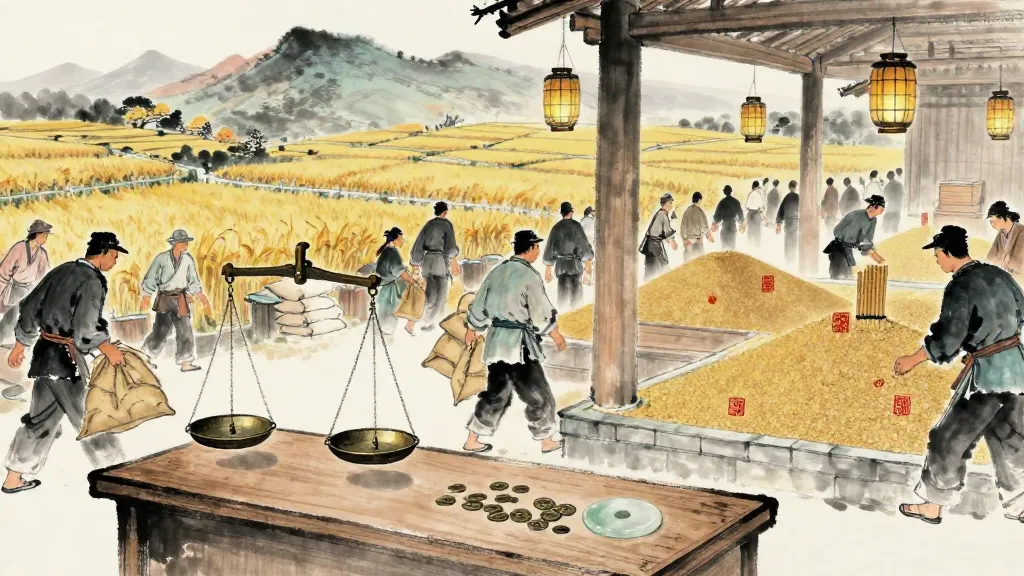
勸學 (Encouraging Learning) — Chinese ink painting

荀子 Xunzi · Chapter 1

勸學

Encouraging Learning

View:

學不可以已

Learning Must Never Cease

君子曰:學不可以已。青、取之於藍,而青於藍;冰、水為之,而寒於水。木直中繩,輮以為輪,其曲中規,雖有槁暴,不復挺者,輮使之然也。故木受繩則直,金就礪則利,君子博學而日參省乎己,則知明而行無過矣。故不登高山,不知天之高也;不臨深溪,不知地之厚也;不聞先王之遺言,不知學問之大也。乾、越、夷、貉之子,生而同聲,長而異俗,教使之然也。詩曰:「嗟爾君子,無恆安息。靖共爾位,好是正直。神之聽之,介爾景福。」神莫大於化道,福莫長於無禍。

The gentleman says: learning must never cease. Blue dye is extracted from the indigo plant, yet it is bluer than indigo; ice is made from water, yet it is colder than water. A piece of wood straight as a plumb line, when steamed and bent into a wheel, curves to match the compass, and even after drying out it will not straighten again — the bending process has made it so. Thus wood submitted to the plumb line becomes straight, and metal submitted to the whetstone becomes sharp. If the gentleman studies broadly and daily examines himself, then his understanding will be clear and his conduct free of error. Therefore without climbing a high mountain, one does not know the height of heaven; without gazing into a deep ravine, one does not know the thickness of the earth; without hearing the inherited teachings of the former kings, one does not know the greatness of learning. Children of Gan, Yue, Yi, and Mo are born with the same cries, yet grow up with different customs — education makes them so. The Odes say: 'Ah, you gentlemen, do not rest constantly at ease. Quietly fulfill your offices and love what is upright. When the spirits hear of it, they will bestow upon you great blessings.' No spiritual transformation is greater than absorbing the Way, and no lasting fortune is greater than being free from disaster.

Notes

1context

This is the most famous opening passage in Xunzi, establishing his central thesis that human excellence is achieved through continuous effort and education, not innate endowment. The metaphors of blue dye surpassing indigo and ice surpassing water illustrate how the product of cultivation can exceed its raw materials.

善假於物

Making Good Use of External Things

吾嘗終日而思矣,不如須臾之所學也。吾嘗跂而望矣,不如登高之博見也。登高而招,臂非加長也,而見者遠;順風而呼,聲非加疾也,而聞者彰。假輿馬者,非利足也,而致千里;假舟楫者,非能水也,而絕江河。君子生非異也,善假於物也。

I once spent an entire day in thought, but it was not as good as a moment of study. I once stood on tiptoe to gaze into the distance, but it was not as good as the broad view from a high place. When you beckon from a height, your arm is no longer than before, yet people see it from farther away. When you shout downwind, your voice is no louder than before, yet it is heard more clearly. One who borrows a carriage and horses does not have faster feet, yet can travel a thousand li. One who borrows a boat and oars does not have the ability to swim, yet can cross great rivers. The gentleman is not different by birth — he is simply skilled at making use of external things.

Notes

1context

This passage encapsulates Xunzi's pragmatic philosophy of education. The gentleman's superiority comes not from innate nature but from skillfully leveraging tools, methods, and accumulated knowledge — a direct contrast to Mencius's emphasis on innate moral sprouts.

蓬生麻中不扶而直

The Power of Environment

南方有鳥焉,名曰蒙鳩,以羽為巢,而編之以發,系之葦苕,風至苕折,卵破子死。巢非不完也,所系者然也。西方有木焉,名曰射干,莖長四寸,生於高山之上,而臨百仞之淵,木莖非能長也,所立者然也。蓬生麻中,不扶而直;白沙在涅,與之俱黑。蘭槐之根是為芷,其漸之滫,君子不近,庶人不服。其質非不美也,所漸者然也。故君子居必擇鄉,游必就士,所以防邪辟而近中正也。

In the south there is a bird called the mengqiu. It builds its nest from feathers, weaves it with hair, and ties it to the tip of a reed. When the wind blows, the reed breaks, the eggs shatter, and the chicks die. The nest is not poorly made — the problem is what it is attached to. In the west there is a plant called shegan, with a stem only four inches long, yet it grows on top of a high mountain and overlooks an abyss of a hundred fathoms. The stem cannot grow longer — it is its position that makes this so. Mugwort growing among hemp needs no support to stand straight; white sand placed in black mud turns black along with it. The root of the orchid-like plant is angelica, yet if soaked in foul liquid, the gentleman will not approach it and the common person will not wear it — not because the substance is not fine, but because what it has been steeped in makes it so. Therefore the gentleman must choose where he lives and must associate with scholars, in order to guard against deviation and draw close to what is correct.

積善成德

Accumulating Good to Build Virtue

積土成山,風雨興焉;積水成淵,蛟龍生焉;積善成德,而神明自得,聖心備焉。故不積蹞步,無以致千里;不積小流,無以成江海。騏驥一躍,不能十步;駑馬十駕,功在不捨。鍥而舍之,朽木不折;鍥而不捨,金石可鏤。螾無爪牙之利,筋骨之強,上食埃土,下飲黃泉,用心一也。蟹六跪而二螯,非蛇蟺之穴,無可寄託者,用心躁也。是故無冥冥之志者,無昭昭之明;無惛惛之事者,無赫赫之功。行衢道者不至,事兩君者不容。目不能兩視而明,耳不能兩聽而聰。螣蛇無足而飛,梧鼠五技而窮。詩曰:「尸鳩在桑,其子七兮。淑人君子,其儀一兮。其儀一兮,心如結兮。」故君子結於一也。

Pile up earth to form a mountain, and wind and rain arise from it. Accumulate water to form a deep pool, and flood dragons are born in it. Accumulate good deeds to build virtue, and spiritual clarity comes of itself, and the mind of a sage is fully prepared. Therefore without accumulating half-steps, one cannot reach a thousand li; without accumulating small streams, one cannot form the Yangtze and the sea. A fine horse cannot cover ten paces in a single leap, yet a worn-out nag pulling a cart for ten days achieves its goal through never stopping. If you carve and then give up, even rotten wood will not break; if you carve and never give up, even metal and stone can be engraved. The earthworm has no sharp claws or strong sinews, yet it eats the dust above and drinks from the underground springs below — because its mind is focused on one thing. The crab has six legs and two pincers, yet without a snake's or eel's burrow it has nowhere to lodge — because its mind is scattered. Therefore without deep and persistent intention, there is no brilliant clarity; without steadfast and painstaking effort, there is no splendid achievement. One who walks crossroads never arrives. One who serves two masters gains no acceptance. The eye cannot see two things clearly at once; the ear cannot hear two things sharply at once. The flying serpent has no feet yet soars; the parasol-tree rat has five skills yet is helpless. The Odes say: 'The turtledove is in the mulberry tree, and her young are seven. The good man, the gentleman, his bearing is consistent. His bearing is consistent — his heart is as though tied in a knot.' Therefore the gentleman binds himself to unity of purpose.

Notes

1context

This passage contains some of the most celebrated metaphors in Chinese literature. The contrast between the earthworm (focused, achieving much with little) and the crab (scattered, achieving little with much) became a standard illustration of the power of concentrated effort in Chinese education.

學惡乎始惡乎終

Where Learning Begins and Ends

學惡乎始?惡乎終?曰:其數則始乎誦經,終乎讀禮;其義則始乎為士,終乎為聖人。真積力久則入。學至乎沒而後止也。故學數有終,若其義則不可須臾舍也。為之人也,舍之禽獸也。故書者、政事之紀也;詩者、中聲之所止也;禮者、法之大兮,類之綱紀也。故學至乎禮而止矣。夫是之謂道德之極。禮之敬文也,樂之中和也,詩書之博也,春秋之微也,在天地之間者畢矣。

Where does learning begin? Where does it end? I say: in terms of its curriculum, it begins with reciting the classics and ends with studying ritual. In terms of its purpose, it begins with becoming a scholar and ends with becoming a sage. Truly accumulating effort over a long time, one enters into it deeply. Learning continues until death and only then stops. Therefore the curriculum of learning has an endpoint, but its purpose must not be abandoned for even a moment. To pursue it is to be human; to abandon it is to be a beast. The Documents record the affairs of government; the Odes are where proper sound comes to rest; ritual is the great pattern of law and the guiding principle of all categories. Therefore learning reaches its culmination in ritual. This is what is called the pinnacle of moral virtue. The reverent patterns of ritual, the harmonious balance of music, the breadth of the Odes and Documents, the subtlety of the Spring and Autumn Annals — everything between heaven and earth is encompassed therein.

君子之學入乎耳著乎心

The Gentleman's Learning Enters the Ear and Lodges in the Heart

君子之學也,入乎耳,著乎心,布乎四體,形乎動靜。端而言,蝡而動,一可以為法則。小人之學也,入乎耳,出乎口;口耳之間,則四寸耳,曷足以美七尺之軀哉!古之學者為己,今之學者為人。君子之學也,以美其身;小人之學也,以為禽犢。故不問而告謂之傲,問一而告二謂之囋。傲、非也,囋、非也;君子如向矣。

The gentleman's learning enters through his ears, lodges in his heart, spreads through his four limbs, and manifests in his movement and stillness. In his careful speech and gentle movements, every aspect can serve as a model. The petty person's learning enters through his ears and exits through his mouth. Between mouth and ear is only four inches — how can that be enough to improve a seven-foot body? The ancients studied for their own sake; today's students study for the sake of others. The gentleman's learning improves his own person; the petty person's learning is merely offered up as tribute to others. Therefore to volunteer information when no one has asked is called presumption; to answer two things when asked about one is called garrulousness. Presumption is wrong; garrulousness is wrong. The gentleman responds like an echo — only when called upon.

學莫便乎近其人

No Learning Is More Effective Than Being Close to the Right Person

學莫便乎近其人。禮樂法而不說,詩書故而不切,春秋約而不速。方其人之習君子之說,則尊以遍矣,周於世矣。故曰:學莫便乎近其人。學之經莫速乎好其人,隆禮次之。上不能好其人,下不能隆禮,安特將學雜識志,順詩書而已耳。則末世窮年,不免為陋儒而已。將原先王,本仁義,則禮正其經緯蹊徑也。若挈裘領,詘五指而頓之,順者不可勝數也。不道禮憲,以詩書為之,譬之猶以指測河也,以戈舂黍也,以錐餐壺也,不可以得之矣。故隆禮,雖未明,法士也;不隆禮,雖察辯,散儒也。

No method of learning is more effective than being close to the right person. Ritual and music provide models but do not explain themselves; the Odes and Documents record the past but are not immediately relevant; the Spring and Autumn Annals are concise but not rapid. But if one draws close to a worthy person and learns the gentleman's teachings, then one's understanding becomes both elevated and comprehensive, encompassing all the world. Therefore I say: no method of learning is more effective than being close to the right person. The fastest path in learning is to admire such a person; exalting ritual comes next. If one cannot manage to admire such a person at the highest level, nor exalt ritual at the next level, then one merely accumulates miscellaneous knowledge and follows the Odes and Documents by rote. In that case, even to the end of one's life, one will never escape being a narrow pedant. If one wishes to trace things back to the former kings and ground oneself in benevolence and duty, then ritual is the very warp and woof, the paths and byways of that endeavor. It is like grasping a fur coat by its collar — press down with five fingers and shake it, and the hairs that fall into line are beyond counting. To disregard ritual as one's guide and rely only on the Odes and Documents is like trying to measure a river with one's finger, or pound grain with a halberd, or eat soup with an awl — it simply cannot be done. Therefore one who exalts ritual, even if not yet fully enlightened, is a principled scholar; one who does not exalt ritual, however sharp and eloquent, is merely a scattered pedant.

百發失一不足謂善射

Missing Once in a Hundred Shots Is Not Good Archery

百發失一,不足謂善射;千里蹞步不至,不足謂善御;倫類不通,仁義不一,不足謂善學。學也者,固學一之也。一出焉,一入焉,塗巷之人也;其善者少,不善者多,桀紂盜跖也;全之盡之,然後學者也。君子知夫不全不粹之不足以為美也,故誦數以貫之,思索以通之,為其人以處之,除其害者以持養之。使目非是無欲見也,使口非是無欲言也,使心非是無欲慮也。及至其致好之也,目好之五色,耳好之五聲,口好之五味,心利之有天下。是故權利不能傾也,民眾不能移也,天下不能盪也。生乎由是,死乎由是,夫是之謂德操。德操然後能定,能定然後能應。能定能應,夫是之謂成人。天見其明,地見其光,君子貴其全也。

To miss once in a hundred shots is not enough to be called good archery. To fall one half-step short of a thousand li is not enough to be called good driving. To fail in understanding categories and analogies, or to be inconsistent in benevolence and duty, is not enough to be called good learning. Learning is fundamentally about achieving unity. To be in one moment and out the next is to be a common person of the street. Those whose good is little and whose bad is much are in the class of Jie, Zhou, and Robber Zhi. Only those who achieve completeness and thoroughness deserve to be called learners. The gentleman knows that what is incomplete and impure is not sufficient for excellence. Therefore he recites and enumerates to thread it all together, reflects and ponders to penetrate it, embodies it in his person to dwell in it, and eliminates what harms it to nurture it. He makes his eyes desire to see nothing else, his mouth desire to speak of nothing else, his mind desire to contemplate nothing else. When he reaches the point of loving it with utmost devotion, his eyes love it more than the five colors, his ears love it more than the five sounds, his mouth loves it more than the five flavors, and his heart finds it more profitable than possessing the whole world. Therefore neither power nor profit can topple him, the masses cannot sway him, and nothing in the world can shake him. He lives by this and dies by this — this is called moral constancy. With moral constancy one can be settled; once settled one can respond to anything. To be both settled and responsive — this is called a complete person. Heaven reveals his clarity and earth reveals his light. The gentleman values this completeness.

Edition & Source

Text
《荀子》 Xunzi
Edition
《四部叢刊》本
Commentary
Traditional commentaries