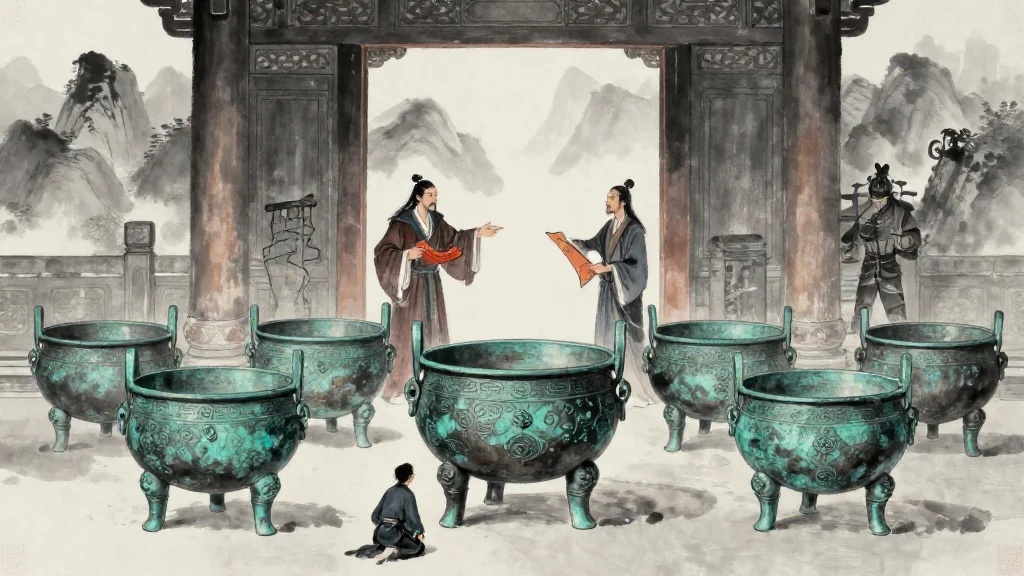
秦興師臨周而求九鼎
Qin Advances on Zhou to Demand the Nine Cauldrons
秦興師臨周而求九鼎,周君患之,以告顏率。顏率曰:「大王勿憂,臣請東借救於齊。」顏率至齊,謂齊王曰:「夫秦之為無道也,欲興兵臨周而求九鼎,周之君臣,內自盡計,與秦,不若歸之大國。夫存危國,美名也;得九鼎,厚寶也。願大王圖之。」齊王大悅,發師五萬人,使陳臣思將以救周,而秦兵罷。
齊將求九鼎,周君又患之。顏率曰:「大王勿憂,臣請東解之。」顏率至齊,謂齊王曰:「周賴大國之義,得君臣父子相保也,願獻九鼎,不識大國何塗之從而致齊?」齊王曰:「寡人將寄徑於梁。」顏率曰:「不可。夫梁之君臣欲得九鼎,謀之暉臺之下,少海之上,其日久矣。鼎入梁,必不出。」齊王曰:「寡人將寄徑於楚。」對曰:「不可。楚之君臣欲得九鼎,謀之於葉庭之中,其日久矣。若入楚,鼎必不出。」王曰:「寡人終何塗之從而致之齊?」顏率曰:「弊邑固竊為大王患之。夫鼎者,非效醯壺醬垂耳,可懷挾提挈以至齊者;非效鳥集、烏飛、兔興、馬逝,灕然止於齊者。昔周之伐殷,得九鼎,凡一鼎而九萬人輓之,九九八十一萬人,士卒師徒,器械被具,所以備者稱此。今大王縱有其人,何塗之從而出?臣竊為大王私憂之。」齊王曰:「子之數來者,猶無與耳。」顏率曰:「不敢欺大國,疾定所從出,弊邑遷鼎以待命。」齊王乃止。
Qin raised an army and advanced on Zhou, demanding the Nine Cauldrons. The lord of Zhou was alarmed and told Yan Shuai about it. Yan Shuai said: "Your Majesty, do not worry. Allow me to go east and borrow Qi's aid."
Yan Shuai went to Qi and said to the King of Qi: "Qin is acting lawlessly. It intends to raise troops, advance on Zhou, and seize the Nine Cauldrons. Zhou's ruler and ministers have deliberated privately and concluded that rather than surrender the cauldrons to Qin, it would be better to present them to a great state. To rescue a state in peril brings a fine reputation; to obtain the Nine Cauldrons is a rich treasure. We beg Your Majesty to consider this." The King of Qi was greatly pleased and dispatched fifty thousand troops under the command of Chen Chensi to rescue Zhou. Qin withdrew its forces.
But then Qi demanded the Nine Cauldrons, and the lord of Zhou was alarmed once more. Yan Shuai said: "Your Majesty, do not worry. Allow me to go east and resolve this." Yan Shuai went to Qi and said to the King of Qi: "Thanks to the great state's righteousness, Zhou's ruler and ministers, fathers and sons, have been preserved. We wish to present the Nine Cauldrons, but we do not know by what route Your Majesty would have them brought to Qi."
The King of Qi said: "I will send them through Wei."
Yan Shuai said: "That will not do. Wei's ruler and ministers have coveted the Nine Cauldrons and plotted to obtain them — below the Hui Terrace and beside the Lesser Sea — for a long time now. If the cauldrons enter Wei, they will certainly never come out."
The King of Qi said: "Then I will send them through Chu."
"That will not do either. Chu's ruler and ministers have coveted the Nine Cauldrons and plotted in the Ye Court to obtain them for a long time. If they enter Chu, the cauldrons will certainly never come out."
The king said: "Then ultimately, by what route can I have them brought to Qi?"
Yan Shuai replied: "Our humble city has indeed been privately worrying about this on Your Majesty's behalf. The cauldrons are not like vinegar jars or sauce pots with handles — things you can tuck under your arm and carry to Qi. Nor are they like flocking birds or galloping horses that might arrive at Qi of their own accord. In ancient times, when Zhou conquered Yin and obtained the Nine Cauldrons, each single cauldron required ninety thousand men to haul it — nine times ninety thousand makes eight hundred and ten thousand men, not counting the soldiers, attendants, equipment, and provisions needed to support them. Even if Your Majesty had the men, by what route could they pass?" He sighed. "I have been privately anxious about this on Your Majesty's behalf."
The King of Qi said: "You have come here repeatedly, and it turns out you have nothing to offer me after all."
Yan Shuai said: "I would not dare deceive a great state. Decide quickly on the route, and our humble city will move the cauldrons and await your command." The King of Qi dropped the matter.
Notes
The Nine Cauldrons (九鼎) were ritual bronze vessels supposedly cast by Yu the Great after he pacified the floods and divided the realm into nine provinces. Possession of the cauldrons symbolised legitimate sovereignty over All-Under-Heaven. By the Warring States period the cauldrons were kept at the Zhou royal capital, and multiple states schemed to seize them.
The lord of Zhou (周君) here is probably King Nan of Zhou (周赧王, r. 315–256 BC), the last Zhou king, though the text uses the vague term 周君 rather than a specific royal title.
Yan Shuai (顏率) was a diplomat in the service of the Zhou court. Nothing else is known of him outside this episode.
The King of Qi is probably King Xuan of Qi (齊宣王, r. 319–301 BC) or King Min of Qi (齊湣王, r. 301–284 BC). The dating of this episode is uncertain.
Chen Chensi (陳臣思) was a Qi general. He appears only in this passage.
Wei (梁) is referred to here by its alternative name Liang, after its capital Daliang (modern Kaifeng, Henan). The Hui Terrace (暉臺) and Lesser Sea (少海) were landmarks in or near the Wei capital.
The Ye Court (葉庭) was a location in Chu, probably near the city of Ye (modern Ye County, Henan), which Chu had conquered from Han.
弊邑 ('our broken city') is a stock diplomatic self-deprecation used by envoys referring to their own state, translated throughout as 'our humble city'.
Yan Shuai's strategy is a masterpiece of diplomatic stalling. He first enlists Qi's aid by offering the cauldrons, then makes Qi give up its claim by demonstrating that the cauldrons are physically impossible to transport — all while appearing perfectly willing to hand them over. The king's exasperated final remark acknowledges he has been outmaneuvered.