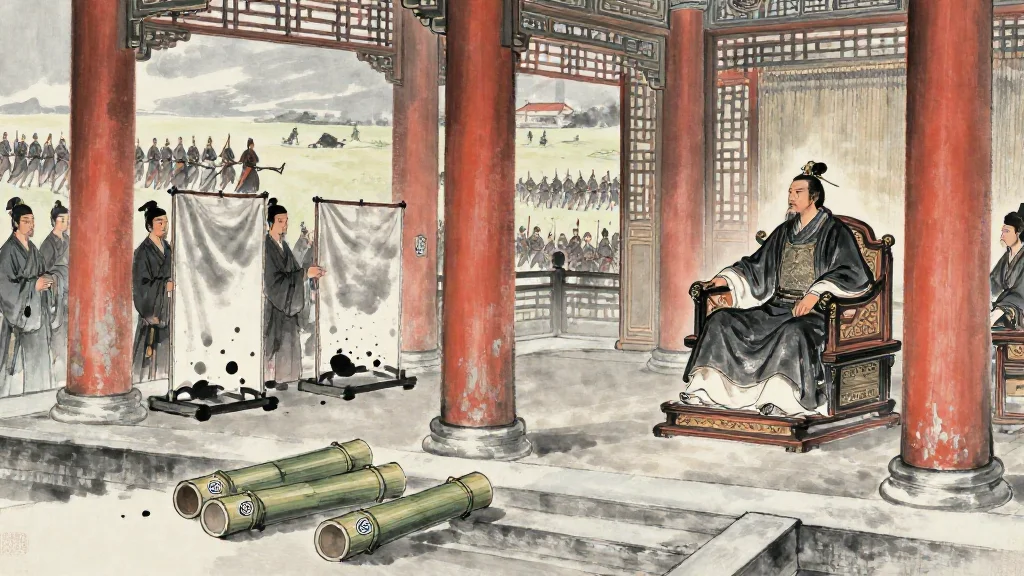
薛公以齊為韓魏攻楚
The Lord of Xue Uses Qi to Attack Chu for Han and Wei
薛公以齊為韓、魏攻楚,又與韓、魏攻秦,而藉兵乞食於西周。韓慶為西周謂薛公曰:「君以齊為韓、魏攻楚,九年而取宛、葉以北以強韓、魏,今又攻秦以益之。韓、魏南無楚憂,西無秦患,則地廣而益重,齊必輕矣。夫本末更盛,虛實有時,竊為君危之。君不如令弊邑陰合於秦而君無攻,又無藉兵乞食。君臨函谷而無攻,令弊邑以君之情謂秦王曰:『薛公必破秦以張韓、魏,所以進兵者,欲王令楚割東國以與齊也。』秦王出楚王以為和。君令弊邑以此忠秦,秦得無破,而以楚之東國自免也,必欲之。楚王出,必得齊。齊得東國而益強,而薛世世無患。秦不大弱,而處之三晉之西,三晉必重齊。」薛公曰:「善。」因令韓慶入秦,而使三國無攻秦,而使不藉兵乞食於西周。
The Lord of Xue used Qi's forces to attack Chu on behalf of Han and Wei, and then joined Han and Wei in attacking Qin, meanwhile requisitioning troops and grain from West Zhou. Han Qing, speaking for West Zhou, said to the Lord of Xue:
"My lord, you have used Qi to fight Chu for Han and Wei. After nine years you took Wan, Ye, and the territory north of them, thereby strengthening Han and Wei. Now you attack Qin to benefit them further. If Han and Wei have no Chu to worry about in the south and no Qin to fear in the west, their territory will expand, their weight will grow, and Qi will inevitably be diminished. Power shifts between root and branch; substance and emptiness have their seasons — I fear for you, my lord.
"Better to let our humble city secretly make terms with Qin while you stand down your attack and stop requisitioning troops and grain. Station your army at Hangu Pass but do not attack, and let our humble city tell the King of Qin on your behalf: 'The Lord of Xue is determined to destroy Qin in order to aggrandize Han and Wei. The reason he has advanced his troops is that he wants Your Majesty to make Chu cede its eastern territories to Qi.' The King of Qin will release the King of Chu to make peace.
"Then let our humble city present this to Qin as an act of loyalty. Qin, having been spared destruction and able to buy its safety with Chu's eastern territories, will certainly agree. Once the King of Chu is released, he will turn to Qi. Qi gains the eastern territories and grows stronger, and the house of Xue will be secure for generations. Qin will not be greatly weakened and will remain on the Three Jin's western flank — so the Three Jin will have to respect Qi."
The Lord of Xue said: "Excellent." He dispatched Han Qing to Qin, halted the three states' attack on Qin, and stopped requisitioning troops and grain from West Zhou.
Notes
The Lord of Xue (薛公) is Meng Changjun (孟嘗君, d. 279 BC), Tian Wen, one of the famous Four Lords of the Warring States. He held the fief of Xue (in modern Tengzhou, Shandong) and served as prime minister of Qi.
Han Qing (韓慶) was a diplomat acting on behalf of West Zhou. The text presents him as effectively running West Zhou's foreign policy — not bad for a minor state's envoy.
Wan (宛) is modern Nanyang, Henan. Ye (葉) is modern Ye County, Henan. Both were strategically important cities on the Chu-Han border.
West Zhou (西周) was the tiny rump state around the old Zhou royal capital at Luoyang after the Zhou domain split into East Zhou and West Zhou in the early 3rd century BC. It survived by diplomatic maneuver among the great powers — this chapter is essentially its playbook.
Han Qing's scheme is a con wrapped in a favor. He gets West Zhou out of paying for someone else's war while positioning it as the indispensable intermediary. The Lord of Xue gets his eastern territories; Qin gets to survive; West Zhou gets to stop bleeding troops and grain. Everyone wins except Han and Wei, who lose their leverage — but nobody tells them.
Hangu Pass (函谷關) was the great western pass separating Qin from the central plains, located in modern Lingbao, Henan.