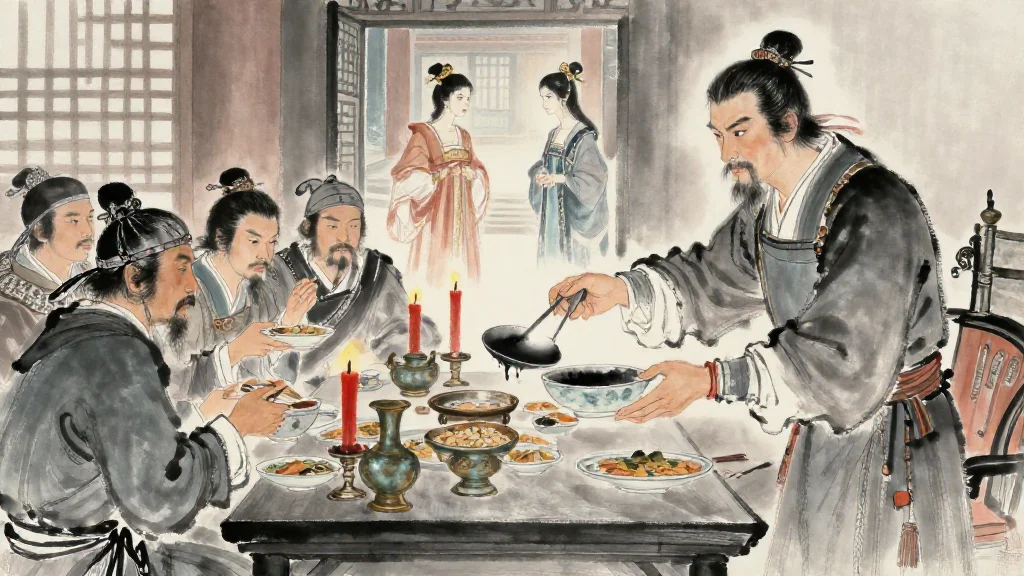
King Zhao of Qin has rested his people and repaired his arms. He plans to attack Zhao again. The Lord of Wu'an says: "This cannot be done."
The king says: "Last year, when the state was exhausted and the people hungry, you did not consider the people's strength and demanded increased military provisions to destroy Zhao. Now I have rested the people, nourished the soldiers, and stockpiled grain — the army's provisions are double what they were. Yet you say 'it cannot be done.' Explain."
The Lord of Wu'an says: "After the affair at Changping, Qin's army won a great victory and Zhao's army suffered a great defeat. The people of Qin rejoiced; the people of Zhao were terrified.
"Qin's dead received lavish burials. Its wounded received generous care. Its weary soldiers feasted each other, spending freely and exhausting their wealth.
"Zhao's dead could not be recovered. Its wounded could not be treated. The people wept and grieved together, toiled together with united purpose, plowed their fields with desperate urgency — and generated new wealth.
"Now, even if Your Majesty deploys double the forces, I estimate Zhao's defenses have increased tenfold. Since Changping, Zhao's ruler and ministers have been anxious and alert — holding court early and dismissing late, sending humble envoys with heavy gifts, marrying off princesses in all four directions, binding themselves to Yan and Wei, and cultivating ties with Qi and Chu. Their every thought and every effort is devoted to preparing against Qin. Their state is internally solid; their alliances externally complete. At this moment, Zhao cannot be attacked."
The king says: "I have already mobilized the army." He sends General Wang Ling of the Five Schools to attack Zhao. Wang Ling loses the battle and his Five Schools are destroyed.
The king wants to send the Lord of Wu'an. The Lord of Wu'an pleads illness and will not go.
The king sends the Marquis of Ying to see the Lord of Wu'an and reproach him: "Chu's territory spans five thousand li with a million halberd-bearers. Yet you led a force of tens of thousands into Chu, took Yan and Ying, burned their temples, and advanced east to Jingling — the people of Chu were so terrified they fled east and dared not look west. Han and Wei combined their forces, assembling vast armies — your troops were less than half their number — yet you fought them at Yique, utterly destroyed both armies, the blood ran so thick it floated the shields, and you took two hundred and forty thousand heads. Han and Wei have called themselves Qin's eastern vassals ever since.
"These are your achievements — All-Under-Heaven knows them. Now, seventeen or eighteen out of every twenty Zhao soldiers are dead from Changping. Their state is hollowed out. Therefore I have raised a massive army, with troops outnumbering Zhao's many times over, and wish you to command it. I intend nothing less than Zhao's annihilation. You have always defeated the many with the few, winning as if by divine power. How much more so now, when the strong attack the weak and the many attack the few?"
The Lord of Wu'an says: "At that time, the King of Chu relied on his state's size and neglected his governance. His ministers competed through jealousy, flatterers held power, able ministers were excluded, the people's hearts had turned, and the walls were in disrepair — he had neither feared ministers nor defensive preparations. That is why I was able to lead my troops deep into enemy territory, bypass cities, burn the bridges and boats to commit my forces, and forage in the countryside to supply the army. At that time, our soldiers regarded the army as their home and their commanders as their parents — united without agreements, trusting without plans, of one heart and shared purpose, they would die rather than turn their backs.
"The Chu soldiers were fighting on their own land. Each one looked toward home, each harbored thoughts of dispersal, none had the will to fight. That is why I was able to succeed.
"At the Battle of Yique, Han stood alone, looking to Wei, not wanting to commit its forces first. Wei relied on Han's sharp troops, wanting to push Han to the front. The two armies maneuvered for advantage with conflicting objectives. That is why I was able to deploy diversionary forces, wait for Han's formation to commit, then concentrate my full elite against Wei where it was unprepared. When Wei's army broke, Han's army collapsed on its own. I pursued the fleeing forces — that is how the achievement was made.
"All of this came from calculating advantages and terrain — the natural logic of circumstances. There was nothing divine about it!
"Now: Qin crushed Zhao's army at Changping but did not immediately exploit their shock and terror to destroy them. Instead, it held back and released the pressure, allowing Zhao time to farm and replenish its stores, to nurture its orphans and raise its young, to increase its numbers, to repair its arms and armor, to raise its walls and deepen its moats. The ruler has humbled himself to honor his ministers; the ministers have pushed ceremony downward to honor their warriors. Even Lord Pingyuan and his peers have had their wives and concubines sewing and mending among the ranks. The entire state is of one mind, high and low united in effort — it is like King Goujian after the siege of Kuaiji.
"If we attack, Zhao will hold firm. If we challenge them to battle, they will not come out. If we besiege their capital, we cannot take it. If we attack their outlying cities, we cannot pull them down. If we raid their countryside, there will be nothing to seize. The army deploys without result. The other lords will take heart. External rescue will arrive. I see the harm but not the benefit. Moreover, I am ill and cannot march."
The Marquis of Ying withdraws in embarrassment and reports to the king. The king says: "Without Bai Qi, can I not destroy Zhao?"
He increases the army further and replaces Wang Ling with Wang He. The siege of Handan lasts eight or nine months, with heavy casualties, but the city does not fall. The King of Zhao sends light elite forces to raid Qin's rear. Qin suffers repeated reverses.
The Lord of Wu'an says: "He did not listen to my plan. How has it turned out?"
The king hears this and is furious. He summons the Lord of Wu'an and tries to force him to serve: "Even if you are ill, lie down in a litter and command from there. If there is an achievement, it is my wish to honor you further. If you refuse to go, I will resent you."
The Lord of Wu'an bows his head to the ground: "I know that if I go, I will achieve nothing, but I may escape punishment. If I do not go, I commit no crime, but I will not escape execution. Nevertheless, I beg Your Majesty to consider my foolish counsel.
"Release Zhao. Nurture the people. Watch for shifts among the lords. Reassure the fearful; attack the arrogant. Punish and destroy the lawless to command the lords. All-Under-Heaven can be settled. Why must Zhao come first?
"This is what is called: yield to one minister and triumph over All-Under-Heaven. If Your Majesty disregards my foolish counsel and insists on gratifying his desire against Zhao and punishing me for my crime, that is what is called: triumph over one minister and yield to All-Under-Heaven. To triumph over one minister's stubbornness — how does that compare with triumphing through All-Under-Heaven's awe?
"I have heard that the wise ruler cherishes his state, and the loyal minister cherishes his name. A destroyed state cannot be made whole again. Dead soldiers cannot be brought back to life. I would rather submit to heavy punishment and die than serve as a general who brings disgrace upon the army. I beg Your Majesty to consider this."
The king leaves without answering.