宋衛策 (Stratagems of Song and Wei) — Chinese ink painting

Chapter 32 of 33

宋衛策

Stratagems of Song and Wei

View:

齊攻宋宋使臧子索救於荊

Qi Attacks Song; Song Sends Zang Zi to Seek Rescue from Chu

齊攻宋,宋使臧子索救於荊。荊王大說,許救甚勸。臧子憂而反。其御曰:「索救而得,有憂色,何也?」臧子曰:「宋小而齊大。夫救於小宋而惡於大齊,此王之所憂也;而荊王說甚,必以堅我。我堅而齊弊,荊之利也。」臧子乃歸。齊王果攻,拔宋五城,而荊王不至。

Qi attacks Song. Song sends Zang Zi to seek rescue from Chu. The King of Chu is delighted and promises aid with great enthusiasm.

Zang Zi returns looking worried. His charioteer asks: "You sought rescue and got it. Why the anxious face?"

Zang Zi says: "Song is small and Qi is large. To rescue small Song at the cost of offending large Qi — this is what any king should worry about. Yet the King of Chu was far too pleased. He intends to stiffen our resolve. If we hold firm and Qi grinds us down, Chu profits."

Zang Zi goes home. Sure enough, Qi attacks and takes five Song cities. The King of Chu never arrives.

Notes

1person臧子Zāng Zǐ

Zang Zi (臧子) was a Song diplomat. His cynical reading of Chu's enthusiasm is proven correct: Chu's eager promise of aid was designed to make Song fight harder, not to actually help Song.

2context

The charioteer's question sets up Zang Zi's insight perfectly: getting what you asked for is not the same thing as getting what you need. When a great power promises help too eagerly, the small state should be worried, not relieved. Chu wants Song to absorb Qi's punishment — Chu's 'rescue' is really Chu's way of using Song as a speed bump.

公輸般為楚設機

Gongshu Ban Builds Siege Engines for Chu

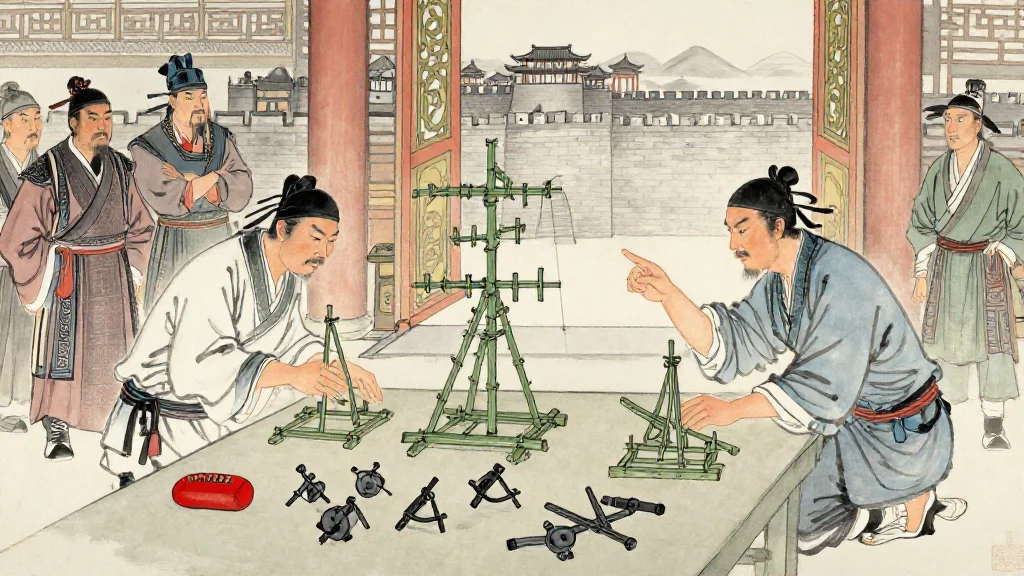
公輸般為楚設機,將以攻宋。墨子聞之,百舍重繭,往見公輸般,謂之曰:「吾自宋聞子。吾欲藉子殺王。」公輸般曰:「吾義固不殺王。」墨子曰:「聞公為雲梯,將以攻宋。宋何罪之有?義不殺王而攻國,是不殺少而殺眾。敢問攻宋何義也?」公輸般服焉,請見之王。

墨子見楚王曰:「今有人於此,舍其文軒,鄰有弊輿而欲竊之;舍其錦繡,鄰有短褐而欲竊之;舍其梁肉,鄰有糟糠而欲竊之。此為何若人也?」王曰:「必為有竊疾矣。」

墨子曰:「荊之地方五千里,宋方五百里,此猶文軒之與弊輿也。荊有雲夢,犀兕麋鹿盈之,江、漢魚鱉黿鼉,為天下饒,宋所謂無雉兔鮒魚者也,此猶梁肉之與糟糠也。荊有長松、文梓、楩、柟、豫樟,宋無長木,此猶錦繡之與短褐也。惡以王吏之攻宋,為與此同類也。」王曰:「善哉!請無攻宋。」

Gongshu Ban builds siege engines for Chu, which intends to use them to attack Song. Mozi hears of this, walks until his shoes wear through and his feet blister, and goes to see Gongshu Ban.

He says: "I have come from Song to see you. I would like to hire you to kill a man."

Gongshu Ban says: "On principle, I do not kill people."

Mozi says: "I hear you have built cloud ladders and intend to attack Song. What crime has Song committed? On principle you refuse to kill one man, yet you will attack an entire state — that is refusing to kill the few while killing the many. May I ask: what principle justifies attacking Song?"

Gongshu Ban is persuaded and arranges an audience with the king.

Mozi sees the King of Chu and says: "Suppose there is a man who owns an ornamental carriage, but his neighbor has a broken-down cart — and he wants to steal it. He owns brocade and silk, but his neighbor has a rough hemp jacket — and he wants to steal it. He has fine grain and meat, but his neighbor has chaff and husks — and he wants to steal them. What sort of man is this?"

The king says: "He must have a compulsion for theft."

Mozi says: "Chu's territory extends five thousand li. Song's territory is five hundred li. This is the ornamental carriage versus the broken-down cart. Chu has the Yunmeng marshes, teeming with rhinoceroses, wild buffalo, elk, and deer. The Yangtze and Han rivers are full of fish, turtles, alligators, and softshell turtles — the richest in All-Under-Heaven. Song, as they say, has not even a pheasant, a rabbit, or a crucian carp. This is fine grain and meat versus chaff and husks. Chu has tall pines, patterned catalpa, bian, nan, and camphor trees. Song has no tall timber. This is brocade and silk versus a rough hemp jacket.

"I respectfully submit that Your Majesty's officials attacking Song falls into the same category."

The king says: "Well said! I will not attack Song."

Notes

1person公輸般Gōngshū Bān

Gongshu Ban (公輸般), also known as Lu Ban, was a legendary craftsman and engineer. In the Mozi and other sources, he is depicted as an inventor of siege weapons including the 'cloud ladder' (雲梯), an early scaling device.

2person墨子Mòzǐ

Mozi (墨子, c. 470–391 BC) was the founder of Mohism, a philosophical school that emphasized universal love, defensive warfare, and opposition to aggressive war. This episode is one of the most famous Mozi stories, also told in greater detail in the Mozi text itself, where Mozi and Gongshu Ban conduct a simulated siege-defense exercise on a tabletop.

3context

Mozi's opening gambit — 'I want to hire you to kill a man' — is a brilliant rhetorical trap. Gongshu Ban's reflexive refusal ('I don't kill people on principle') hands Mozi exactly the contradiction he needs: you claim you don't kill, but you're building weapons to kill thousands. The argument with the King of Chu uses a different tactic — the 'kleptomania' analogy — but drives toward the same point: attacking Song makes no rational sense for a state that already has everything. This is Mohist anti-war rhetoric at its most effective.

4place

Yunmeng (雲夢) was a vast marshland in ancient Chu (roughly modern Hubei), legendary for its abundance of wildlife. It served as a royal hunting ground and was one of the symbols of Chu's natural wealth.

犀首伐黃

Xishou Attacks Huang

犀首伐黃,過衛,使人謂衛君曰:「弊邑之師過大國之郊,曾無一介之使以存之乎?敢請其罪。今黃城將下矣,已將移兵而造大國之城下。」衛君懼,束組三百緄,黃金三百鎰,以隨使者。南文子止之曰:「是勝黃城,必不敢來;不勝,亦不敢來。是勝黃城,則功大名美,內臨其倫。夫在中者惡臨,議其事。蒙大名,挾成功,坐御以待中之議,犀首雖愚,必不為也。是不勝黃城,破心而走,歸,恐不免於罪矣!彼安敢攻衛以重其不勝之罪哉?」果勝黃城,帥師而歸,遂不敢過衛。

Xishou is attacking Huang and passes through Wei's territory. He sends a man to tell the lord of Wei: "Our humble city's army is passing through your great state's outskirts, and there has not been so much as a single envoy to acknowledge us. May I inquire as to the offense? The city of Huang is about to fall. Once it does, I will move my troops to the base of your great state's walls."

The lord of Wei is frightened and prepares three hundred bundles of silk cord and three hundred yi of gold to send with the messenger.

Nan Wenzi stops him: "If he takes Huang, he certainly will not dare come here. If he fails to take Huang, he also will not dare come here.

"If he takes Huang, his achievement will be great and his reputation glorious — and upon returning he will face the scrutiny of his peers at court. Those at the center resent the scrutiny of the returning hero and will question his conduct. Bearing a great name and carrying a major achievement, he will need to sit carefully and await their judgment. Even if Xishou were a fool, he would not compound that situation by picking a fight with Wei on the way home.

"If he fails to take Huang, he will retreat in dismay. When he returns, he will be hard-pressed to avoid punishment. How would he dare attack Wei and add to the burden of his defeat?"

Sure enough, Xishou takes Huang, leads his army home, and does not dare pass through Wei.

Notes

1person犀首Xī Shǒu

Xishou (犀首, 'Rhinoceros Head') was the courtesy title of Gongsun Yan, a prominent Wei military commander and diplomat who later became associated with the east-west alignment (連橫) strategy. His nickname presumably refers to his physical appearance or his helmet.

2person南文子Nán Wénzǐ

Nan Wenzi (南文子) was a minister of Wei known for his cool-headed analysis. He appears in multiple Zhanguoce episodes as the voice of reason preventing Wei from being extorted.

3context

Nan Wenzi's logic is airtight and worth studying: a general on campaign can only either succeed or fail, and in either case he has no incentive to pick an unnecessary fight. Success means he needs to get home and cash in his achievement before his court rivals undermine him. Failure means he needs to get home and minimize his losses. Either way, shaking down Wei is all downside, no upside. Xishou's threat is pure bluff — and Nan Wenzi calls it.

梁王伐邯鄲

The King of Liang Attacks Handan

梁王伐邯鄲,而征師於宋。宋君使使者請於趙王曰:「夫梁兵勁而權重,今征師於弊邑,弊邑不從,則恐危社稷;若扶梁伐趙,以害趙國,則寡人不忍也。願王之有以命弊邑。」

趙王曰:「然。夫宋之不足如梁也,寡人知之矣。弱趙以強梁,宋必不利也,則吾何以告子而可乎?」使者曰:「臣請受邊城,徐其攻而留其日,以待下吏之有城而已。」趙王曰:「善。」

宋人因遂舉兵入趙境,而圍一城焉。梁王甚說,曰:「宋人助我攻矣。」趙王亦說曰:「宋人止於此矣。」故兵退難解,德施於梁而無怨於趙。故名有所加而實有所歸。

The King of Liang attacks Handan and conscripts troops from Song. The lord of Song sends an envoy to the King of Zhao: "Wei's forces are powerful and its influence is heavy. Now it conscripts troops from our humble city. If we refuse, we fear for the state. But if we support Wei in attacking Zhao and thereby harm Zhao, we cannot bear it. We ask Your Majesty to instruct our humble city."

The King of Zhao says: "Indeed. I know that Song cannot match Wei. To weaken Zhao in order to strengthen Wei would not profit Song either. So what can I tell you that would help?"

The envoy says: "I ask that you cede us a border town. We will go slowly in our attack and drag out the campaign, waiting only until our subordinate officials have a city to show for it."

The King of Zhao says: "Good."

Song then raises troops, enters Zhao territory, and besieges a single city. The King of Wei is delighted: "Song is helping us attack!" The King of Zhao is also satisfied: "Song is stopping here."

So the troops withdraw when the operation is done. Song earns gratitude from Wei without incurring resentment from Zhao. The name goes one way; the substance goes another.

Notes

1context

This is one of the Zhanguoce's most elegant studies of small-state survival. Song is caught between Wei and Zhao — refuse Wei's demand and face destruction; obey it and make an enemy of Zhao. The solution: secretly negotiate with Zhao to take a single border city (which Zhao voluntarily surrenders), then present this minimal effort to Wei as enthusiastic participation. Wei thinks Song is a loyal ally; Zhao knows Song is a reluctant participant. Both are satisfied. The final line — 'the name goes one way; the substance goes another' — could be the motto of the entire Zhanguoce.

2place

Handan (邯鄲) was the capital of Zhao, located in modern Handan, Hebei. Liang (梁) is Wei's alternative name, after its capital Daliang.

謂大尹曰

Someone Addresses the Grand Steward

謂大尹曰:「君日長矣,自知政,則公無事。公不如令楚賀君之孝,則君不奪太后之事矣,則公常用宋矣。」

Someone says to the Grand Steward: "The lord is growing up. When he starts managing affairs himself, you will have nothing to do. You would do better to have Chu congratulate the lord on his filial piety — then the lord will not take affairs away from the Queen Dowager, and you will remain in charge of Song's affairs indefinitely."

Notes

1context

A tiny, cynical fragment. The Grand Steward's power derives from the Queen Dowager's regency. The young lord growing up threatens the entire arrangement. The solution: get Chu to publicly praise the lord for being filial (i.e., obedient to his mother), which creates pressure on the lord to keep deferring to the Queen Dowager — and by extension, to the Grand Steward. It is a three-move power-preservation scheme compressed into two sentences.

2textual

This section is extremely brief and lacks context. The identities of the speaker, the Grand Steward (大尹), and the lord in question are uncertain. It likely refers to Song's internal court politics during a period of regency.

宋與楚為兄弟

Song and Chu Are Brother States

宋與楚為兄弟。齊攻宋,楚王言救宋。宋因賣楚重以求講於齊,齊不聽。蘇秦為宋謂齊相曰:「不如與之,以明宋之賣楚重於齊也。楚怒,必絕於宋而事齊,齊、楚合,則攻宋易矣。」

Song and Chu are allied as brother states. Qi attacks Song. The King of Chu announces he will rescue Song. Song then offers to sell out Chu's interests at a high price to negotiate peace with Qi. Qi refuses.

Su Qin, speaking on Song's behalf, tells the Qi chancellor: "You should accept the deal. This will demonstrate to everyone that Song sold out Chu's interests at a premium to buy Qi's favor. Chu will be furious and will certainly break with Song and align with Qi. Once Qi and Chu are allied, attacking Song becomes easy."

Notes

1context

The layers of betrayal here are almost comic. Song is allied with Chu but tries to buy peace with Qi by selling out Chu. Su Qin — supposedly advising Song — then tells Qi's chancellor to accept the deal, but his real argument is that accepting it will destroy the Song-Chu alliance and make Song easier to conquer. Su Qin is nominally Song's advocate, but his advice benefits Qi at Song's ultimate expense. Everyone is betraying everyone, and the only honest actor in the story is Qi's chancellor, who initially refuses because the deal seems too good.

2person蘇秦Sū Qín

Su Qin (蘇秦) was the legendary architect of the north-south coalition (合縱) and the elder brother of Su Dai. His appearance here advising Song is one of many Zhanguoce episodes where Su Qin operates as a freelance strategist whose actual loyalties are opaque.

魏太子自將過宋外黃

The Wei Crown Prince Passes Through Waihuang in Song

魏太子自將,過宋外黃。外黃徐子曰:「臣有百戰百勝之術,太子能聽臣乎?」太子曰:「願聞之。」客曰:「固願效之。今太子自將攻齊,大勝並莒,則富不過有魏,而貴不益為王。若戰不勝,則萬世無魏。此臣之百戰百勝之術也。」太子曰:「諾。請必從公之言而還。」客曰:「太子雖欲還,不得矣。彼利太子之戰攻,而欲滿其意者眾,太子雖欲還,恐不得矣。」太子上車請還。其御曰:「將出而還,與北同,不如遂行。」遂行。與齊人戰而死,卒不得魏。

The Wei crown prince is personally leading an army and passes through Waihuang in Song. A man called Xu Zi of Waihuang says: "I possess a technique for winning a hundred battles out of a hundred. Is the prince willing to hear it?"

The prince says: "I would like to hear it."

The man says: "I am glad to share it. The prince is personally leading an attack on Qi. If you win a great victory and annex Ju, your wealth cannot exceed possessing Wei and your rank cannot rise above being its king. If you lose the battle, Wei is lost for ten thousand generations. This is my technique for winning a hundred battles out of a hundred."

The prince says: "Agreed. I will certainly follow your advice and turn back."

The man says: "Even if the prince wishes to turn back, he may not be able to. Those who profit from the prince fighting — who want to see their ambitions fulfilled through his campaign — are many. Even if the prince wishes to turn back, I fear he will not be allowed to."

The prince boards his chariot and tries to turn back. His charioteer says: "To march out and then turn back is the same as a defeat. Better to continue."

He continues. He fights the men of Qi and is killed. Wei never becomes his.

Notes

1context

Xu Zi's 'technique for winning a hundred battles' turns out to be: don't fight. The logic is watertight: the crown prince has nothing to gain (he already inherits Wei) and everything to lose (his life and Wei's future). But Xu Zi's second insight is even sharper: the prince is surrounded by people who benefit from the war continuing, and they will not let him stop. The charioteer's argument — 'turning back equals defeat' — is exactly the kind of pressure Xu Zi predicted. The prince recognizes the wisdom, agrees with it, and is then unable to act on it because the institutional momentum is too strong. He dies because the people around him need him to fight.

2place

Waihuang (外黃) was a city in Song territory, near modern Minquan County, Henan. Ju (莒) was a city in Qi territory, in modern Shandong.

宋康王之時有雀生鸇於城之陬

In King Kang of Song's Time, a Sparrow Hatches a Hawk

宋康王之時,有雀生鸇於城之陬。使史占之,曰:「小而生巨,必霸天下。」康王大喜。

於是滅滕代薛,取淮北之地。乃愈自信,欲霸之亟成,於射天笞地,斬社稷而焚滅之。曰:「威服天下鬼神。」罵國老諫曰,為無顏之冠以示勇。剖傴之背,鍥朝涉之脛,而國人大駭。齊聞而伐之,民散,城不守。王乃逃倪侯之館,遂得而死。見祥而不為祥,反為禍。

In the time of King Kang of Song, a sparrow hatches a hawk on the corner of the city wall. The king has his diviner interpret the omen. The diviner says: "The small gives birth to the great — this means certain hegemony over All-Under-Heaven."

King Kang is overjoyed. He proceeds to annihilate Teng, conquer Xue, and seize the lands north of the Huai. Emboldened, he grows ever more confident and wants his hegemony completed quickly. He shoots arrows at heaven and flogs the earth. He chops down the altars of soil and grain and burns them. He declares: "I have cowed the ghosts and spirits of All-Under-Heaven."

He curses the elders who remonstrate with him. He makes a faceless cap to display his fearlessness. He has a hunchback's spine split open. He has the shins of a man who waded a river at dawn cut and examined. The people are horrified.

Qi hears of this and attacks. The people scatter, the walls are not defended. The king flees to the residence of the lord of Ni, where he is captured and killed.

He saw an auspicious omen but did not make it auspicious — he turned it into a catastrophe.

Notes

1person宋康王Sòng Kāng Wáng

King Kang of Song (宋康王, r. ~328–286 BC) was the last ruler of Song, notorious for his megalomania and cruelty. His behavior — shooting at the sky, flogging the earth, destroying his own state altars — was so bizarre that he became the Warring States period's stock example of a ruler who has lost touch with reality.

2context

The sparrow-hatching-a-hawk omen is a setup: the diviner tells the king what he wants to hear, and the king takes it as a blank check for increasingly deranged behavior. Splitting a hunchback's spine to examine it, cutting open a wader's shins to see why he could endure cold water — these are not the acts of a tyrant pursuing a rational political agenda. They are the acts of a man who has decided that reality should conform to his will. The text's moral — 'he saw an auspicious omen but did not make it auspicious' — is almost gentle compared to the horror of the preceding catalog.

3translation

社稷 (the altars of soil and grain) were the most sacred ritual sites of any state — their destruction was tantamount to annihilating the state itself. For a ruler to destroy his own state's altars is an act of self-negation bordering on the psychotic.

智伯欲伐衛

Zhibo Plans to Attack Wei

智伯欲伐衛,遺衛君野馬四百,白璧一。衛君大悅。群臣皆賀,南文子有憂色。衛君曰:「大國大歡,而子有憂色何?」文子曰:「無功之賞,無力之禮,不可不察也。野馬四,白璧一,此小國之禮也,而大國致之。君其圖之。」衛君以其言告邊境。智伯果起兵而襲衛,至境而反曰:「衛有賢人,先知吾謀也。」

Zhibo plans to attack Wei. He sends four hundred wild horses and a piece of white jade to the lord of Wei. The lord of Wei is greatly pleased. All his ministers offer congratulations — except Nan Wenzi, who looks worried.

The lord of Wei says: "A great state shows us great favor, yet you look worried. Why?"

Nan Wenzi says: "Rewards without merit, gifts without cause — these must be scrutinized. Four hundred wild horses and a piece of white jade — this is a small state's tribute, yet a great power is sending it to us. Your Lordship should think carefully about this."

The lord of Wei relays Nan Wenzi's words to the border garrisons. Zhibo does indeed raise troops and launches a surprise attack on Wei, but when he reaches the border he turns back, saying: "Wei has a worthy minister who anticipated my plan."

Notes

1person智伯Zhì Bó

Zhibo (智伯), also known as Zhi Yao, was the most powerful lord in the state of Jin before its partition. He was eventually destroyed by the Han, Zhao, and Wei clans in 453 BC — the event that effectively ended the state of Jin and created the Three Jin.

2context

Nan Wenzi's principle — 'rewards without merit, gifts without cause must be scrutinized' — is one of the Zhanguoce's cleanest maxims. When a powerful state suddenly sends you generous gifts for no reason, it is not being generous. It is fattening you for the kill, or at minimum testing whether you are alert. Nan Wenzi's ability to see the gift as a warning sign while everyone else sees it as a celebration is precisely what makes him a 'worthy minister' in Zhibo's own judgment.

智伯欲襲衛

Zhibo Plans to Raid Wei

智伯欲襲衛,乃佯亡其太子,使奔衛。南文子曰:「太子顏為君子也,甚愛而有寵,非有大罪而亡,必有故。」使人迎之於境,曰:「車過五乘,慎勿納也。」智伯聞之,乃止。

Zhibo plans to raid Wei. He pretends to banish his crown prince and has him flee to Wei.

Nan Wenzi says: "The crown prince, by reputation, is a gentleman — deeply loved and favored. If he flees without having committed a great crime, there must be a reason behind it." He sends men to meet the prince at the border with instructions: "If his retinue exceeds five chariots, do not admit him."

Zhibo hears of this and abandons the plan.

Notes

1context

The trick is transparent to anyone paying attention: if a beloved crown prince 'flees' from a powerful state to a weak one without any prior scandal, the flight is staged. The crown prince is either a Trojan horse (his retainers are really soldiers) or a pretext for invasion ('you harbored my runaway heir'). Nan Wenzi's countermeasure — allow him in only if his retinue is small enough to be harmless — is elegant because it neither accepts nor refuses. It calls the bluff without creating a diplomatic incident. Five chariots: a gentleman's travel party. Six or more: an advance guard.

秦攻衛之蒲

Qin Attacks Wei's City of Pu

秦攻衛之蒲,胡衍謂樗里疾曰:「公之伐蒲,以為秦乎?以為魏乎?為魏則善,為秦則不賴矣。衛所以為衛者,以有蒲也。今蒲入於魏,衛必折於魏。魏亡西河之外,而弗能復取者,弱也。今並衛於魏,魏必強。魏強之日,西河之外必危。且秦王亦將觀公之事。害秦以善魏,秦王必怨公。」樗里疾曰:「奈何?」胡衍曰:「公釋蒲勿攻,臣請為公入戒蒲守,以德衛君。」樗里疾曰:「善。」

胡衍因入蒲,謂其守曰:「樗里子知蒲之病也,其言曰:『吾必取蒲。』今臣能使釋蒲勿攻。」蒲守再拜,因效金三百鎰焉,曰:「秦兵誠去,請厚子於衛君。」胡衍取金於蒲,以自重於衛。樗里子亦得三百金而歸,又以德衛君也。

Qin attacks Wei's city of Pu. Hu Yan says to Chuli Ji: "Is your attack on Pu for Qin's benefit or for Wei's? If it benefits Wei, fine. If it is for Qin, then it is not worthwhile.

"The reason Wei remains Wei is because it has Pu. If Pu falls to Wei, then Wei must submit to the larger Wei. The larger Wei lost the lands west of the Yellow River and could not recover them because it was too weak. If you add the smaller Wei to the larger Wei's territory, the larger Wei becomes strong. On the day Wei becomes strong, the lands west of the Yellow River are in danger. Moreover, the King of Qin is watching your actions. If you harm Qin's interests to benefit Wei, the king will surely resent you."

Chuli Ji says: "What should I do?"

Hu Yan says: "Withdraw from Pu and do not attack. Allow me to go in and warn the Pu garrison on your behalf — thereby earning the gratitude of the lord of Wei."

Chuli Ji says: "Good."

Hu Yan goes into Pu and tells the garrison commander: "Chuli Ji knows Pu's weakness. He has said: 'I will certainly take Pu.' But I can make him withdraw and not attack."

The garrison commander bows twice and offers three hundred yi of gold, saying: "If Qin's forces truly withdraw, I will see that the lord of Wei rewards you generously."

Hu Yan takes the gold from Pu and uses it to enhance his own standing with Wei. Chuli Ji also receives three hundred pieces of gold and withdraws — while also gaining credit for showing mercy to the lord of Wei.

Notes

1person樗里疾Chūlí Jí

Chuli Ji (樗里疾), also known as Lord Yan, was a Qin royal (half-brother of King Huiwen) famous for his cunning. The Shiji describes him as 'Qin's wisdom bag' (秦之智囊). Here he is being out-conned by a freelancer, which is somewhat ironic.

2person胡衍Hú Yǎn

Hu Yan (胡衍) was a roving persuader who appears in several Zhanguoce episodes, always working the angles. Here he simultaneously collects payment from Pu's garrison for arranging Qin's withdrawal and builds his reputation with the lord of Wei — a textbook double-dip.

3context

Note the two 'Wei' states in this passage: 衛 (Wei, the small state descended from the Zhou royal house) and 魏 (Wei, the large former-Jin state). They are different states with different characters but the same romanization. The smaller Wei (衛) depends on holding Pu for its survival. Hu Yan's argument to Chuli Ji is actually sound geopolitics — taking Pu strengthens the larger Wei (魏) at Qin's expense — but his real interest is in getting paid from both sides.

衛使客事魏

Wei Sends a Guest-Retainer to Serve in the Larger Wei

衛使客事魏,三年不得見。衛客患之,乃見梧下先生,許之以百金。梧下先生曰:「諾。」乃見魏王曰:「臣聞秦出兵,未知其所之。秦、魏交而不修之日久矣。願王博事秦,無有佗計。」魏王曰:「諾。」

客趨出,至郎門而反曰:「臣恐王事秦之晚。」王曰:「何也?」先生曰:「夫人於事己者過急,於事人者過緩。今王緩於事己者,安能急於事人。」「奚以知之?」「衛客曰:事王三年不得見。臣以是知王緩也。」魏王趨見衛客。

The smaller Wei sends a guest-retainer to serve in the larger Wei. For three years he cannot obtain an audience. The Wei guest grows anxious and visits Master Wuxia, promising him a hundred pieces of gold.

Master Wuxia says: "Agreed." He goes to see the King of Wei and says: "I hear Qin has mobilized troops, though their destination is unknown. The Qin-Wei relationship has gone unmaintained for too long. I urge Your Majesty to make a broad effort to serve Qin — there is no alternative."

The King of Wei says: "Agreed."

Master Wuxia hurries out, reaches the corridor gate, then turns back and says: "I fear Your Majesty may be too late in serving Qin."

The king says: "Why?"

Master Wuxia says: "Men are too eager about what serves themselves and too slow about what serves others. If Your Majesty is slow about what serves yourself, how can you be prompt about serving others?"

"How do you know I am slow?"

"The Wei guest-retainer has been seeking an audience with Your Majesty for three years without being received. From this I know Your Majesty is slow."

The King of Wei immediately grants the Wei guest an audience.

Notes

1context

Master Wuxia's method is a beautiful piece of misdirection. He opens with a completely unrelated foreign-policy alarm (Qin is mobilizing!) to get the king's attention. He then pivots — via a general observation about speed and urgency — to the actual point: the king has been ignoring a guest-retainer from the smaller Wei for three years. The Qin scare is pure pretext, a door-opener. The real payload is the accusation of negligence, delivered so deftly that the king acts on it immediately.

衛嗣君病

Lord Si of Wei Falls Ill

衛嗣君病。富術謂殷順且曰:「子聽吾言也以說君,勿益損也,君必善子。人生之所行,與死之心異。始君之所行於世者,食高麗也;所用者,紲錯、挐薄也。群臣盡以為君輕國而好高麗,必無與君言國事者。子謂君:『君之所行天下者甚謬。紲錯主斷於國,而挐薄輔之,自今以往者,公孫氏必不血食矣。』」

君曰:「善。」與之相印,曰:「我死,子制之。」嗣君死,殷順且以君令相公期。紲錯、挐薄之族皆逐也。

Lord Si of Wei falls ill. Fu Shu says to Yin Shunqie: "Listen to my words and use them to persuade the lord — add nothing and subtract nothing — and the lord will certainly favor you.

"What a man does in life differs from what weighs on his mind at death. Throughout his life, the lord's pleasure has been dining with courtesans. The men he has employed are Xiecuo and Nabo. All his ministers believe the lord takes the state lightly and cares only for pleasure, so none dares discuss affairs of state with him.

"Tell the lord: 'Your Lordship's conduct in All-Under-Heaven has been deeply mistaken. Xiecuo controls all decisions of state, while Nabo assists him. From this day forward, the Gongsun clan will certainly lose its ancestral sacrifices.'"

The lord says: "You are right." He gives Yin Shunqie the chancellor's seal and says: "When I die, you take control."

Lord Si dies. Yin Shunqie uses the lord's order to install Gongqi as chancellor. The clans of Xiecuo and Nabo are all expelled.

Notes

1context

Fu Shu understands something essential about deathbed politics: a dying ruler's anxieties are different from a living ruler's pleasures. The lord spent his life enjoying courtesans and empowering his favorites. On his deathbed, he suddenly cares about his legacy — about whether the Gongsun family line will survive him. Fu Shu exploits this shift by having Yin Shunqie deliver the warning at exactly the right psychological moment. The lord, facing mortality, instantly reverses course on the men he trusted his whole life.

2person衛嗣君Wèi Sì Jūn

Lord Si of Wei (衛嗣君) was a late ruler of the smaller Wei state (衛). By this period Wei was a tiny remnant state with minimal power, which makes the court intrigues all the more pointed — the stakes are small, but the scheming is relentless.

衛嗣君時胥靡逃之魏

A Convict Laborer Flees from Wei to the Larger Wei

衛嗣君時,胥靡逃之魏,衛贖之百金,不與。乃請以左氏。群臣諫曰:「以百金之地,贖一胥靡,無乃不可乎?」君曰:「治無小,亂無大。教化喻於民,三百之城,足以為治;民無廉恥,雖有十左氏,將何以用之?」

In the time of Lord Si of Wei, a convict laborer flees to the larger Wei. The smaller Wei offers to ransom him for a hundred pieces of gold. The larger Wei refuses. So the smaller Wei offers to trade the city of Zuoshi.

The ministers remonstrate: "To trade a city worth a hundred pieces of gold for a single convict laborer — is that not unacceptable?"

The lord says: "In governance, nothing is too small to matter. In disorder, nothing is too large to ignore. If moral instruction is understood by the people, a city of three hundred households is enough for good governance. If the people have no sense of integrity or shame, even ten cities like Zuoshi would be useless."

Notes

1context

Lord Si's argument is a Legalist principle applied with startling clarity: the point of ransoming the convict is not the convict's value — it is the principle that no one escapes punishment. If a convict can flee to another state and be safe, the entire system of law enforcement collapses. A city is a small price to pay for maintaining the credibility of the legal order. Whether this is admirable commitment to the rule of law or an insane overvaluation of principle over pragmatism depends on your philosophical starting point.

衛人迎新婦

A Wei Man Fetches His New Bride

衛人迎新婦,婦上車,問:「驂馬,誰馬也?」御曰:「借之。」新婦謂仆曰:「拊驂,無笞服。」車至門,扶,教送母:「滅灶,將失火。」入室見臼,曰:「徙之牖下,妨往來者。」主人笑之。此三言者,皆要言也,然而不免為笑者,蚤晚之時失也。

A man of Wei fetches his new bride. The bride climbs into the carriage and asks: "The side horse — whose horse is that?"

The driver says: "Borrowed."

The bride tells the groom's servant: "Pat the side horse gently. Do not whip the shaft horse."

When the carriage reaches the gate, the bride is helped down. She instructs the woman who escorted her: "Put out the kitchen fire — it is about to spread."

Entering the house and seeing a mortar, she says: "Move it beneath the window — it is blocking the walkway."

The household laughs at her. All three of her remarks are sensible. But the reason she is laughed at is that her timing is wrong.

Notes

1context

This is a parable about timing, not about the bride's intelligence. Every one of her observations is correct: a borrowed horse should be treated gently, an unattended fire is dangerous, and a mortar in a walkway is an obstruction. But she delivers practical household management advice within minutes of arriving as a new bride — before she has any standing, before anyone has asked her opinion, before she has established herself. Good counsel delivered at the wrong moment is indistinguishable from presumptuousness. The Zhanguoce uses this domestic fable to make a point that applies equally to court politics: being right is necessary but not sufficient. You also have to be right at the right time.

Edition & Source

Text
《戰國策》 Zhanguoce
Edition
中華古詩文古書籍網 transcription
Commentary
鮑彪 (Bao Biao) Song dynasty commentary