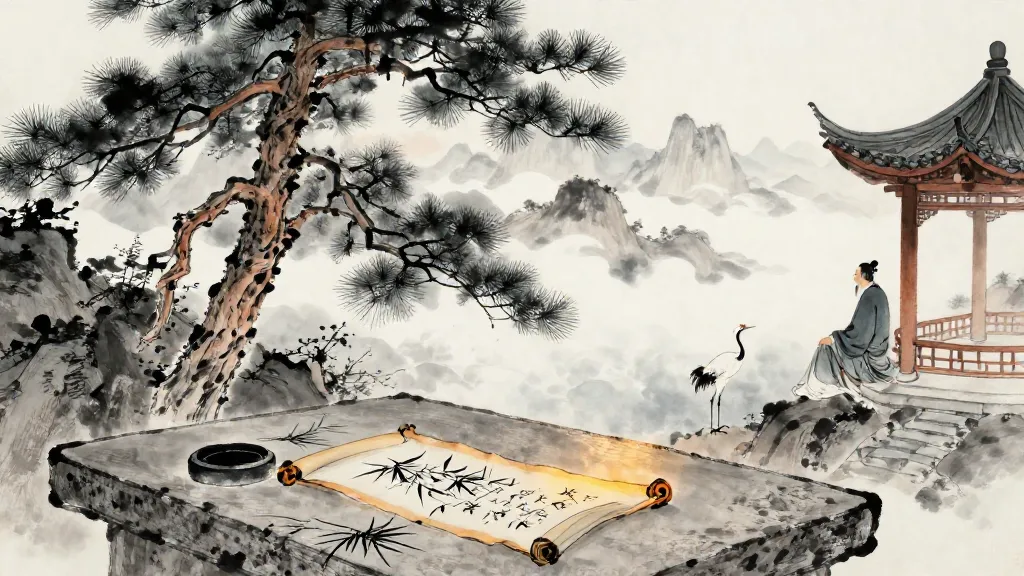
逍遙遊 (Free and Easy Wandering) — Chinese ink painting

莊子 Zhuangzi · Chapter 1

逍遙遊

Free and Easy Wandering

View:

鯤鵬之變

The Transformation of Kun and Peng

北冥有魚,其名為鯤。鯤之大,不知其幾千里也。化而為鳥,其名為鵬。鵬之背,不知其幾千里也。怒而飛,其翼若垂天之雲。是鳥也,海運則將徙於南冥。南冥者,天池也。

In the northern darkness there is a fish called Kun. The Kun is so vast that no one knows how many thousands of li it measures. It transforms into a bird called Peng. The Peng's back is so vast that no one knows how many thousands of li it stretches. When it rouses itself and flies, its wings are like clouds hanging from the sky. This bird, when the sea churns, sets off for the southern darkness — the southern darkness, which is the Pool of Heaven.

Notes

1context

The Kun (鯤) and Peng (鵬) represent the limitless potential of transformation in Daoist thought. The opening image establishes the chapter's theme: what appears fixed is always in the process of becoming something else. The 'northern darkness' (北冥) and 'southern darkness' (南冥) suggest the cosmic scope of the Peng's journey.

齊諧之志

The Record of Wonders

《齊諧》者,志怪者也。《諧》之言曰:"鵬之徙於南冥也,水擊三千里,摶扶搖而上者九萬里,去以六月息者也。"野馬也,塵埃也,生物之以息相吹也。天之蒼蒼,其正色邪?其遠而無所至極邪?其視下也,亦若是則已矣。

The Qixie is a record of wonders. The Qixie says: 'When the Peng sets off for the southern darkness, it beats the water for three thousand li, then spirals upward on a whirlwind to a height of ninety thousand li, riding the winds of the sixth month.' Shimmering heat-haze, swirling dust, the breath of living things blowing against one another — is the blue of the sky its true color? Or is it simply that the sky is so far away that it has no limit? When the Peng looks down, it sees the same thing.

Notes

1context

The 'wild horses' (野馬) refers to the shimmering heat-haze that rises from the earth, which ancient Chinese observers compared to galloping horses. Zhuangzi uses this image to blur the distinction between the grand (the Peng's flight) and the minute (dust motes), suggesting that all phenomena arise from the same breath (氣) of transformation.

大小之辯

The Debate Between Great and Small

且夫水之積也不厚,則其負大舟也無力。覆杯水於坳堂之上,則芥為之舟。置杯焉則膠,水淺而舟大也。風之積也不厚,則其負大翼也無力。故九萬里則風斯在下矣,而後乃今培風;背負青天而莫之夭閼者,而後乃今將圖南。

蜩與學鳩笑之曰:"我決起而飛,槍榆枋而止,時則不至,而控於地而已矣,奚以之九萬里而南為?"適莽蒼者,三餐而反,腹猶果然;適百里者,宿舂糧;適千里者,三月聚糧。之二蟲又何知!

Now if the water is not deep enough, it will not have the strength to bear a great boat. Pour a cup of water into a hollow in the floor, and a mustard seed will serve as a boat; but place the cup there and it sticks fast — the water is too shallow and the boat too large. If the wind is not strong enough, it will not have the strength to bear great wings. Therefore at ninety thousand li, the wind is all beneath the Peng, and only then does it mount the wind. With the blue sky at its back and nothing to obstruct it, only then does it set its course for the south.

The cicada and the young dove laugh at the Peng, saying: 'We spring up with a burst and fly toward the elm or sandalwood tree, and sometimes we don't even make it and just tumble to the ground. What's the use of going ninety thousand li to the south?' If you're going to the nearby countryside, you can bring enough food for three meals and come back with your belly still full. If you're going a hundred li, you must grind grain the night before. If you're going a thousand li, you must lay in provisions for three months. What do these two little creatures know!

Notes

1context

This passage introduces a central paradox of the Zhuangzi: even the magnificent Peng 'depends' on the wind to fly. The cicada and dove mock what they cannot comprehend, but their laughter reveals their own limitations — they are 'dependent' on close trees. Zhuangzi will later transcend this entire debate by pointing toward a freedom that depends on nothing at all.

小知不及大知

Small Knowledge Cannot Match Great Knowledge

小知不及大知,小年不及大年。奚以知其然也?朝菌不知晦朔,蟪蛄不知春秋,此小年也。楚之南有冥靈者,以五百歲為春,五百歲為秋;上古有大椿者,以八千歲為春,八千歲為秋。而彭祖乃今以久特聞,眾人匹之,不亦悲乎!

Small knowledge cannot match great knowledge; a short life cannot match a long life. How do we know this is so? The morning mushroom does not know the waxing and waning of the moon; the summer cicada does not know spring and autumn — these are short-lived. South of Chu there is a tree called the Dark Spirit, for which five hundred years is a single spring and five hundred years a single autumn. In high antiquity there was a great cedar, for which eight thousand years was a single spring and eight thousand years a single autumn. Yet Pengzu alone is famous today for his longevity, and everyone tries to match him — is this not pitiful!

Notes

1person彭祖Péng Zǔ

Pengzu (彭祖) was a legendary figure said to have lived over 800 years, from the Shang dynasty onward. He was the Chinese equivalent of Methuselah and served as the standard example of extraordinary longevity.

湯問棘

Tang's Questions to Ji

湯之問棘也是已:窮髮之北,有冥海者,天池也。有魚焉,其廣數千里,未有知其修者,其名為鯤。有鳥焉,其名為鵬,背若泰山,翼若垂天之雲,摶扶搖羊角而上者九萬里,絕雲氣,負青天,然後圖南,且適南冥也。

斥鴳笑之曰:"彼且奚適也?我騰躍而上,不過數仞而下,翱翔蓬蒿之間,此亦飛之至也,而彼且奚適也?"此小大之辯也。

Tang's questions to Ji tell us the same thing. In the far north, where the land is barren, there lies the Dark Sea — the Pool of Heaven. There is a fish there, thousands of li across, and no one knows how long it is; its name is Kun. There is a bird there called Peng; its back is like Mount Tai, its wings like clouds hanging from the sky. It spirals upward on a whirlwind to ninety thousand li, breaks through the clouds, carries the blue sky on its back, and only then does it head south toward the southern darkness.

The marsh quail laughs at the Peng, saying: 'Where does it think it's going? I spring up with a bound and come down after a few dozen feet, fluttering among the bushes and brambles — this is the perfection of flight! Where does it think it's going?' This is the debate between the great and the small.

Notes

1personTāng

Tang (湯) was the founder of the Shang dynasty. Ji (棘) was his minister. Their dialogue parallels the opening passage about the Kun and Peng, confirming the cosmic scale of the narrative through an independent source.

至人無己

The Utmost Person Has No Self

故夫知效一官,行比一鄉,德合一君,而徵一國者,其自視也,亦若此矣。而宋榮子猶然笑之。且舉世而譽之而不加勸,舉世而非之而不加沮,定乎內外之分,辯乎榮辱之境,斯已矣。彼其於世,未數數然也。雖然,猶有未樹也。

夫列子御風而行,泠然善也,旬有五日而後反。彼於致福者,未數數然也。此雖免乎行,猶有所待者也。

若夫乘天地之正,而御六氣之辯,以游無窮者,彼且惡乎待哉!故曰:至人無己,神人無功,聖人無名。

So those whose wisdom can fill one office, whose conduct can win over one district, whose virtue can please one ruler, whose ability can impress one state — they see themselves just as the marsh quail sees itself. Song Rongzi would laugh at such people. If the whole world praised him, he would not be encouraged; if the whole world condemned him, he would not be discouraged. He had fixed the boundary between inner and outer, distinguished the borderline of honor and disgrace — and that was all. He was not anxious about the world. Even so, there was something he had not yet established.

Liezi could ride the wind and travel with wonderful ease, returning after fifteen days. He was not anxious about acquiring blessings. Yet although he could dispense with walking, he still had something he depended on.

But suppose one were to mount upon the truth of heaven and earth, ride the changes of the six energies, and wander through the limitless — what would such a person need to depend on? Therefore it is said: the utmost person has no self, the spirit person has no achievement, the sage has no name.

Notes

1person宋榮子Sòng Róng Zǐ

Song Rongzi (宋榮子, also known as Song Xing) was a philosopher of the Warring States period who advocated reducing desires and argued that insult does not bring disgrace. Though admirable, Zhuangzi considers him still limited because he maintains a distinction between inner and outer.

2person列子Liè Zǐ

Liezi (列子, Lie Yukou) was a semi-legendary Daoist sage said to be able to ride the wind. He is the putative author of the Liezi, another major Daoist text. Though more free than ordinary men, he still depends on the wind — hence Zhuangzi places him below the 'utmost person' who depends on nothing.

3context

The famous formulation '至人無己,神人無功,聖人無名' (the utmost person has no self, the spirit person has no achievement, the sage has no name) is the philosophical culmination of the chapter. It defines three ascending levels of freedom: freedom from ego, freedom from purposeful action, and freedom from the very categories of recognition.

堯讓天下

Yao Offers the Empire to Xu You

堯讓天下於許由,曰:"日月出矣,而爝火不息,其於光也,不亦難乎!時雨降矣,而猶浸灌,其於澤也,不亦勞乎!夫子立而天下治,而我猶屍之,吾自視缺然。請致天下。"許由曰:"子治天下,天下既已治也,而我猶代子,吾將為名乎?名者,實之賓也,吾將為賓乎?鷦鷯巢於深林,不過一枝;偃鼠飲河,不過滿腹。歸休乎君,予無所用天下為!庖人雖不治庖,尸祝不越樽俎而代之矣。"

Yao offered the empire to Xu You, saying: 'When the sun and moon have risen, if you still keep torches burning, would not their light be hard-pressed? When the seasonal rains have fallen, if you still go on irrigating the fields, would not your labor be wasted? If you were to take your place, the empire would be well ordered, yet I still occupy the position — I see myself as lacking. Please take the empire.' Xu You said: 'You govern the empire, and the empire is already well governed. If I were to replace you, would I do it for the name? Name is merely the guest of reality — shall I become a guest? The wren nests in the deep forest, but uses only one branch. The mole drinks from the river, but takes only a bellyful. Go home and rest, my lord — I have no use for the empire! Though the cook may not tend his kitchen, the priest and the impersonator of the dead do not leap over the wine vessels and sacrificial stands to take his place.'

Notes

1person許由Xǔ Yóu

Xu You (許由) was a legendary hermit of high antiquity who refused Yao's offer of the empire. He represents the Daoist ideal of the sage who values inner freedom over worldly power. In some traditions, he washed his ears in a stream after hearing Yao's offer, to cleanse himself of the pollution of such words.

2personYáo

Yao (堯) was the legendary sage-emperor of high antiquity, regarded as the model ruler in Confucian thought. In the Zhuangzi, he is often shown as earnest but still limited by his attachment to governance and moral categories.

藐姑射之神人

The Spirit Person of Distant Guye Mountain

肩吾問於連叔曰:"吾聞言於接輿,大而無當,往而不返。吾驚怖其言猶河漢而無極也,大有逕庭,不近人情焉。"連叔曰:"其言謂何哉?""曰'藐姑射之山,有神人居焉。肌膚若冰雪,淖約若處子;不食五穀,吸風飲露;乘雲氣,御飛龍,而游乎四海之外;其神凝,使物不疵癘而年穀熟。'吾以是狂而不信也。"連叔曰:"然,瞽者無以與乎文章之觀,聾者無以與乎鐘鼓之聲。豈唯形骸有聾盲哉?夫知亦有之。是其言也,猶時女也。之人也,之德也,將旁礴萬物以為一,世蘄乎亂,孰弊弊焉以天下為事!之人也,物莫之傷,大浸稽天而不溺,大旱金石流、土山焦而不熱。是其塵垢粃糠,將猶陶鑄堯舜者也,孰肯以物為事!"

Jian Wu said to Lian Shu: 'I heard Jieyu's words — grand but without substance, going on and on without return. I was frightened by his talk — boundless as the Milky Way, wildly extravagant, not close to human experience.' Lian Shu said: 'What did he say?' 'He said that on distant Guye Mountain there lives a spirit person. Her skin is like ice and snow, her grace like that of a young maiden. She does not eat the five grains but sucks the wind and drinks the dew. She mounts the clouds, rides flying dragons, and wanders beyond the four seas. By concentrating her spirit, she can protect creatures from plague and ensure the ripening of the harvest.' I took this for madness and did not believe it.' Lian Shu said: 'Of course! The blind cannot appreciate patterns and colors; the deaf cannot appreciate bells and drums. But is it only the body that can be blind and deaf? Understanding too can be so. These words apply to you. This person, with such virtue, will merge all things into one. The world begs for order, but who would wear themselves out making the empire their business? Nothing can harm this person — a flood that reaches the sky cannot drown her, a drought so fierce that metals and stones melt and hills and fields scorch cannot burn her. From her very dust and chaff you could mold a Yao or a Shun — why would she bother with mere things!'

Notes

1person接輿Jiē Yú

Jieyu (接輿) was the 'Madman of Chu,' a semi-legendary figure who feigned madness to avoid political entanglements. He appears in the Analerta singing a song of warning to Confucius. Here his 'wild' words turn out to contain higher truth.

無用之用:大瓠與大樹

The Usefulness of Uselessness: The Great Gourd and the Great Tree

惠子謂莊子曰:"魏王貽我大瓠之種,我樹之成而實五石。以盛水漿,其堅不能自舉也。剖之以為瓢,則瓠落無所容。非不呺然大也,吾為其無用而掊之。"莊子曰:"夫子固拙於用大矣。宋人有善為不龜手之藥者,世世以洴澼絖為事。客聞之,請買其方百金。聚族而謀之曰:'我世世為澼絖,不過數金。今一朝而鬻技百金,請與之。'客得之,以說吳王。越有難,吳王使之將。冬,與越人水戰,大敗越人,裂地而封之。能不龜手一也,或以封,或不免於澼絖,則所用之異也。今子有五石之瓠,何不慮以為大樽而浮乎江湖,而憂其瓠落無所容?則夫子猶有蓬之心也夫!"

惠子謂莊子曰:"吾有大樹,人謂之樗。其大本臃腫而不中繩墨,其小枝捲曲而不中規矩。立之塗,匠者不顧。今子之言,大而無用,眾所同去也。"莊子曰:"子獨不見狸狌乎?卑身而伏,以候敖者;東西跳梁,不避高下;中於機辟,死於罔罟。今夫嫠牛,其大若垂天之雲。此能為大矣,而不能執鼠。今子有大樹,患其無用,何不樹之於無何有之鄉,廣莫之野,彷徨乎無為其側,逍遙乎寢臥其下。不夭斤斧,物無害者,無所可用,安所困苦哉!"

Huizi said to Zhuangzi: 'The King of Wei gave me the seeds of a great gourd. I planted them, and when they matured the fruit was large enough to hold five bushels. I tried to use it for holding water, but it was too heavy to lift. I cut it in half to make ladles, but they were so large and flat there was nothing they could scoop. It was not that the gourd wasn't impressively big — I just smashed it because it was useless.' Zhuangzi said: 'You are certainly clumsy when it comes to using big things! There was a man of Song who was skilled at making a salve to prevent chapped hands. For generations his family had made their living bleaching silk. A traveler heard of it and offered to buy the formula for a hundred pieces of gold. The clan gathered to discuss it and said: "For generations we have bleached silk and never earned more than a few pieces of gold. Now in one morning we can sell the technique for a hundred — let us give it to him." The traveler got it and used it to persuade the King of Wu. When the state of Yue caused trouble, the King of Wu put the traveler in command of his fleet. In the winter, they fought a naval battle with Yue and routed them utterly. The traveler was enfeoffed with a grant of land. The ability to prevent chapped hands was the same in both cases — but one man used it to win an enfeoffment, while the other could never get beyond bleaching silk. The difference lay in how it was used. Now you have a gourd large enough to hold five bushels — why didn't you think of tying it to your waist as a great buoy and floating through the rivers and lakes, instead of worrying that it was too flat and big for a ladle? Your mind, sir, is still full of tangled weeds!'

Huizi said to Zhuangzi: 'I have a great tree — people call it the ailanthus. Its trunk is so gnarled and knotted that no carpenter's line can be applied to it. Its branches are so bent and twisted that no square or compass can measure them. It stands by the road, and no carpenter gives it a second look. Your words are just like that — big and useless, rejected by everyone.' Zhuangzi said: 'Have you never seen a wildcat or a weasel? It crouches low and waits, then leaps this way and that, high and low, until it lands in a trap or dies in a net. But the yak is as huge as a cloud hanging from the sky — it certainly knows how to be big, yet it cannot catch mice. Now you have this great tree, and you worry that it is useless. Why not plant it in the village of Nothing Whatsoever, in the wilds of the Boundless, and wander in effortless action by its side, or lie down to sleep beneath it in free and easy wandering? It will never fall to the axe, and nothing will ever harm it. If there is no use for it, how can it come to grief?'

Notes

1person惠子Huì Zǐ

Huizi (惠子, Hui Shi, c. 370–310 BC) was a logician and philosopher of the School of Names, and Zhuangzi's closest intellectual companion and sparring partner. Their debates are among the most famous in Chinese philosophy. Despite their disagreements, Zhuangzi mourned his death deeply (see Chapter 24).

2context

The 'village of Nothing Whatsoever' (無何有之鄉) is one of Zhuangzi's most evocative phrases — a place beyond all categories of use and uselessness, where the tree can simply be what it is. The chapter's closing image of lying beneath the great 'useless' tree in free and easy wandering (逍遙) brings the entire chapter full circle to its title.

Edition & Source

Text
《莊子》 Zhuangzi
Edition
《四部叢刊》本
Commentary
Traditional Daoist commentaries