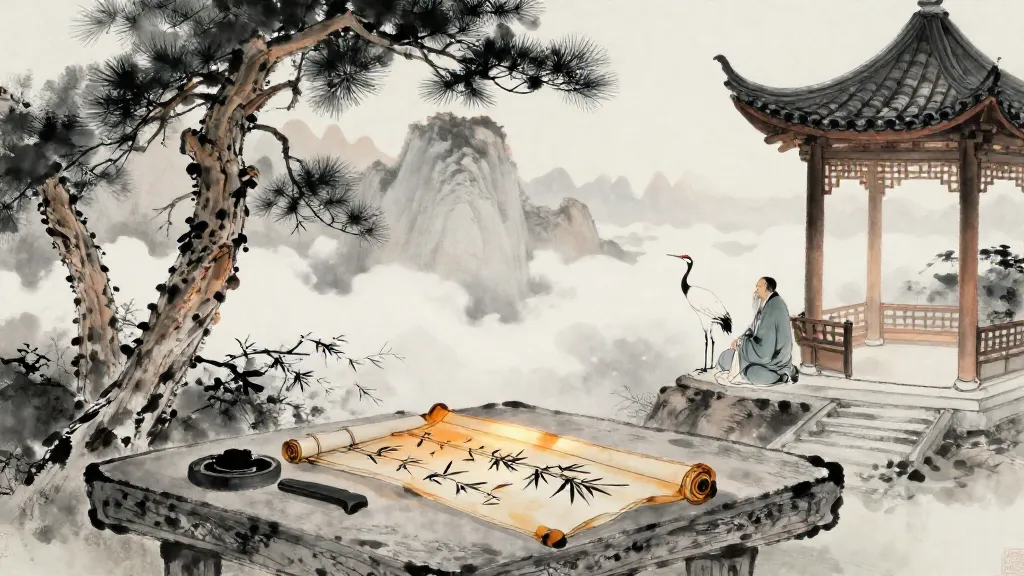
齊物論 (On the Equality of Things) — Chinese ink painting

莊子 Zhuangzi · Chapter 2

齊物論

On the Equality of Things

View:

吾喪我

I Have Lost Myself

南郭子綦隱機而坐,仰天而噓,荅焉似喪其耦。顏成子游立侍乎前,曰:"何居乎?形固可使如槁木,而心固可使如死灰乎?今之隱機者,非昔之隱機者也?"子綦曰:"偃,不亦善乎,而問之也!今者吾喪我,汝知之乎?女聞人籟而未聞地籟,女聞地籟而不聞天籟夫!"

Ziqi of the South Wall sat leaning on his armrest, gazing up at the sky and breathing softly, vacant and far away, as though he had lost his companion. Yancheng Ziyou, who was standing in attendance before him, said: 'What is this? Can the body really be made like a withered tree, and the mind like dead ashes? The man leaning on the armrest now is not the one who was leaning on it before!' Ziqi said: 'Yan, it is good that you asked! Just now I lost myself — did you know? You have heard the piping of men, but not the piping of earth. You have heard the piping of earth, but not the piping of Heaven!'

Notes

1context

The phrase '吾喪我' (I have lost myself) is one of the most philosophically dense expressions in the Zhuangzi. It distinguishes between the conventional ego (我, wo) and a deeper selfhood (吾, wu). The 'piping of Heaven' (天籟) represents the spontaneous harmony underlying all apparent differences — the philosophical foundation for the chapter's argument about the equality of things.

天籟地籟

The Piping of Earth and Heaven

子游曰:"敢問其方。"子綦曰:"夫大塊噫氣,其名為風。是唯無作,作則萬竅怒呺。而獨不聞之翏翏乎?山陵之畏佳,大木百圍之竅穴,似鼻,似口,似耳,似枅,似圈,似臼,似窪者,似污者。激者、謞者、叱者、吸者、叫者、譹者、宎者,咬者,前者唱於而隨者唱喁,泠風則小和,飄風則大和,厲風濟則眾竅為虛。而獨不見之調調之刁刁乎?"

子游曰:"地籟則眾竅是已,人籟則比竹是已,敢問天籟。"子綦曰:"夫吹萬不同,而使其自己也。鹹其自取,怒者其誰邪?"

Ziyou said: 'May I ask what you mean?' Ziqi said: 'The Great Clod belches out breath, and its name is wind. As long as it does not blow, nothing happens. But when it does, the ten thousand hollows begin to howl. Haven't you heard the long moaning? In the mountain forests, the crags and crevasses, the hollows of great trees a hundred spans round — they are like nostrils, like mouths, like ears, like sockets, like goblets, like mortars, like pools, like puddles. The wind makes sounds like rushing water, like whizzing arrows, like scolding, like gasping, like shouting, like wailing, like moaning, like howling. The first notes are a quavering echo, and those that follow harmonize — a gentle breeze brings a small harmony, a fierce gale a great harmony. When the blast has passed, all the hollows are empty again. Haven't you seen the way the leaves tremble and sway?'

Ziyou said: 'The piping of earth is the sound of these hollows, and the piping of men is the sound of bamboo flutes. But may I ask about the piping of Heaven?' Ziqi said: 'It blows through the ten thousand things in different ways, so that each can be itself. They all take what they need for themselves — but who is it that rouses them?'

Notes

1context

The final question — 'who is it that rouses them?' (怒者其誰邪) — is deliberately unanswerable. The piping of Heaven is not a third kind of sound alongside earth's hollows and man's flutes, but the principle by which all sounds arise spontaneously, each 'being itself' (自己) without any external cause. This is Zhuangzi's answer to the question of cosmic order: things are naturally so, not because someone makes them so.

是非之爭

The Struggle of Right and Wrong

大知閒閒,小知間間。大言炎炎,小言詹詹。其寐也魂交,其覺也形開。與接為構,日以心斗。縵者、窖者、密者。小恐惴惴,大恐縵縵。其發若機栝,其司是非之謂也;其留如詛盟,其守勝之謂也;其殺如秋冬,以言其日消也;其溺之所為之,不可使復之也;其厭也如緘,以言其老洫也;近死之心,莫使復陽也。喜怒哀樂,慮嘆變蜇,姚佚啟態——樂出虛,蒸成菌。日夜相代乎前而莫知其所萌。已乎,已乎!旦暮得此,其所由以生乎!

Great knowledge is broad and leisurely; small knowledge is cramped and busy. Great speech blazes like fire; small speech is all chatter and prattle. In sleep, the soul crosses over; in waking, the body opens. Through their contact and entanglement, day after day the mind battles. Some thoughts are loose, some are deep, some are tight. Small fears make them anxious and fretful; great fears leave them stunned and dazed. They fly forth like an arrow from a crossbow, appointed as arbiters of right and wrong. They cling fast like an oath or treaty, guarding their victory. They fade like autumn into winter — describing their daily decline. They drown in what they do, and nothing can bring them back. They seal up like a stopped bottle — describing how they grow old and dull. The mind near death cannot be made to turn toward the light again. Joy, anger, grief, delight, worry, regret, fickleness, fixity, modesty, willfulness, candor, arrogance — music from empty holes, mushrooms formed from vapor. Day and night they alternate before us, yet no one knows from where they sprout. Enough, enough! Morning and evening we find them — is this the source from which they are born?

Notes

2context

This passage describes the exhausting mental and emotional life of human beings trapped in the cycle of disputation and emotional reaction. The phrase '樂出虛,蒸成菌' (music from empty holes, mushrooms formed from vapor) links back to the piping of earth: our emotions arise spontaneously from no identifiable source, just as wind makes sounds through hollow openings.

道樞

The Pivot of the Way

物無非彼,物無非是。自彼則不見,自知則知之。故曰:彼出於是,是亦因彼。彼是方生之說也。雖然,方生方死,方死方生;方可方不可,方不可方可;因是因非,因非因是。是以聖人不由而照之於天,亦因是也。是亦彼也,彼亦是也。彼亦一是非,此亦一是非,果且有彼是乎哉?果且無彼是乎哉?彼是莫得其偶,謂之道樞。樞始得其環中,以應無窮。是亦一無窮,非亦一無窮也。故曰:莫若以明。

There is nothing that is not 'that'; there is nothing that is not 'this.' From the standpoint of 'that' you cannot see it, but through self-knowledge you can know it. Therefore I say: 'that' arises from 'this,' and 'this' depends on 'that' — which is to say, 'this' and 'that' give birth to each other. Although this is so, where there is birth there is death, where there is death there is birth. Where there is acceptability there is unacceptability, where there is unacceptability there is acceptability. Where there is recognition of right there follows recognition of wrong; where there is recognition of wrong there follows recognition of right. Therefore the sage does not proceed along these lines but illuminates all in the light of Heaven — and this too is simply following along with things. 'This' is also 'that,' 'that' is also 'this.' 'That' has its own right and wrong, 'this' too has its own right and wrong. Is there really a 'this' and a 'that'? Or is there really no 'this' and no 'that'? Where 'this' and 'that' cease to find their opposites — that is called the pivot of the Way. When the pivot is placed at the center of the ring, it can respond to all things without limit. Right is one infinity, wrong is another infinity. Therefore I say: there is nothing like using clarity.

Notes

1context

The 'pivot of the Way' (道樞) is one of Zhuangzi's most important metaphors. A door pivot sits at the center and allows the door to swing freely in all directions. Similarly, the sage stands at the center of all distinctions (this/that, right/wrong) without being trapped in any of them. This is not relativism but a higher perspective that includes all viewpoints without being limited to any.

朝三暮四

Three in the Morning

其分也,成也;其成也,毀也。凡物無成與毀,復通為一。唯達者知通為一,為是不用而寓諸庸。庸也者,用也;用也者,通也;通也者,得也;適得而幾矣。因是已。已而不知其然,謂之道。勞神明為一而不知其同也,謂之"朝三"。何謂"朝三"?狙公賦芧,曰:"朝三而暮四。"眾狙皆怒。曰:"然則朝四而暮三。"眾狙皆悅。名實未虧而喜怒為用,亦因是也。是以聖人和之以是非而休乎天鈞,是之謂兩行。

When things are divided, something is completed; when something is completed, something is destroyed. But for all things, there is neither completion nor destruction — they are again made one. Only the person of penetrating understanding knows how to merge all things into one. Such a person does not use categories but lodges them in the ordinary. The ordinary is the useful; the useful is what penetrates; what penetrates is what succeeds. To succeed and stop there — that is nearly it. Just go along with things. To go along with things and not know why — this is called the Way. To wear out your spirit trying to make all things one, without knowing that they are already the same — this is called 'Three in the Morning.' What is 'Three in the Morning'? A monkey keeper was handing out chestnuts and said: 'Three in the morning and four in the evening.' All the monkeys were furious. So he said: 'All right, four in the morning and three in the evening.' All the monkeys were delighted. With no change in the actual amount, yet their joy and anger were used — this too is simply going along with things. Therefore the sage harmonizes right and wrong and rests on the balance of Heaven. This is called walking two roads.

Notes

1context

The 'Three in the Morning' (朝三暮四) parable became a famous Chinese idiom. The monkeys' anger and delight change even though the total (seven) remains the same — illustrating how emotional reactions arise from distinctions that have no real basis. 'Walking two roads' (兩行) means the sage can simultaneously accommodate both sides of any opposition without being trapped in either.

齧缺問王倪

Nie Que Questions Wang Ni

齧缺問乎王倪曰:"子知物之所同是乎?"曰:"吾惡乎知之!""子知子之所不知邪?"曰:"吾惡乎知之!""然則物無知邪?"曰:"吾惡乎知之!雖然,嘗試言之:庸詎知吾所謂知之非不知邪?庸詎知吾所謂不知之非知邪?且吾嘗試問乎女:民濕寢則腰疾偏死,鰍然乎哉?木處則惴慄恂懼,猨猴然乎哉?三者孰知正處?民食芻豢,麋鹿食薦,蝍蛆甘帶,鴟鴉耆鼠,四者孰知正味?猨猵狙以為雌,麋與鹿交,鰍與魚游。毛嬙麗姬,人之所美也;魚見之深入,鳥見之高飛,麋鹿見之決驟,四者孰知天下之正色哉?自我觀之,仁義之端,是非之塗,樊然淆亂,吾惡能知其辯!"

Nie Que asked Wang Ni: 'Do you know what all things agree in considering right?' 'How would I know that!' 'Do you know what you don't know?' 'How would I know that!' 'Then do things know nothing?' 'How would I know that! But let me try saying something. How do I know that what I call knowing is not really not-knowing? How do I know that what I call not-knowing is not really knowing? Let me try a question on you: If a person sleeps in a damp place, they get an aching back and die. But what about a loach? If a person sits in a tree, they tremble with fright. But what about an ape? Of the three, which knows the correct place to live? People eat grain-fed animals. Deer eat grass. Centipedes relish snakes. Owls and crows crave mice. Of the four, which knows the correct taste? Monkeys mate with monkeys, deer consort with deer, loaches swim with fish. Mao Qiang and Lady Li were considered great beauties by men. But when fish saw them they dove to the depths; when birds saw them they soared into the sky; when deer saw them they bolted away. Of these four, which knows the correct standard of beauty in the world? From my point of view, the starting points of benevolence and righteousness, the paths of right and wrong, are all hopelessly tangled and confused. How would I be able to tell them apart!'

Notes

1person毛嬙Máo Qiáng

Mao Qiang (毛嬙) and Lady Li (麗姬) were legendary beauties. Their inclusion in this argument about relativism makes the philosophical point vivid: what humans consider beautiful is merely one perspective among many, with no claim to universality.

莊周夢蝶

Zhuang Zhou Dreams of Being a Butterfly

昔者莊周夢為胡蝶,栩栩然胡蝶也。自喻適志與!不知周也。俄然覺,則蘧蘧然周也。不知周之夢為胡蝶與?胡蝶之夢為周與?周與胡蝶則必有分矣。此之謂物化。

Once Zhuang Zhou dreamed he was a butterfly — a butterfly fluttering about, happy with itself and doing as it pleased. It did not know it was Zhuang Zhou. Suddenly he woke up, and there he was, solid and unmistakable Zhuang Zhou. But he did not know if he was Zhuang Zhou who had dreamed he was a butterfly, or a butterfly dreaming it was Zhuang Zhou. Between Zhuang Zhou and a butterfly there must certainly be a distinction. This is called the Transformation of Things.

Notes

1person莊周Zhuāng Zhōu

Zhuang Zhou (莊周, c. 369–286 BC) was the author of the Inner Chapters of the Zhuangzi. This butterfly dream passage is the most famous in all of Chinese philosophy. By using his own name rather than a fictional sage, Zhuangzi makes the experience immediate and personal.

2context

The 'Transformation of Things' (物化) that closes this chapter is the culmination of its entire argument. If right and wrong, this and that, self and other, waking and dreaming cannot be firmly distinguished, then all things are in a constant process of mutual transformation. The butterfly dream is not a skeptical riddle but an affirmation: in the experience of dreaming, the butterfly was fully real. The boundary between identities is fluid, and this fluidity is itself the deepest truth.

Edition & Source

Text
《莊子》 Zhuangzi
Edition
《四部叢刊》本
Commentary
Traditional Daoist commentaries