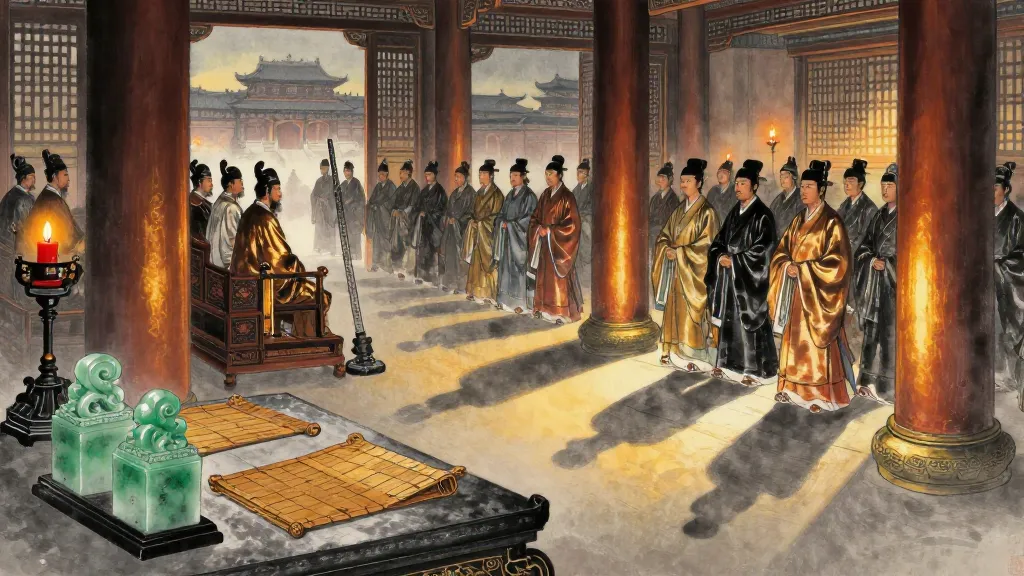
人間世 (In the Human World) — Chinese ink painting

莊子 Zhuangzi · Chapter 4

人間世

In the Human World

View:

顏回請行

Yan Hui Asks to Go to Wei

顏回見仲尼,請行。曰:"奚之?"曰:"將之衛。"曰:"奚為焉?"曰:"回聞衛君,其年壯,其行獨。輕用其國而不見其過。輕用民死,死者以國量,乎澤若蕉,民其無如矣!回嘗聞之夫子曰:'治國去之,亂國就之。醫門多疾。'願以所聞思其則,庶幾其國有瘳乎!"

Yan Hui went to see Confucius and asked permission to travel. 'Where are you going?' 'I am going to Wei.' 'What for?' 'I have heard that the ruler of Wei is young and headstrong in his actions. He uses his state recklessly and does not see his faults. He thinks nothing of letting his people die — the dead fill the state like grass in a marsh, and the people have nowhere to turn! I once heard you say, Master: "Leave the well-ordered state and go to the disordered one. A doctor's door is crowded with the sick." I wish to use what I have learned to ponder a remedy — perhaps his state can still be healed!'

Notes

1person顏回Yán Huí

Yan Hui (顏回, also Yan Yuan, 521–481 BC) was Confucius's most beloved disciple, renowned for his virtue and love of learning. In the Zhuangzi, he frequently serves as a foil — his Confucian earnestness is redirected toward Daoist insights by the fictional Confucius.

心齋

The Fasting of the Heart-Mind

回曰:"敢問心齋。"仲尼曰:"若一志,無聽之以耳而聽之以心;無聽之以心而聽之以氣。聽止於耳,心止於符。氣也者,虛而待物者也。唯道集虛。虛者,心齋也"

Yan Hui said: 'May I ask about the fasting of the heart-mind?' Confucius said: 'Unify your will. Do not listen with your ears but listen with your heart-mind. Do not listen with your heart-mind but listen with your vital breath. Hearing stops with the ears, the heart-mind stops at matching things up. But the vital breath is empty and waits for things. Only the Way gathers in emptiness. Emptiness — this is the fasting of the heart-mind.'

Notes

1context

The 'fasting of the heart-mind' (心齋) is one of the Zhuangzi's most important spiritual practices. It describes a progressive emptying: from sensory perception (ears), to conceptual understanding (heart-mind), to pure openness (vital breath/qi). The final state of emptiness (虛) is not nihilistic but receptive — it is the condition in which the Way can gather and act through the person.

無用之用

The Usefulness of Uselessness

匠石之齊,至於曲轅,見櫟社樹。其大蔽牛,絜之百圍,其高臨山十仞而後有枝,其可以舟者旁十數。觀者如市,匠伯不顧,遂行不輟。弟子厭觀之,走及匠石,曰:"自吾執斧斤以隨夫子,未嘗見材如此其美也。先生不肯視,行不輟,何邪?"曰:"已矣,勿言之矣!散木也。以為舟則沉,以為棺槨則速腐,以為器則速毀,以為門戶則液瞞,以為柱則蠹,是不材之木也。無所可用,故能若是之壽。"

Carpenter Shi was traveling to Qi when he came to Crooked Shaft and saw an oak tree at the village shrine. It was so large that several thousand oxen could shelter under it, a hundred spans around, taller than the hills with branches beginning only eighty feet up — a dozen of them big enough to be carved into boats. Spectators gathered like a market crowd, but the Master Carpenter did not even glance at it, walking on without stopping. His apprentice stared at it in wonder, then ran to catch up, saying: 'Since I first took up my axe and followed you, Master, I have never seen timber as beautiful as this. Yet you won't even look at it and walk right past. Why?' The carpenter said: 'Stop, say no more! It is worthless wood. Make a boat from it and it will sink. Make a coffin and it will rot quickly. Make a vessel and it will break quickly. Make a door and it will sweat sap. Make a pillar and it will be eaten by worms. This is wood that has no talent. There is nothing it can be used for — that is why it has lived so long.'

Notes

1context

The 'useless tree' is one of Zhuangzi's signature parables. By being useless in conventional terms — unfit for any practical purpose — the tree has preserved itself and lived to an enormous age. This is a metaphor for surviving in dangerous political times: those who display no useful talent that rulers can exploit will be left alone to live out their natural years.

支離疏

Shu the Deformed

支離疏者,頤隱於齊,肩高於頂,會撮指天,五管在上,兩髀為脅。挫針治獬,足以糊口;鼓莢播精,足以食十人。上征武士,則支離攘臂於其間;上有大役,則支離以有常疾不受功;上與病者粟,則受三鍾與十束薪。夫支離者其形者,猶足以養其身,終其天年,又況支離其德者乎!

Shu the Deformed — his chin was tucked into his navel, his shoulders rose above his head, the bump at the base of his skull pointed toward the sky, his five vital organs were on top, his thighs pressed against his ribs. By doing a bit of tailoring and washing, he earned enough to fill his mouth. By winnowing and sifting grain, he could feed ten people. When the authorities called up soldiers, Shu stood among them flapping his arms. When there was a great public work project, Shu was excused because of his chronic illness. When the authorities distributed grain to the sick, he received three bushels of grain and ten bundles of firewood. A man deformed in body can still nourish himself and live out the years Heaven gave him — how much more can someone deformed in virtue!

Notes

1context

Shu the Deformed (支離疏) represents the Zhuangzi's radical inversion of conventional values. His uselessness to the state — he cannot serve as a soldier or laborer — is precisely what preserves him. The closing twist, 'how much more can someone deformed in virtue,' suggests that moral nonconformity is an even greater protection than physical deformity.

無用之用之結

Conclusion: The Use of Uselessness

山木,自寇也;膏火,自煎也。桂可食,故伐之;漆可用,故割之。人皆知有用之用,而莫知無用之用也。

The mountain tree invites its own cutting down. The lamp oil burns itself up. Cinnamon bark can be eaten, so the tree is cut down. Lacquer can be used, so the tree is slashed. Everyone knows the usefulness of the useful, but no one knows the usefulness of the useless.

Edition & Source

Text
《莊子》 Zhuangzi
Edition
《四部叢刊》本
Commentary
Traditional Daoist commentaries