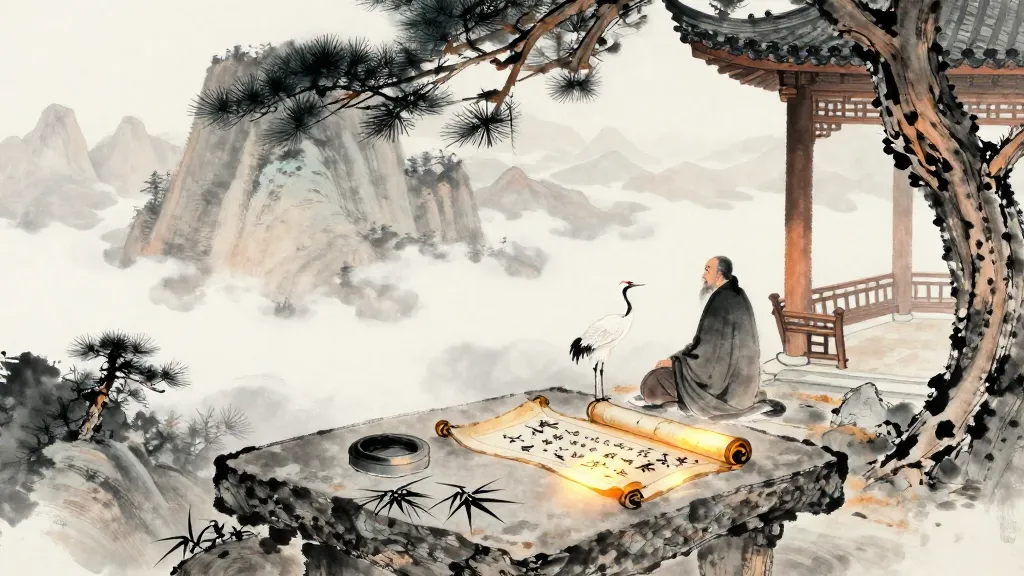
德充符 (The Sign of Virtue Complete) — Chinese ink painting

莊子 Zhuangzi · Chapter 5

德充符

The Sign of Virtue Complete

View:

王駘

Wang Tai the One-Footed

魯有兀者王駘,從之游者與仲尼相若。常季問於仲尼曰:"王駘,兀者也,從之游者與夫子中分魯。立不教,坐不議。虛而往,實而歸。固有不言之教,無形而心成者邪?是何人也?"仲尼曰:"夫子,聖人也,丘也直後而未往耳!丘將以為師,而況不若丘者乎!奚假魯國,丘將引天下而與從之。"

In Lu there was a man named Wang Tai who had lost a foot. Yet those who followed him as students were as numerous as those who followed Confucius. Chang Ji asked Confucius: 'Wang Tai has lost a foot, yet he divides the followers of Lu evenly with you, Master. He does not stand up and teach, he does not sit down and discuss. People go to him empty and come back full. Can there really be a wordless teaching, a formless way of perfecting the heart-mind? What kind of man is he?' Confucius said: 'He is a sage. I have simply been slow to go to him. I intend to make him my teacher — and how much more should those who are less than me! Why just Lu? I shall lead the whole world to follow him.'

Notes

1person王駘Wáng Tái

Wang Tai (王駘) is a fictional character who embodies the Zhuangzi's central teaching in this chapter: inner virtue (德) transcends physical form. His lost foot — a punishment typically marking criminals — makes his spiritual magnetism all the more remarkable.

人莫鑒於流水

Do Not Mirror Yourself in Running Water

常季曰:"何謂也?"仲尼曰:"自其異者視之,肝膽楚越也;自其同者視之,萬物皆一也。夫若然者,且不知耳目之所宜,而游心乎德之和。物視其所一而不見其所喪,視喪其足猶遺土也。"

常季曰:"彼為己,以其知得其心,以其心得其常心。物何為最之哉?"仲尼曰:"人莫鑒於流水而鑒於止水。唯止能止眾止。"

Chang Ji said: 'What do you mean?' Confucius said: 'If you look at things from the standpoint of their differences, even your own liver and gallbladder are as far apart as the states of Chu and Yue. If you look at them from the standpoint of their sameness, all things are one. A person like this does not even know what is proper for the ears and eyes to attend to, but lets the heart-mind wander in the harmony of virtue. He sees things from the standpoint of their unity and does not notice what they have lost. He regards the loss of his foot as he would the loss of a clod of dirt.'

Chang Ji said: 'He uses his understanding to arrive at his heart-mind, and uses his heart-mind to arrive at the constant heart-mind. Why do things flock to him?' Confucius said: 'No one mirrors themselves in running water — only in still water. Only stillness can still all things that seek stillness.'

Notes

1context

'Only stillness can still all things that seek stillness' (唯止能止眾止) is a profound statement about spiritual influence. The sage attracts others not by doing anything but by being completely still and centered — like still water that naturally reflects whatever comes before it.

莊子論無情

Zhuangzi on Having No Emotions

惠子謂莊子曰:"人故無情乎?"莊子曰:"然。"惠子曰:"人而無情,何以謂之人?"莊子曰:"道與之貌,天與之形,惡得不謂之人?"惠子曰:"既謂之人,惡得無情?"莊子曰:"是非吾所謂情也。吾所謂無情者,言人之不以好惡內傷其身,常因自然而不益生也。"惠子曰:"不益生,何以有其身?"莊子曰:"道與之貌,天與之形,無以好惡內傷其身。今子外乎子之神,勞乎子之精,倚樹而吟,據槁梧而瞑。天選子之形,子以堅白鳴。"

Huizi said to Zhuangzi: 'Can a person really be without emotions?' Zhuangzi said: 'Yes.' Huizi said: 'But if a person has no emotions, how can you call them a person?' Zhuangzi said: 'The Way gave them their appearance, Heaven gave them their form — how can you say they are not a person?' Huizi said: 'But if you call them a person, how can they be without emotions?' Zhuangzi said: 'That is not what I mean by emotions. When I say a person is without emotions, I mean that they do not allow likes and dislikes to damage their inner being. They constantly follow what is natural and do not try to add to life.' Huizi said: 'If they don't try to add to life, how can they have a body at all?' Zhuangzi said: 'The Way gave them their appearance, Heaven gave them their form. They do not let likes and dislikes damage their inner being. But you — you exhaust your spirit, wear out your vital essence, lean on a tree and drone, slump over your desk and doze. Heaven chose your form for you, and you babble about "hard" and "white"!'

Notes

1context

This debate clarifies what Zhuangzi means by 'no emotions' (無情): not the absence of feeling, but refusing to let emotional reactions — likes and dislikes — damage one's inner nature. The closing jab at Hui Shi's 'hard and white' debates refers to the School of Names' logical paradoxes, which Zhuangzi sees as an exhausting waste of vital energy.

Edition & Source

Text
《莊子》 Zhuangzi
Edition
《四部叢刊》本
Commentary
Traditional Daoist commentaries