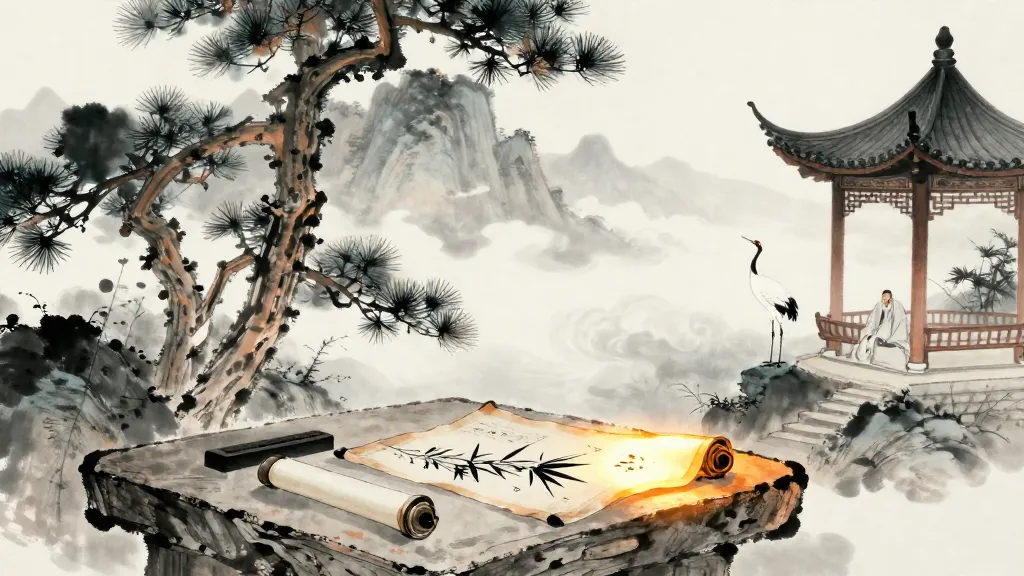
知北游 (Knowledge Wandered North) — Chinese ink painting

莊子 Zhuangzi · Chapter 22

知北游

Knowledge Wandered North

View:

知問道於無為謂

Knowledge Questions the Way

知北游於玄水之上,登隱弅之丘,而適遭無為謂焉。知謂無為謂曰:"予欲有問乎若:何思何慮則知道?何處何服則安道?何從何道則得道?"三問而無為謂不答也。非不答,不知答也。

Knowledge wandered north to the banks of the Black Water, climbed the hill of Hidden Heights, and there met Do-Nothing-Say-Nothing. Knowledge said: 'I have some questions for you. What thought and effort will let me know the Way? Where must I dwell and what must I do to find peace in the Way? What path and what method will let me attain the Way?' Three times Knowledge asked, and Do-Nothing-Say-Nothing did not answer. Not that he would not answer — he did not know the answer.

道在屎溺

The Way Is in Urine and Excrement

東郭子問於莊子曰:"所謂道,惡乎在?"莊子曰:"無所不在。"東郭子曰:"期而後可。"莊子曰:"在螻蟻。"曰:"何其下邪?"曰:"在稊稗。"曰:"何其愈下邪?"曰:"在瓦甓。"曰:"何其愈甚邪?"曰:"在屎溺。"東郭子不應。

Dongguozi asked Zhuangzi: 'This thing called the Way — where is it?' Zhuangzi said: 'There is nowhere it is not.' Dongguozi said: 'Be more specific.' Zhuangzi said: 'It is in the ant.' 'How can it be so low?' 'It is in the panic grass.' 'How can it be even lower?' 'It is in the tiles and shards.' 'How can it be even more so?' 'It is in urine and excrement.' Dongguozi said nothing.

Notes

1context

This famous exchange demonstrates the Daoist principle of the Way's absolute omnipresence. Each of Dongguozi's protests reveals his hidden assumption that the Way must be 'noble' or 'elevated.' By progressively naming lower and more despised things, Zhuangzi shatters these hierarchical assumptions: the Way pervades everything equally, including what humans consider base and disgusting.

通天下一氣

All Under Heaven Is One Breath

人之生,氣之聚也。聚則為生,散則為死。若死生為徒,吾又何患!故萬物一也。是其所美者為神奇,其所惡者為臭腐。臭腐復化為神奇,神奇復化為臭腐。故曰:'通天下一氣耳。'聖人故貴一。

Human life is the gathering of vital breath. When it gathers, there is life; when it scatters, there is death. If life and death are companions, what is there to worry about? Therefore all things are one. What we consider beautiful is the marvelous and miraculous; what we consider ugly is the rotten and putrid. But the rotten and putrid transforms back into the marvelous and miraculous, and the marvelous and miraculous transforms back into the rotten and putrid. Therefore it is said: 'All under heaven is one breath.' The sage therefore values oneness.

Edition & Source

Text
《莊子》 Zhuangzi
Edition
《四部叢刊》本
Commentary
Traditional Daoist commentaries