Redrawing the Earth
Dispatch 8 ended with a diagnosis and a prescription. The diagnosis: the 22-territory board violates every guideline the Diplomacy variant community has established. Spaces-per-unit ratio of 1.16 instead of 2.0. Neutral supply center fraction of 14% instead of 33%. Fifteen cross-border home territory adjacencies. Zheng at degree 6 creating a central stalemate node. Every territory a supply center, leaving no room to stage, position, or maneuver.
The prescription: add corridor provinces between states, add neutral supply centers to extend the early-game scramble, reduce central connectivity to break the stalemate line. No rule changes — the combat mechanics are sound. Only the map needs to change.
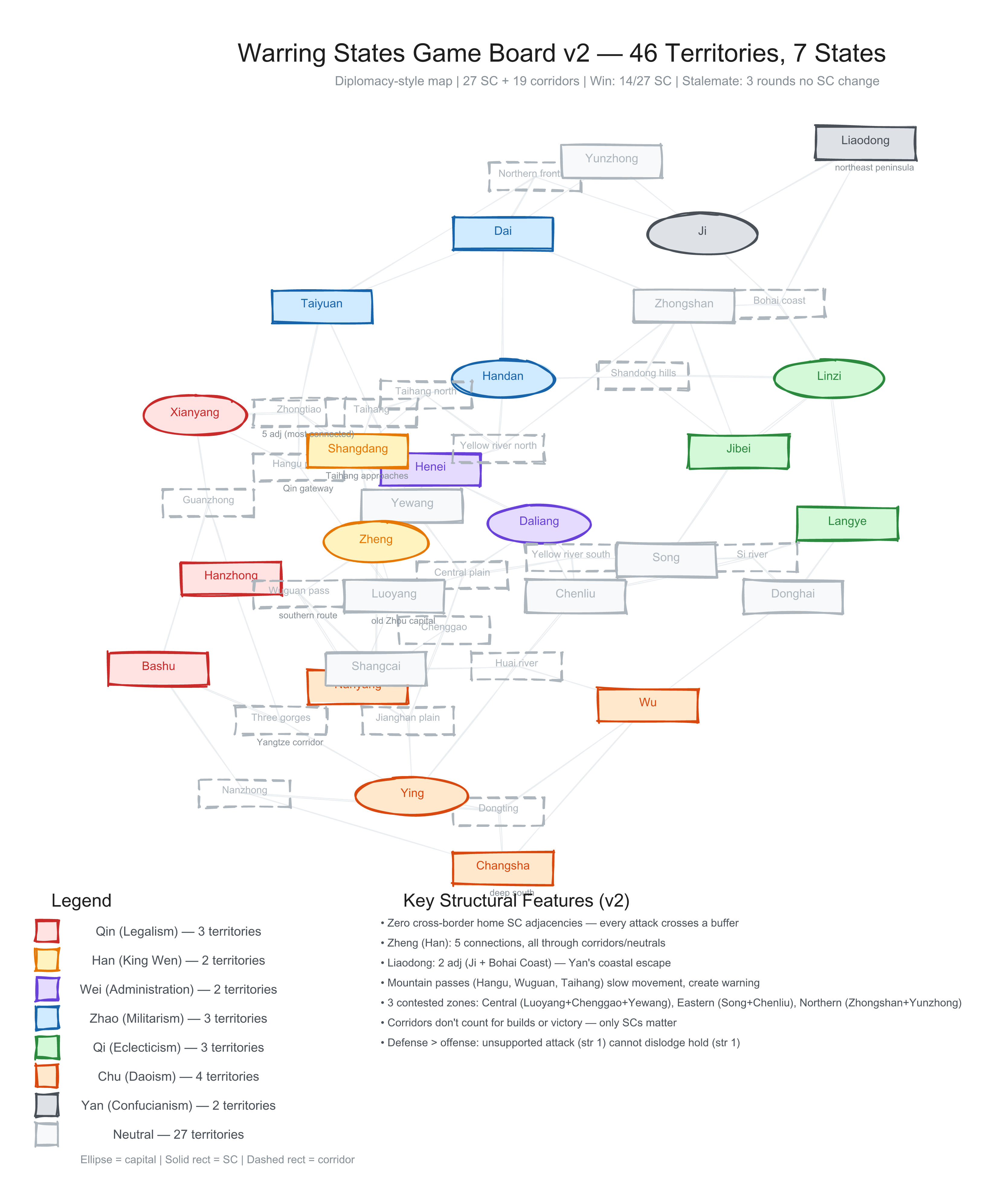
The second-generation board is now built. Forty-six territories. Twenty-seven supply centers. Nineteen non-supply-center corridors. The same seven states, the same starting positions, the same combat rules. A different earth for the same heaven.
解,利西南。無所往,其來復吉。有攸往,夙吉。
— 易經・解・彖
Deliverance. The southwest furthers. If there is no longer anything where one has to go, return brings good fortune. If there is still something where one has to go, hastening brings good fortune.
The judgment of Hexagram 40 offers two paths: return if the work is done, hasten if it is not. Dispatch 8 established that the work was not done — the board was the obstruction. Now the obstruction is removed. The judgment's second path applies: there is still somewhere to go, so hasten. The v2 board is the hastening. Not a cautious iteration but a decisive redesign — 46 territories where there were 22, corridors where there were walls, open approaches where there were fortress lines.
The numbers tell the story of what changed:
Spaces per unit: 1.16 becomes 2.42. Within Agar's 2.0-2.5 target range. Room to breathe.
Neutral supply centers: 3 of 22 becomes 8 of 27. The fraction rises from 14% to 30% — approaching the 33% guideline. Five additional contested territories to fight over in the opening rounds.
Cross-border home territory adjacencies: 15 becomes 0. Every pair of home territories belonging to different states is now separated by at least one corridor or neutral supply center. No more instant attacks on enemy capitals. Every assault requires at least two moves — one to enter the buffer, one to strike.
Zheng's degree: 6 becomes 5. Still central, still pressured, still Han's vulnerable capital. But every approach route now crosses a buffer. The defender has warning.
Victory threshold: 12 of 22 becomes 14 of 27. Fifty-two percent of supply centers, comparable to standard Diplomacy's 53%.
The Corridors Between States
The most dramatic structural change is the simplest to describe: units can now move between states without immediately conquering something.
Nineteen corridor provinces fill the spaces that the first board left empty. Mountain passes. River crossings. Frontier zones. Interior plains. Each corridor is a territory that units can occupy and move through, but that does not count toward supply center totals, does not trigger new unit builds, and does not contribute to the victory threshold. They are the Tyrolias and Gallicias of this map — staging areas where armies position for attacks without changing the strategic balance.
The corridors follow historical geography. Hangu Pass sits between Xianyang and the central plains — the most famous chokepoint of the Warring States period, where Qin's armies emerged from the western mountains. An army marching east from Qin now takes two moves instead of one. The defender at Henei sees the army enter Hangu Pass and has a full round to respond. The attacker can be intercepted in the pass, or can use it to stage a supported assault that was previously impossible.
Wuguan Pass separates Hanzhong from Zheng and Nanyang — Qin's southern route that historically bypassed Hangu. The Taihang Mountains interpose between Shangdang and Yewang, breaking the direct connection that let four states pile onto the same chokepoint. Zhongtiao Mountains shield Taiyuan from Xianyang, creating the mountain barrier that historically protected Zhao's western flank.
Yellow River crossings separate Henei from Handan in the north and Daliang from Song in the south. The Huai River marks Chu's northern boundary. Three Gorges connects Bashu to Ying — Qin's historical Yangtze corridor into southern Chu. The Northern Frontier stretches between Dai and Ji, the steppe border where Zhao and Yan contested nomadic territories.
None of these corridors are walls. Units move through them freely. But they take a round to cross — an army in Hangu Pass is visible and vulnerable. This mirrors the historical function of these passes: they did not prevent movement, they slowed it and channeled it into predictable routes where defenders could prepare.
Eight Neutral Supply Centers
The first board had three neutral supply centers: Luoyang, Song, and Zhongshan. All three were claimed by Round 2. By Round 3, there was nothing left to contest except enemy home territories — and the board froze.
The second board has eight. The three originals remain, joined by five new contested territories drawn from historically significant locations.
Yewang sits between Han and Wei, adjacent to both Zheng and Henei through the Taihang corridor. Historically the site where Han Fei was sent as envoy to Qin — a territory whose ownership determined whether Han's northern border was a frontier or a chokepoint.
Shangcai lies between Chu and Han, on the route Chu used for its historical annexation of Han. It connects to Wuguan Pass and Jianghan Plain, giving both Qin and Chu access through different corridors.
Donghai occupies the eastern coast between Qi and Chu. It creates a maritime frontier that was absent from the first board — the coastal territory where Qi's commercial power and Chu's territorial ambition collided.
Chenliu sits at the commercial crossroads between Wei, Chu, and Qi. It connects to Daliang through the Yellow River South corridor and to Chu through the Huai River — a junction that historically decided control of the eastern plains.
Yunzhong marks the northern frontier between Zhao and Yan. It gives both states a contested border territory that reflects the historical competition for the northern steppe approaches.
天地解而雷雨作,雷雨作而百果草木皆甲坼。解之時大矣哉。
— 易經・解・彖傳
When heaven and earth are delivered, thunder and rain arise. When thunder and rain arise, the seeds of all fruits and plants burst open. Great indeed is the time of Deliverance.
The Tuan commentary describes deliverance as a generative moment — not just the end of obstruction, but the beginning of growth. Thunder and rain do not merely clear the sky; they crack open seeds. The eight neutral supply centers serve this function on the board. They are the seeds that crack open the frozen equilibrium — points of contact and contest that generate the momentum from which strategic differentiation can grow. Without them, the board had no spring.
These eight neutrals are grouped into contested zones following Agar's guideline that neutrals should be clustered to create areas where multiple powers collide:
The Central Zone — Luoyang, Chenggao (corridor), and Yewang — is contested by Qin, Han, Wei, and Chu. Four states converging on three territories in the geographic center of the map. This is where the early-game scramble will be fiercest.
The Eastern Zone — Song and Chenliu — is contested by Wei, Qi, and Chu. Three states converging on two supply centers, connected through the Yellow River and Si River corridors.
The Northern Zone — Zhongshan and Yunzhong — is contested by Zhao, Yan, and Qi. The least crowded zone, appropriate for corner powers whose defensive positions compensate for fewer expansion options.
The Southern Approaches — Shangcai and Donghai — sit on the borders between Chu and its neighbors, creating contested frontiers that draw Chu's four-unit advantage outward instead of letting it turtle.
The scramble now extends to Round 5 or 6 instead of ending at Round 2. States collide over neutrals, form grievances, build alliances. The momentum carries into the mid-game. This is the transitional phase the first board lacked entirely.
Zero Cross-Border Adjacencies
The first board had fifteen instances where a home supply center of one state directly bordered a home supply center of another state. Zheng bordered Hanzhong, Henei, Daliang, and Nanyang — four enemy capitals or home territories reachable in a single move. The central cluster of Han, Wei, Qin, and Zhao territories was so densely interwoven that every border was a frontline from Round 1.
The second board has zero.
Every pair of home territories belonging to different states is now separated by at least one corridor or neutral supply center. Qin's Xianyang connects to Guanzhong, Hangu Pass, and Zhongtiao — all corridors. Han's Zheng connects to Wuguan Pass, Shangdang (its own territory), Yewang, Luoyang, and Shangcai — corridors and neutrals only. Wei's Daliang connects to Henei (its own), Central Plain, Chenliu, and Yellow River South — its own territory, a corridor, and two neutrals.
This is the most consequential structural change. It creates the warning phase that the first board lacked entirely. On the first board, Qin could attack Henei (Wei) from Xianyang in a single move — no warning, no staging, no chance for Wei to see it coming and request support. On the second board, Qin must first move through Hangu Pass. Wei sees the army arrive at Hangu and has one full round to react: reinforce Henei, seek an ally to support the defense, or counterattack through a different corridor.
The effect cascades through every interaction. Diplomacy becomes meaningful because there is time to negotiate. Alliances form around shared buffer zones rather than panicked reactions to border incursions. The oracle's counsel — to advance, to wait, to seek allies — becomes a genuine strategic choice rather than a reflexive response to immediate threat.
What the Oracle Can Now Test
The first board absorbed behavioral differences. The oracle made Han think differently — 61% hold orders versus 42% for control, twice the reasoning text, twice the support order rate. But the board gave Han nowhere to apply that different thinking. Different cognition produced the same frozen positions.
The second board is designed to let outcomes diverge.
An agent that positions armies in corridors for a coordinated two-front assault achieves something structurally different from one that holds. The corridors provide staging areas where strength can be built without triggering immediate retaliation. An army in Hangu Pass threatens both Henei and Luoyang. An army in Taihang threatens both Yewang and Taiyuan. The choice of which corridor to enter — and when — becomes a genuine strategic decision.
An agent that races for neutral supply centers in Rounds 1-5 builds a different foundation than one that turtles. With eight neutrals instead of three, the early game rewards initiative. A state that claims Yewang and Luoyang in the opening rounds starts the mid-game with nine supply centers instead of seven — a structural advantage that compounds through builds and territorial pressure.
象曰:雷雨作,解。君子以赦過宥罪。
— 易經・解・象傳
The Xiang commentary says: Thunder and rain arise — the image of Deliverance. The superior man forgives mistakes and pardons offenses.
The Xiang commentary's counsel of forgiveness applies in an unexpected way. The sixty-eight v1 games were not wasted — they diagnosed the obstruction, catalogued the anti-patterns, and demonstrated that the oracle changes behavior even when the board prevents behavioral differences from producing outcome differences. The mistakes of v1 are pardoned because they taught something essential: the map matters more than the model. Now the map has been redrawn to give the model room to demonstrate what it can do. The thunder has arrived. The seeds are cracking open.
An agent that uses flanking routes — marching through Three Gorges instead of attacking directly through Wuguan Pass, approaching Handan from Shandong Hills instead of Yellow River North — creates game states that are qualitatively different from head-on confrontation. The corridors provide the multiple approach vectors that the first board lacked. The defender cannot fortify every approach because there are too many.
The experimental question refines itself. On the first board, the question was: does the oracle help Han survive? The answer was: survival rates converge because the board prevents decisive outcomes regardless of strategy. On the second board, the question becomes: does the oracle help Han navigate a map with options? Does reflecting through the I-Ching produce different territorial positions by Round 10? Different alliance patterns? Different expansion trajectories?
The oracle's role becomes testable not because it changes what Han thinks — that was already demonstrated — but because the board now provides the space for different thinking to produce different positions. The earth has been redrawn. The test of heaven can begin.