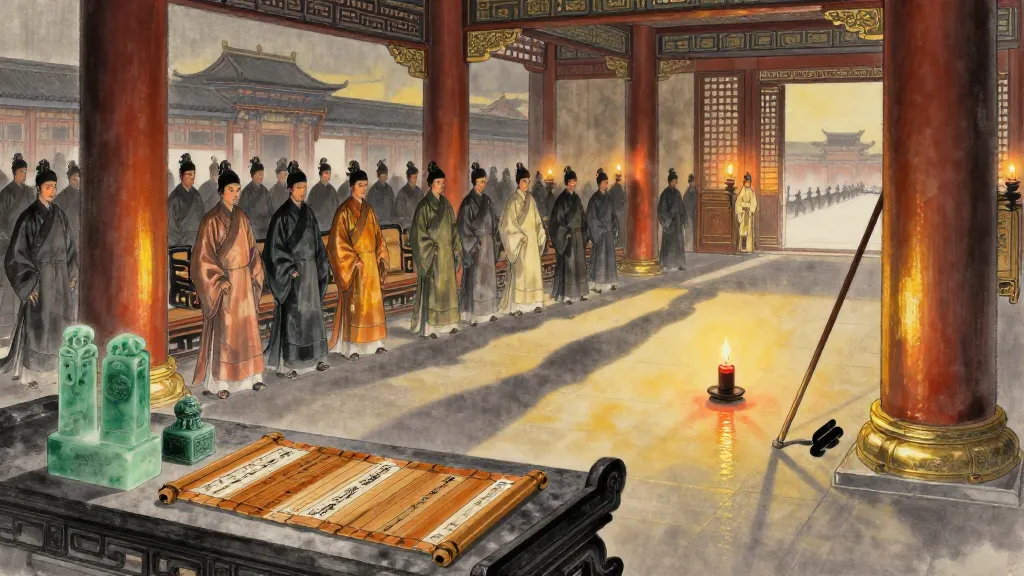
法禁 (Laws and Prohibitions) — Chinese ink painting

管子 Guanzi · Chapter 14

法禁

Laws and Prohibitions

View:

法制之基

The Foundation of Legal Institutions

法制不議,則民不相私。刑殺毋赦,則民不偷於為善。爵祿毋假。則下不亂其上。三者藏於官則為法,施於國則成俗,其餘不彊而治矣。

When legal institutions are not debated, the people will not engage in private dealings. When executions and punishments are not pardoned, the people will not slack in doing good. When rank and emolument are not borrowed, subordinates will not disturb their superiors. These three, stored in the offices become law; applied to the state they become custom — and the rest is governed without compulsion.

聖王之禁

The Sage King's Prohibitions

昔者聖王之治人也,不貴其人博學也,欲其人之和同以聽令也。

The sage kings of old, in governing people, did not value wide learning but desired that people harmonize and unite to obey commands. The 'Great Oath' says: 'Zhou had ministers by the hundred million, but they had a hundred million minds. King Wu had ministers of three thousand, but they were of one mind. Therefore Zhou perished with his hundred million minds, and King Wu survived with his one mind.' Those who usurp state authority to deeply exploit the people — the sage king prohibits them. Those who flaunt contrarian conduct and strange rites, speak grandly and act with difficulty, and elevate themselves — the sage king prohibits them.

Notes

1person周武王Zhōu Wǔ Wáng

King Wu of Zhou (周武王) overthrew the last Shang king Zhou (紂) around 1046 BC, establishing the Zhou dynasty. Zhou (紂) is the archetypal tyrant in Chinese historical tradition.

聖王之教

The Sage King's Methods of Education

聖王之身,治世之時,德行必有所是,道義必有所明;故士莫敢詭俗異禮,以自見於國。

When the sage king was alive and governing the world, virtue and conduct always had their standard of approval, and the Way and duty always had their clear expression. Therefore no scholar dared to display eccentric customs or unusual rites to make himself conspicuous in the state. None dared spread favors and relaxed conduct to cultivate relationships above and below and curry favor with the people. Therefore none dared surpass their rank or usurp offices, seizing advantage and claiming merit to ingratiate themselves with their ruler. The sage king's governance of the people ensured that advancing, they could not obtain what they desired through improper means; retreating, they could not avoid what they feared through improper means. He made them return to contentment in their positions, delighting in their groups, attending to their duties, and taking pride in their reputations.

Edition & Source

Text
《管子》 Guanzi
Edition
中華古詩文古書籍網 transcription
Commentary
Traditional commentaries