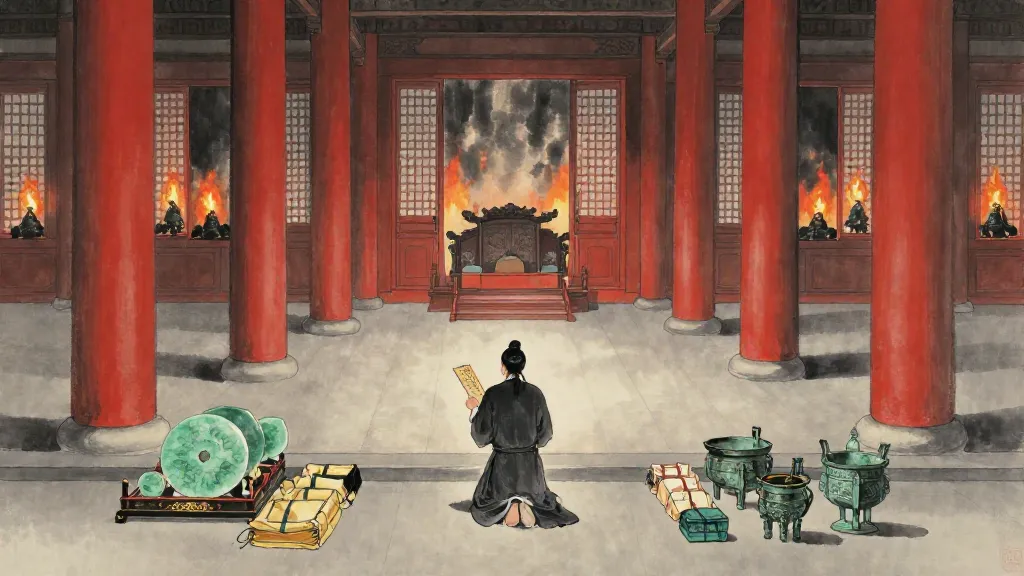
存韓 (Preserving Han) — Chinese ink painting

韓非子 Hanfeizi · Chapter 2

存韓

Preserving Han

View:

韓之忠臣:不宜伐韓

Han's Loyal Service: The Case Against Attacking Han

韓事秦三十餘年,出則為扞蔽,入則為席薦。秦特出銳師取地而韓隨之,怨懸於天下,功歸於強秦。且夫韓入貢職,與郡縣無異也。今日臣竊聞貴臣之計,舉兵將伐韓。夫趙氏聚士卒,養從徒,欲贅天下之兵,明秦不弱則諸侯必滅宗廟,欲西面行其意,非一日之計也。今釋趙之患,而攘內臣之韓,則天下明趙氏之計矣。

Han has served Qin for over thirty years. Abroad, it has served as a shield and buffer; at home, it has been a mat laid out for Qin's convenience. Whenever Qin dispatches crack troops to seize territory, Han follows behind -- the resentment of All-Under-Heaven falls on Han, while the merit accrues to mighty Qin. Moreover, Han pays tribute and performs its obligations no differently from a commandery or county.

Today, I have privately learned of a plan by your honored ministers to raise an army and attack Han. Now, Zhao has been assembling soldiers, cultivating adherents of the Vertical Alliance, and seeking to unite the armies of All-Under-Heaven, making clear that unless Qin is weakened, the ancestral temples of every state will be destroyed. Zhao intends to turn westward and impose its will -- this is no scheme of a single day.

To set aside the threat of Zhao and instead attack Han, which is already an inner vassal, will only make plain to All-Under-Heaven the wisdom of Zhao's strategy.

Notes

1context

This is Han Fei's memorial to the King of Qin (likely King Zheng, the future First Emperor) arguing against the conquest of his home state of Han. Han Fei was a prince of the Han royal house who had traveled to the Qin court, where his writings had attracted the king's admiration. This chapter is one of the most personally significant in the entire Hanfeizi.

2translation

扞蔽 ('shield and cover') and 席薦 ('mat and cushion') are vivid metaphors: Han serves as Qin's buffer against eastern attacks and as a doormat at home. The paired phrases capture Han's complete subordination.

3context

Han was geographically positioned between Qin and the eastern states, making it a natural buffer zone. Its territory covered parts of modern Henan and Shanxi provinces, centered on its capital Xinzheng (新鄭).

4translation

貴臣 ('honored ministers') is a polite reference to the senior advisors at court whose plan Han Fei is opposing. This likely refers to Li Si and his faction.

伐韓之害

The Dangers of Attacking Han

夫韓,小國也,而以應天下四擊,主辱臣苦,上下相與同憂久矣。修守備,戎強敵,有蓄積,築城池以守固。今伐韓,未可一年而滅,拔一城而退,則權輕於天下,天下摧我兵矣。韓叛,則魏應之,趙據齊以為原,如此,則以韓、魏資趙假齊以固其從,而以與爭強,趙之福而秦之禍也。夫進而擊趙不能取,退而攻韓弗能拔,則陷銳之卒勤於野戰,負任之旅罷於內攻,則合群苦弱以敵而共二萬乘,非所以亡趙之心也。均如貴臣之計,則秦必為天下兵質矣。陛下雖以金石相弊,則兼天下之日未也。

Han is a small state, yet it has endured attacks from all four directions under Heaven. Its ruler has borne humiliation and its ministers have suffered; high and low have shared the same anxieties for a long time. They have maintained their defenses, armed against powerful enemies, built up stores, and fortified their city walls. If we attack Han now, we cannot destroy it in a single year. If we take one city and then withdraw, our prestige will be diminished throughout All-Under-Heaven, and the states will crush our army's reputation.

If Han rebels, Wei will support it. Zhao will use Qi as its base of support. In that case, Han and Wei's resources would bolster Zhao, which would borrow Qi's strength to cement the Vertical Alliance and contest supremacy with us. That would be Zhao's blessing and Qin's disaster.

If we advance to strike Zhao but cannot take it, and retreat to attack Han but cannot capture it, then our elite troops will be worn down in field battles and our supply corps exhausted in sieges. We would then face a coalition of weakened but desperate enemies with a combined strength of twenty thousand chariots -- this is no way to fulfill the ambition of destroying Zhao.

If we follow your honored ministers' plan to its conclusion, Qin will surely become a hostage to the armies of All-Under-Heaven. Even if Your Majesty were to wear out metal and stone in the effort, the day of unifying All-Under-Heaven will never come.

Notes

1translation

二萬乘 ('twenty thousand chariots'): the combined military strength of the allied states. A state of 'ten thousand chariots' (萬乘) was a major power; 'twenty thousand chariots' represents the combined might of multiple states.

2translation

兵質 ('hostage to armies'): literally 'military hostage' -- Qin would be trapped in a position where it is committed to fighting but unable to achieve decisive victory.

3translation

金石相弊 ('wearing out metal and stone'): a metaphor for exhausting all resources over an extended period. Metal and stone are among the most durable materials, so wearing them out implies an impossibly long effort.

韓非之計:聯韓伐趙

Han Fei's Strategy: Ally with Han to Attack Zhao

今賤臣之愚計:使人使荊,重幣用事之臣,明趙之所以欺秦者;與魏質以安其心,從韓而伐趙,趙雖與齊為一,不足患也。二國事畢,則韓可以移書定也。是我一舉二國有亡形,則荊、魏又必自服矣。故曰:"兵者,兇器也。"不可不審用也。以秦與趙敵衡,加以齊,今又背韓,而未有以堅荊、魏之心。夫一戰而不勝,則禍構矣。計者,所以定事也,不可不察也。韓、秦強弱,在今年耳。且趙與諸侯陰謀久矣。夫一動而弱於諸侯,危事也;為計而使諸侯有意我之心,至殆也。見二疏,非所以強於諸侯也。臣竊願陛下之幸熟圖之!攻伐而使從者聞焉,不可悔也。

Now, this humble minister's foolish plan is as follows: send an envoy to Chu, lavishing gifts on its influential ministers, and expose how Zhao has been deceiving Qin. Exchange hostages with Wei to reassure them. Then, bringing Han along as an ally, attack Zhao. Even if Zhao and Qi stand as one, they need not be feared. Once the business with these two states is concluded, Han can be settled with a single dispatch. Thus in one stroke, two states face the prospect of ruin, and Chu and Wei will inevitably submit of their own accord.

As the saying goes: "Weapons are instruments of ill omen" -- they must not be used without careful deliberation. With Qin and Zhao evenly matched, and Qi added to the balance, if we now also turn against Han without having secured the commitment of Chu and Wei -- then a single battle lost, and disaster takes root.

Strategy is the means by which affairs are settled; it demands the utmost scrutiny. The relative strength of Han and Qin hangs on this very year. Zhao has been plotting with the other lords in secret for a long time. To make one move and be weakened before the lords -- that is perilous. To adopt a strategy that gives the lords reason to suspect our intentions -- that is the height of danger. To reveal two vulnerabilities is no way to maintain strength over the lords.

I humbly beg Your Majesty to consider this carefully! Once an attack is launched and the members of the Vertical Alliance learn of it, there will be no undoing the consequences.

Notes

1translation

移書定 ('settled with a dispatch/letter'): Han Fei argues that once Zhao is neutralized, Han can be brought to heel through diplomatic correspondence alone, without military force -- a key point of his argument for indirect rather than direct conquest.

2context

The quote '兵者兇器也' ('weapons are instruments of ill omen') echoes the Laozi (chapter 31) and was a common saying in Warring States discourse. Han Fei uses it strategically -- despite being a Legalist, he invokes this cautionary principle to argue for restraint toward Han.

3translation

見二疏 ('reveal two vulnerabilities'): the two gaps in Qin's position would be (1) exposing its hostility toward Han, a nominal vassal, and (2) stretching its forces across too many fronts simultaneously.

李斯之反駁

Li Si's Rebuttal

詔以韓客之所上書,書言韓子之未可舉,下臣斯。甚以為不然。秦之有韓,若人之有腹心之病也,虛處則然,若居濕地,著而不去,以極走,則發矣。夫韓雖臣於秦,未嘗不為秦病,今若有卒報之事,韓不可信也。秦與趙為難。荊蘇使齊,未知何如。以臣觀之,則齊、趙之交未必以荊蘇絕也;若不絕,是悉趙而應二萬乘也。夫韓不服秦之義而服於強也。今專於齊、趙,則韓必為腹心之病而發矣。韓與荊有謀,諸侯應之,則秦必復見崤塞之患。

An edict sent down the memorial submitted by the guest from Han, whose letter argues that Han should not be taken, to your minister Si for review. I strongly disagree.

Qin's possession of Han is like a person afflicted with a disease of the heart and belly: when at rest it seems manageable, as if one merely dwells in a damp place, but the illness clings and will not depart. Once one exerts oneself to the utmost, it flares up. Although Han nominally serves Qin, it has never ceased to be a source of affliction. If a sudden crisis arises, Han cannot be trusted.

Qin is contending with Zhao. Jing Su has been sent as envoy to Qi, and the outcome is uncertain. In my assessment, the alliance between Qi and Zhao will not necessarily be broken by Jing Su. If it is not broken, then we face the full strength of Zhao supported by a coalition of twenty thousand chariots.

Han submits to Qin not out of conviction in Qin's righteousness, but out of submission to Qin's strength. If we now focus entirely on Qi and Zhao, Han will inevitably become a disease of the heart and belly that erupts. If Han conspires with Chu and the other lords respond, Qin will surely face the peril of Xiao Pass once again.

Notes

1person李斯Li Si

Li Si (李斯, c. 284-208 BC) was the chief minister of Qin who opposed Han Fei's argument. A fellow student of Xunzi alongside Han Fei, Li Si advocated for the immediate conquest of Han. He later became Chancellor of the Qin dynasty and played a role in Han Fei's imprisonment and death.

2translation

韓客 ('the guest from Han') refers to Han Fei. Li Si pointedly calls him a 'guest' rather than a minister, emphasizing his foreign origin and implying divided loyalties.

3translation

腹心之病 ('disease of the heart and belly'): a powerful metaphor for an internal threat that cannot be ignored. Li Si turns Han Fei's argument on its head -- rather than seeing Han as a useful buffer, he sees it as a hidden vulnerability within Qin's own body.

4person荊蘇Jing Su

Jing Su (荊蘇) was likely a Qin diplomat sent to Qi to try to break the Qi-Zhao alliance. The historical details are unclear.

5place崤塞Xiao sai

Xiao Pass (崤塞) refers to the strategic Xiao Mountain pass in modern western Henan, site of the devastating ambush of a Qin army by Jin in 627 BC. The 'peril of Xiao' became shorthand for the danger of being attacked through one's own mountain passes.

李斯論韓非之私心

Li Si Impugns Han Fei's Motives

非之來也,未必不以其能存韓也為重於韓也。辯說屬辭,飾非詐謀,以釣利於秦,而以韓利窺陛下。夫秦、韓之交親,則非重矣,此自便之計也。

臣視非之言,文其淫說靡辯,才甚。臣恐陛下淫非之辯而聽其盜心,因不詳察事情。

Han Fei's reason for coming here is quite likely because his ability to preserve Han makes him valued by Han. With clever arguments and polished phrases, he glosses over wrongs and concocts deceptive schemes to fish for advantage at Qin's court, while using Han's interests to probe Your Majesty's intentions. If the alliance between Qin and Han grows closer, then Han Fei becomes more important -- this is a plan for his own convenience.

I have examined Han Fei's words: the elegance of his extravagant arguments and ornate rhetoric reveals considerable talent. But I fear that Your Majesty may be seduced by Han Fei's eloquence and heed his treacherous heart, thereby failing to examine the facts of the matter closely.

Notes

1context

This is the most devastating passage in the chapter. Li Si attacks not Han Fei's logic but his motives, arguing that Han Fei's diplomatic strategy is ultimately self-serving: a preserved Han means a more important Han Fei. This ad hominem attack proved fatally effective -- according to Sima Qian, it contributed to King Zheng's decision to imprison Han Fei, who was then forced to take poison.

2translation

盜心 ('thieving heart' or 'treacherous heart'): Li Si accuses Han Fei of harboring hidden, self-interested motives beneath his persuasive exterior. This is an extremely serious charge at court.

3translation

淫說靡辯 ('extravagant arguments and ornate rhetoric'): Li Si acknowledges Han Fei's brilliance even while attacking him. 淫 and 靡 both carry connotations of excess and seductiveness.

李斯之計策

Li Si's Counter-Strategy

今以臣愚議:秦發兵而未名所伐,則韓之用事者以事秦為計矣。臣斯請往見韓王,使來入見,大王見,因內其身而勿遣,稍召其社稷之臣,以與韓人為市,則韓可深割也。因令象武發東郡之卒,窺兵於境上而未名所之,則齊人懼而從蘇之計,是我兵未出而勁韓以威擒,強齊以義從矣。聞於諸侯也,趙氏破膽,荊人狐疑,必有忠計。荊人不動,魏不足患也,則諸侯可蠶食而盡,趙氏可得與敵矣。願陛下幸察愚臣之計,無忽。

Now, in my humble opinion: if Qin mobilizes its army without announcing the target, the officials in charge in Han will adopt serving Qin as their policy. I, your minister Si, request permission to go and see the King of Han, and have him come to present himself at court. When Your Majesty receives him, detain his person and do not let him leave. Then gradually summon the ministers who control Han's altars of soil and grain, and use them as bargaining chips with the people of Han -- thus Han can be deeply carved up.

Meanwhile, order Xiang Wu to mobilize the troops of the Eastern Commandery and station the army threateningly on the border without announcing its destination. The people of Qi will grow afraid and follow Su's plan. Thus, before our troops have even marched, we will have seized a weakened Han through intimidation and brought a powerful Qi to heel through diplomatic leverage.

When the other lords hear of this, Zhao will be terror-stricken and Chu will waver with indecision -- they will surely reconsider their strategies. If Chu does not move, Wei is not worth worrying about. Then the lords can be devoured one by one like silkworms eating mulberry leaves, and Zhao can be properly confronted as an enemy. I beg Your Majesty to examine your foolish minister's plan and not disregard it.

Notes

1person象武Xiang Wu

Xiang Wu (象武) was likely a Qin military commander. Historical details about him are scarce.

2place東郡Dongjun

The Eastern Commandery (東郡) was a Qin administrative district in the former territory of Wei, centered on modern Puyang (濮陽), Henan province. It was established after Qin's conquests in the region and provided a staging ground for operations against the eastern states.

3translation

蠶食 ('silkworm-eating'): the metaphor of a silkworm consuming a mulberry leaf -- steady, methodical, irreversible consumption. This became a standard Chinese idiom (蠶食 or 蠶食鯨吞) for gradual territorial annexation.

4context

Li Si's plan is ruthlessly pragmatic: lure the King of Han to Qin and hold him hostage, use this leverage to dismember Han diplomatically, and meanwhile use military posturing to intimidate Qi into compliance. This contrasts sharply with Han Fei's more indirect strategy.

秦遣斯使韓

Qin Dispatches Li Si to Han

秦遂遣斯使韓也。

Qin thereupon dispatched Li Si as envoy to Han.

Notes

1context

This terse narrative sentence marks the decisive moment: the King of Qin accepted Li Si's counsel over Han Fei's. The implications were catastrophic for both Han Fei personally and for the state of Han. Han Fei was subsequently imprisoned and forced to take poison in 233 BC. Han was conquered by Qin in 230 BC.

李斯上韓王書

Li Si's Letter to the King of Han

李斯往詔韓王,未得見,因上書曰:"昔秦、韓戮力一意,以不相侵,天下莫敢犯,如此者數世矣。前時五諸侯嘗相與共伐韓,秦發兵以救之。韓居中國,地不能滿千里,而所以得與諸侯班位於天下,君臣相保者,以世世相教事秦之力也。先時五諸侯共伐秦,韓反與諸侯先為雁行以向秦軍於闕下矣。諸侯兵困力極,無奈何,諸侯兵罷。杜倉相秦,起兵發將以報天下之怨而先攻荊。荊令尹患之,曰:'夫韓以秦為不義,而與秦兄弟共苦天下。已又背秦,先為雁行以攻關。韓則居中國,展轉不可知。'天下共割韓上地十城以謝秦,解其兵。夫韓嘗一背秦而國迫地侵,兵弱至今,所以然者,聽奸臣之浮說,不權事實,故雖殺戮奸臣,不能使韓復強。

Li Si went to deliver the royal message to the King of Han but was unable to obtain an audience. He therefore submitted a letter, which read:

"In former times, Qin and Han joined forces with one purpose, agreeing not to invade each other. No state under Heaven dared to transgress against either. This arrangement lasted for several generations. Previously, when five lords joined together to attack Han, Qin dispatched troops to rescue it. Han sits in the center of the realm, its territory not even a thousand li in extent, yet the reason it has been able to maintain its rank among the lords of All-Under-Heaven, with ruler and ministers preserving each other, is the strength that comes from generations of serving Qin.

"Yet earlier, when five lords joined together to attack Qin, Han reversed course and joined the lords, forming the vanguard in goose-wing formation to advance on Qin's army at the pass. The lords' troops were exhausted and at the end of their strength, and could do nothing, so they withdrew. Du Cang, as chancellor of Qin, raised troops and dispatched generals to repay the resentment of All-Under-Heaven, and first attacked Chu. The Chief Minister of Chu was distressed and said: 'Han considered Qin unjust, yet as a sworn brother of Qin, it joined in afflicting All-Under-Heaven. Then it betrayed Qin and led the vanguard in attacking the passes. Han sits in the center of the realm and shifts allegiances unpredictably.'

"All-Under-Heaven jointly carved away ten cities from Han's best territory to apologize to Qin and resolve the military crisis. Han once betrayed Qin, and its state was pressed, its territory encroached upon, its army weakened down to this day. The reason for this is that it heeded the empty talk of treacherous ministers and did not weigh the facts. Thus, even though it executed those treacherous ministers, it could not restore Han's strength."

Notes

1person杜倉Du Cang

Du Cang (杜倉) was a chancellor of Qin. Historical details about his tenure are sparse, but the event described likely dates to the mid-3rd century BC.

2translation

雁行 ('goose-wing formation'): a military formation where troops are arranged in a V-shape like migrating geese. Here 先為雁行 means Han took the leading position in this formation -- i.e., served as the vanguard of the anti-Qin coalition.

3translation

令尹 was the title for the chief minister of Chu, equivalent to chancellor (相) in other states.

4context

Li Si's letter is a masterpiece of coercive diplomacy. He reminds the King of Han of past benefits from Qin's patronage, then recounts how Han's one act of betrayal led to lasting damage -- implicitly threatening that further resistance will bring far worse consequences.

李斯之威脅與利誘

Li Si's Threats and Inducements

今趙欲聚兵士,卒以秦為事,使人來借道,言欲伐秦,其勢必先韓而後秦。且臣聞之:'唇亡則齒寒。'夫秦、韓不得無同憂,其形可見。魏欲發兵以攻韓,秦使人將使者於韓。今秦王使臣斯來而不得見,恐左右襲昔奸臣之計,使韓復有亡地之患。臣斯不得見,請歸報,秦韓之交必絕矣。斯之來使,以奉秦王之歡心,願效便計,豈陛下所以逆賤臣者邪?臣斯願得一見,前進道愚計,退就葅戮,願陛下有意焉。

"Now Zhao intends to assemble its soldiers, ultimately to make Qin its target. It has sent envoys to borrow passage through Han, saying it wishes to attack Qin, but its inevitable course is first Han, then Qin. Moreover, as the saying goes: 'When the lips are gone, the teeth grow cold.' Qin and Han cannot but share the same anxieties -- the pattern is plain to see.

"Wei intends to launch an attack on Han. Qin has sent me to escort envoys to Han. Now the King of Qin has sent your minister Si here, yet I am unable to obtain an audience. I fear that those around you are repeating the schemes of treacherous ministers past, and will cause Han once again to suffer the disaster of lost territory.

"If I, your minister Si, cannot obtain an audience, I shall return and report, and the alliance between Qin and Han will assuredly be severed. I have come as envoy to fulfill the King of Qin's goodwill, wishing to offer a plan of mutual benefit. Is this truly the way for Your Majesty to receive a humble envoy? I, your minister Si, wish only for a single audience: to step forward and present my humble plan, and then to step back and accept execution if it fails. I beg Your Majesty to give this your attention."

Notes

1translation

唇亡則齒寒 ('when the lips are gone, the teeth grow cold'): one of the most famous Chinese diplomatic proverbs, originating from the Spring and Autumn period. Li Si invokes it to argue that Qin and Han share a common fate -- though ironically, the proverb was traditionally used to argue against destroying buffer states, precisely the opposite of what Li Si actually intends.

2translation

葅戮 ('pickled and executed'): an extreme form of punishment in which the body was minced and preserved. Li Si's offer to submit to this punishment if his plan fails is a rhetorical flourish demonstrating sincerity.

3context

Li Si's letter blends threats with apparent goodwill. He warns of Zhao's and Wei's hostile intentions, implies that refusing to see him will end the Qin-Han alliance, and positions himself as offering aid -- all while his actual mission is to lure the King of Han into a trap.

李斯之最後通牒

Li Si's Ultimatum

今殺臣於韓,則大王不足以強,若不聽臣之計,則禍必構矣。秦發兵不留行,而韓之社稷憂矣。臣斯暴身於韓之市,則雖欲察賤臣愚忠之計,不可得已。過鄙殘,國固守,鼓鐸之聲於耳,而乃用臣斯之計,晚矣。且夫韓之兵於天下可知也,今又背強秦。夫棄城而敗軍,則反掖之寇必襲城矣。城盡則聚散,則無軍矣。城固守,則秦必興兵而圍王一都,道不通,則難必謀,其勢不救,左右計之者不用,願陛下熟圖之。若臣斯之所言有不應事實者,願大王幸使得畢辭於前,乃就吏誅不晚也。秦王飲食不甘,遊觀不樂,意專在圖趙,使臣斯來言,願得身見,因急於陛下有計也。今使臣不通,則韓之信未可知也。夫秦必釋趙之患而移兵於韓,願陛下幸復察圖之,而賜臣報決。

"If you kill me here in Han, it will not be enough to make Your Majesty strong. If you do not heed my plan, disaster will assuredly take root. Once Qin dispatches its army without delay, the altars of soil and grain of Han will be in peril. If my body is exposed in the marketplace of Han, then even if you later wish to examine this humble minister's plan of foolish loyalty, it will be impossible.

"When the border towns have been overrun and ravaged, and the state retreats to its inner defenses, and the sound of war drums and bells fills your ears -- to adopt my plan then will be too late. The strength of Han's army is well known throughout All-Under-Heaven; now to also turn against mighty Qin? If you abandon your cities and your army is defeated, then rebels from within will surely seize those cities. When all cities are lost, the population will scatter, and there will be no army left. If the cities hold firm, then Qin will surely raise an army to besiege Your Majesty's single capital. When the roads are cut off, crisis will follow upon crisis, the situation will be beyond rescue, and the plans of your advisors will go unheeded.

"I beg Your Majesty to consider this carefully. If anything I have said does not accord with the facts, I ask only that Your Majesty graciously allow me to finish speaking in your presence -- it will not be too late to hand me over to the executioner afterward.

"The King of Qin finds no pleasure in food or drink, no enjoyment in excursions. His mind is focused entirely on the campaign against Zhao. He has sent your minister Si to speak with you, wishing for a personal audience, because he has an urgent plan to share with Your Majesty. If you now refuse to receive his envoy, then Han's good faith becomes uncertain. Qin will surely set aside the problem of Zhao and redirect its army against Han. I beg Your Majesty to examine and reconsider, and to grant me your reply and decision."

Notes

1translation

暴身於市 ('expose the body in the marketplace'): public execution with the corpse displayed as a warning. Li Si says that killing him would be pointless and would only eliminate Han's last chance for a diplomatic solution.

2context

Li Si's final argument is pure coercion dressed as concern: if Han does not cooperate, Qin will abandon its Zhao campaign and turn on Han instead. The claim that the King of Qin 'finds no pleasure in food or drink' is a diplomatic convention suggesting the king's deep personal concern for the matter at hand.

3context

The chapter ends without resolution. Historically, Han did eventually submit to Qin's demands, but this only delayed the inevitable: Han was the first of the six states to be conquered, falling in 230 BC. Han Fei had already been dead for three years.

4translation

反掖之寇 ('rebels from within'): literally 'enemies from the armpit/flank,' referring to internal rebels or neighboring opportunists who would exploit Han's military defeats.

Edition & Source

Text
《韓非子》 Hanfeizi
Edition
中華古詩文古書籍網 transcription, 《四部叢刊》本
Commentary
Han Fei (韓非), Warring States period