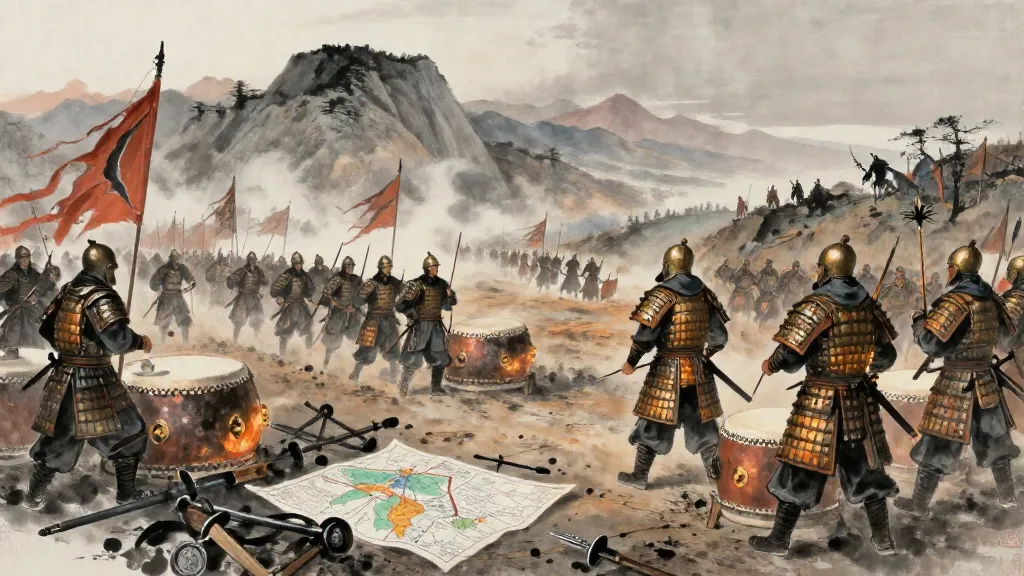
愛臣 (On Loving Ministers) — Chinese ink painting

韓非子 Hanfeizi · Chapter 4

愛臣

On Loving Ministers

View:

寵臣之危

The Danger of Favored Ministers

愛臣太親,必危其身;人臣太貴,必易主位;主妾無等,必危嫡子;兄弟不服,必危社稷;臣聞千乘之君無備,必有百乘之臣在其側,以徒其民而傾其國;萬乘之君無備,必有千乘之家在其側,以徒其威而傾其國。是以奸臣蕃息,主道衰亡。是故諸候之博大,天子之害也;群臣之太富,君主之敗也。將相之管主而隆家,此君人者所外也。萬物莫如身之至貴也,位之至尊也,主威之重,主勢之隆也。此四美者,不求諸外,不請於人,議之而得之矣。故曰:人主不能用其富,則終於外也。此君人者之所識也。

When the ruler loves his ministers with too much intimacy, he endangers his own person. When ministers become too exalted, they will inevitably encroach upon the ruler's position. When the principal wife and concubines are not differentiated in rank, the legitimate heir is endangered. When brothers do not submit to hierarchy, the altars of soil and grain are endangered.

I have heard that a lord of a thousand chariots who takes no precautions will certainly have a minister of a hundred chariots at his side, who will steal his people and overturn his state. A lord of ten thousand chariots who takes no precautions will certainly have a household of a thousand chariots at his side, who will usurp his authority and overturn his state. This is how treacherous ministers multiply and the ruler's Way declines into ruin.

Thus, when the feudal lords grow too great, it harms the Son of Heaven. When the assembled ministers grow too wealthy, it ruins the ruler. When generals and chancellors control the ruler while aggrandizing their own houses -- this is what a ruler of men must guard against.

Of all things, nothing is more precious than one's own person, nothing more exalted than one's position, nothing weightier than the ruler's authority, nothing more elevated than the ruler's positional advantage. These four excellences need not be sought from without, nor requested from others -- deliberate upon them and they are yours. Therefore it is said: a ruler who cannot employ his own wealth will end up subordinate to others. This is what a ruler of men must understand.

Notes

1context

This chapter presents a core Legalist thesis: affection between ruler and minister is not a virtue but a structural vulnerability. The chapter systematically shows how every form of personal closeness creates a channel for the erosion of sovereign power.

2translation

千乘 (qiansheng, 'thousand chariots') and 萬乘 (wansheng, 'ten thousand chariots') are standard measures of state power. A 'thousand-chariot state' is a mid-ranking feudal domain; a 'ten-thousand-chariot state' is a great power.

3translation

主道 ('the ruler's Way/the Way of rulership') is a key Legalist concept referring not to personal virtue but to the institutional principles that preserve sovereign authority.

明君蓄臣之法

How an Enlightened Ruler Manages His Ministers

昔者紂之亡,周之卑,皆從諸候之博大也;晉也分也,齊之奪也,皆以群臣之太富也。夫燕、宋之所以弒其君者,皆此類也。故上比之殷周,中比之燕、宋,莫不從此術也。是故明君之蓄其臣也,盡之以法,質之以備。故不赦死,不宥刑;赦死宥刑,是謂威淫。社稷將危,國家偏威。是故大臣之祿雖大,不得藉威城市;黨與雖眾,不得臣士卒。故人臣處國無私朝,居軍無私交,其府軍不得私貸於家。此明君之所以禁其邪。是故不得四從,不載奇兵,非傳非遽,載奇兵革,罪死不赦。此明君之所以備不虞者也。

In the past, the ruin of Zhou of Shang and the decline of the Zhou dynasty both arose from the feudal lords growing too great. The partition of Jin and the usurpation of Qi both arose from the assembled ministers growing too wealthy. The assassinations of rulers in Yan and Song were of the same kind. Thus, comparing upward to Yin and Zhou, and in the middle to Yan and Song, all followed from this same pattern.

Therefore, when an enlightened ruler manages his ministers, he exhaustively applies the law to regulate them and holds them in check with precautionary measures. He does not pardon capital crimes; he does not forgive punishments. To pardon death and forgive punishment is called 'dissipation of authority.' When this happens, the altars of soil and grain are endangered and state power becomes unbalanced.

Therefore, no matter how great a minister's stipend, he must not be permitted to leverage his authority over cities and markets. No matter how numerous his partisans, he must not be permitted to command soldiers as his own. Ministers in the state must hold no private courts; ministers in the army must form no private alliances; their household treasuries must not make private loans. This is how an enlightened ruler prohibits treachery.

Therefore, ministers may not travel with unauthorized entourages, may not carry irregular weapons. Unless on official relay or urgent dispatch, anyone carrying irregular weapons or military equipment is punished with death without pardon. This is how an enlightened ruler prepares against the unforeseen.

Notes

1context

The partition of Jin (晉之分) refers to the Three Jin partition of 403 BC. The usurpation of Qi (齊之奪) refers to the Tian clan's gradual takeover of the Qi state from the Jiang clan, completed in 386 BC. Both events were defining moments of the Warring States period.

2translation

蓄臣 ('managing/keeping ministers') uses a verb (蓄) that implies husbandry or animal management -- a deliberately unsentimental metaphor. The ruler does not 'lead' or 'inspire' ministers; he contains and regulates them.

3translation

威淫 -- 'dissipation of authority.' 淫 here means excess or overflow, not licentiousness. When punishments are pardoned, the ruler's authority leaks away and becomes diluted.

Edition & Source

Text
《韓非子》 Hanfeizi
Edition
中華古詩文古書籍網 transcription, 《四部叢刊》本
Commentary
Han Fei (韓非), Warring States period