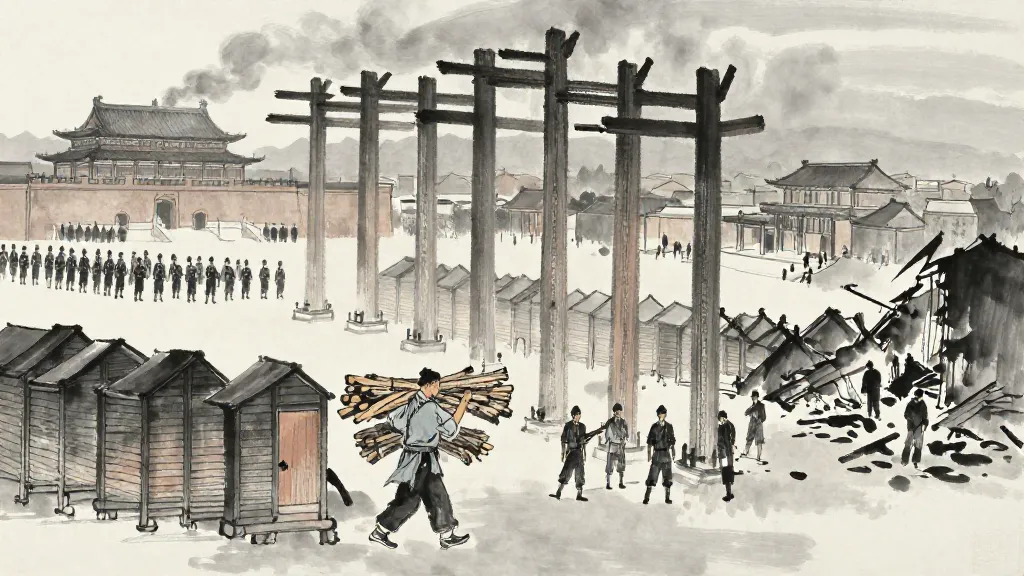
有度 (Having Standards) — Chinese ink painting

韓非子 Hanfeizi · Chapter 6

有度

Having Standards

View:

法者強國之本

Law as the Foundation of a Strong State

國無常強,無常弱。奉法者強,則國強;奉法者弱,則國弱。荊莊王並國二十六,開地三千里;莊王之氓社稷也,而荊以亡。齊桓公並國三十,啟地三千里;桓公之氓社稷也,而齊以亡。燕襄王以河為境,以薊為國,襲涿、方城,殘齊,平中山,有燕者重,無燕者輕;襄王之氓社稷也,而燕以亡。魏安釐王攻燕救趙,取地河東;攻盡陶、魏之地;加兵於齊,私平陸之都;攻韓拔管,勝於淇下;睢陽之事,荊軍老而走;蔡、召陵之事,荊軍破;兵四布於天下,威行於冠帶之國;安釐王死而魏以亡。故有荊莊、齊桓公,則荊、齊可以霸;有燕襄、魏安釐,則燕、魏可以強。今皆亡國者,其群臣官吏皆務所以亂而不務所以治也。其國亂弱矣,又皆釋國法而私其外,則是負薪而救火也,亂弱甚矣!

No state is permanently strong; no state is permanently weak. When those who uphold the law are strong, the state is strong; when those who uphold the law are weak, the state is weak. King Zhuang of Chu annexed twenty-six states and opened up three thousand li of territory — yet after King Zhuang's death, Chu declined. Duke Huan of Qi annexed thirty states and opened up three thousand li of territory — yet after Duke Huan's death, Qi declined. King Xiang of Yan took the Yellow River as his border and Ji as his capital, overran Zhuo and Fangcheng, devastated Qi, and pacified Zhongshan; those who had Yan's support gained weight, those who lacked it lost it — yet after King Xiang's death, Yan declined. King Anxi of Wei attacked Yan, rescued Zhao, and seized lands east of the Yellow River; conquered all the territory of Tao and Wei; sent troops against Qi and took the capital of Pinglu; attacked Han and captured Guan, winning victory below the Qi River; in the affair of Suiyang, the Chu army grew old waiting and withdrew; in the affairs of Cai and Shaoling, the Chu army was routed; his soldiers spread across the realm, his authority extending over all the civilized states — yet when King Anxi died, Wei declined. Thus when Chu had a King Zhuang and Qi had a Duke Huan, Chu and Qi could become hegemons; when Yan had a King Xiang and Wei had a King Anxi, Yan and Wei could become strong. Yet all are now ruined states. The reason is that their assembled ministers and officials all devoted themselves to what produces disorder rather than to what produces order. Their states were already in chaos and weakened, and on top of that, they all abandoned the laws of the state and pursued private interests abroad — this is like carrying firewood to put out a fire; the chaos and weakness only grow worse!

Notes

1person楚莊王Chǔ Zhuāng Wáng

荊莊王 (King Zhuang of Chu, r. 613-591 BC): One of the Five Hegemons of the Spring and Autumn period. 'Chu' is written here as 荊 (Jing), an older name for the state. His reign marked Chu's peak as a military power.

2person齊桓公Qí Huán Gōng

齊桓公 (Duke Huan of Qi, r. 685-643 BC): The first of the Five Hegemons, who under the guidance of his minister Guan Zhong (管仲) built Qi into the dominant state of the Spring and Autumn period.

3person燕襄王Yān Xiāng Wáng

燕襄王 (King Xiang of Yan, r. ~254-222 BC): Presided over Yan's brief period of military expansion, including the campaigns of General Yue Yi (樂毅) against Qi.

4person魏安釐王Wèi Ānxī Wáng

魏安釐王 (King Anxi of Wei, r. 276-243 BC): Under his reign Wei enjoyed a late period of military success, largely due to the efforts of Lord Xinling (信陵君), one of the Four Lords of the Warring States.

5context

Han Fei's argument is that personal greatness in rulers produces only temporary strength, because it depends on the individual rather than on institutional structures. This is the central thesis of the chapter: 法 (law/standards) endure, but personal virtue dies with the ruler.

6translation

氓社稷 (death and loss of the altars of grain and soil): 氓 here means to perish or be lost. The 'altars of grain and soil' (社稷) is a metonym for the state itself, referring to the sacred altars where rulers performed state sacrifices.

公法與私行

Public Law Versus Private Conduct

故當今之時,能去私曲就公法者,民安而國治;能去私行行公法者,則兵強而敵弱。故審得失有法度之制者,加以群臣之上,則主不可欺以詐偽;審得失有權衡之稱者,以聽遠事,則主不可欺以天下之輕重。今若以譽進能,則臣離上而下比周;若以黨舉官,則民務交而不求用於法。故官之失能者其國亂。以譽為賞,以毀為罰也,則好賞惡罰之人,釋公行,行私術,比周以相為也。忘主外交,以進其與,則其下所以為上者薄也。交眾、與多,外內朋黨,雖有大過,其蔽多矣。故忠臣危死於非罪,奸邪之臣安利於無功。忠臣之所以危死而不以其罪,則良臣伏矣;奸邪之臣安利不以功,則奸臣進矣。此亡之本也。

Therefore in the present age, one who can abandon private bias and follow public law will find his people at peace and his state well-governed; one who can abandon private conduct and practice public law will find his army strong and his enemies weak. When one who examines gains and losses has a system of legal standards to apply above his assembled ministers, then the ruler cannot be deceived by fraud and falsehood. When one who examines gains and losses has a balanced scale to weigh with, using it to evaluate distant affairs, then the ruler cannot be deceived about the relative weight of matters in the realm. Now if advancement is based on reputation, then ministers will abandon the ruler above and form cliques below. If officials are appointed through factions, then the people will devote themselves to making connections rather than seeking employment through the law. When offices lose their capable men, the state falls into disorder. If reputation is made the basis of reward and slander the basis of punishment, then those who love reward and hate punishment will abandon public conduct, pursue private schemes, and form cliques to help one another. They forget the ruler and cultivate outside connections to advance their associates, and so what those below do for those above becomes thin indeed. When connections are many and associates are numerous, forming factions both inside and outside the court, then even great offenses will be covered up. Thus loyal ministers are endangered and killed for offenses they did not commit, while treacherous ministers live securely and profit without merit. When loyal ministers face danger and death without having committed real crimes, then good ministers go into hiding. When treacherous ministers enjoy security and profit without merit, then treacherous ministers advance. This is the root of ruin.

Notes

7translation

私曲 (private bias): 曲 literally means 'crooked' or 'bent,' as opposed to the straightness (直) of public law. The compound 私曲 denotes partiality, favoritism, and deviation from impartial standards.

8translation

比周 (form cliques): A compound meaning to band together in exclusive factions for mutual benefit. Already used pejoratively in the Analerta (2.14): 君子周而不比 ('The gentleman is inclusive and does not form cliques').

9context

權衡 (balanced scale): Literally a steelyard balance. Han Fei frequently uses measurement instruments — scales, plumb lines, compasses, and squares — as metaphors for law. The point is that law, like a measuring instrument, is objective and impersonal.

亡國之廷無人

The Court of a Doomed State Has No Men

若是,則群臣廢慶法而行私重,輕公法矣。數至能人之門,不一至主之廷;百慮私家之便,不一圖主之國。屬數雖多,非所尊君也;百官雖具,非所以任國也。然則主有人主之名,而實托於群臣之家也。故臣曰:亡國之廷無人焉。廷無人者,非朝廷之衰也;家務相益,不務厚國;大臣務相尊,而不務尊君;小臣奉祿養交,不以官為事。此其所以然者,由主之不上斷於法,而信下為之也。故明主使法擇人,不自舉也;使法量功,不自度也。能者不可弊,敗者不可飾,譽者不能進,非者弗能退,則君臣之間明辯而易治,故主仇法則可也。

When things reach this point, the assembled ministers abandon public law and give weight to private interests, treating public law lightly. They go constantly to the doors of influential men but never once to the ruler's court. They think a hundred times about what benefits their private households but never once plan for the ruler's state. Though their subordinates are many, these do not serve to honor the ruler. Though the hundred offices are filled, these do not serve to sustain the state. In such cases the ruler has the title of a ruler, but in reality power rests with the households of his ministers. Therefore your servant says: The court of a doomed state has no men. To say the court has no men does not mean the court is deserted — rather, the great families work to benefit each other and do not work to enrich the state. The great ministers work to elevate each other and do not work to elevate the ruler. The lesser officials receive their salaries and use them to cultivate connections, not treating their offices as their true business. The reason this happens is that the ruler does not make decisions from above according to law, but entrusts action to those below. Therefore the enlightened ruler uses law to select men and does not select them personally; he uses law to measure merit and does not measure it personally. When the capable cannot be hidden, the incompetent cannot be disguised, the praised cannot be advanced by flattery, and the slandered cannot be removed by calumny, then the relationship between ruler and minister is clearly defined and the state is easy to govern. Therefore the ruler should match himself to the law, and all will be well.

Notes

10translation

亡國之廷無人 (the court of a doomed state has no men): One of Han Fei's most memorable formulations. He immediately clarifies that this does not mean the court is literally empty, but that no one present is actually serving the state — they are all serving private interests.

11translation

仇法 (match himself to the law): 仇 here is used in its less common sense of 'to match, to correspond to' (as a counterpart), not its common meaning of 'enemy.' The ruler should make law his counterpart and standard.

賢臣之道

The Way of the Worthy Minister

賢者之為人臣,北面委質,無有二心。朝廷不敢辭賤,軍旅不敢辭難;順上之為,從主之法,虛心以待令,而無是非也。故有口不以私言,有目不以私視,而上盡制之。為人臣者,譬之若手,上以修頭,下以修足;清暖寒熱,不得不救;鏌鋣傳體,不敢弗搏慼,無私賢哲之臣,無私事能之士。故民不越鄉而交,無百里之感。貴賤不相逾,愚智提衡而立,治之至也。

A worthy man in the role of minister faces north and pledges his loyalty with a single heart, harboring no divided allegiance. At court he does not dare refuse lowly assignments; on campaign he does not dare refuse dangerous ones. He follows the actions of his superior, obeys the laws of his ruler, empties his mind to await orders, and makes no judgments of right and wrong on his own. Though he has a mouth, he does not use it for private speech. Though he has eyes, he does not use them for private observation. His superior controls everything. A minister is like a hand: above, it tends the head; below, it tends the feet. Whether cold or hot, it must provide relief. If a sharp blade touches the body, it dares not fail to ward it off. There should be no privately favored wise ministers, no privately patronized capable officers. Thus the people do not cross their local boundaries to form connections, and there is no influence reaching beyond a hundred li. The noble and base do not overstep their stations; the foolish and wise stand in balanced measure. This is the perfection of good governance.

Notes

12context

北面委質 (faces north and pledges loyalty): In Chinese court ritual, the ruler sits facing south and the minister faces north. 委質 means to hand over a 'hostage' or pledge — symbolically surrendering one's person to the ruler's authority.

13translation

鏌鋣 (Mo Ye): The name of a legendary sword. Here used generically for a sharp blade. The metaphor is that a minister, like a hand, must instinctively protect the body (the ruler and the state) from harm, without deliberation.

14context

This passage presents the Legalist ideal of the minister as a purely instrumental agent — one who has no private opinions, connections, or interests. This stands in stark contrast to the Confucian ideal of the minister who remonstrates with the ruler based on moral principle.

六反:非廉非忠非仁非義非智

Six Reversals: What Is Not Integrity, Not Loyalty, Not Benevolence, Not Righteousness, Not Wisdom

今夫輕爵祿,易去亡,以擇其主,臣不謂廉。詐說逆法,倍主強諫,臣不謂忠。行惠施利,收下為名,臣不謂仁。離俗隱居,而以詐非上,臣不謂義。外使諸候,內耗其國,伺其危險之陂,以恐其主曰:「交非我不親,怨非我不解。」而主乃信之,以國聽之。卑主之名以顯其身,毀國之厚以利其家,臣不謂智。此數物者,險世之說也,而先王之法所簡也。先王之法曰:「臣毋或作威,毋或作利,從王之指;無或作惡,從王之路。」古者世治之民,奉公法,廢私術,專意一行,具以待任。

Now, one who makes light of rank and salary and readily departs to choose a different ruler — your servant does not call this integrity. One who speaks deceptively, defies the law, turns his back on his ruler, and forces his remonstrances upon him — your servant does not call this loyalty. One who distributes favors and bestows benefits to win a following among the people and gain a reputation — your servant does not call this benevolence. One who separates himself from the common world and lives in seclusion, then uses deceitful arguments to criticize the ruler — your servant does not call this righteousness. One who serves as envoy to other lords abroad while depleting his own state at home, watching for moments of peril and danger to frighten his ruler by saying, 'Without me, alliances cannot be made close; without me, grudges cannot be resolved' — and the ruler believes him and entrusts the state to his management. To lower the ruler's reputation in order to elevate his own person, to diminish the state's resources in order to enrich his own household — your servant does not call this wisdom. These several types are the doctrines of a treacherous age, and what the laws of the former kings would have eliminated. The laws of the former kings say: 'No minister shall arrogate authority; no minister shall arrogate profit; follow the king's direction. Let no one make mischief; follow the king's road.' In antiquity, the people of a well-governed age upheld public law, abandoned private schemes, concentrated their minds on a single course, and prepared themselves fully to await appointment.

Notes

15context

This passage systematically attacks the virtues celebrated by other philosophical schools: the 'integrity' of the itinerant advisor (praised by Mohists and strategists), the 'loyalty' of the remonstrating minister (praised by Confucians), the 'benevolence' of the popular benefactor, the 'righteousness' of the recluse-critic (praised by Daoists), and the 'wisdom' of the diplomat. Han Fei redefines each as a form of treachery.

16textual

先王之法曰 (the laws of the former kings say): This quotation closely paraphrases the Book of Documents (尚書), 'Hong Fan' (洪範) chapter. Han Fei is unusual among Legalists in citing ancient authority — typically to show that even the ancients upheld institutional law over personal virtue.

17translation

倍主 (turns his back on his ruler): 倍 is used as a loan character for 背 (to turn one's back on, to betray).

以法數審賞罰

Using Legal Methods to Examine Reward and Punishment

夫為人主而身察百官,則日不足,力不給。且上用目,則下飾觀;上用耳,則下飾聲;上用慮,則下繁辭。先王以三者為不足,故舍己能而因法數,審賞罰。先王之所守要,故法省而不侵。獨制四海之內,聰智不得用其詐,險躁不得關其佞,奸邪無所依。遠在千里外,不敢易其辭;勢在郎中,不敢蔽善飾非;朝廷群下,直湊單微,不敢相逾越。故治不足而日有餘,上之任勢使然之。

If a ruler personally inspects the hundred officials, then the days will not suffice and his strength will not be equal to it. Moreover, if the ruler uses his eyes, those below will adorn appearances. If the ruler uses his ears, those below will embellish sounds. If the ruler uses his own deliberation, those below will multiply their rhetoric. The former kings considered these three insufficient, and therefore set aside personal ability and relied on legal methods, rigorously applying reward and punishment. What the former kings held to was essential, and so the laws were few yet not violated. They controlled everything within the four seas single-handedly: the clever and intelligent could not employ their deceptions; the reckless and impetuous could not push through their flattery; the treacherous and wicked had nothing to rely on. Those far away, a thousand li distant, did not dare alter their words. Those in positions of influence close to the ruler did not dare conceal merit or disguise faults. The assembled officials at court, from the highest down to the humblest, did not dare overstep one another. Thus there was more than enough governance and days to spare — the ruler's reliance on positional authority made it so.

Notes

18translation

法數 (legal methods): 數 here means 'methods' or 'techniques,' complementing 法 (law). Together they denote the complete system of governance through impersonal standards.

19translation

任勢 (reliance on positional authority): 勢 (shi) is one of the three pillars of Han Fei's political theory alongside 法 (fa, law) and 術 (shu, techniques). It refers to the structural power inherent in the ruler's position, independent of the ruler's personal qualities.

20translation

郎中 (positions of influence close to the ruler): Originally a title for attendants in the inner court. Here used broadly for those with proximity to power.

立司南以端朝夕

Setting Up the Compass to Fix Direction

夫人臣之侵其主也,如地形焉,即漸以往,使人主失端,東西易面而不自知。故先王立司南以端朝夕。故明主使其群臣不游意於法之外,不為惠於法之內,動無非法。峻法,所以凌過游外私也;嚴刑,所以遂令懲下也。威不貳錯,制不共門。威、制共,則眾邪彰矣;法不信,則君行危矣;刑不斷,則邪不勝矣。

The way ministers encroach upon their ruler is like the shifting of terrain — it happens gradually over time, causing the ruler to lose his bearings until east and west have traded places without his knowing it. Therefore the former kings established a compass to fix the directions of morning and evening. Thus the enlightened ruler ensures that his assembled ministers do not let their thoughts wander beyond the law, do not bestow favors outside the law, and make no move that is not in accordance with law. Stern laws are the means to cut down those who transgress and stray into private interests. Strict punishments are the means to carry out commands and chastise those below. Authority must not be exercised in two places; control must not share the same gate. If authority and control are shared, then the multitude of evils will become manifest. If the law is not trusted, then the ruler's conduct will be endangered. If punishments are not decisive, then wickedness will not be overcome.

Notes

21context

司南 (compass): An ancient Chinese magnetic direction-finding instrument, one of the earliest references to compass technology. Han Fei uses it as a metaphor: just as the compass provides an objective, invariant standard of direction, so law provides an objective standard of governance that prevents gradual drift.

22translation

威不貳錯,制不共門 (authority must not be exercised in two places; control must not share the same gate): A compact formulation of the Legalist principle that sovereign power is indivisible. If both the ruler and ministers wield authority, the result is chaos.

法不阿貴

The Law Does Not Fawn on the Noble

故曰:巧匠目意中繩,然必先以規矩為度;上智捷舉中事,必以先王之法為比。故繩直而枉木斷,準夷而高科削,權衡縣而重益輕,斗石設而多益少。故以法治國,舉措而已矣。法不阿貴,繩不撓曲。法之所加,智者弗能辭,勇者弗敢爭。刑過不辟大臣,賞善不遺匹夫。故矯上之失,詰下之邪,治亂決繆,絀羨齊非,一民之軌,莫如法。厲官威名,退淫詞,止詐偽,莫如刑。刑重,則不敢以貴易賤;法審,則上尊而不侵。上尊而不侵,則主強而守要,故先王貴之而傳之。人主釋法用私,則上下不別矣。

Therefore it is said: A skilled craftsman can estimate by eye and hit the mark of the plumb line, yet he must first use compass and square as his measure. A man of superior intelligence can act swiftly and hit upon the right course, yet he must first take the laws of the former kings as his standard. Therefore when the plumb line is stretched straight, crooked timber is cut; when the level is set even, high branches are trimmed; when the steelyard is hung, heavy things are lightened; when the measuring vessels are set out, excess is reduced. Thus to govern a state by law is simply a matter of applying measures — nothing more. The law does not fawn on the noble; the plumb line does not bend for the crooked. What the law is applied to, the wise cannot talk their way out of and the brave do not dare contest. In punishing faults, it does not avoid great ministers; in rewarding merit, it does not pass over commoners. Therefore for correcting the errors of superiors, examining the wickedness of subordinates, governing disorder, resolving confusion, pruning excess, and rectifying error — for bringing the people onto a single track — nothing compares to law. For sharpening the authority and reputation of officials, for silencing licentious speech, and for stopping fraud and falsehood — nothing compares to punishment. When punishments are heavy, men dare not use their nobility to treat the lowly with contempt. When the law is rigorously applied, the ruler is honored and his authority is not encroached upon. When the ruler is honored and his authority is not encroached upon, the ruler is strong and holds the essentials. Therefore the former kings valued this and transmitted it. If the ruler abandons law and employs private judgment, then the distinction between superior and inferior dissolves.

Notes

23context

法不阿貴,繩不撓曲 (The law does not fawn on the noble; the plumb line does not bend for the crooked): Perhaps the most famous line in the Hanfeizi. It crystallizes the Legalist ideal of impersonal, universal law applied without regard to social status — a principle that remains foundational in Chinese legal thought.

24translation

規矩 (compass and square): The compass (規) draws circles; the square (矩) draws right angles. Together they symbolize fixed, objective standards of measurement — the craftsman's equivalent of law in statecraft.

25translation

刑過不辟大臣,賞善不遺匹夫 (In punishing faults, it does not avoid great ministers; in rewarding merit, it does not pass over commoners): This directly challenges the ancient Zhou ritual principle from the Book of Rites (禮記): 禮不下庶人,刑不上大夫 ('Ritual does not descend to commoners; punishment does not ascend to great ministers'). Han Fei's reversal is deliberate and radical.

26translation

一民之軌 (bringing the people onto a single track): 軌 is the rut or track left by a cart wheel. The metaphor is of standardization — all people should follow one uniform track defined by law, rather than going their separate ways.

Edition & Source

Text
《韓非子》 Hanfeizi
Edition
中華古詩文古書籍網 transcription, 《四部叢刊》本
Commentary
Han Fei (韓非), Warring States period